Cape Canaveral is building up its counter-drone defenses, Space Force says美国太空部队称,卡纳维拉尔角正在加强其反无人机防御能力。
The Florida facility is key to the Pentagon’s plans to launch a thousand rockets a year.
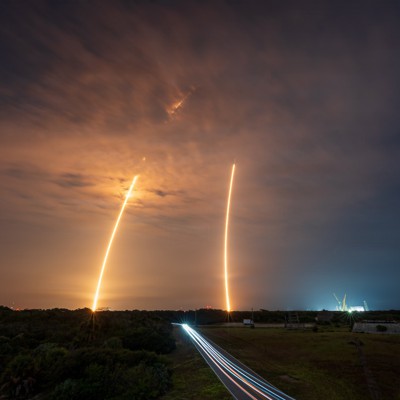
A Falcon 9 rocket launches from Cape Canaveral Space Force Station, Florida, on July 30, 2026. U.S. Space Force / Gwendolyn Kurzen
The Florida facility is key to the Pentagon’s plans to launch a thousand rockets a year.
NATIONAL HARBOR, Md.— Cape Canaveral Space Force Station will get new defenses against small drones in coming weeks, part of a “whole-of-government” effort to better protect the nation’s spaceports as the White House pushes for hundreds more launches per year.
The new gear will come from Joint Interagency Task Force 401 , the Pentagon’s counterdrone task force, Space Force Col. Brian Chatman told Defense One on the sidelines of the annual Air, Space and Cyber Conference here. Chatman commands Space Launch Delta 45, which oversees all East Coast launch missions.
Cape Canaveral is “top of their list” for “investing in additional capability,” Chatman said.
“We're going to see an inject of new capability here in the very short term from JIATF 401, based on the latest and greatest in technology that's out there,” Chatman said. “That'll be integrated in with everything we have today.”
Cape Canaveral, the nation’s busiest launch facility, launched 109 rockets last year; its California counterpart at Vandenberg Space Force Base supported 66. Chatman said securing such facilities is a growing national-security priority as the U.S. military calls for more satellites and the White House pushes for 1,000 launches and re-entries by decade’s end.
Defense experts and wargame planners have warned about launchpads’ vulnerability to attacks from land or sea. In June, the Mitchell Institute for Aerospace Studies described several potentially catastrophic scenarios. For example, mysterious explosions on the bridges that connect the cape to the mainland could put “East Coast launch operations at a halt,” the paper said.
Chatman said Cape Canaveral is well-protected against aircraft, but not smaller drones.
“It's great today that my radars can see a Cessna up to a 747,” Chatman said, but he needs to be able to detect a “747 down to a quadcopter.”
Chatman and a Space Launch Delta 45 spokesperson did not say what technology was being provided by JIATF 401. The task force deploys defenses as prioritized by combatant commanders.
“While I will not speak to specific capabilities at specific locations, our strategic installations are prioritized for c-UAS fielding,” Lt. Col. Adam Scher, a JIATF 401 spokesperson, wrote in an email. “In this capacity, we work in support of U.S. Northern Command and each of the Services to ensure their installations are protected from the illicit use of drones.”
“There is no silver bullet, and we remain focused on accelerating the delivery of innovative capabilities at speed and scale,” Scher said.
In a twist, private space companies are also interested in spending money to improve security at the Space Force base.
Chatman said base security typically takes about 10 minutes to inspect and clear a truck coming onto Cape Canaveral Space Force Station. He said he’d heard from one company that said they’d be willing to spend their own money to make that more efficient.
“One of the launch service providers came to us and said, ‘With the amount of construction we have going on, we want to pay to put some type of automated scan, like a rapid scan type system” in, Chatman said. “This particular solution we're looking at, you can drive a vehicle through and in 30 seconds, it can give you a go/no go to reduce from a 10-minute timeline. And this particular launch service provider is looking to cut a check to put that capability in because it increases their commitment, but also increases everyone else that has to have that inspection on their trucks on the throughput side of the house.”
But the Space Force needs more than new tech at its launch facilities; it also needs more people.
In July, the Government Accountability Office reported that one-quarter of the jobs Space Force leaders say they need went unfilled in fiscal 2025, largely because the service couldn’t track its personnel
An official at one Space Launch delta told GAO that “supporting increased space launch operations is becoming more challenging and unsustainable.” Another, at a Space Base delta said a lack of funded civil-engineering positions is “leading to a higher risk of mission failure, and that the Space Force is taking risk against wartime readiness requirements and Joint Force needs.”
Manning shortfalls forced one delta to close one of its six fire stations in a squadron that could not “meet National Fire Protection Association safety standards.” The report said that “providing enough fire crew support for launches leaves the remainder of the base vulnerable in case of an emergency.”
Chatman told reporters during a roundtable earlier in the day that he doesn’t view the White House’s call for 1,000 launches per year as pressure, but rather as advocacy for his mission. He also said that will take more than Space Force personnel.
“The Space Force can't do it alone. It requires heavily on a partnership with the Air Force for that base operations support personnel, and so we are advocating across the Air Force for additional bodies, whether it's firefighters or security forces or civil engineers, to come in and continue support as we have this expansive growth,” Chatman said. “One big thing that's changed over time to where we are today is you're seeing a whole-of-government approach, and focus, on the launch industry.”
NEXT STORY: US military has ‘on-orbit’ space weapons, Air Force Secretary reveals
2026年7月30日,一枚猎鹰9号火箭从佛罗里达州卡纳维拉尔角太空军基地发射升空。美国太空军/格温多琳·库尔岑
佛罗里达州的这个设施对于五角大楼每年发射一千枚火箭的计划至关重要。
马里兰州国家港——卡纳维拉尔角太空部队基地将在未来几周内获得新的小型无人机防御系统,这是政府为更好地保护国家太空港而采取的“全政府”努力的一部分,因为白宫正在推动每年增加数百次发射。
太空部队上校布莱恩·查特曼在一年一度的航空航天网络会议间隙告诉《防务一号》杂志,这批新装备将来自五角大楼的反无人机特遣部队——联合跨部门特遣部队401。查特曼指挥着负责东海岸所有发射任务的德尔塔45太空发射中心。
查特曼表示,卡纳维拉尔角是他们“投资扩建能力”的“首选之地”。
查特曼说:“在很短的时间内,我们将看到JIATF 401为我们注入新的能力,这些能力基于目前最先进的技术。这些能力将与我们现有的所有能力整合起来。”
卡纳维拉尔角是美国最繁忙的发射场,去年发射了109枚火箭;位于加利福尼亚州范登堡太空军基地的同类设施则支持了66枚火箭的发射。查特曼表示,随着美国军方呼吁发射更多卫星,白宫也力推在本十年末完成1000次发射和再入大气层任务,确保此类设施的安全已成为日益重要的国家安全优先事项。
国防专家和兵棋推演策划人员曾警告,发射场极易遭受来自陆地或海上的攻击。今年6月,米切尔航空航天研究所描述了几种潜在的灾难性情景。例如,该研究所的报告指出,连接科德角和大陆的桥梁发生神秘爆炸可能会导致“东海岸的发射行动被迫停止”。
查特曼表示,卡纳维拉尔角对飞机有很好的防御措施,但对小型无人机则无能为力。
“今天我的雷达能探测到从塞斯纳飞机到747飞机,这很棒,”查特曼说,但他需要能够探测到“从747飞机到四旋翼飞行器”。
查特曼和德尔塔45号航天发射公司的一位发言人都没有透露JIATF 401提供了哪些技术。该特遣部队根据作战指挥官的优先顺序部署防御措施。
“虽然我不会就具体地点的具体能力发表评论,但我们的战略设施已优先部署反无人机系统,”第401联合特遣部队发言人亚当·谢尔中校在一封电子邮件中写道。“为此,我们与美国北方司令部和各军种合作,确保他们的设施免受非法使用无人机的侵害。”
“没有灵丹妙药,我们将继续专注于加速、大规模地交付创新能力,”谢尔说。
出人意料的是,一些私营航天公司也对投资改善太空部队基地的安全状况感兴趣。
查特曼表示,基地安保通常需要大约10分钟来检查和放行驶入卡纳维拉尔角太空部队基地的卡车。他说,他曾听一家公司表示愿意自掏腰包提高安检效率。
查特曼说:“一家发射服务供应商找到我们,表示‘鉴于我们目前的施工量,我们希望付费安装某种自动化扫描系统,比如快速扫描系统’。我们正在考虑的这个方案,可以让车辆驶入,30秒内就能给出合格/不合格的判定结果,从而将原本需要10分钟的时间缩短。这家发射服务供应商愿意为此付费,因为这不仅能提升他们的投入,还能让其他所有需要对车辆进行检查的人员也受益。”
但太空部队需要的不仅仅是发射设施的新技术;它还需要更多的人员。
今年7月,美国政府问责局发布报告称,太空军领导人表示,2025财年他们所需的职位中有四分之一空缺,主要原因是该军种无法追踪其人员情况。
一位太空发射基地官员告诉美国政府问责局(GAO),“支持日益增长的太空发射行动正变得越来越具有挑战性,也越来越难以持续。”另一位太空基地官员表示,缺乏资金支持的土木工程岗位“导致任务失败的风险更高,太空部队正在拿战备要求和联合部队的需求冒险。”
由于人员短缺,一个三角洲部队被迫关闭了其六个消防站中的一个,该消防站所在的消防中队无法“达到美国国家消防协会的安全标准”。报告指出,“为发射任务提供足够的消防人员支持,使得基地其他部分在紧急情况下容易受到攻击。”
查特曼当天早些时候在一次圆桌会议上告诉记者,他不认为白宫呼吁每年进行1000次发射是一种压力,而是对他的使命的一种支持。他还表示,这需要的不仅仅是太空部队的人员。
“太空军无法独自完成这项工作。它高度依赖空军的合作,包括基地运行保障人员,因此我们正在空军内部积极争取更多人员加入,无论是消防员、安保人员还是土木工程师,以继续为我们快速发展提供支持,”查特曼说道。“随着时间的推移,我们今天所面临的一个重大变化是,政府各部门正在采取全政府的方针和重点来发展发射产业。”
下一篇报道:美国空军部长透露,美军拥有“在轨”太空武器