Scammers are using AI to commit crimes at speed. How is Singapore police's new Cyber Command keeping up?诈骗分子正利用人工智能快速作案。新加坡警方新成立的网络指挥部如何应对?
Hackers are using AI to help write malicious code and find exploitable weaknesses, says a cybersecurity specialist with the Singapore Police Force's new Cyber Command.
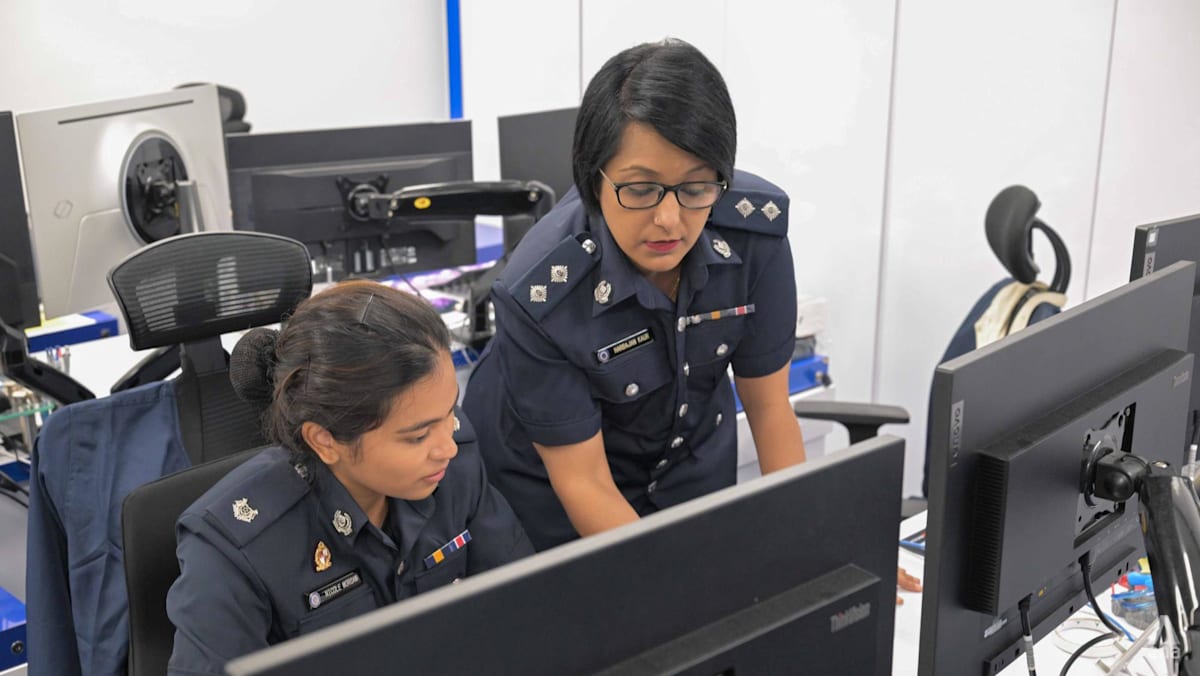
Hackers are using AI to help write malicious code and find exploitable weaknesses, says a cybersecurity specialist with the Singapore Police Force's new Cyber Command.
(From left) Assistant Superintendent of Police Nicole Monica Morgan and Inspector of Police Harbhajan Kaur from the Singapore Police Force's newly formed Cyber Command, on Sep 16, 2026. (Photo: CNA/Lim Li Ting)
This audio is generated by an AI tool.
SINGAPORE: It looked like an ordinary text message about a pending delivery: parcels could not be delivered due to an "invalid address".
The message appeared to be from familiar Singapore courier companies, and recipients were sent a link and instructed to update their details within 24 hours.
Here’s the catch: they would have to pay a small fee between S$0.06 (US$0.05) and S$1.64 to get their items redelivered.
Once they entered their credit card details, that information did not go to the delivery companies – it was now in the hands of scammers.
CNA Games Guess Word Crack the word, one row at a time Buzzword Create words using the given letters Mini Sudoku Tiny puzzle, mighty brain teaser Mini Crossword Small grid, big challenge Word Search Spot as many words as you can Show More Show Less The link took them to a website that looked like the delivery company’s, but it was actually controlled by con artists. Tracking down such fraudulent websites is part of the job for officers at the Digital Disruption Centre, a core component of the Singapore Police Force's (SPF) new Cyber Command. But when one website goes down, another can spring up almost immediately – with the help of artificial intelligence. In the courier company phishing case, cybercriminals exploited AI and found new ways to operate at speed and scale.
The link took them to a website that looked like the delivery company’s, but it was actually controlled by con artists.
Tracking down such fraudulent websites is part of the job for officers at the Digital Disruption Centre, a core component of the Singapore Police Force's (SPF) new Cyber Command.
But when one website goes down, another can spring up almost immediately – with the help of artificial intelligence. In the courier company phishing case, cybercriminals exploited AI and found new ways to operate at speed and scale.
A phishing website resembling J&T Express prompting victims for redelivery payment. (Images: Singapore Police Force)
Launched two months ago, Cyber Command consolidated cybercrime-fighting units from across the SPF. It aims to be the "tip of the spear" in the fight against scams and cybercrimes.
Its focus is not only on investigating individual cases, but also on understanding and disrupting the broader criminal ecosystem, said Inspector of Police (INSP) Harbhajan Kaur.
This includes working with local and international partners to identify syndicates, their facilitators and other enablers involved in cybercrime and scam operations, she said.
AI has made social engineering more convincing and scalable in three main ways, said INSP Kaur.
Deepfakes and voice cloning enable realistic impersonation of trusted figures, while hyper-personalised messaging uses scraped personal data to make phishing far harder to detect.
Conversational AI allows scammers to sustain believable relationships at scale without human operators.
"Together, these developments have contributed to more victims self-transferring money, which also complicates prosecution since the transfers can appear voluntary on the surface," said the senior investigation officer from the Anti-Scam Investigation Branch at Cyber Command.
The police have warned of a growing trend of phishing scams impersonating courier companies to obtain victims' personal and banking details.
In another phishing scam involving Community Development Council (CDC) vouchers , scammers used fake websites masquerading as government ones and circulated the links through hijacked Telegram accounts. As such, victims might have received them from someone they knew and trusted.
The challenge here was scammers using legitimate online services and automation to generate new links quickly, said Special Constable Sergeant (SCSGT) Javier Lau, a cybercrime operator stationed at the Digital Disruption Centre.
"There's definitely going to be a rise in automation on the scammer side. That's why our Cyber Command also has to keep up with advances in technology, so that we can counteract this load that will come in from automation," he said.
"If they are using more advanced technologies, we also have to keep up and use more advanced technologies to uncover these scams and understand the (scam) campaign as a whole."
Special Constable Sergeant Javier Lau from the Singapore Police Force's newly formed Cyber Command, on Sep 16, 2026. (Photo: CNA/Lim Li Ting)
In the courier phishing scams, the websites were churned out quickly and officers used AI to tackle them, SCSGT Lau said.
"To combat this volume, we use AI and machine learning to disrupt these sites as quickly as (they are) being created … We want to reduce manual labour, so we can focus our energy on looking at, for example, tackling the whole campaign in (and) of itself, or focusing on other scams."
Rather than treating each malicious link as an isolated case, cybercrime operators look for patterns across reports and use open-source tools to identify related suspicious sites more efficiently, he added.
Cybersecurity professional Syazwan Suhaimi, who is with the unit's cybercrime investigation branch, said the use of AI cuts both ways.
Just as attackers use it to find vulnerabilities, the police are using it to analyse the volume of data faster than any person could alone.
"It is as much about constantly retraining our people as it is about the tools. AI is not just writing better phishing messages anymore; some hacking groups are using it to help write malicious code and find exploitable weaknesses, automating steps that used to need a skilled human," he said.
Cyber Command also taps expertise through partnerships with local stakeholders and foreign counterparts who have dealt with similar tech-enabled scam cases and may be more advanced in certain areas, said Assistant Superintendent of Police (ASP) Nicole Monica Morgan, an International Cooperation and Liaison staff officer under the command's Partnership and Engagement Division.
The unit also learns from task forces from organisations such as Interpol and Europol, officially known as the European Union Agency for Law Enforcement Cooperation, she added.
MINUTES INSTEAD OF HOURS
Before Cyber Command was formed, officers from the different units used to "work in silos", they told reporters on Wednesday (Sep 16). Operating under a unified command has made it easier to share information across teams, said SCSGT Lau.
In some cases, processes that once took hours can now be completed within minutes.
He pointed to job scams, which can involve multiple scammers across different platforms. A victim might first come across a fraudulent job advertisement on social media and be directed to a website. That website might contain a phone number.
All three – the social media advertisement, fraudulent website and phone number – were dealt with separately previously.
"For me, I deal with website disruption. So previously, before Cyber Command, if I wanted to disrupt the phone number or the advertisement on social media platforms, it would take longer.
“It will be a bit more tedious because I will have to draft an email and give the information to the relevant teams," said SCSGT Lau.
"But with Cyber Command now, because we're all under one roof, I can just turn around and give the info to them more efficiently, give context verbally, which is easier to understand. If they have any questions, they can ask me on the spot," he added.
"Effectively, with Cyber Command, we are able to disrupt more than one scam enabler, which affects the scammers' operations. It just hurts them more whenever we disrupt the scam itself."
On how long the process would have taken before Cyber Command was set up, he said: "I would say previously maybe it would take a couple of hours.
“We'll for sure get it done as quickly as we can, but then now maybe in a couple of minutes, because we'll be … able to look to our left, look to our right, and give the information more efficiently."
Cybersecurity professional Syazwan Suhaimi from the Singapore Police Force's newly formed Cyber Command, on Sep 16, 2026. (Photo: CNA/Lim Li Ting)
Mr Syazwan said he is now able to share his expertise with investigation officers and assist them in any technical areas.
"IOs do investigations. They do have a little bit of cyber background, but they are not really the specialists or the experts in that area. When I come into the command, I can become the adviser on what to do," said Mr Syazwan, who specialises in cryptocurrency investigations and blockchain tracing.
He added that he can also build tools to improve officers' workflows, help them trace scams faster, as well as to identify potential victims who may lose a lot of money in different scams.
One tool he built was used to pinpoint threat actors when they attempted to move cryptocurrency through a mixer, which is designed to increase the privacy and anonymity of blockchain transactions.
Before Cyber Command was formed, officers used tools from vendors, but now, with more hands and brains on deck, those with a cybersecurity background like Mr Syazwan can support officers with in-house tools.
But delays in victims reporting scams remain a challenge for officers, said INSP Harbhajan Kaur.
When there is a delay in reporting, the money transferred to scammers may have already been moved overseas, making it difficult for police to trace, she said.
One reason victims hesitate to report scams is denial, she said. For instance, in internet love scams, scammers may spend months or years cultivating a relationship with their victims.
Over time, victims come to trust the person at the other end. They "blindly transfer" money and keep doing so – sometimes until they are pushed to take out bank loans – before the warning bells ring.
"Some will come forward, some will not come forward. So those that don't come forward, they will say, 'I think I report also I'm not going to get back my money'," said INSP Kaur.
Mr Syazwan has similarly come across victims who did not believe they had been scammed.
"We try and try to convince them that it's a scam. Maybe it doesn't work the first time, and then maybe the second time, they realise that after doing their own research and stuff like that, they know that they (were) really scammed."
For him, one of the most rewarding parts of his job is when potential victims believe him and stop investing or sending their money to scammers.
He also feels a sense of satisfaction when he manages to recover the money lost or identify the scammer.
The number of scam cases fell in the first half of 2026, continuing the downward trend that started in 2025 after years of increases.
But the numbers remain high, and tackling scams is still a national priority, the police said last month.
The road to success for Cyber Command ultimately comes down to three outcomes, said ASP Morgan: fewer scam cases, more funds recovered and more cybercriminals arrested.
Get our pick of top stories and thought-provoking articles in your inbox
Stay updated with notifications for breaking news and our best stories
Join our channel for the top reads for the day on your preferred chat app
新加坡警察部队新成立的网络指挥部的一位网络安全专家表示,黑客正在利用人工智能来帮助编写恶意代码并寻找可利用的漏洞。
(从左至右)新加坡警察部队新成立的网络指挥部助理警司妮可·莫妮卡·摩根和警督哈尔巴詹·考尔,摄于2026年9月16日。(图片:CNA/林丽婷)
这段音频是由人工智能工具生成的。
新加坡:这看起来像是一条关于待递送包裹的普通短信:由于“地址无效”,包裹无法递送。
该信息似乎来自新加坡的知名快递公司,收件人会收到一个链接,并被要求在 24 小时内更新他们的信息。
但需要注意的是:他们需要支付 0.06 新元(0.05 美元)到 1.64 新元之间的少量费用才能重新寄送物品。
一旦他们输入了信用卡信息,这些信息并没有交给快递公司——而是落入了诈骗分子手中。
CNA游戏 猜词游戏 逐行破解单词 流行词游戏 用给定的字母组成单词 迷你数独 小谜题,脑力挑战 迷你填字游戏 小方格,大挑战 单词搜索 尽可能多地找出单词 显示更多 显示更少 该链接将他们带到一个看起来像是快递公司的网站,但实际上却被骗子控制。追踪此类欺诈网站是新加坡警察部队(SPF)新成立的网络指挥部核心部门——数字干扰中心警员的职责之一。但当一个网站宕机时,另一个网站几乎可以立即出现——这要归功于人工智能。在快递公司网络钓鱼案件中,网络犯罪分子利用人工智能找到了快速大规模运作的新方法。
该链接将他们带到一个看起来像是快递公司的网站,但实际上是由骗子控制的网站。
追踪此类欺诈网站是新加坡警察部队 (SPF) 新成立的网络指挥部核心组成部分——数字干扰中心警官的工作之一。
但当一个网站宕机时,另一个网站几乎可以立即上线——这得益于人工智能。在快递公司网络钓鱼案件中,网络犯罪分子利用人工智能找到了快速大规模运作的新方法。
一个模仿J&T快递的钓鱼网站诱骗受害者支付重新派送费用。(图片:新加坡警方)
网络司令部于两个月前成立,整合了新加坡警察部队各部门打击网络犯罪的单位。其目标是成为打击诈骗和网络犯罪的“先锋”。
警督哈尔巴詹·考尔表示,该机构的重点不仅在于调查个案,还在于了解和打击更广泛的犯罪生态系统。
她表示,这包括与本地和国际合作伙伴合作,以识别参与网络犯罪和诈骗活动的犯罪集团、其协助者和其他促成者。
INSP Kaur表示,人工智能在三个主要方面使社会工程更具说服力和可扩展性。
深度伪造和语音克隆技术能够逼真地模仿受信任的人物,而高度个性化的消息传递则利用抓取的个人数据,使网络钓鱼更难被检测出来。
对话式人工智能使诈骗分子能够在没有人工操作的情况下大规模地维持可信的关系。
网络司令部反诈骗调查部门的高级调查官表示:“这些发展趋势导致更多受害者自行转账,这也使起诉变得更加复杂,因为这些转账表面上看起来是自愿的。”
警方警告称,冒充快递公司的网络钓鱼诈骗活动日益猖獗,骗子企图获取受害者的个人和银行信息。
在另一起涉及社区发展委员会 (CDC) 代金券的网络钓鱼诈骗案中,诈骗分子使用伪装成政府网站的虚假网站,并通过被盗用的 Telegram 账户传播链接。因此,受害者可能从他们认识和信任的人那里收到这些链接。
数字破坏中心的网络犯罪操作员、特别警长哈维尔·劳表示,这里的挑战在于诈骗分子利用合法的在线服务和自动化技术快速生成新链接。
“诈骗分子方面的自动化程度肯定会提高。正因如此,我们的网络司令部也必须跟上技术进步的步伐,以便应对自动化带来的挑战,”他说道。
“如果他们使用更先进的技术,我们也必须与时俱进,使用更先进的技术来揭露这些骗局,并了解整个(诈骗)活动。”
2026年9月16日,新加坡警察部队新成立的网络指挥部特别警员刘嘉维尔警长。(图片:CNA/林丽婷)
刘中士表示,在快递网络钓鱼诈骗中,网站迅速涌现,警员们利用人工智能来打击这些诈骗。
“为了应对如此庞大的数量,我们利用人工智能和机器学习技术,在这些网站刚创建时就将其拦截……我们希望减少人工劳动,以便将精力集中在例如打击整个诈骗活动本身,或专注于其他诈骗手段上。”
他补充说,网络犯罪分子不会将每个恶意链接视为孤立事件,而是会寻找报告中的模式,并使用开源工具来更有效地识别相关的可疑网站。
该部门网络犯罪调查部门的网络安全专家 Syazwan Suhaimi 表示,人工智能的应用有利有弊。
正如攻击者利用它来发现漏洞一样,警方也利用它来分析海量数据,速度比任何个人单独分析都要快得多。
他说:“这不仅关乎工具,更关乎不断对人员进行再培训。人工智能不再仅仅用于编写更高级的网络钓鱼信息;一些黑客组织正在利用它来帮助编写恶意代码和寻找可利用的漏洞,自动完成以前需要熟练人员才能完成的步骤。”
网络司令部还通过与当地利益相关者和处理过类似技术诈骗案件的外国同行建立伙伴关系来获取专业知识,这些同行在某些领域可能更先进。网络司令部伙伴关系与参与部门的国际合作与联络参谋官、助理警司妮可·莫妮卡·摩根 (Nicole Monica Morgan) 表示。
她补充说,该部门还会向国际刑警组织和欧洲刑警组织(正式名称为欧盟执法合作机构)等组织的特别工作组学习。
以分钟而非小时为单位
网络司令部成立之前,各单位的军官们各自为政,他们周三(9月16日)告诉记者。刘中士表示,统一指挥使得各团队之间的信息共享更加便捷。
在某些情况下,以前需要几个小时才能完成的流程,现在几分钟就能完成。
他指出,求职诈骗可能涉及多个诈骗者,且涉及多个平台。受害者可能首先在社交媒体上看到虚假招聘广告,然后被引导至某个网站。该网站可能包含一个电话号码。
这三者——社交媒体广告、欺诈网站和电话号码——此前已分别处理过。
“对我来说,我负责处理网站中断问题。所以以前,在网络司令部成立之前,如果我想干扰电话号码或社交媒体平台上的广告,需要更长的时间。”
“这会有点繁琐,因为我需要起草一封电子邮件,并将信息提供给相关团队,”SCSGT Lau说道。
“但现在有了网络司令部,因为我们都在同一个办公室,我可以更高效地把信息传递给他们,用口头方式解释背景,这样更容易理解。如果他们有任何问题,可以当场问我,”他补充道。
“实际上,借助网络司令部,我们能够打击多个诈骗助推器,从而影响诈骗者的运作。如果我们直接打击诈骗本身,对他们的打击会更大。”
关于在网络司令部成立之前这个过程需要多长时间,他说:“我想以前可能需要几个小时。
“我们一定会尽快完成,但现在可能只需要几分钟,因为我们可以……向左看,向右看,更有效地提供信息。”
2026年9月16日,新加坡警察部队新成立的网络指挥部网络安全专家Syazwan Suhaimi。(图片:CNA/林丽婷)
Syazwan 先生表示,他现在能够与调查人员分享他的专业知识,并在任何技术领域为他们提供帮助。
“调查人员负责调查工作。他们确实有一些网络安全方面的背景知识,但他们并不是这方面的专家。当我加入指挥部后,我可以成为这方面的顾问,”专门从事加密货币调查和区块链追踪的Syazwan先生说道。
他还补充说,他还可以开发工具来改进警员的工作流程,帮助他们更快地追踪诈骗案件,以及识别可能在各种诈骗中损失大量金钱的潜在受害者。
他开发的一款工具用于在威胁行为者试图通过混币器转移加密货币时对其进行精确定位,混币器旨在提高区块链交易的隐私性和匿名性。
在网络司令部成立之前,军官们使用供应商提供的工具,但现在,随着更多的人手和智慧投入使用,像 Syazwan 先生这样具有网络安全背景的人可以使用内部工具为军官提供支持。
哈尔巴詹·考尔警督表示,受害者报案延迟仍然是警方面临的一大挑战。
她表示,如果举报出现延迟,转移给诈骗分子的资金可能已经转移到海外,使警方难以追踪。
她说,受害者不愿举报诈骗的原因之一是否认心理。例如,在网络爱情骗局中,骗子可能会花费数月甚至数年的时间与受害者建立关系。
随着时间的推移,受害者会逐渐信任对方。他们会“盲目地”转账,并且不断重复这个过程——有时甚至直到被迫去银行贷款——直到警钟敲响。
“有些人会站出来,有些人不会站出来。那些不站出来的人会说,‘我觉得即使我举报了,我的钱也拿不回来了’,”考尔警督说道。
Syazwan 先生也遇到过类似的受害者,他们不相信自己被骗了。
“我们反复尝试说服他们这是个骗局。也许第一次没用,但第二次,他们经过自己的调查研究后,可能就意识到自己真的被骗了。”
对他来说,工作中最大的成就感之一就是潜在的受害者相信他,停止向骗子投资或汇款。
当他成功追回损失的钱款或认出诈骗者时,他也会感到满足。
2026 年上半年诈骗案件数量有所下降,延续了自 2025 年开始的下降趋势,此前该行业已连续多年增长。
但警方上个月表示,诈骗案件数量仍然居高不下,打击诈骗仍然是国家优先事项。
ASP Morgan表示,网络司令部的成功之路最终取决于三个结果:减少诈骗案件、追回更多资金和逮捕更多网络犯罪分子。
订阅我们的邮件,即可获取精选热点新闻和引人深思的文章。
订阅通知,第一时间获取突发新闻和精彩报道。
加入我们的频道,即可在您常用的聊天应用上获取当日热门文章。