Community centres, some RCs will open air-con rooms to public when PSI exceeds 200: Haze Task Force社区中心,部分居民委员会将在空气污染指数(PSI)超过200时向公众开放空调房:雾霾工作组
Read more at straitstimes.com.
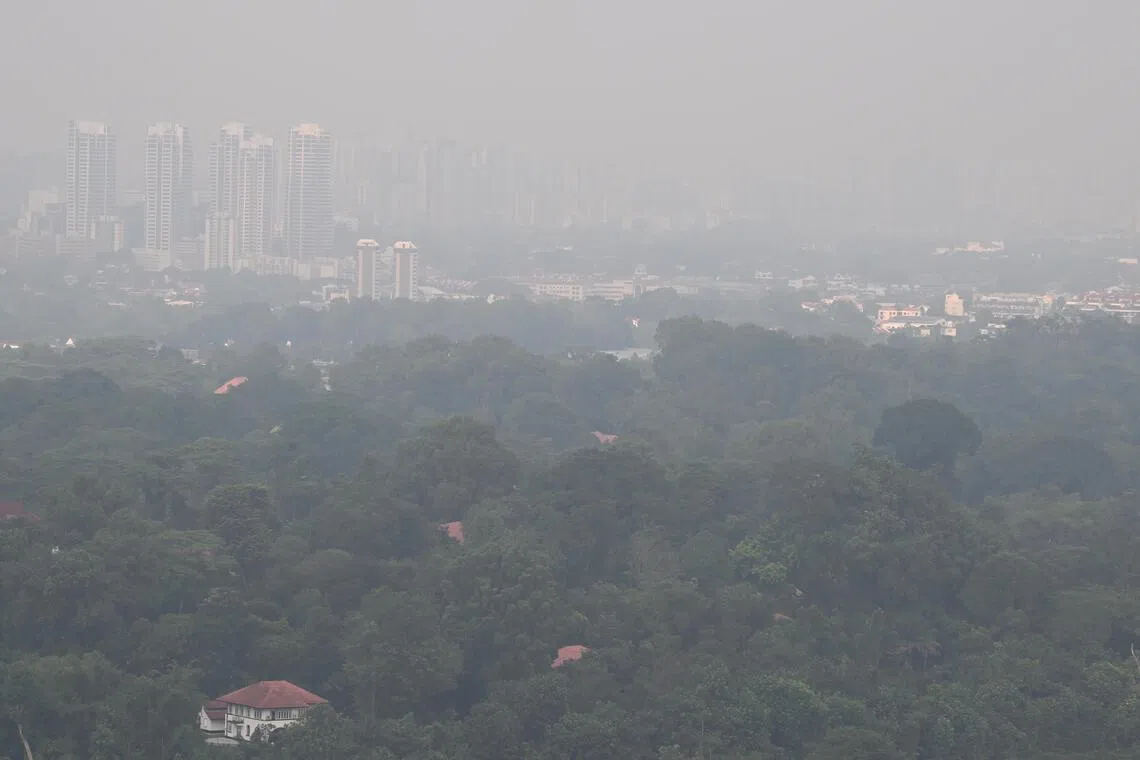
The haze condition as seen from Toa Payoh Lorong 1, toward the Thomson Road area at 9am on Sept 4.
Published Sep 04, 2026, 12:50 PM
Updated Sep 04, 2026, 12:50 PM
SINGAPORE - Air-conditioned rooms in all community centres and selected residents’ committee centres here will be on standby for people to seek respite from the haze, should air quality here breach ‘very unhealthy’ levels when the Pollutant Standards Index (PSI) exceeds 200, the authorities said on Sept 4.
This wa s among the contingency measures announced by Singapore’s Haze Task Force in a media statement issued at about noon. It comes as air quality in Singapore hit unhealthy levels for the first time since October 2023, with the PSI, a measure of air quality here, reaching the unhealthy threshold of 101 at 7am. As at 12pm, the PSI in the central region was 105.
Air quality is considered unhealthy when the PSI exceeds 101. It is considered ‘very unhealthy’ when the PSI exceeds 200, and ‘hazardous’ when PSI surpasses 300.
Schools are currently closed on Sept 4 due to Teachers’ Day.
But the advisory also stated that teachers at all institutions – from pre-schools to junior colleges – have been reminded to keep a lookout for students who are unwell or have pre-existing lung or heart conditions in the coming days.
All classrooms at primary and tertiary institutions have been equipped with air purifiers. Parents should ensure that their children have their medication such as inhalers for asthma, with them, and take their children to the doctor if needed, the authorities said in the statement.
During exam season, arrangements are made for all students to take their papers in enclosed spaces with air purifiers if the air quality is in the unhealthy range or worse.
Workplaces ar e urged to reduce the duration of strenuous work for employees, and get them to use machines such as trolleys hoists to transport or carry heavy objects instead of manually lifting them, w hen air quality is in the unhealthy range . Tasks should also be rotated so that each worker spends less time outdoors, s aid the task force.
Workers with chronic heart and lung conditions should avoid strenuous outdoor work.
The Land Transport Authority also advises motorists to switch on headlights when visibility is low.
Sport Singapore has advised all participants and organisers of sports activities to monitor the air quality and follow the health advisories issued by the relevant agencies.
Event organisers should conduct their own risk management when deciding whether to proceed with sports activities, the statement added.
“While outdoor and indoor sports facilities may remain open, members of the public are advised to take necessary precautions to ensure personal safety,” said the National Environment Agency (NEA) which chairs the Haze Task Force. Other agencies involved in the 28-member task force include the Ministry of Education, Sport Singapore, the Ministry of Defence and the Ministry of Health.
NEA will also begin providing daily haze advisories from the evening of Sept 4, and this will include the additional 24-hour PSI forecast, which can be used by the public in planning their activities and events for the next 24 hours. This is separate from the current PSI readings on the NEA haze website.
To decide whether to go outdoors within the hour, residents should refer to the one-hour PM2.5 readings on the haze website. PM2.5 refers to micro-pollutants found in smoke haze from Indonesian forest fires.
The one-hour PM2.5 readings point to current air quality, which the public can reference when planning their own immediate activities. PM2.5 is the dominant pollutant during periods of transboundary haze, and has the most influence over the 24-hour PSI readings, which reference six different pollutants.
On Sept 4 noon, the PM2.5 level at the central region was elevated with a reading of 69. In the other parts of Singapore, the values were within normal levels, between 41 and 53.
Health advisories are pegged to the 24-hour PSI readings, which are also what the authorities here reference when issuing guidelines for various sectors.
The health impact of the haze is dependent on each individual’s health status, the PSI level, and the duration and intensity of outdoor activity.
NEA said N95 masks are not required for short exposure, like commuting from home to school or work, or in an indoor environment. People who have to be outdoors for several hours may wear an N95 mask to reduce when air quality is in the hazardous range and PSI exceeds 300.
“The elderly, pregnant women and those with severe lung or heart conditions who have difficulty breathing at rest or on exertion should consult their doctors on whether they should use the N95 mask,” added the agency.
Reducing outdoor activities and physical exertion can help limit the ill effects from haze exposure. The public is advised to drink plenty of water to stay hydrated. Those with chronic heart and lung conditions should ensure that medications are on hand and readily accessible.
“Vulnerable persons, especially the elderly, pregnant women, children, and those with chronic heart and lung conditions, who develop symptoms or feel unwell, should seek medical attention promptly,” said NEA.
9 月 4 日上午 9 点,从大巴窑 1 巷往汤申路方向看到的雾霾情况。
发布于2026年9月4日下午12:50
更新于2026年9月4日下午12:50
新加坡——当局于9月4日表示,如果空气污染标准指数(PSI)超过200,空气质量达到“非常不健康”的水平,所有社区中心和部分居民委员会中心的空调房将随时待命,供人们躲避雾霾。
这是新加坡雾霾应对工作组在中午左右发布的媒体声明中宣布的应急措施之一。此前,新加坡的空气质量自2023年10月以来首次达到不健康水平,空气质量指数(PSI)于早上7点达到不健康阈值101。截至中午12点,中部地区的PSI为105。
当 PSI 超过 101 时,空气质量被认为是不健康的;当 PSI 超过 200 时,空气质量被认为是“非常不健康的”;当 PSI 超过 300 时,空气质量被认为是“危险的”。
由于9月4日是教师节,学校目前停课。
但该建议还指出,已提醒所有教育机构(从幼儿园到初级学院)的教师,在未来几天内要留意身体不适或患有肺部或心脏疾病的学生。
中小学和高等院校的所有教室都已配备空气净化器。当局在声明中表示,家长应确保孩子随身携带哮喘吸入器等药物,如有需要,应带孩子就医。
考试期间,如果空气质量处于不健康或更差的水平,学校会安排所有学生在配备空气净化器的封闭空间内参加考试。
工作组敦促各工作场所减少员工从事繁重体力劳动的时间,并在空气质量处于不健康范围时,鼓励员工使用手推车、起重机等机械设备来运输或搬运重物,而不是手动搬运。工作组还建议轮换工作任务,以减少每位员工在户外工作的时间。
患有慢性心脏和肺部疾病的工人应避免从事剧烈的户外工作。
陆路交通管理局也建议驾驶员在能见度低时打开车头灯。
新加坡体育理事会建议所有体育活动的参与者和组织者监测空气质量,并遵守相关机构发布的健康建议。
声明还补充说,赛事组织者在决定是否进行体育活动时,应自行进行风险管理。
“虽然室内外体育设施可以继续开放,但建议公众采取必要的预防措施,确保自身安全,”国家环境局(NEA)表示。NEA是雾霾工作组的主席机构。参与该工作组的28个成员机构还包括教育部、新加坡体育理事会、国防部和卫生部。
新加坡国家环境局(NEA)将于9月4日晚间开始每日发布雾霾预警,其中包括未来24小时的空气污染指数(PSI)预报,公众可据此安排未来24小时的活动。此预报与NEA雾霾网站上显示的PSI读数不同。
为了决定是否在一小时内外出,居民应参考雾霾网站上的一小时PM2.5读数。PM2.5指的是印尼森林火灾产生的烟雾中存在的微量污染物。
一小时PM2.5读数反映了当前的空气质量,公众在规划近期活动时可以参考该数据。PM2.5是跨境雾霾期间的主要污染物,对24小时PSI读数影响最大,而24小时PSI读数则反映了六种不同的污染物。
9月4日中午,中心区域的PM2.5浓度升高,读数为69。新加坡其他地区的数值则在正常范围内,介于41至53之间。
健康建议与 24 小时 PSI 读数挂钩,这也是当局在发布各行业指南时所参考的指标。
雾霾对健康的影响取决于每个人的健康状况、PSI 值以及户外活动的持续时间和强度。
新加坡国家环境局(NEA)表示,短时间接触空气污染,例如上下学或上下班途中,或在室内环境中,无需佩戴N95口罩。但如果需要在户外停留数小时,且空气质量达到危险级别,气压超过300磅/平方英寸(PSI),则可佩戴N95口罩以降低吸入风险。
该机构补充说:“老年人、孕妇以及患有严重肺部或心脏疾病、在休息或运动时呼吸困难的人,应咨询医生是否应该使用 N95 口罩。”
减少户外活动和体力消耗有助于减轻雾霾带来的不良影响。建议公众多喝水保持水分。患有慢性心肺疾病的人应确保随身携带并随时取用所需药物。
国家环境局表示:“弱势群体,特别是老年人、孕妇、儿童以及患有慢性心脏和肺部疾病的人,如果出现症状或感到不适,应立即就医。”