Yawning, food cravings, mood changes: These could be warning signs of a migraine打哈欠、食欲旺盛、情绪变化:这些都可能是偏头痛的预警信号。
Yawning and food cravings can signal a migraine before the pain starts. A Singapore neurologist explains the early warning signs and when to seek help. Read more at straitstimes.com.
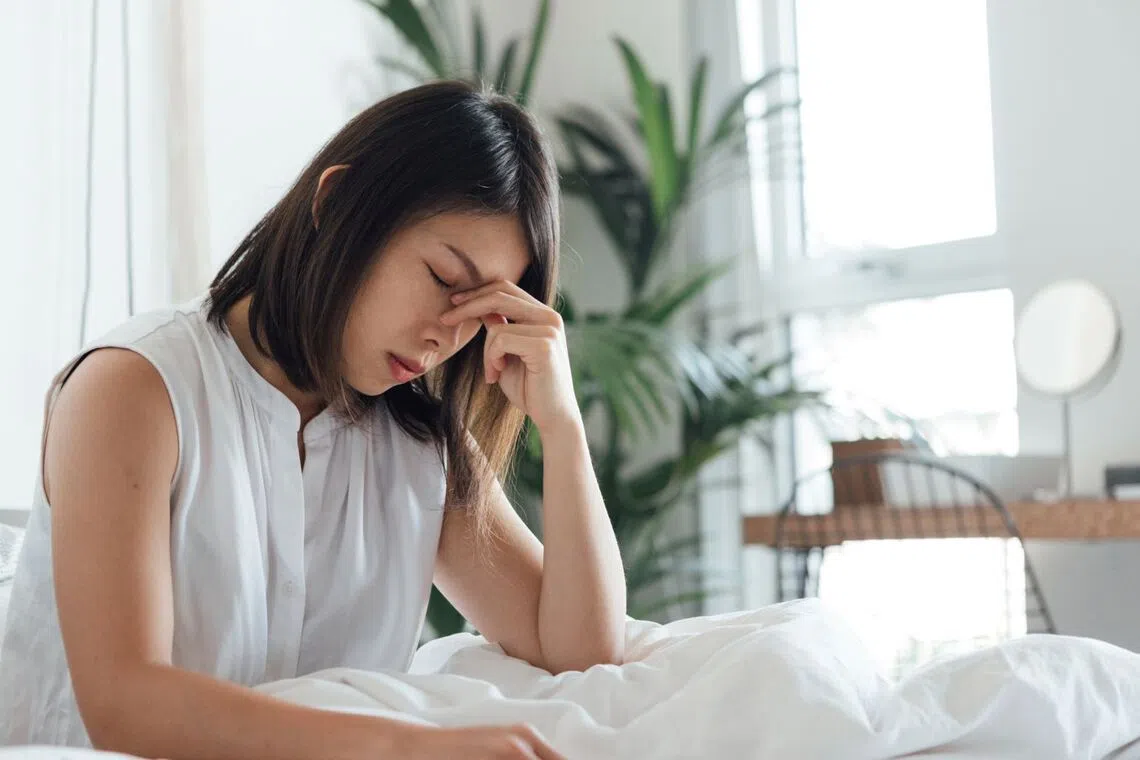
Many people dismiss recurring headaches, but recognising these early signs, which may appear hours before the pain, could help you get the right diagnosis and treatment, says Adjunct Associate Professor Jonathan Ong
Recurring headaches may be a sign of migraine, a neurological condition that often goes undiagnosed (see footnote 2).
Published Sep 21, 2026, 04:00 AM
It starts innocently enough. You cannot shake off a sudden urge to indulge in a bar of chocolate despite having just eaten lunch; or perhaps it is the frequent yawning even after a good night’s sleep.
The day after, it strikes – one of those crippling headaches that can last up to three days and leave you feeling drained, nauseated and needing to recuperate in a quiet, dark room.
These sudden food cravings or frequent yawning could be more than isolated incidents. According to the Mayo Clinic, these and other warning signs such as a stiff neck 1 , unusual tiredness or even unexpected sadness could mean that a migraine episode is just one or two days away 1 .
It may be common practice to pop a pill and push through the pain, but this may not prevent future migraines – and over time, it could even make things worse 1 .
What’s the difference between headache and migraine?
According to Adjunct Associate Professor Jonathan Ong, senior consultant, Division of Neurology, Department of Medicine, National University Hospital (NUH), the above could be signs of something more than a common headache. Prof Ong is also the current president of the Headache Society of Singapore . He explains: “A headache is a symptom, not a diagnosis 2 . Because migraine is a neurological condition affecting multiple brain pathways 3 , it can sometimes occur without significant head pain, but with other symptoms.”
“Just as an engine warning light on a car dashboard signals that something is wrong but doesn’t identify the cause, a symptom signals that there is a problem, while a diagnosis identifies the underlying cause – such as a faulty spark plug.”
Migraine commonly causes recurrent attacks² characterised by pulsating pain, sensitivity to movement, light and sound, as well as nausea and vomiting 1,2,4 .
Other key signs of migraine 2 may include intense, often one-sided throbbing pain, visual or neurological disturbances, such as flashing lights, jagged zigzag lines, blurry patches or blind spots 1 , collectively known as auras 2 .
How common is migraine in Singapore?
In Singapore, roughly 1 in 10 adults – or around 330,000 people – are affected by migraine 5 , with the condition up to three times more common in women after puberty due to hormonal factors such as menstrual cycle changes, contraception or hormonal therapy 6 .
A local study, Economic Burden of Migraine in Singapore , estimated that migraine resulted in $1.04 billion in economic losses in 2018 5,7 . This was mostly due to lost productivity, and the remaining 20 per cent was attributed to healthcare costs, such as medical tests and consultations. Prof Ong was one of the researchers involved in the study.
Migraine episodes can disrupt work and daily activities, but recognising the early signs may help people seek medical advice sooner (see footnote 4 and 8). PHOTO: GETTY IMAGES
Migraine episodes can disrupt work and daily activities, but recognising the early signs may help people seek medical advice sooner (see footnote 4 and 8).
Yet migraine is often underdiagnosed, under-recognised and undertreated in Singapore, with only a proportion of patients seeking medical care, and many not receiving long-term optimal care 8 .
It all boils down to awareness, adds Prof Ong, citing global awareness initiatives, including Migraine Awareness Month in June 9 , and the work that organisations such as the Headache Society of Singapore does, which all aim to raise awareness about migraine as a potentially disabling neurological condition rather than “just a headache”.
He adds: “People need to recognise the symptoms so they know when to seek medical advice 8 . There is a need to raise awareness among both healthcare professionals and the general public, and significant opportunities remain for further improvement.”
Episodic vs chronic migraine: when to seek treatment
Even among people with migraine, there is a distinction between those who suffer from episodic and chronic migraines 10 .
Prof Ong explains that the latter, which he says affects about 2.5 per cent 10 of the entire migraine cohort, means a person experiences migraine headaches on 15 or more days each month 10 , for more than three months.
“Chronic migraine often develops from episodic migraine when symptoms such as headache and nausea aren’t managed well 11 ,” says Prof Ong. That is where preventive care is key, he adds. “Early recognition and appropriate management may help reduce the risk of episodic migraine progressing to chronic migraine 11 .”
For people whose episodic migraine is starting to disrupt their daily life, a combination of preventive treatment 4 and lifestyle adjustments 4 may be recommended. For chronic migraine, preventive treatment is usually necessary to reduce both frequency and severity 12, 13 .
Yet in reality, however, it is not so simple, notes Prof Ong. “Migraine can be highly disabling 14 . A single attack may keep someone off work for days, and visual symptoms 15 can be especially dangerous for people who drive or work in high-risk jobs 14 .”
At a glance: Recognising migraine
Here are some common features of migraine to look out for 1,2 .
Throbbing, pulsing pain
Moderate to severe pain
Often comes with nausea/vomiting
Sensitivity to light and sound
Lasts from 4 to 72 hours
May come with aura or other signs
Know what triggers migraine
Migraine triggers vary from person to person, but multiple triggers can combine to push someone past their threshold 14 – like a cup filling until it overflows. Keeping a daily diary 15 can help identify these triggers, says Prof Ong.
Stress is one of the most commonly reported migraine triggers, affecting around 70 per cent of people with migraine. 16 Some people may also experience the “let-down” effect, where an attack occurs after a high-stress period 17 .
“The migraine brain thrives on routine,” he says. “Even taking a break from work can trigger what’s known as a ‘holiday headache’. People often assume less stress means fewer migraines, but it’s the disruption to routine 18 that can trigger an attack.”
“Sleeping in, changing meal times, travelling or crossing time zones 18,19 can all be enough to trigger symptoms in some people.”
Lifestyle and environmental factors can also trigger migraine, including dehydration, skipping meals, caffeine and abrupt temperature changes 1,19 , such as moving from a warm environment into an air-conditioned room.
Frequent use of pain-relieving medicines over time may contribute to medication overuse headache 20 in some people.
Research has helped doctors better understand what happens in the brain during a migraine attack. One area involved is the hypothalamus, which helps regulate functions such as sleep, appetite and hormones 3 .
Prof Ong explains: “Researchers have identified CGRP, or calcitonin gene-related peptide, as one of the key molecules involved in migraine 4 . Newer treatments either target CGRP or block its receptor 4 , helping to interrupt a pathway involved in migraine⁴.”
Because these therapies are more targeted, he says, they are designed to minimise effects on other pathways, which may improve tolerability and safety 4 .
He says: “Migraine treatment is no longer a one-size-fits-all approach. Advances in treatment, including newer targeted therapies, have expanded the options available 4 , allowing doctors to tailor care to individual patients 4 .” Nevertheless, treatments – both pharmacological and lifestyle modifications – should be tailored to each patient 4 . “Even the best treatment must be tailored to a patient’s lifestyle and occupation to be effective,” says Prof Ong.
Learn more about migraine, including its symptoms, triggers and when to seek medical advice.
1. Mayo Clinic Staff, “ Migraine: Symptoms and Causes ,” Mayo Clinic, last updated July 8, 2025, accessed July 2, 2026.
2. Headache Classification Committee of the International Headache Society (IHS). The International Classification of Headache Disorders, 3rd edition: 1.1 Migraine without aura. Cephalalgia . 2018;38(1):1–211
3. Goadsby PJ, Lipton RB, Ferrari MD. “ Migraine – Current Understanding and Treatment. ” N Engl J Med. 2002;346(4):257–270.
4. Ailani J, Burch RC, Robbins MS, et al. The American Headache Society consensus statement: update on integrating new migraine treatments into clinical practice .
5. Duke-NUS Medical School: Migraine is a billion-dollar headache for Singapore, nationwide study finds . Published September 18, 2019. Accessed July 2, 2026.
6. American Migraine Foundation. Migraine in Women . American Migraine Foundation. Accessed July 2, 2026.
7. Jonathan Jia Yuan Ong, Devanshi Patnaik, Yee Cheun Chan, Oliver Simon, and Eric A. Finkelstein, “ Economic Burden of Migraine in Singapore ,” Cephalalgia Reports 3 (2020)
8. Khu JV, Siow HC, Ho KH et. al. Headache diagnosis, management and morbidity in the Singapore primary care setting: findings from a general practice survey Singapore Med J 2008;49(10):744.
9. Migraine & Headache Australia, “ Migraine Awareness Month ,” accessed July 2, 2026 10. Katsarava Z, Buse DC, Manack AN, Lipton RB. Defining the differences between episodic migraine and chronic migraine. Curr Pain Headache Rep 2012; 16 (1): 86–92.
11. Richard B. Lipton, Dawn C. Buse, et al., “ Migraine Progression: A Systematic Review ,” Headache 55, no. 1 (2015): 4–24. 12. Migraine Acute and Preventive Treatment: A Practical Guide to Modern Therapy, Medaptly .
13. Blumenfeld AM. Clinician-Patient Dialogue About Preventive Chronic Migraine Treatment . J Prim Care Community Health. 2020;11:2150132720959935. doi:10.1177/2150132720959935.
14. World Health Organization, “ Headache Disorders ,” accessed July 2, 2026.
15. NICE. Headaches in over 12s: diagnosis and management (CG150) , 19 September 2012, National Institute for Healthcare Excellence.
16. American Migraine Foundation. Top 10 Migraine Triggers and How to Deal with Them . American Migraine Foundation. July 27, 2017. Accessed September 4, 2026.
17. American Migraine Foundation. Migraine “Let Down” Headache . American Migraine Foundation. September 1, 2022. Accessed September 4, 2026.
18. Al‑Quliti et al., Behav Sci (Basel). 2022 Mar 1;12(3):65. doi: 10.3390/bs12030065 https://pmc.ncbi.nlm.nih.gov/articles/PMC8945022 /
19. Legesse et al., BMC Nutrition (2025) 11:60 https://doi.org/10.1186/s40795-025-01048-8 20. Cleveland Clinic, “ Rebound Headaches: What They Are, Symptoms & Treatment ,” last updated August 2, 2023, accessed July 2, 2026 The opinions expressed are those of the healthcare professional(s) featured and do not necessarily reflect those of Pfizer.
This material is intended solely for general disease awareness and public health education purposes. It does not promote any specific medicine, vaccine or treatment. The information provided should not be used as a substitute for professional medical advice. Individuals should consult a qualified healthcare professional for diagnosis and treatment decisions based on their individual circumstances. References supporting this article are available upon request. Pfizer Pte Ltd 80 Pasir Panjang Road #16-81/82, Mapletree Business City Singapore PP-UNP-SGP-0337
Health and well-being
许多人对反复出现的头痛不以为意,但兼职副教授乔纳森·翁表示,识别这些早期征兆(可能在疼痛出现前数小时就已出现)有助于获得正确的诊断和治疗。
反复头痛可能是偏头痛的征兆,偏头痛是一种神经系统疾病,经常得不到诊断(见脚注 2)。
发布于 2026 年 9 月 21 日 上午 4:00
事情的起因往往很平常。比如,你刚吃过午饭,却突然很想吃一块巧克力;又或者,即使睡了个好觉,也经常打哈欠。
第二天,头痛就袭来——那种剧烈的头痛可能会持续长达三天,让人感到精疲力竭、恶心,需要在安静黑暗的房间里休息恢复。
这些突然出现的食欲旺盛或频繁打哈欠可能并非孤立事件。据梅奥诊所称,这些以及其他预警信号,例如颈部僵硬¹、异常疲倦甚至莫名其妙的悲伤,都可能意味着偏头痛发作将在1到2天内到来¹。
吃药缓解疼痛可能是一种常见的做法,但这并不能预防未来的偏头痛,而且随着时间的推移,甚至可能使情况变得更糟¹。
头痛和偏头痛有什么区别?
据新加坡国立大学医院(NUH)内科神经内科高级顾问、兼职副教授王俊杰(Jonathan Ong)称,上述症状可能不仅仅是普通头痛的征兆。王教授同时也是新加坡头痛协会现任主席。他解释说:“头痛是一种症状,而非诊断²。由于偏头痛是一种影响多条脑通路³的神经系统疾病,因此有时可能没有明显的头痛,但伴有其他症状。”
“就像汽车仪表盘上的发动机警告灯表明出了问题,但并没有指出原因一样,症状表明存在问题,而诊断则能确定根本原因——例如火花塞故障。”
偏头痛通常会导致反复发作²,其特征是搏动性疼痛、对运动、光线和声音敏感,以及恶心和呕吐¹,²,⁴。
偏头痛的其他主要症状 2 可能包括剧烈的、通常是单侧的搏动性疼痛、视觉或神经系统紊乱,如闪光、锯齿状的锯齿线、模糊的斑块或盲点 1,统称为先兆 2 。
偏头痛在新加坡有多常见?
在新加坡,大约十分之一的成年人(约 33 万人)患有偏头痛 5,由于月经周期变化、避孕或激素治疗等激素因素,青春期后女性患偏头痛的几率高达男性的三倍 6。
新加坡一项名为《偏头痛的经济负担》的本地研究估计,2018年偏头痛造成了10.4亿美元的经济损失⁵,⁷。这主要是由于生产力下降造成的,其余20%则归因于医疗保健费用,例如医疗检查和咨询。翁教授是参与这项研究的研究人员之一。
偏头痛发作会扰乱工作和日常生活,但识别早期症状有助于人们尽早寻求医疗建议(参见脚注4和8)。图片:盖蒂图片社
偏头痛发作会扰乱工作和日常活动,但识别早期症状可能有助于人们尽早寻求医疗建议(见脚注 4 和 8)。
然而,在新加坡,偏头痛常常被漏诊、未得到充分认识和治疗,只有一部分患者寻求医疗护理,许多患者没有得到长期的最佳护理8。
Ong教授补充说,这一切都归结于意识的提高。他列举了全球意识提升活动,包括6月9日的偏头痛意识月,以及新加坡头痛协会等组织所做的工作,所有这些活动都旨在提高人们对偏头痛的认识,将其视为一种可能致残的神经系统疾病,而不仅仅是“头痛”。
他补充道:“人们需要识别这些症状,以便知道何时寻求医疗建议8。有必要提高医疗保健专业人员和公众的认识,并且仍有很大的改进空间。”
发作性偏头痛与慢性偏头痛:何时寻求治疗
即使在偏头痛患者中,也存在着发作性偏头痛和慢性偏头痛之间的区别¹⁰。
Ong 教授解释说,后者(他表示影响约 2.5% 的偏头痛患者)是指一个人每月有 15 天或以上出现偏头痛,且持续超过三个月。
“慢性偏头痛通常是由发作性偏头痛发展而来,尤其是在头痛和恶心等症状未得到有效控制的情况下<sup>11</sup>,”翁教授说道。他补充说,预防性护理至关重要。“早期识别和适当治疗有助于降低发作性偏头痛发展为慢性偏头痛的风险<sup>11</sup>。”
对于发作性偏头痛开始影响日常生活的人来说,可以建议采用预防性治疗<sup>4</sup>和生活方式调整<sup>4</sup>相结合的方法。对于慢性偏头痛,通常需要预防性治疗来降低发作频率和严重程度<sup>12, 13</sup>。
然而,翁教授指出,实际情况并非如此简单。“偏头痛可能造成严重的残疾¹⁴。一次发作就可能使人无法工作数日,而视觉症状¹⁵对于驾驶员或从事高风险工作的人来说尤其危险¹⁴。”
一览:识别偏头痛
以下是一些需要注意的偏头痛常见特征1,2。
搏动性、脉动性疼痛
中度至重度疼痛
常伴有恶心/呕吐
对光和声音敏感
持续时间为 4 至 72 小时
可能伴有光环或其他迹象
了解偏头痛的诱因
偏头痛的诱因因人而异,但多种诱因叠加可能会使人超出阈值14——就像杯子里的水慢慢注满直至溢出一样。翁教授表示,记录每日偏头痛日记15有助于识别这些诱因。
压力是最常见的偏头痛诱因之一,约有 70% 的偏头痛患者会受到压力的影响。16 有些人可能还会经历“放松”效应,即在高压力时期之后发生偏头痛发作。17
“偏头痛患者的大脑依赖于规律,”他说。“即使休息一段时间,也可能引发所谓的‘假期头痛’。人们通常认为压力小了偏头痛也会减少,但实际上,正是规律的改变才会引发偏头痛。”
“睡懒觉、改变用餐时间、旅行或跨越时区 18,19 都足以引发某些人的症状。”
生活方式和环境因素也可能引发偏头痛,包括脱水、漏餐、咖啡因和温度骤变 1,19,例如从温暖的环境进入空调房。
长期频繁使用止痛药可能会导致某些人出现药物过度使用性头痛 20。
研究帮助医生更好地了解偏头痛发作期间大脑中发生的情况。其中一个相关区域是下丘脑,它有助于调节睡眠、食欲和激素等功能³。
Ong教授解释说:“研究人员已经确定CGRP(降钙素基因相关肽)是与偏头痛相关的关键分子之一⁴。较新的治疗方法要么靶向CGRP,要么阻断其受体⁴,从而有助于中断与偏头痛相关的通路⁴。”
他表示,由于这些疗法更具针对性,因此旨在最大限度地减少对其他途径的影响,这可能会提高耐受性和安全性 4 。
他表示:“偏头痛的治疗不再是千篇一律的方法。治疗技术的进步,包括新型靶向疗法,拓宽了治疗选择范围<sup>4</sup>,使医生能够为每位患者量身定制治疗方案<sup>4</sup>。” 然而,无论是药物治疗还是生活方式调整,治疗方案都应该根据每位患者的具体情况进行调整<sup>4</sup>。“即使是最好的治疗方案,也必须根据患者的生活方式和职业进行调整才能有效,”翁教授说道。
了解更多关于偏头痛的信息,包括其症状、诱因以及何时寻求医疗建议。
1. Mayo Clinic Staff,“偏头痛:症状和病因”,Mayo Clinic,最后更新于 2025 年 7 月 8 日,访问于 2026 年 7 月 2 日。
2. 国际头痛协会(IHS)头痛分类委员会。《国际头痛疾病分类》,第3版:1.1 无先兆偏头痛。《头痛杂志》。2018;38(1):1–211
3. Goadsby PJ、Lipton RB、Ferrari MD。“偏头痛——目前的认识和治疗。”《新英格兰医学杂志》2002;346(4):257-270。
4. Ailani J、Burch RC、Robbins MS 等。美国头痛协会共识声明:将新的偏头痛治疗方法纳入临床实践的最新进展。
5. 杜克-新加坡国立大学医学院:全国性研究发现,偏头痛给新加坡造成了数十亿美元的经济负担。发表于2019年9月18日。访问日期:2026年7月2日。
6. 美国偏头痛基金会。《女性偏头痛》。美国偏头痛基金会。访问日期:2026年7月2日。
7. Jonathan Jia Yuan Ong、Devanshi Patnaik、Yee Cheun Chan、Oliver Simon 和 Eric A. Finkelstein,“新加坡偏头痛的经济负担”,《头痛报告》3 (2020)
8. Khu JV、Siow HC、Ho KH 等。新加坡初级保健机构的头痛诊断、管理和发病率:一项全科诊所调查的结果。新加坡医学杂志 2008;49(10):744。
9. 澳大利亚偏头痛与头痛协会,“偏头痛宣传月”,访问日期:2026 年 7 月 2 日。10. Katsarava Z、Buse DC、Manack AN、Lipton RB。定义发作性偏头痛和慢性偏头痛之间的差异。Curr Pain Headache Rep 2012; 16 (1): 86–92。
11. Richard B. Lipton、Dawn C. Buse 等,“偏头痛进展:系统评价”,《头痛》55,第 1 期(2015 年):4-24。12.《偏头痛急性期和预防性治疗:现代疗法的实用指南》,Medaptly。
13. Blumenfeld AM. 临床医生与患者就预防性慢性偏头痛治疗的对话。J Prim Care Community Health. 2020;11:2150132720959935. doi:10.1177/2150132720959935。
14. 世界卫生组织,“头痛疾病”,访问日期:2026 年 7 月 2 日。
15. NICE。12 岁以上人群的头痛:诊断和治疗 (CG150),2012 年 9 月 19 日,英国国家医疗保健卓越研究所。
16. 美国偏头痛基金会。《十大偏头痛诱因及应对方法》。美国偏头痛基金会。2017年7月27日。访问日期:2026年9月4日。
17. 美国偏头痛基金会。偏头痛“缓解”头痛。美国偏头痛基金会。2022年9月1日。访问日期:2026年9月4日。
18. Al‑Quliti 等人,《行为科学》(巴塞尔)。2022 年 3 月 1 日;12(3):65。doi:10.3390/bs12030065 https://pmc.ncbi.nlm.nih.gov/articles/PMC8945022 /
19. Legesse 等人,《BMC Nutrition》(2025)11:60 https://doi.org/10.1186/s40795-025-01048-8 20. 克利夫兰诊所,“反弹性头痛:其定义、症状和治疗”,最后更新于 2023 年 8 月 2 日,访问于 2026 年 7 月 2 日。文中表达的观点仅代表相关医疗保健专业人员的观点,并不一定反映辉瑞公司的观点。
本资料仅用于提高公众对疾病的认识和进行公共卫生教育,并不推广任何特定的药物、疫苗或疗法。所提供的信息不应替代专业医疗建议。个人应咨询合格的医疗保健专业人员,根据自身情况做出诊断和治疗决定。本文参考文献可应要求提供。辉瑞私人有限公司,地址:新加坡巴西班让路80号,丰树商业城16-81/82室,PP-UNP-SGP-0337
健康与福祉