TikTok removes AI images of S’poreans missing in Nepal floods for spreading misinformationTikTok删除了传播虚假信息的AI生成的尼泊尔洪灾失踪新加坡人图像。
The post had over 150,000 views and close to 300 comments before it was taken down. Read more at straitstimes.com.
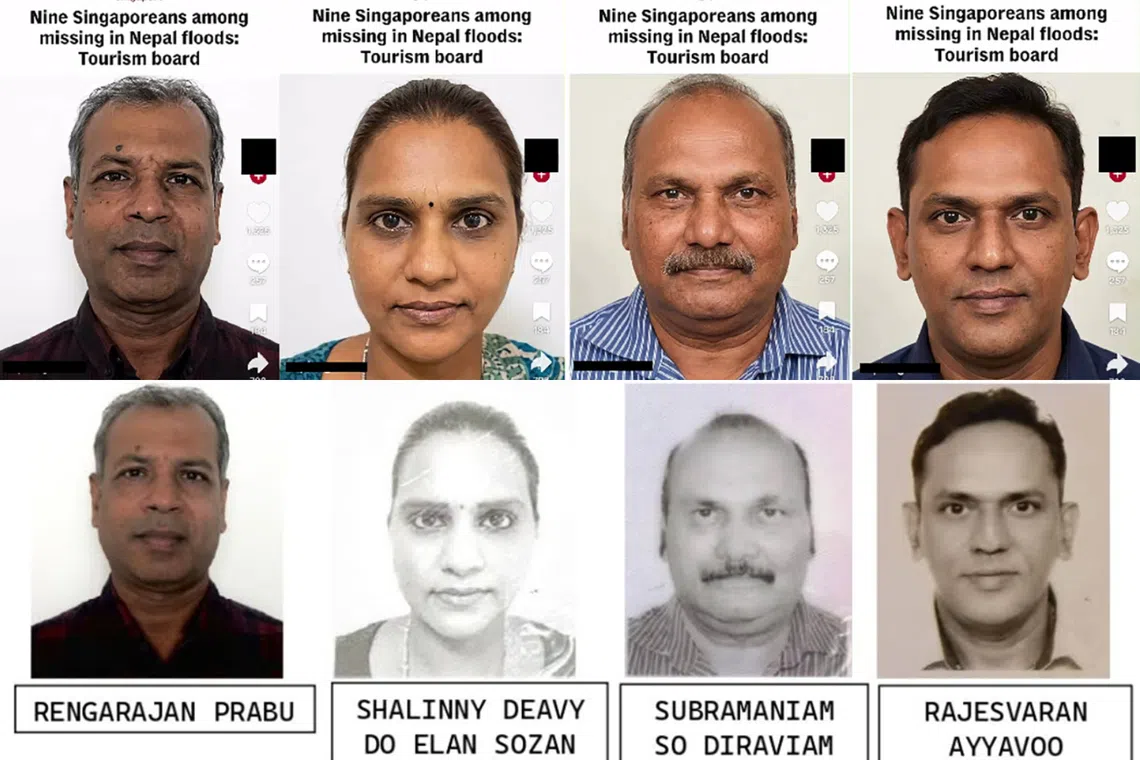
AI-generated images (top row) of four Singaporeans missing in Nepal have been shared online. A travel agency uploaded photos (bottom row) of the four to Facebook on Aug 28. The photos were taken from scans of their travel documents.
PHOTOS: SOCIAL MEDIA, LEAF HOLIDAYS TREKS AND EXPEDITION
Published Sep 04, 2026, 02:00 PM
Updated Sep 04, 2026, 02:00 PM
TikTok removed a post with AI-generated images of Singaporeans missing in Nepal floods for spreading misinformation, violating platform guidelines.
HTX used AI detection tool AlchemiX to identify AI images and face morphing in the post.
The public should verify images by checking sources, context, image consistency, and other evidence before sharing or reporting.
SINGAPORE - A widely seen post on TikTok with AI images of Singaporeans missing in the Nepal floods has been removed after it violated the platform’s guidelines.
The post uploaded on Aug 31 contained AI-generated photos of four of the nine missing Singaporeans, alongside real photos of three of the other missing Singaporeans.
The Straits Times ran a story on the post on Sept 1, and TikTok removed it the next day.
The post had violated guidelines on edited media and generated AI content, spreading misinformation and deceiving users into thinking those were real images of the missing Singaporeans.
The post had over 150,000 views and close to 300 comments before it was taken down.
The missing Singaporeans have been uncontactable since Aug 26, when flash floods swept through parts of Tibet and Nepal.
The death toll as of Sept 3 was over 1,200, and over 5,000 are still missing.
The missing Singaporeans have been identified as Rengarajan Prabu, Shalinny Deavy Elan Sozan, Subramaniam Diraviam, Rajesvaran Ayyavoo, Estee Loeh, Ghosh Aditi, Ng Kit Kuen, Shubakshi Rawla and Sumit Rawla.
The TikTok post included real photos of Loeh and the Rawlas, and AI images of Rengarajan, Shalinny, Subramaniam and Rajesvaran.
Rengarajan, Shalinny, Subramaniam and Rajesvaran were travelling with an agency, Leaf Holidays Treks and Expedition.
On Aug 28, the travel agency posted photos of the four Singaporeans on Facebook.
It is believed the AI images of them on TikTok were derived from the travel agency’s photos.
In the fake images, Shalinny, who works at the State Courts, was portrayed with a black “pottu” (a traditional coloured dot or mark worn on the forehead).
Her husband, who only wanted to be known as Selvaganesh, had told ST he was upset when he saw the post, as the AI image did not look like his wife, who has only worn a red pottu, never black.
On Sept 4, Selvaganesh said he was relieved and thankful the post had been removed .
TikTok said it launches additional detection efforts with a dedicated task force in events such as natural disasters and public safety emergencies.
This led to it removing similar posts on the Nepal floods, alongside the one removed on Sept 2.
AI images on social media platforms are a growing problem , with more fake, AI-generated content entering Singapore’s online space.
AI has been used to impersonate senior political office holders here to scam victims, with the police warning the public to be wary of such ruses.
Detecting fake images
To fight the scourge of fake videos and images in Singapore’s online space, the Home Team Science and Technology Agency (HTX) has been developing tools such as AlchemiX to detect them.
HTX engineers ran the AI images of the missing Singaporeans through AlchemiX which detected traces of AI generation and face morphing.
Alvin Wong, from HTX’s Sensors and Sensemaking Centre of Expertise, said it may take just a few seconds to generate AI images, but these can spread very quickly and cause widespread harm in major events.
He said: “A polished AI-generated image may require several iterative prompts to perfect.
“But even one with obvious defects can spread rapidly during breaking news events, particularly when viewers are consuming content on small mobile screens where such flaws are harder to detect.”
He added that AI cannot accurately recover detail that is missing.
That means when one takes a blurry image and asks an AI to make it clearer and larger, the added details are not real.
He said: “The AI restoration is done on a purely predictive basis. Furthermore, the result of the restoration process can vary depending on the instructions given.”
Wong said with AI advancing rapidly, it is not possible for AI images to always be detected by tools.
But the public should take steps to check on the authenticity of a photo or video before deciding whether to share or report it.
He said things to check are:
Source: Check who first published the image. Look for the original post and any mentions of the photographer or organisation.
Context: Check whether the date, place, people and clothing match reliable records.
Image: Check whether the text, hands, shadows and object edges look consistent.
Other evidence: Check whether photographs or videos from trusted sources or official notices support the claim.
Wong said: “Find out who first published the image and what the post claims. Then, compare that claim with reliable records.”
David Sun is The Straits Times’ crime correspondent. He has a background in criminology and is a licensed private investigator.
AI/artificial intelligence
网上流传着四名在尼泊尔失踪的新加坡人的AI生成图像(上排)。一家旅行社于8月28日将这四人的照片(下排)上传到Facebook。这些照片是根据他们的旅行证件扫描件制作的。
照片来源:社交媒体、LEAF HOLIDAYS TREKS AND EXPEDITION
发布于2026年9月4日下午2:00
更新于2026年9月4日下午2:00
TikTok删除了一条包含新加坡人在尼泊尔洪灾中失踪的AI生成的图像的帖子,原因是该帖子传播虚假信息,违反了平台准则。
HTX 使用 AI 检测工具 AlchemiX 来识别帖子中的 AI 图像和人脸变形。
公众在分享或报道图片之前,应通过检查来源、背景、图片一致性和其他证据来核实图片的真实性。
新加坡——TikTok上广泛流传的一则帖子因违反平台准则而被删除。该帖子使用了人工智能生成的图像,展示了在尼泊尔洪灾中失踪的新加坡人。
8 月 31 日上传的帖子包含人工智能生成的九名失踪新加坡人中的四人的照片,以及另外三名失踪新加坡人的真实照片。
《海峡时报》9月1日刊登了一篇关于该帖子的报道,TikTok第二天就将其删除。
该帖子违反了有关编辑媒体和生成人工智能内容的准则,传播虚假信息,欺骗用户,让他们以为这些是失踪新加坡人的真实照片。
该帖子被删除前已有超过 15 万次浏览和近 300 条评论。
自 8 月 26 日山洪暴发席卷西藏和尼泊尔部分地区以来,失踪的新加坡人一直无法联系。
截至9月3日,死亡人数超过1200人,仍有超过5000人失踪。
失踪的新加坡人已被确认为Rengarajan Prabu、Shalinny Deavy Elan Sozan、Subramaniam Diraviam、Rajesvaran Ayyavoo、Estee Loeh、Ghosh Aditi、Ng Kit Kuen、Shubakshi Rawla和Sumit Rawla。
TikTok 帖子中包含了 Loeh 和 Rawlas 的真实照片,以及 Rengarajan、Shalinny、Subramaniam 和 Rajesvaran 的 AI 图像。
Rengarajan、Shalinny、Subramaniam 和 Rajesvaran 是通过 Leaf Holidays Treks and Expedition 这家旅行社旅行的。
8月28日,该旅行社在Facebook上发布了这四名新加坡人的照片。
据信,TikTok 上他们的 AI 图像源自旅行社的照片。
在这些伪造的图片中,在州法院工作的沙林尼被描绘成额头上戴着黑色的“pottu”(一种戴在额头上的传统彩色点或标记)。
她的丈夫只愿透露自己名叫塞尔瓦加内什,他告诉《海峡时报》,看到这则帖子后他很生气,因为人工智能生成的图像不像他的妻子,他的妻子只穿过红色的波图,从来没有穿过黑色的。
9月4日,塞尔瓦加内什表示,他感到欣慰和感激,因为该帖子已被删除。
TikTok表示,在自然灾害和公共安全紧急情况等事件中,将成立专门工作组,开展额外的检测工作。
这导致它删除了与尼泊尔洪灾相关的类似帖子,以及 9 月 2 日删除的帖子。
社交媒体平台上的人工智能图像正成为一个日益严重的问题,越来越多的虚假人工智能生成内容涌入新加坡的在线空间。
人工智能已被用于冒充本地高级政治官员进行诈骗,警方警告公众警惕此类骗局。
检测伪造图像
为了打击新加坡网络空间中虚假视频和图像的祸害,内政团队科学技术局 (HTX) 一直在开发 AlchemiX 等工具来检测它们。
HTX 的工程师使用 AlchemiX 对失踪新加坡人的 AI 图像进行处理,检测到了 AI 生成和面部变形的痕迹。
HTX传感器和感知中心专家Alvin Wong表示,生成人工智能图像可能只需要几秒钟,但这些图像可以迅速传播,并在重大事件中造成广泛的危害。
他说:“要完善人工智能生成的图像,可能需要多次迭代提示。”
“但即使是存在明显缺陷的信息,在突发新闻事件期间也能迅速传播,尤其是在观众使用小型移动屏幕观看内容时,这些缺陷更难被发现。”
他还补充说,人工智能无法准确地恢复缺失的细节。
这意味着,当人们拍摄一张模糊的图像,并要求人工智能使其更清晰、更大时,添加的细节并非真实存在。
他说:“人工智能修复完全基于预测。此外,修复结果会根据给定的指令而有所不同。”
黄先生表示,随着人工智能的快速发展,人工智能生成的图像不可能总是被工具检测到。
但公众在决定是否分享或举报照片或视频之前,应该采取措施核实其真实性。
他说需要检查的事项包括:
来源:查看图片最初发布者的信息。查找原始帖子以及其中提及的摄影师或机构。
背景:检查日期、地点、人物和服装是否与可靠记录相符。
图片:检查文字、手部、阴影和物体边缘是否一致。
其他证据:查看来自可信来源或官方公告的照片或视频是否支持该说法。
黄说:“查清楚是谁最先发布了这张图片,以及帖子里的内容。然后,把这些内容与可靠的记录进行比对。”
大卫·孙是《海峡时报》的犯罪记者。他拥有犯罪学背景,并且是一名持证私人侦探。
人工智能