Malaysia’s ‘elephant whisperer’ leads push to save Sabah’s endangered Bornean elephants马来西亚“象语者”带头拯救沙巴濒危婆罗洲象
SUKAU, Sept 21 — Deep in Malaysia’s Borneo jungle, wild shouts fill the air as a Bornean elephant is darted and her angry herd rallies to protect her.The downed elephant is one...
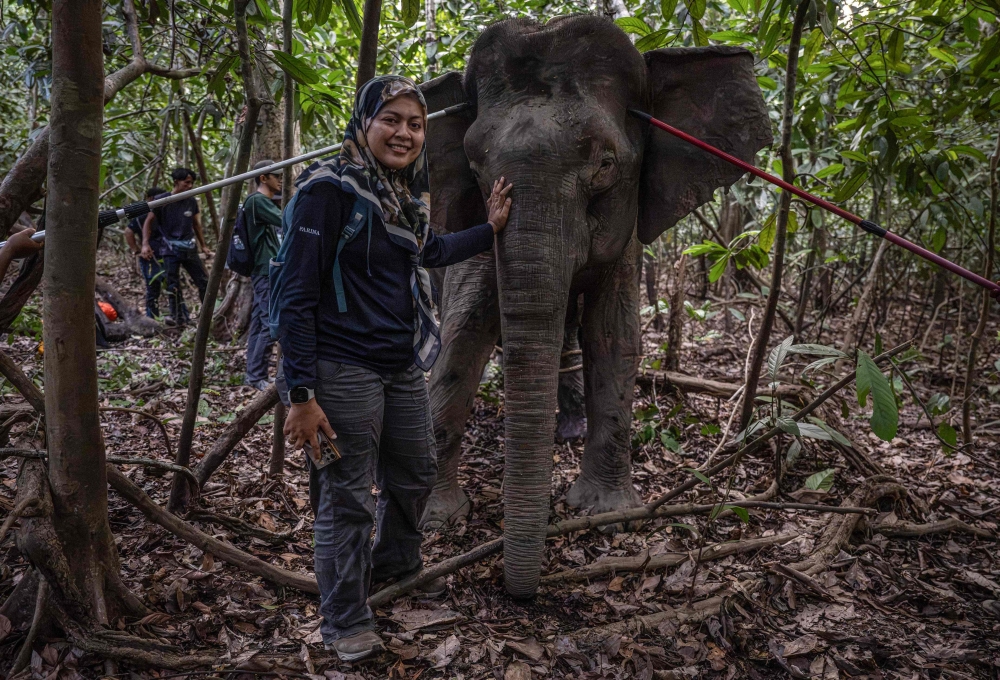
In Malaysia's Borneo jungle, conservationists darted a rare Bornean elephant to attach a tracking collar, aiming to reduce conflicts with local communities and protect the endangered species.
Bornean elephants have lost significant habitat due to logging and palm oil expansion, leading to inevitable conflicts with humans when they wander into plantations and villages.
Conservationist Farina Othman promotes coexistence by advocating for elephant corridors, educating locals, and involving communities in safely guiding elephants away from human areas.
SUKAU, Sept 21 — Deep in Malaysia’s Borneo jungle, wild shouts fill the air as a Bornean elephant is darted and her angry herd rallies to protect her.
The downed elephant is one of only around 1,000 Bornean elephants left in the wild, and the team that darted her is working to protect the endangered species by minimising growing conflict between the animals and local communities.
Once the herd has been chased off, conservationist Farina Othman and her team move in to attach a tracking collar to the animal.
The collar allows them to alert villagers if the elephant strays too near.
It is also key to a programme Farina is designing to create “corridors” for elephants roaming a fragmented landscape of virgin forest patches, hemmed in by vast oil palm plantations and villages.
Farina has studied these elephants for years, earning her the nickname “Borneo’s elephant whisperer” as well as the prestigious Whitley Award for conservationists.
“It’s Pigtail,” she whispered, stroking the tranquilised elephant’s trunk and nodding to the distinctive tail that prompted its nickname.
The team works fast — the dart’s sedative effects last only half an hour, and the herd can still be heard nearby. Overhead, there are flashes of lightning as a tropical thunderstorm approaches.
As soon as the collar is securely fastened and blood samples are taken, the team, accompanied by AFP journalists, retreat into the forest before Pigtail rouses.
‘Conflict inevitable’
For the past 40 years, Bornean elephants have lost more than 60 per cent of their habitat in Sabah, in northern Borneo, to logging and, later, oil palm expansion, according to the International Union for Conservation of Nature, which listed the animal as endangered in 2024.
Lower Kinabatangan, a floodplain in eastern Sabah of around 400 square kilometres, is home to around 160 elephants.
But “only half of that is now a space left for the elephants,” said Farina, a Malaysian academic who heads local conservation group Seratu Aatai, or “Solidarity” in the local Sungai language.
When the animals venture into private property or nearby villages, “conflict is inevitable”, she told AFP.
In a recent incident, a herd of 20 elephants stomped into palm oil smallholdings and three villages, terrifying residents.
No one was injured, but the incident prompted calls for stronger deterrents, including upgraded electric fencing.
“People don’t feel safe around elephants, and that’s when conflict happens,” Farina said.
The animosity worsens when the animals, especially adventurous bulls, which can weigh up to five tonnes, cleverly bypass electric fencing to feast on palm trees or saplings.
That is why Farina and her team of 17 conservationists prioritise coexistence.
“We’re working to increase people’s tolerance, to increase connectivity space for elephants and to find a long-term solution,” she said.
Based in Sukau, a hamlet on the crocodile-infested banks of the Kinabatangan river, Seratu Aatai runs an outreach programme in plantation schools, distributes information pamphlets and has designated “community wildlife guardians” who help usher away elephants that have wandered into human habitation.
“Before, we didn’t know how to manage living near them,” said homestay owner Firah Kazenn, 21, who recently encountered elephants behind her home in Sukau.
“The elephants were unmonitored, and many were lost to conflict. Now, with the Seratu Aatai unit, they are protected, and the community is actively involved too,” Firah told AFP.
“We’ve learnt safe ways to guide the elephants away when they come too close to our homes, without harming them,” she added.
Farina believes the best way to protect the animals is by creating “elephant corridors” — pathways through plantations connecting patches of habitat.
She is hoping to convince seven plantations in the area that elephants are “an ecological reality, rather than an occasional disturbance”.
But it will be a challenge.
Fierce competition driven by tight, volatile margins means many producers are not keen to sacrifice land for corridors, said Muhammad Al Shafieq bin Mustafa, a former plantation manager in Sukau and now a palm oil industry specialist.
“Those plantations that do commit and are willing to work with people like Farina often do not get the recognition that they deserve or the financial support that they need, especially from Western palm oil buyers,” he told AFP.
Industry-funded conservation associations say plantations have made progress in becoming sustainable palm oil producers but face difficult economic realities.
“It needs to be a win-win situation between the planters and also the wildlife,” said Daniel Pamin, conservation and sustainability executive at the Malaysian Palm Oil Green Conservation Foundation.
Farina believes change will come.
Before, locals used the Malay word “halau”, meaning “chase away” or “banish”, when talking about elephants.
“Now, we are working to get people to say... ‘walking’ or ‘escorting’ out the elephant.” — AFP
Malaysia condemns Houthi attacks, stands in solidarity with Saudi Arabia
Five-year-old girl found dead after uncle allegedly throws her into river in Johor
Anwar leaves Istana Negeri Sembilan after hour-long audience with Tuanku Muhriz
在马来西亚婆罗洲的丛林里,自然保护主义者用麻醉枪射中了一头罕见的婆罗洲象,以便给它戴上追踪项圈,目的是减少与当地社区的冲突,并保护濒危物种。
由于伐木和棕榈油种植园的扩张,婆罗洲象失去了大量的栖息地,当它们闯入种植园和村庄时,与人类发生冲突是不可避免的。
自然保护主义者法里娜·奥斯曼倡导人象共存,她倡导建立大象走廊,教育当地居民,并让社区参与安全地引导大象远离人类区域。
苏考,9 月 21 日——在马来西亚婆罗洲丛林深处,一阵阵狂野的叫喊声响彻天空,一头婆罗洲象被麻醉枪射中,愤怒的象群聚集起来保护她。
这头倒下的大象是仅存的约 1000 头野生婆罗洲象之一,而麻醉它的团队正在努力保护这一濒危物种,尽量减少动物与当地社区之间日益加剧的冲突。
驱散兽群后,自然保护主义者法里娜·奥斯曼和她的团队会上前给动物戴上追踪项圈。
项圈可以让他们在大象靠近村民时发出警报。
这也是法里纳正在设计的一项计划的关键所在,该计划旨在为在原始森林碎片化景观中漫游的大象创造“走廊”,这些森林碎片被大片油棕种植园和村庄包围。
法里纳多年来一直研究这些大象,因此赢得了“婆罗洲大象语者”的绰号,并获得了著名的惠特利自然保护奖。
“它是小猪尾巴,”她轻声说道,一边抚摸着被麻醉的大象的鼻子,一边指着它那条独特的尾巴,正是这条尾巴让它有了“小猪尾巴”这个昵称。
救援队行动迅速——麻醉飞镖的药效只持续了半小时,附近还能听到牛群的叫声。头顶上,闪电划破夜空,热带雷暴正在逼近。
项圈系好并采集完血样后,在法新社记者的陪同下,团队迅速撤退到森林中,以免小尾巴醒来。
冲突不可避免
据国际自然保护联盟称,过去 40 年来,婆罗洲象在婆罗洲北部沙巴州的栖息地因伐木和后来的油棕种植园扩张而丧失了 60% 以上,该联盟已将婆罗洲象列为 2024 年濒危物种。
沙巴东部面积约 400 平方公里的下京那巴当岸河冲积平原是约 160 头大象的家园。
但马来西亚学者法里纳表示,“现在只剩下其中一半的空间留给了大象。”法里纳是当地保护组织 Seratu Aatai(在当地双溪语中意为“团结”)的负责人。
她告诉法新社,当这些动物闯入私人领地或附近的村庄时,“冲突是不可避免的”。
最近发生的一起事件中,20 头大象闯入棕榈油小农场和三个村庄,吓坏了居民。
虽然无人受伤,但该事件引发了人们对加强威慑措施的呼吁,包括升级电围栏。
“人们在大象身边感觉不安全,这就是冲突发生的原因,”法里纳说。
当这些动物,尤其是体重可达五吨的、喜欢冒险的公牛,巧妙地绕过电网去啃食棕榈树或幼苗时,敌意就会加剧。
这就是为什么法里纳和她的17名自然保护主义者团队将共存放在首位的原因。
“我们正在努力提高人们的容忍度,增加大象的活动空间,并寻找长期的解决方案,”她说。
Seratu Aatai 的总部位于苏考村,该村位于基纳巴当岸河鳄鱼出没的河岸边。Seratu Aatai 在种植园学校开展外展项目,分发宣传册,并指定“社区野生动物守护者”帮助驱赶闯入人类居住区的大象。
“以前,我们不知道如何与它们一起生活,”21岁的民宿老板菲拉·卡赞说道,她最近在苏考的家后面遇到了大象。
“这些大象以前无人监管,很多都在冲突中丧生。现在,有了塞拉图阿泰保护队,它们得到了保护,当地社区也积极参与其中,”菲拉告诉法新社。
她补充说:“我们已经学会了如何在不伤害大象的情况下,安全地引导它们离开,尤其是在它们过于靠近我们家的时候。”
法里纳认为保护这些动物的最好方法是建立“大象走廊”——穿过种植园连接不同栖息地的通道。
她希望说服该地区的七个种植园,大象是“一种生态现实,而不是偶尔的干扰”。
但这将是一个挑战。
穆罕默德·沙菲克·本·穆斯塔法(Muhammad Al Shafieq bin Mustafa)曾是苏考(Sukau)的种植园经理,现在是一名棕榈油行业专家。他表示,由于利润微薄且波动不定,激烈的竞争意味着许多生产商不愿为了走廊而牺牲土地。
“那些真正投入并愿意与像法里纳这样的人合作的种植园,往往得不到他们应得的认可或所需的财政支持,尤其是来自西方棕榈油买家的支持,”他告诉法新社。
由行业资助的环保组织表示,种植园在成为可持续棕榈油生产商方面取得了进展,但面临着严峻的经济现实。
“这必须是种植者和野生动物之间的双赢局面,”马来西亚棕榈油绿色保护基金会的保护和可持续发展主管丹尼尔·帕明说。
法里纳相信改变终将到来。
以前,当地人在谈论大象时会使用马来语“halau”,意思是“驱赶”或“驱逐”。
“现在,我们正努力让人们用‘步行’或‘护送’的方式来描述这头大象。”——法新社
马来西亚谴责胡塞武装的袭击,并与沙特阿拉伯站在一起。
柔佛州一名五岁女童被发现溺亡,据称是其叔叔将其抛入河中。
安华在与端姑慕力兹会面一小时后离开森美兰皇宫