41 Chinese artefacts to make Singapore debut on Dec 7 in four classic novels showcase41件中国文物将于12月7日在新加坡首次亮相,同时展出的还有四部经典小说。
Also on display will be early editions, woodblock prints and opera scripts dating from the 17th to 19th centuries. Read more at straitstimes.com.
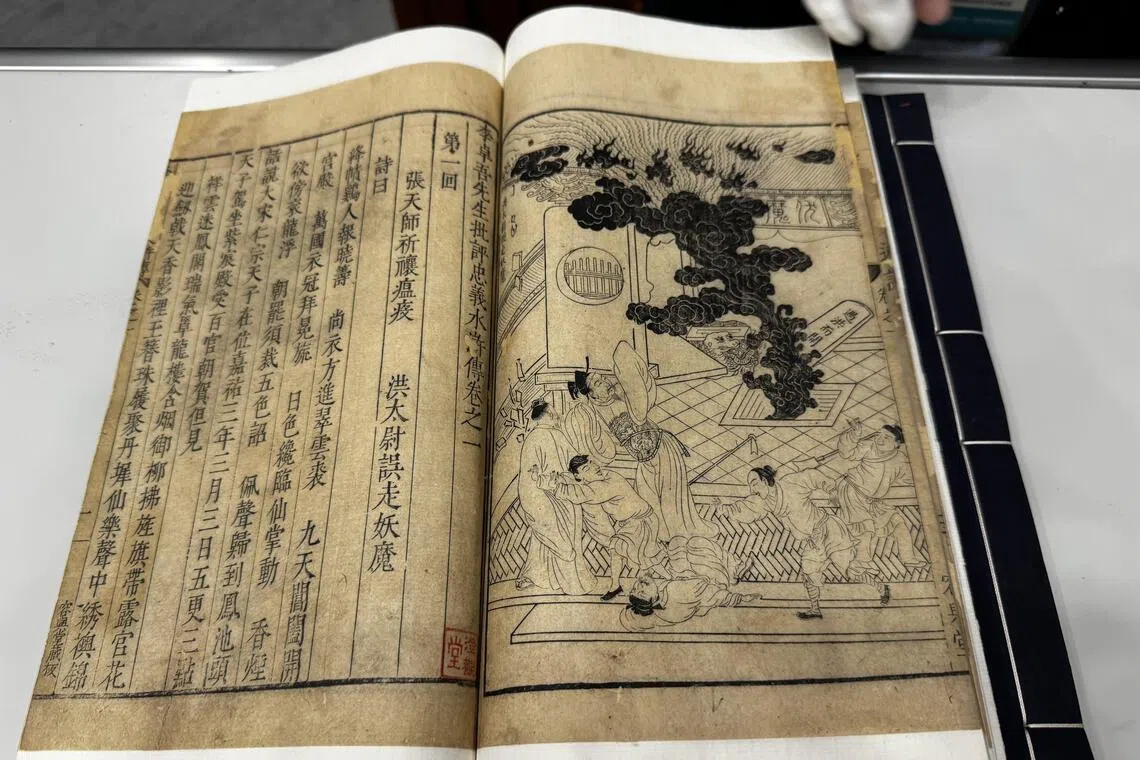
A rare edition of Water Margin will be part of a six-month exhibition that opens at the National Library Singapore in December.
PHOTO: LIANHE ZAOBAO
Published Sep 21, 2026, 03:00 PM
Updated Sep 21, 2026, 09:36 PM
Forty-one rare Chinese artefacts, including two top-graded cultural relics, will be exhibited in Singapore in December 2026, showcasing the Four Great Chinese Classic Novels with items on loan from the National Library of China.
The exhibition features early editions, manuscripts, and other items like drinking game cards, alongside Singapore’s own collection.
Interactive digital installations will enrich the visitor experience, reflecting the novels’ cultural impact and the strong partnership between Singapore and China’s national libraries.
SINGAPORE – Forty-one historical artefacts that have never been exhibited outside China will make their way to Singapore for an exhibition opening on Dec 7.
Among the items on loan from the National Library of China (NLC) are two cultural relics that China has classified in its highest grade for national heritage objects, based on factors such as rarity and significance.
They will be part of a six-month exhibition on the four great Chinese classic novels – Romance Of The Three Kingdoms, Dream Of The Red Chamber, Water Margin and Journey To The West – that opens at the National Library Singapore in December .
A National Library Board (NLB) team, led by chief executive Melissa Tam, caught a glimpse of the items during a Sept 20 visit to the NLC in Beijing. Tam was accompanied by five members of NLB’s curatorial and partnerships teams.
One of the two top-graded artefacts is a rare edition of Water Margin containing commentary by renowned Ming Dynasty philosopher, literary critic and historian Li Zhuowu.
It is the most complete 100-chapter version still in existence and contains high-quality illustrations of key story scenes that have influenced the history of Chinese printing. The work preserves many of the original poems found in author Shi Nai’an’s text and is critical for studies on the novel’s development.
The other is a rare manuscript of Dream Of The Red Chamber, one of the earliest surviving handwritten versions, dating to 1759. Such manuscripts are often used to trace the novel’s evolution and uncover the author’s original intent.
Also featured is a rare manuscript of Dream Of The Red Chamber, one of the items China has classified in its highest grade of national heritage objects. PHOTO: LIANHE ZAOBAO
Also featured is a rare manuscript of Dream Of The Red Chamber, one of the items China has classified in its highest grade of national heritage objects.
Other notable artefacts include an early version of Romance Of The Three Kingdoms with revisions and commentary by scholar Mao Zonggang, whose edition was later widely adopted, and a set of drinking-game cards featuring 40 characters from Water Margin.
Also on display will be early editions, woodblock prints and opera scripts dating from the 17th to 19th centuries.
An NLC representative said on Sept 20 that the ancient books were selected based on three principles: tracing the history of the editions, showing the breadth of their circulation and highlighting their continued relevance through later adaptations and reinterpretations.
The items will be displayed alongside artefacts from the National Library of Singapore’s own collection.
These include Chrita Dahulu-kala, Namanya Sam Kok, a 30-volume Baba Malay translation of Romance Of The Three Kingdoms by Chan Kim Boon. Published in Singapore between 1892 and 1896, it shows how a Chinese literary classic became part of Singapore’s multicultural literary history, NLB said.
The exhibition, presented in both English and Chinese, will also offer an immersive journey through the world of each novel via interactive digital installations.
Among them is an interactive wall inspired by a Qing Dynasty imperial opera, where visitors can discover how Sun Wukong in Journey To The West obtained his iconic weapon – a magical staff that can change size at his command.
The exhibition builds on a longstanding partnership between the two national libraries established in 1997, covering areas such as the exchange of library materials, staff attachments and the sharing of information resources.
A recent memorandum of understanding signed between the two libraries in March 2025 made the loan of the artefacts possible.
Prime Minister Lawrence Wong announced the exhibition in his Mandarin speech at the National Day Rally on Aug 23. He said many Singaporeans have known these stories from a young age and learnt many values from them.
Tam said on Sept 20: “These Chinese classics transcend time and language... and they speak to timeless themes of love, friendship, loyalty and discipline.”
She added that NLB is working closely with its counterparts at NLC to ensure that the artefacts are appropriately cared for throughout their journey to Singapore, their display and eventual return.
What are the novels about?
The four great Chinese classic novels have influenced literature, film and popular culture across Asia for centuries.
Journey To The West is a 16th-century novel from the late Ming Dynasty, traditionally attributed to Wu Cheng’en.
In the story, the Tang emperor and the Buddha task the monk, Tang Sanzang, with retrieving Buddhist scriptures from Tian Zhu, a mythical location in the Indian subcontinent. Tang is accompanied by three disciples: Monkey King Sun Wukong, Pigsy the pig demon Zhu Bajie and Sandy the river ogre Sha Wujing.
Water Margin’s current version is believed to have been completed in the 16th century, around 1524, during the reign of the Jiajing emperor.
It is generally attributed to Shi Nai’an and Luo Guanzhong, with Shi credited as the author of the first 100 chapters and Luo, a student of Shi, credited for the remaining 30.
Set in the late Northern Song Dynasty, it tells the story of a band of 108 heroes who gather at the marshes of Mount Liang to oppose the Song government, which is helmed by corrupt officials.
Romance Of The Three Kingdoms is a historical novel written in the 14th century (late Yuan Dynasty to early Ming Dynasty), attributed to Luo Guanzhong.
It follows a semi-fictional historical narrative set in the late years of the Eastern Han Dynasty and the subsequent Three Kingdoms period. It details power struggles among the many warlords as they vie for dominion over China and combines historical material from the Three Kingdoms Annals with folklore and legends.
This Chinese New Year painting is believed to date from 1978. The figures are Dream Of The Red Chamber’s Jia Baoyu and Lin Daiyu, who appear to be reading poetry. PHOTO: LIANHE ZAOBAO
This Chinese New Year painting is believed to date from 1978. The figures are Dream Of The Red Chamber’s Jia Baoyu and Lin Daiyu, who appear to be reading poetry.
Dream Of The Red Chamber was written in the 18th century during the Qing Dynasty. It is attributed to Cao Xueqin, although the authorship of its final 40 chapters remains disputed among scholars.
The story follows the rise and fall of the Jia family and is often viewed as a social critique of Qing materialist culture and values. The novel has even sparked its own academic field, known as “Redology”.
Chin Soo Fang is senior correspondent at The Straits Times, covering a wide range of topics including community, politics, social issues, consumer, culture and heritage.
National Library Board
《水浒传》的珍稀版本将作为新加坡国家图书馆12月开幕的为期六个月展览的一部分展出。
图片来源:联合早报
发布于2026年9月21日下午3:00
更新于2026年9月21日晚上9:36
2026年12月,新加坡将展出41件中国珍稀文物,其中包括两件顶级文物,展出中国四大经典小说,部分展品来自中国国家图书馆。
展览展出了早期版本、手稿以及其他物品,例如饮酒游戏卡片,以及新加坡自己的藏品。
互动式数字装置将丰富参观者的体验,体现小说的文化影响力以及新加坡和中国国家图书馆之间的紧密合作关系。
新加坡——41件从未在中国境外展出的历史文物将前往新加坡,于12月7日开幕展览。
此次从中国国家图书馆借出的藏品中,有两件文物被中国根据其稀有性和重要性等因素,列为国家级文物最高等级。
它们将成为新加坡国家图书馆于 12 月开幕的为期六个月的中国四大古典名著——《三国演义》、《红楼梦》、《水浒传》和《西游记》展览的一部分。
由行政长官谭咏诗率领的新加坡国家图书馆管理局(NLB)团队于9月20日访问北京国家图书馆时,对这些展品进行了初步了解。陪同谭咏诗的有NLB策展和合作团队的五名成员。
两件顶级文物之一是罕见的《水浒传》,其中包含明代著名哲学家、文学评论家和历史学家李卓武的评注。
这是现存最完整的百章本,其中包含大量对中国印刷史产生深远影响的关键故事场景的高质量插图。该版本保留了史乃庵原著中的许多诗句,对于研究这部小说的创作发展至关重要。
另一份是《红楼梦》的珍贵手稿,是现存最早的手写版本之一,可追溯至 1759 年。这类手稿常被用来追溯小说的演变过程,并揭示作者的最初意图。
此次展出的还有《红楼梦》的珍贵手稿,该手稿是中国最高级别的国家级文物之一。图片来源:联合早报
展出的还有《红楼梦》的珍贵手稿,这是中国列为最高级别国家级文物之一的文物。
其他值得注意的文物包括学者毛宗刚修订并注释的《三国演义》早期版本(他的版本后来被广泛采用),以及一套印有《水浒传》中 40 个人物的饮酒游戏卡片。
展览还将展出17至19世纪的早期版本、木版画和歌剧剧本。
9月20日,国家图书馆的一位代表表示,选择这些古籍是基于三个原则:追溯版本的历史,展示其流通的广度,以及通过后来的改编和重新诠释来突出其持续的相关性。
这些物品将与新加坡国家图书馆馆藏文物一同展出。
其中包括《三国演义》(Chrita Dahulu-kala, Namanya Sam Kok),这是一部30卷的峇峇马来语译本,译自陈金文的《三国演义》。新加坡国家图书馆管理局表示,该译本于1892年至1896年间在新加坡出版,展现了一部中国文学经典如何融入新加坡多元文化的文学史。
本次展览将以英文和中文两种语言呈现,并通过互动式数字装置,为观众提供沉浸式的体验,深入了解每部小说的世界。
其中一面互动墙的设计灵感来自清代宫廷戏曲,参观者可以在这里了解《西游记》中的孙悟空是如何获得他的标志性武器——一根可以根据他的意愿改变大小的魔杖的。
此次展览建立在两家国家图书馆自 1997 年建立的长期合作关系之上,涵盖图书馆资料交换、人员交流和信息资源共享等领域。
2025年3月,两家图书馆签署了一份谅解备忘录,使得文物借展成为可能。
黄循财总理在8月23日国庆群众大会上用华语发表讲话时宣布了此次展览。他说,许多新加坡人从小就熟悉这些故事,并从中汲取了许多价值观。
谭于9月20日表示:“这些中国经典超越了时间和语言……它们讲述的是爱、友谊、忠诚和纪律等永恒的主题。”
她补充说,国家图书馆管理局正与国家文物局密切合作,以确保文物在运往新加坡、展出和最终归还的过程中得到妥善保管。
这些小说讲的是什么内容?
中国四大古典名著几个世纪以来一直影响着亚洲的文学、电影和流行文化。
《西游记》是明朝晚期的一部小说,传统上认为是吴承恩所著。
故事中,唐朝皇帝和佛祖委派僧人唐僧前往印度次大陆的神秘之地天竺取回佛经。唐僧有三位弟子随行:孙悟空、猪八戒和沙悟净。
《水浒传》目前的版本据信完成于16世纪,大约在1524年,即嘉靖皇帝统治时期。
该书一般认为是石乃安和罗贯中所著,石乃安被认为是前100章的作者,而石乃安的学生罗贯中被认为是后30章的作者。
故事发生在北宋末年,讲述了108位英雄聚集在梁山沼泽地,反抗由腐败官员统治的宋朝政府的故事。
《三国演义》是一部写于14世纪(元朝末至明朝初)的历史小说,相传作者为罗贯中。
这部作品以东汉末年和随后的三国时期为背景,采用半虚构的历史叙事手法,详细描述了众多军阀争夺中国霸权的权力斗争,并将《三国志》中的历史资料与民间传说和神话故事相结合。
这幅春节画据信创作于1978年。画中人物是《红楼梦》中的贾宝玉和林黛玉,他们似乎正在吟诗作赋。图片来源:联合早报
这幅中国新年画作据信创作于 1978 年。画中人物是《红楼梦》中的贾宝玉和林黛玉,他们似乎正在吟诗作赋。
《红楼梦》写于十八世纪清朝时期,通常被认为是曹雪芹所著,但其最后四十章的作者归属至今仍存在争议。
这部小说讲述了贾家兴衰的故事,常被视为对清代唯物主义文化和价值观的社会批判。它甚至催生了一个独立的学术领域,被称为“红学”。
Chin Soo Fang 是《海峡时报》的资深记者,报道范围广泛,包括社区、政治、社会问题、消费者、文化和遗产等话题。
国家图书馆委员会