Johanne Siy's new restaurant Aro features rare Filipino seaweed, pili nuts and artisanal saltJohanne Siy 的新餐厅 Aro 以珍稀的菲律宾海藻、皮利果和手工盐为特色。
Acclaimed chef Johanne Siy's debut restaurant Aro opens on Mohamed Sultan Road on Sep 25 with a menu showcasing overlooked ingredients from the Philippines and beyond.
Acclaimed chef Johanne Siy's debut restaurant Aro opens on Mohamed Sultan Road on Sep 25 with a menu showcasing overlooked ingredients from the Philippines and beyond.
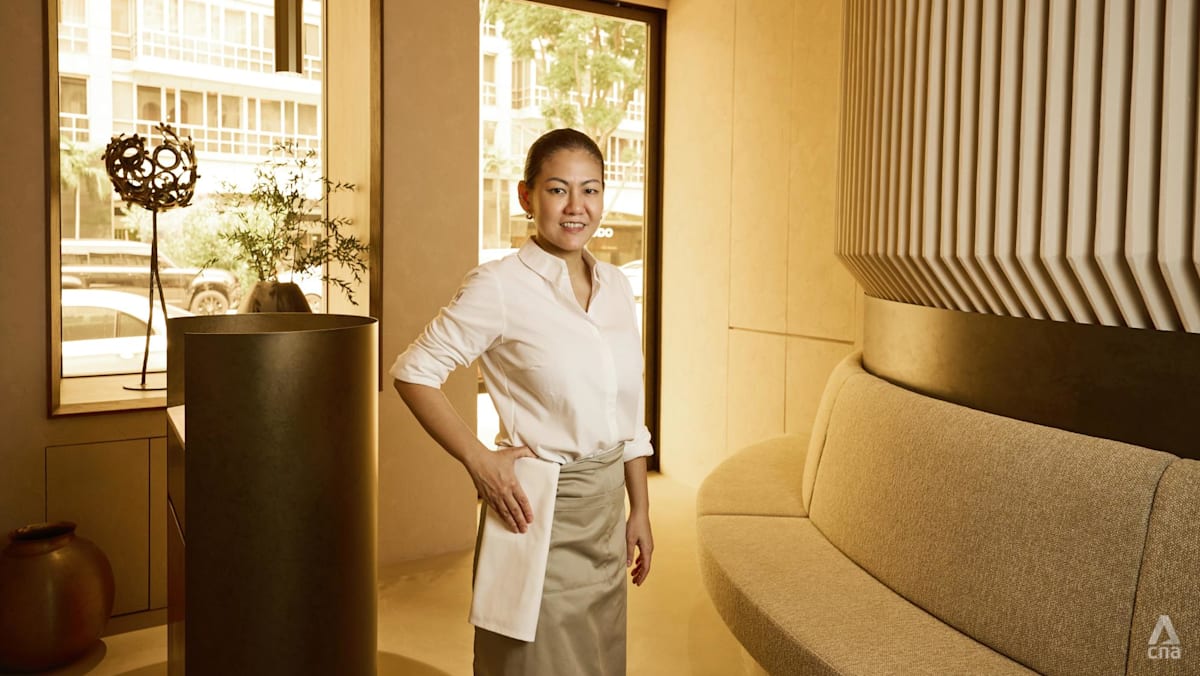
With the opening of her own restaurant, Aro, chef Johanne Siy has complete freedom of expression. (Photo: CNA/Aik Chen)
This audio is generated by an AI tool.
When you hold the title of Asia’s Best Female Chef 2023, and you are putting your name to your very own restaurant for the first time, the pressure is on.
“I'm very much afraid. I'm nervous every day,” chef Johanne Siy confided with a smile, seated in her brand new dining room as staff members bustled around fussing over the finishing touches on the table settings.
Aro, opening Sep 25, is the culmination of many years of dreaming for the Philippines-born chef who has called Singapore home for the last two decades. In the year and a half since she left Lolla, the restaurant where she gained 50 Best recognition (which subsequently closed), she’s been travelling the world, visiting producers and gathering the inspiration to orchestrate her much-anticipated comeback.
Aro's warm, residential-style interiors were designed by Japanese studio Keiji Ashizawa Design, with a natural palette partly inspired by the colours of the Filipino pili nut. (Photo: CNA/Aik Chen)
For Aro – a word that means “love” in her native Pangasinan dialect, which Siy discovered serendipitously while thumbing through an old dictionary – she went all out to convert the conservation shophouse space on Mohamed Sultan Road, previously restaurant Esora, into a stylish living room-like respite of rich wood tones and natural textures. She’s hoping the space will be welcoming for guests to experience the labour of love – or “aro” – that crafting her own cuisine has been.
As to what that cuisine actually is, well, she’s had a hard time putting it into concise words for the people who’ve asked.
The main idea is to “showcase ingredients that are underrated” from all over the world, and Southeast Asia in particular – the ones that excite, challenge or trigger her to see things from new perspectives.
A bowl of pili nuts forms part of the decor at Aro. (Photo: CNA/Aik Chen)
Here, “we celebrate ingredients with amazing people behind them”, including “the craftsmen and the producers, and the communities that actually sustain our food systems.”
She explained: “I think, more often than not, a restaurant becomes about just the chef. It should be bigger than that, because there are so many people who have a hand in how a restaurant operates. The amazing experience is actually the hard work of many people.”
DELICIOUS SIMPLICITY
It’s a culinary philosophy she’s embraced since her days staging at heavyweight Nordic restaurants Noma, Faviken and Relae. Those experiences came after her exposure to fine French techniques in the kitchens of Le Bernardin and Cafe Boulud in New York City, and Restaurant Andre in Singapore.
“I feel like now, as I get older, I'm less hung up on the techniques. When I was younger, I was like, "Oh, I can do this! I can do that!’ The dishes become so complex, and you employ so many techniques you don't really need, that don’t contribute to the taste or the flavour of the dish,” she said. “Now, I let the ingredient shine. If it's an amazing ingredient, we treat it very simply.”
A celebration of seaweed (Photo: CNA/Aik Chen)
Gillardeau oysters from France, for example, are simply poached in butter. But, the sweet, luscious oyster is actually a supporting actor in the dish, the real star of which is gamet, a rare seaweed from Siy’s mother’s hometown in Ilocos in northern Philippines that is harvested at great risk. That, too, is simply grilled with salt, pepper “and a bit of wok hey. The natural umami comes out.”
The dish is a celebration of seaweed and includes four other varieties – wakame, ayunori, sea lettuce and hijiki – dressed simply in a kombu sauce. “The brininess from the sea is an aroma that is is inspiring for me. Every time we get like a delivery of seaweed, I inhale,” she shared. “We think we’ve seen all the varieties of seaweed, but actually, there's a whole world out there that we are not familiar with, like gamet.”
Other ingredients from the Philippines that have captured her imagination include stingless bee honey from Laguna, pili nuts from Bicol and sea salt from Bohol.
A showcase of stingless bee honey (Photo: CNA/Aik Chen)
The honey from stingless bees is showcased as the centre of an edible flower cradled by layers of cheese crackers. Open the serving vessel and you’ll find a taste of aged honey, which is wonderfully acidic and fruity, paired with tiny tastes of blue cheese and lime gel.
This honey is “something that we have in Southeast Asia, including Malaysia and Thailand, that is super underrated,” Siy said. In the dish, “we highlight different virtues of the product and even showcase what time does to to that ingredient.”
Pili nut milk, egg yolk, caviar (Photo: CNA/Aik Chen)
Pili nuts, which are usually eaten as a sugared treat in most of the Philippines, take centre stage in a savoury, dimensional custard made from pili nut milk and enlivened with jamon, fried capers, egg yolk sauce and Oscetria caviar. Native to the Philippines, pili nuts are foraged from wild trees in volcanic soil, with each nut cracked by hand.
And then there is Asin Tibuok, Bohol’s artisanal sea salt made by filtering seawater through coconut husk ash before boiling the resulting brine in clay pots to form distinctive egg-shaped blocks of salt. Last year, UNESCO inscribed the family-run practice of making Asin Tibuok on its List of Intangible Cultural Heritage in Need of Urgent Safeguarding.
Artisanal Asin Tibuok is used to finish a cucumber and citrus dessert. (Photo: CNA/Aik Chen)
The salt is grated over a cucumber sorbet with citrus granita, pomelo, kaffir lime oil and lime zest.
All of these are ingredients Siy deep-dove into on her travels around the Philippines. But, Aro’s cuisine is not centred around Filipino food. “That's not how I pay tribute to my heritage. The moment you put that label on it, “you box it up and limit creativity… that creates more barriers, rather than unifying us,” she asserted.
Yes, the “maiden menu” does highlight many ingredients of Filipino origin, but that is a “natural”, “organic” result of her recent travels.
The bigger picture is “finding hidden gems and being able to bring them to the table and have the diners enjoy them. That is the part of the work that I enjoy most,” she said, “especially in a place like Singapore, where we have we don't have a connection with agriculture and the land.”
View this post on Instagram
It’s also about “celebrating ingredients that we already know, but talking about a different aspect of them that not many people are familiar with.”
Also on the menu are fan-favourite dishes that have followed her throughout the years — her popular signatures, in slightly evolved incarnations. “Many people, after I left Lolla, would constantly message me and say, ‘When are you opening your own restaurant? We miss your food.’ I want to be able to sustain the relationships I've built over time.”
There’s a spanner crab tart with aligue sauce, enlivened with green apple, pink guava and basil oil. And, a dish of avocado with smoked eel, cucumber, black garlic, yuzu, coconut, dashi and jalapeno granita.
Siy's signature avocado dish explores how an everyday ingredient can be presented in a new light. (Photo: CNA/Aik Chen)
For this dish, “we’ve upped everything and made small tweaks here and there,” said Siy, revealing that she doesn’t order her avocados from a supplier, but rather, employs “an auntie who helps curate avocados for us” from wet market stalls: “She helps us look out for the best avocados!"
The menu doesn’t yet incorporate Singaporean influences, but Siy would like it to. One ingredient on her wishlist, for example, is kedongdong, which she hopes to use once she can secure a reliable supply.
Still, the city has undoubtedly contributed to her journey as a chef.
“I think I'm part of the generation that started asking young, 'Is this all there is to life?’,” said the 45-year-old, who moved here when she landed her first job as a marketing executive at Proctor and Gamble.
“It was actually being in Singapore that made me realise you can actually pursue a career in a field like this and still be happy, and have it be lucrative. Here, we are not so hung up on the Asian thing of, ‘You must become a doctor or lawyer’.”
(Photo: CNA/Aik Chen)
After leaving her corporate job at 29, “I spent all my savings sending myself to culinary school” in New York, working her way from “surviving paycheck to paycheck” to “a place where you are able to execute your vision and hire great talents you can mould and help in their career. It's been quite rewarding.”
While her own training was old-school – “you put in 22 hours and destroy yourself early on” – “I feel like the industry is evolving towards a more sustainable path, and I embrace that,” she said. For instance, within her largely female kitchen team, those who have young children are allowed flexible working arrangements so they don’t have to sacrifice their talents in favour of childrearing.
What excites her about Aro is the menu’s infinite permutations.
“You could have the same menu for 10 years and just have different elaborations of the same ingredient in different ways. You could dive deep into one ingredient if you wanted to. Or, you could explore more ingredients and bring those to the table,” she said. “Keeping it ingredients-focused gives us flexibility to evolve.”
And, “when I think about future collaborations, for example, I'm not thinking about collaborations with chefs per se. I'm thinking about bringing a producer in. We do one menu where it's just that product, and they can talk to guests about it. This is how I would see the restaurant progressing.
“I'm excited because the future holds so many possibilities.”
Aro opens Sep 25 at 15 Mohamed Sultan Road.
A single handpicked story that we think you shouldn't miss. Just one a day.
备受赞誉的厨师 Johanne Siy 的首家餐厅 Aro 将于 9 月 25 日在 Mohamed Sultan 路开业,其菜单以菲律宾及其他地区被忽视的食材为特色。
随着她自己的餐厅 Aro 的开业,主厨 Johanne Siy 获得了完全的创作自由。(图片:CNA/Aik Chen)
这段音频由人工智能工具生成。
当你拥有“2023年亚洲最佳女厨师”的称号,并且第一次以自己的名字命名一家餐厅时,压力可想而知。
“我很害怕。我每天都很紧张,”主厨 Johanne Siy 微笑着坦白道,她坐在崭新的餐厅里,员工们正忙碌地进行着餐桌布置的最后润色。
Aro餐厅将于9月25日开业,对于这位在新加坡生活了二十年的菲律宾裔主厨来说,这实现了她多年的梦想。自从一年半前离开曾让她荣获“全球50佳餐厅”称号的Lolla餐厅(该餐厅随后关闭)后,她一直在世界各地旅行,拜访食材供应商,汲取灵感,筹备她备受期待的回归之作。
Aro餐厅温馨舒适的居家风格室内设计由日本Keiji Ashizawa Design工作室操刀,其自然色调部分灵感源自菲律宾比里果的颜色。(图片:CNA/Aik Chen)
Aro——这个词在Siy的家乡邦阿西楠语中意为“爱”,是她在翻阅一本旧字典时偶然发现的——她倾注心血,将位于穆罕默德苏丹路(Mohamed Sultan Road)的这间受保护的店屋(原为Esora餐厅)改造成了一个时尚的、如同客厅般的休憩空间,以丰富的木质色调和天然纹理为主。她希望这个空间能让客人感受到她倾注心血——或者说“aro”——精心烹制美食的诚意。
至于这种菜系究竟是什么,嗯,她很难用简洁的语言向那些询问过她的人解释清楚。
主要理念是“展示来自世界各地,尤其是东南亚的被低估的食材”——那些能够激发她兴趣、挑战她思维或促使她从新的角度看待事物的食材。
Aro餐厅的装饰品中包括一碗碧力果。(图片:CNA/Aik Chen)
在这里,“我们赞美食材及其背后杰出的人们”,包括“工匠、生产者以及真正维持我们食品系统的社区”。
她解释说:“我觉得,很多时候,人们都把餐厅的重点放在厨师身上。但餐厅的意义远不止于此,因为餐厅的运营离不开很多人的参与。真正令人难忘的用餐体验,是许多人辛勤工作的成果。”
美味的简约
这是她自幼便秉持的烹饪理念,当时她在北欧顶级餐厅 Noma、Faviken 和 Relae 实习。在此之前,她曾在纽约的 Le Bernardin 和 Cafe Boulud 以及新加坡的 Restaurant Andre 的厨房里接触到精湛的法式烹饪技艺。
“我觉得随着年龄增长,我不再那么执着于烹饪技巧了。年轻的时候,我总是想着‘哦,这个我会做!那个我也会做!’结果菜肴变得非常复杂,用了太多其实并不需要、对菜肴味道或风味毫无帮助的技巧,”她说道。“现在,我更注重食材本身的品质。如果食材本身就很出色,我们就会用最简单的方式来烹饪它。”
海藻盛宴(图片:CNA/陈爱克)
例如,法国吉拉多牡蛎只需用黄油慢煮即可。但鲜甜多汁的牡蛎在这道菜中其实只是配角,真正的主角是海藻——一种产自Siy母亲家乡菲律宾北部伊罗戈斯地区的珍稀海藻,采摘过程充满风险。海藻也只是简单地用盐、胡椒和一点锅气烤制,“这样就能激发其天然的鲜味。”
这道菜是对海藻的赞颂,包含了四种海藻——裙带菜、海苔、海莴苣和羊栖菜——仅用昆布酱简单调味。“大海的咸鲜气息对我来说是一种灵感的源泉。每次收到海藻,我都会深深吸一口气,”她分享道。“我们以为已经见过所有种类的海藻了,但实际上,还有许多我们并不熟悉的种类,比如海藻。”
其他让她心动的菲律宾食材包括拉古纳的无刺蜜蜂蜂蜜、比科尔的皮利坚果和保和岛的海盐。
无刺蜂蜂蜜展示(图片:CNA/陈爱克)
这款甜点以无刺蜜蜂采集的蜂蜜为中心,置于一朵可食用的花朵之中,花朵被层层叠叠的奶酪饼干包裹着。打开盛放容器,你会品尝到陈年蜂蜜的醇香,酸甜可口,并伴有淡淡的蓝纹奶酪和青柠凝胶的清香。
Siy说,这种蜂蜜“在东南亚地区,包括马来西亚和泰国,都是非常珍贵的特产,但却被严重低估了”。在这道菜中,“我们突出了这种蜂蜜的不同优点,甚至展现了时间对这种食材的影响。”
皮利果奶、蛋黄、鱼子酱(图片:CNA/陈爱克)
在菲律宾大部分地区,人们通常将皮利果作为甜食食用。而在一道以皮利果奶为原料,佐以火腿、炸刺山柑、蛋黄酱和奥塞特里亚鱼子酱的咸味蛋奶冻中,皮利果成为了主角。皮利果原产于菲律宾,人们从火山土壤中的野生树木上采摘,每一颗果仁都需手工敲开。
还有一种叫做阿辛蒂布奥克(Asin Tibuok)的薄荷岛手工海盐,制作方法是将海水用椰子壳灰过滤,然后将得到的盐水在陶罐中熬煮,最终形成独特的蛋形盐块。去年,联合国教科文组织将这种家族式阿辛蒂布奥克制作工艺列入了《亟需保护的非物质文化遗产名录》。
手工 Asin Tibuok 用于完成黄瓜和柑橘甜点。 (照片:CNA/Aik Chen)
将盐磨碎撒在黄瓜冰糕上,佐以柑橘冰沙、柚子、青柠油和青柠皮。
这些都是Siy在菲律宾各地旅行时深入研究过的食材。但是,Aro的菜肴并非以菲律宾菜为中心。“我不会用这种方式来致敬我的文化传承。一旦你给它贴上标签,你就把它框住了,限制了创造力……这只会制造更多隔阂,而不是团结我们,”她断言道。
是的,“首发菜单”确实突出了许多菲律宾食材,但这只是她近期旅行的“自然”和“有机”结果。
她说:“更重要的是,我们要找到那些隐藏的美味,并将它们呈现在餐桌上,让食客们享用。这是我最喜欢的工作部分,尤其是在像新加坡这样的地方,我们与农业和土地并没有真正的联系。”
在 Instagram 上查看此帖子
它还旨在“赞美我们已经熟知的食材,但要谈论它们鲜为人知的另一个方面”。
菜单上还有多年来深受粉丝喜爱的招牌菜,只是略作改良。“我离开Lolla音乐节后,很多人不断给我发信息问:‘你什么时候开自己的餐厅?我们想念你的菜。’我希望能够维系这些年来建立起来的人际关系。”
一道菜是蟹肉挞,配以蟹膏酱,佐以青苹果、粉红番石榴和罗勒油。还有一道菜是牛油果配烟熏鳗鱼、黄瓜、黑蒜、柚子、椰子、日式高汤和墨西哥辣椒冰沙。
Siy的招牌牛油果菜肴探索了如何以全新的视角呈现这种日常食材。(图片:CNA/Aik Chen)
Siy 表示,为了这道菜,“我们提高了所有食材的用量,并进行了一些细微的调整”。她还透露,她并不从供应商那里订购牛油果,而是雇佣了一位“阿姨帮我们从菜市场摊位上挑选牛油果”:“她帮我们寻找最好的牛油果!”
菜单目前还没有融入新加坡风味,但Siy希望能够加入。例如,她想用的食材之一是木瓜,她希望一旦能稳定供应就能使用。
不过,这座城市无疑对她作为一名厨师的成长之路做出了贡献。
“我认为我是年轻时就开始问自己‘人生就只有这些吗?’的那一代人中的一员,”这位 45 岁的女士说道。她在宝洁公司找到第一份营销主管的工作后搬到了这里。
“正是在新加坡的经历让我意识到,你完全可以在这样的领域发展事业,既能获得快乐,又能赚到丰厚的收入。在这里,我们不像亚洲人那样执着于‘你必须成为医生或律师’这种观念。”
(图片:中央社/陈爱克)
29岁离开公司后,“我花光了所有积蓄,送自己去纽约的烹饪学校学习”,从“勉强糊口”到“能够实现自己的愿景,并聘请优秀人才,培养他们,帮助他们发展事业。这真的很有成就感。”
她表示,虽然她自己的培训方式比较传统——“每周工作22个小时,很快就会把自己累垮”——“但我感觉餐饮业正在朝着更可持续的方向发展,我很乐见其成”。例如,在她以女性为主的厨房团队中,有年幼子女的员工可以灵活安排工作时间,这样她们就不必为了照顾孩子而牺牲自己的才能。
Aro餐厅最让她兴奋的是菜单上无穷无尽的组合。
“你可以十年都用同一份菜单,只是用同一种食材做出不同的菜肴。如果你愿意,你可以深入研究一种食材。或者,你也可以探索更多食材,并将它们融入到菜肴中,”她说。“以食材为中心,能让我们灵活地发展。”
“比如,当我思考未来的合作时,我并不是想着和厨师合作,而是想邀请生产商加入。我们会做一份只用他们产品做的菜单,然后他们可以和客人交流。这就是我设想的餐厅发展方向。”
“我很兴奋,因为未来充满无限可能。”
Aro将于9月25日在穆罕默德苏丹路15号开业。
每天一篇,我们精心挑选一篇您不容错过的精彩故事。