CNA Explains: How does haze reach Singapore and what do air quality readings tell us?CNA解读:雾霾是如何到达新加坡的?空气质量读数告诉我们什么?
Smoke from fires hundreds of kilometres away can take days to reach Singapore, with wind conditions affecting how it travels and disperses. CNA looks at how air quality is measured, and why what people see and smell may not always correspond with pollution readings.
新闻视频
Smoke from fires hundreds of kilometres away can take days to reach Singapore, with wind conditions affecting how it travels and disperses. CNA looks at how air quality is measured, and why what people see and smell may not always correspond with pollution readings.
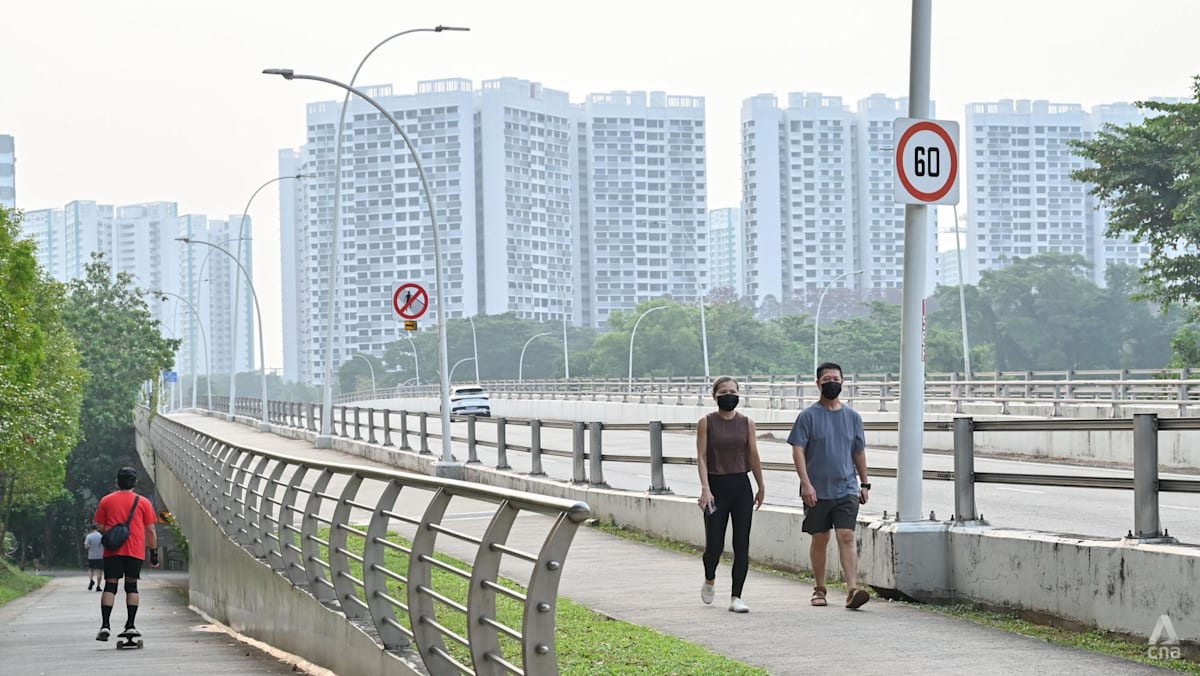
People wearing masks walk along Sengkang East Way, near Sengkang Riverside Park, against a hazy skyline on Sep 19, 2026. (Photo: CNA/Alyssa Tan)
This audio is generated by an AI tool.
SINGAPORE: Singapore’s air quality hit new highs last week, with the Pollutant Standards Index (PSI) reaching 154 in the central region .
The hazy conditions have prompted schools and companies to limit the outdoor exposure of students and workers.
But why can one part of Singapore experience worse haze than another? And why can the air sometimes smell smoky even when pollution readings are relatively low?
WIND DIRECTION AND SPEED MATTER
Prevailing winds can carry airborne particles hundreds of kilometres from their source.
Assistant Professor Wang Jingyu, a climate and environment researcher at Nanyang Technological University’s National Institute of Education, said wind direction affects whether smoke is carried towards Singapore, while wind speed affects how quickly it gets here.
Using southeasterly winds of about 5 metres per second as an example, he said smoke from Central Kalimantan, about 1,000km from Singapore, could take up to three days to arrive.
CNA Games Guess Word Crack the word, one row at a time Buzzword Create words using the given letters Mini Sudoku Tiny puzzle, mighty brain teaser Mini Crossword Small grid, big challenge Word Search Spot as many words as you can Show More Show Less
A drone view of a house while smoke rises from a wildfire burning in Palangka Raya, Central Kalimantan province, Indonesia, August 14, 2026. (Photo: REUTERS/Ajeng Dinar Ulfiana)
“If the fire location is directly located at the upwind side, and the wind speed is strong, smoke can arrive faster,” he said.
The travel time varies depending on where the smoke originates.
Professor Rajasekhar Balasubramanian from the Department of Civil and Environmental Engineering at the National University of Singapore’s College of Design and Engineering said smoke from Sumatra could take about one to two days to reach Singapore, assuming wind speeds of about 3m to 4m per second.
WHY HAZE CAN BE WORSE IN SOME PARTS OF SINGAPORE
Once haze reaches Singapore, it does not necessarily spread evenly across the island.
Local winds affect where pollutants move, while Singapore’s urban landscape can also influence how easily polluted air disperses.
“Certain parts of Singapore could be more exposed to the polluted air coming from the affected areas,” said Prof Balasubramanian.
“But at the same time, we also have tall buildings and other aspects of the urban infrastructure that tend to slow down the movement of air.”
As a result, pollution can become trapped to some extent, worsening air quality in a particular area, he said.
Haze situation from Tanjong Pagar Plaza overlooking Spottiswoode Park HDB on Sep 14, 2026. (Photo: CNA/Raydza Rahman)
Asst Prof Wang said the higher haze readings in central Singapore could also be influenced by its terrain and the urban heat island effect.
The central region has some elevated terrain, including Bukit Timah Hill, which he said can partially block airflow near the ground and cause haze particles to remain in the area for longer instead of dispersing.
The urban heat island effect can also play a role. Buildings and other surfaces can absorb heat and release it back into the air. This warms the air near the ground, causing some of it to rise and helping smoke particles remain in the air for longer, Asst Prof Wang said.
WHAT DOES HAZE CONTAIN?
Haze is not a single pollutant, but a mixture of particles and gases.
Small particles measuring 2.5 micrometres or less are known as PM2.5, while particulate matter measuring up to 10 micrometres is known as PM10.
Asst Prof Wang said PM2.5 is a major component of transboundary haze because the particles are small enough to remain suspended in the air for days and travel long distances.
But the burnt smell associated with haze does not necessarily come from PM2.5.
Haze can also contain organic compounds and gases produced by burning vegetation and peat. These can produce an odour even when PM2.5 levels are relatively low.
Firefighters spraying water at a wildfire in Ogan Ilir, South Sumatra, Indonesia, on Sep 11, 2026. (Photo: CNA/Wisnu Agung Prasetyo)
Prof Balasubramanian said gases travel faster than larger particles.
“The odour or smell tends to diffuse or travel relatively faster, as compared to particles that are larger in size,” he said.
“So the rate of movement or the speed with which the particles migrate from affected areas into Singapore is relatively lower as compared to gases.
“And hence, you smell the air first before you see a spike in PM 2.5 concentrations.”
Prof Balasubramanian added that fine particles suspended in the air can absorb or scatter sunlight, reducing visibility.
A man wearing a mask cycles in the haze around the Bishan-Ang Mo Kio area in the late afternoon, Sep 14, 2026. (Photo: CNA/Alyssa Tan)
WHAT DOES THE PSI ACTUALLY MEASURE?
PSI indicates the level of air pollution in Singapore. It is not a direct measurement of haze.
Sensors across Singapore continuously monitor the concentration of six pollutants: PM2.5, PM10, sulphur dioxide, carbon monoxide, ozone and nitrogen dioxide.
A sub-index score is calculated for each pollutant, and the highest of these determines the overall PSI.
The National Environment Agency (NEA) says the PSI is calculated using the concentrations of these six pollutants over a rolling 24-hour period.
Because of this, it takes time for the PSI to reflect sudden changes in air quality.
For a more current picture, the one-hour PM2.5 reading measures the average concentration of these fine particles over the previous hour.
For immediate outdoor activities, NEA advises referring to the one-hour PM2.5 reading.
For activities planned for the following day, it recommends referring to the 24-hour PSI forecast.
Want an issue or topic explained? Email us at digitalnews [at] mediacorp.com.sg . Your question might become a story on our site.
Get our pick of top stories and thought-provoking articles in your inbox
Stay updated with notifications for breaking news and our best stories
Join our channel for the top reads for the day on your preferred chat app
数百公里外的火灾产生的烟雾可能需要数天时间才能抵达新加坡,风向会影响烟雾的传播和扩散。亚洲新闻台(CNA)探讨了空气质量的测量方法,以及人们的所见所闻为何与污染读数并不总是相符。
2026年9月19日,戴着口罩的人们走在盛港东路,靠近盛港河滨公园,背景是朦胧的天空。(图片:CNA/Alyssa Tan)
这段音频由人工智能工具生成。
新加坡:上周新加坡空气质量创下新高,中部地区的污染物标准指数(PSI)达到 154。
雾霾天气促使学校和公司限制学生和员工的户外活动。
但为什么新加坡不同地区的雾霾情况会有差异?为什么即使污染指数相对较低,空气中有时也会散发出烟味?
风向和风速都很重要
盛行风可以将空气中的颗粒物从其源头吹送到数百公里之外。
南洋理工大学国立教育学院气候与环境研究员王景宇助理教授表示,风向会影响烟雾是否会被吹向新加坡,而风速会影响烟雾到达新加坡的速度。
他以每秒约 5 米的东南风为例,表示来自距离新加坡约 1000 公里的中加里曼丹的烟雾可能需要长达三天的时间才能到达。
CNA游戏 猜词游戏 逐行破解单词 流行词游戏 用给定的字母组成单词 迷你数独 小小谜题,挑战你的大脑 迷你填字游戏 小方格,大挑战 单词搜索 尽可能多地找出单词 显示更多 显示更少
2026 年 8 月 14 日,无人机拍摄印度尼西亚中加里曼丹省帕朗卡拉亚野火升起的房屋景象。(照片:REUTERS/Ajeng Dinar Ulfiana)
他说:“如果火灾地点正好位于上风侧,而且风速很大,那么烟雾就会更快到达。”
烟雾扩散所需时间因烟雾来源地而异。
新加坡国立大学设计与工程学院土木与环境工程系教授拉贾塞卡尔·巴拉苏布拉马尼亚表示,假设风速为每秒 3 米至 4 米,来自苏门答腊的烟雾可能需要一到两天才能到达新加坡。
为什么新加坡某些地区的雾霾情况会更严重?
雾霾一旦抵达新加坡,并不一定会均匀地扩散到整个岛屿。
局部风向会影响污染物的扩散方向,而新加坡的城市景观也会影响污染空气的扩散难易程度。
巴拉苏布拉马尼亚教授表示:“新加坡的某些地区可能更容易受到来自受影响地区的污染空气的影响。”
“但与此同时,我们也有高楼大厦和其他城市基础设施,这些都会减缓空气流动。”
他说,这样一来,污染物就会在一定程度上滞留在空气中,导致特定区域的空气质量恶化。
2026年9月14日,从丹戎巴葛广场俯瞰斯波蒂斯伍德公园组屋,可见雾霾情况。(图片:CNA/Raydza Rahman)
王助理教授表示,新加坡中部地区较高的雾霾读数也可能受到其地形和城市热岛效应的影响。
中部地区有一些地势较高的地形,包括武吉知马山,他说,这些地形会部分阻挡地面附近的空气流动,导致雾霾颗粒在该地区停留更长时间,而不是消散。
城市热岛效应也可能起到一定作用。建筑物和其他地表会吸收热量并将其释放回空气中。这会使近地面空气升温,导致部分空气上升,从而使烟雾颗粒在空气中停留更长时间,王助理教授说道。
HAZE 含有哪些成分?
雾霾不是单一污染物,而是颗粒物和气体的混合物。
直径小于等于 2.5 微米的颗粒物称为 PM2.5,直径小于等于 10 微米的颗粒物称为 PM10。
王助理教授表示,PM2.5是跨境雾霾的主要成分,因为这些颗粒足够小,可以在空气中悬浮数天并传播很远的距离。
但是,与雾霾相关的烧焦气味并不一定来自 PM2.5。
雾霾中也可能含有燃烧植被和泥炭产生的有机化合物和气体。即使PM2.5浓度相对较低,这些物质也会产生气味。
2026 年 9 月 11 日,消防员在印度尼西亚南苏门答腊岛奥甘伊利尔的野火中喷水。(照片:CNA/Wisnu Agung Prasetyo)
巴拉苏布拉马尼亚教授表示,气体的运动速度比较大的颗粒更快。
他说:“与体积较大的颗粒相比,这种气味或气味扩散或传播的速度相对较快。”
“因此,与气体相比,颗粒物从受影响地区迁移到新加坡的速度或移动速率相对较低。
“因此,你会先闻到空气中的异味,然后才会看到 PM2.5 浓度飙升。”
巴拉苏布拉马尼亚教授补充说,空气中悬浮的细颗粒物会吸收或散射阳光,降低能见度。
2026年9月14日下午,一名戴着口罩的男子在碧山-宏茂桥一带的雾霾中骑自行车。(图片:CNA/Alyssa Tan)
PSI 实际测量的是什么?
PSI指数表明新加坡的空气污染程度,但它并非雾霾的直接测量指标。
新加坡各地的传感器持续监测六种污染物的浓度:PM2.5、PM10、二氧化硫、一氧化碳、臭氧和二氧化氮。
计算每种污染物的子指数得分,其中最高分决定了总体 PSI 值。
国家环境局 (NEA) 表示,PSI 是根据这六种污染物在 24 小时滚动周期内的浓度计算得出的。
正因如此,PSI 需要一段时间才能反映空气质量的突然变化。
为了更准确地了解当前情况,一小时 PM2.5 读数测量的是过去一小时内这些细颗粒物的平均浓度。
对于即将进行的户外活动,新加坡国家环境局建议参考一小时 PM2.5 读数。
对于第二天的活动计划,建议参考 24 小时 PSI 预报。
想了解某个问题或话题?请发送邮件至 digitalnews [at] mediacorp.com.sg。您的提问可能会成为我们网站上的报道内容。
订阅我们的邮件,即可获取精选热点新闻和引人深思的文章。
订阅通知,第一时间获取突发新闻和精彩报道。
加入我们的频道,即可在您常用的聊天应用上获取当日热门文章。