North Korea Tests New Hwasong-11Ma Hypersonic Missile朝鲜试射新型火星-11Ma高超音速导弹
The new missile and launcher was shown in action, but just how close it is to being anywhere near a usable weapon is highly questionable. The new missile and launcher is shown in action, but there is conflicting range data surrounding the test.
Published Sep 22, 2026 2:44 PM EDT
North Korean State Media
North Korea has released imagery of what appears to be a flight test of an updated version of its Hwasong-11Ma hypersonic missile, nearly a year after the weapon first appeared publicly at a military technology exhibition in Pyongyang.
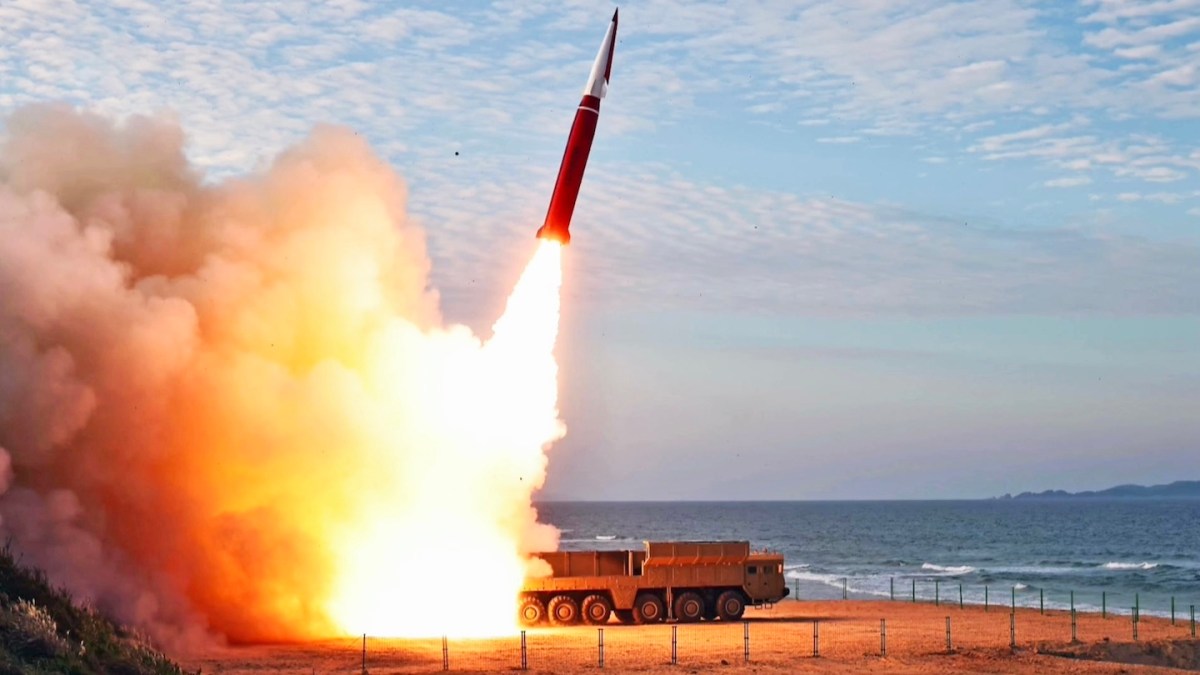
Launch of a Hwasong-11Ma-1 missile from the test facility in Anbyon County, south of Wonsan. North Korean State Media
The September 20 test involved a short-range ballistic missile (SRBM) booster fitted with a hypersonic glide vehicle , according to photographs released by North Korean state media. A display screen visible in the imagery identifies the weapon as the Hwasongpho-11Ma-1, or Hwasong-11E-1 in the equivalent English-language designation.
The test was conducted from the east coast near Anbyon County, south of Wonsan, an area North Korea has repeatedly used for missile testing. The launch site allows missiles to be fired eastward over the Sea of Japan, providing a relatively controlled area for testing short- and medium-range systems.
Another two views of the launch of the Hwasong-11Ma-1 missile. North Korean State Media
South Korean and Japanese authorities say they detected two launches on September 20, with the first occurring at approximately 3:00 p.m. local time and the second several hours later.
North Korean photographs show the missile being launched from a coastal location, with Kim Jong Un and senior missile officials observing the test. Kim’s daughter, Kim Ju Ae, also appears in the imagery.
Kim Jong Un and Kim Ju Ae monitor the progress of the Hwasong-11Ma-1 test. North Korean State Media
North Korea displayed a mock-up of what it called the Hwasong-11Ma at its Defense Development-2025 exhibition in October 2025. The design uses the basic architecture of the Hwasong-11 family, known in the West as the KN-23 family , but substitutes a distinctive glide wedge-shaped vehicle for the conventional warhead arrangement.
The Hwasong-11Ma, among other weapons, on display at the weapons exhibition in Pyongyang in October 202. North Korean State Media
North Korea claimed another hypersonic missile test that same month, but did not release launch imagery clearly connecting that test to the Hwasong-11Ma. The missile was subsequently shown again during a military parade in Pyongyang.
Hwasong-11Ma missiles on five-axle TELs at last October’s military parade in Pyongyang. North Korean State Media
The latest “-1” designation suggests an iterative evolution of the Hwasong-11Ma, although Pyongyang has not explained what modifications it represents.
Based on the imagery, the new configuration also includes a modified launcher, with the missile carried on a six-axle transporter-erector-launcher (TEL). When the Hwasong-11Ma was first shown, it was mounted on a five-axle TEL. The latest vehicle also appears to incorporate modified retractable covers around the missile.
It remains unclear whether the new TEL represents a standardized operational vehicle or a test configuration.
Preliminary illustration of the new launch vehicle for North Korea's hypersonic missiles. pic.twitter.com/dZ31LA1cbn — Tal Inbar (@inbarspace) September 22, 2026
Preliminary illustration of the new launch vehicle for North Korea's hypersonic missiles. pic.twitter.com/dZ31LA1cbn
As with previous North Korean weapons announcements, the country’s state media claims need to be treated very cautiously. Pyongyang has a long record of publicizing weapons systems and test results that cannot be independently verified, while some of its purported hypersonic tests have left outside analysts unable to determine whether the advertised maneuvering performance was actually demonstrated.
Perhaps the most revealing test-related imagery comes from a display screen photographed at the launch site.
Kim Jong Un and his daughter can be seen watching the screen, which shows the apparent flight trajectory of the Hwasong-11Ma-1. The displayed path initially follows a ballistic trajectory before descending and then performing a pull-up maneuver, regaining altitude before continuing toward the target area.
That type of trajectory is consistent with the basic concept behind a hypersonic glide vehicle. The booster provides the initial velocity and altitude, after which the unpowered glide body follows a relatively shallow, atmospheric flight path at hypersonic speeds, while maneuvering rather than following a simple ballistic path.
The graphic is useful for understanding what Pyongyang says the weapon is designed to do, but it does not independently demonstrate that the missile actually followed the depicted trajectory.
The flight data visible on the display provides some unusually specific figures.
Enhancing the original image released by North Korea allows for an excellent view of the HS-11Ma hypersonic glide missile trajectory, providing altitude and speed data. Note: Slight inaccuracies in the numbers may occur due to the use of AI tools. pic.twitter.com/M4LkfF5VYu — Tal Inbar (@inbarspace) September 22, 2026
Enhancing the original image released by North Korea allows for an excellent view of the HS-11Ma hypersonic glide missile trajectory, providing altitude and speed data. Note: Slight inaccuracies in the numbers may occur due to the use of AI tools. pic.twitter.com/M4LkfF5VYu
According to the North Korean imagery, the missile traveled 908.2 kilometers (564.3 miles), reached an altitude of 35.8 kilometers (22.2 miles), and remained in flight for approximately 445 seconds, or 7.4 minutes.
The display gives a velocity of 2,146 meters per second, equivalent to roughly 4,800 mph. That is hypersonic velocity in the aerodynamic sense, but speed alone is not what makes a hypersonic glide weapon particularly challenging to defend against. More consequential parameters include sustained controlled flight, maneuverability, guidance, and accuracy.
Other portions of the display appear to show additional points along the flight, including different times, altitudes, and speeds. None of these figures have been independently verified.
The TEL raises one of its two Hwasong-11Ma-1 missiles into the launch position. North Korean State Media
The claimed range is particularly noteworthy because it does not match the publicly reported tracking data from South Korea and Japan.
South Korea’s Joint Chiefs of Staff said North Korea launched two SRBMs from the Wonsan area on September 20. The missiles were assessed to have traveled approximately 450 and 600 kilometers, respectively.
Japan similarly reported two launches, assessing the first at approximately 440 kilometers and the second at approximately 590 kilometers, with maximum altitudes of roughly 60 and 70 kilometers.
Those figures are substantially different from the 908.2-kilometer distance shown on North Korea’s display.
The Hwasong-11Ma-1 climbs after launch. North Korean State Media
The discrepancy does not necessarily establish that either side’s data are incorrect. The North Korean figure could represent a different measurement of the flight path, or could correspond to a portion of the test that was not reflected in the public South Korean and Japanese assessments. It is also possible, if not highly probable, that Pyongyang selectively presented or altered the data.
South Korean analysts have already raised questions about the unusually long distance displayed by North Korea. Yonhap reported that experts suggested Pyongyang may have altered the figure to portray the test as more successful.
Regardless of the range actually achieved in this test, the Hwasong-11Ma/Ma-1 is significant because it represents an attempt to combine a relatively compact SRBM with a maneuvering hypersonic glide vehicle.
The underlying Hwasong-11 family is a well-established North Korean missile design. In its KN-23 configuration , members of the family have also been used by Russia against Ukraine . By placing a glide vehicle on this type of booster, Pyongyang could potentially give a regional strike weapon a flight profile substantially different from that of a conventional ballistic missile. The Hwasong-11Ma/Ma-1 also uses a solid-fuel booster, allowing for faster launches than earlier liquid-fuel designs .
The original North Korean Hwasong-11 short-range ballistic missile. North Korean State Media
In principle, the Hwasong-11Ma/Ma-1 could give North Korea an additional hypersonic strike option against more heavily defended targets in South Korea. Having road-mobile TELs would also provide greater operational flexibility despite their relatively limited range, while making it more difficult for adversaries to locate and track the launchers.
A genuine boost-glide weapon creates significant challenges for defending forces since the sheer speed of the weapon bypasses most air defenses. Its trajectory can also become less predictable after the boost phase. Maneuvering at lower altitudes could also reduce the time available to detect, track, and engage the weapon.
A close-up look at the Hwasong-11Ma’s boost-glide-vehicle. North Korean State Media
However, the available imagery does not establish the extent of the vehicle’s maneuverability, its ability to maintain controlled flight, its accuracy, or the reliability of the complete missile system.
North Korea has made similar claims about its hypersonic weapons in the past.
Pyongyang says it has flight-tested multiple hypersonic boost-glide vehicle designs since at least 2021, but there continue to be questions about what degree of actual capability the country has achieved in this regard. Viable wedge-shaped boost-glide vehicles have historically been extremely difficult to design and then bring to an operational state.
The challenge is not simply reaching hypersonic speed. A weapon has to sustain controlled flight and maneuverability under extreme thermal loads, while also overcoming demanding materials-science, guidance, and navigation requirements. The terminal phase is harder still. Accurately finding and striking a moving target, particularly a ship, requires a highly capable seeker and guidance system. Integrating a nuclear warhead introduces another layer of engineering and weapons-design challenges.
Those demands have made hypersonic weapons a major technological challenge for the United States and other major powers. China is currently widely regarded as the leading country in deploying and developing operational hypersonic systems, although important questions remain about the capabilities and maturity of individual weapons.
Pyongyang said it first flight-tested a wedge-shaped hypersonic glide vehicle in 2021 aboard the liquid-fuel Hwasong-8, before pairing a similar-looking vehicle with the solid-fueled Hwasong-16B intermediate-range ballistic missile (IRBM) in 2024.
VIDEO: Korean Central Television (KCTV) broadcasted footage of North Korea successfully testing the new "Hwasong-16B" hypersonic intermediate-range ballistic missile (IRBM) on Tuesday. pic.twitter.com/VNdhLAeyyK — NK NEWS (@nknewsorg) April 3, 2024
VIDEO: Korean Central Television (KCTV) broadcasted footage of North Korea successfully testing the new "Hwasong-16B" hypersonic intermediate-range ballistic missile (IRBM) on Tuesday. pic.twitter.com/VNdhLAeyyK
In its coverage of the latest test, North Korean state media initially avoided identifying the weapon, describing the event as a successful trial of a “new-type weapon” that it said was significant for the rapid development of weapons technology.
Kim said the development would give adversaries an “incurable headache” and deliver what he described as a “cruel and unavoidable blow.”
Tal Inbar, the head of the Space and UAV Research Center at Israel’s Fisher Institute for Air and Space Strategic Studies identifies the Hwasong-11Ma/Ma-1 as a “very significant weapon, bringing hypersonics to the operational/tactical arena and [posing] a challenge to … air and missile defense systems.”
Whatever the exact achievements of the test, the imagery points to continued development of a weapon North Korea first publicly displayed nearly a year ago. The appearance of a new, six-axle TEL, a potentially modified missile, combined with the apparent flight test, suggests that the Hwasong-11Ma/Ma-1 program has progressed since its initial public unveiling.
What remains uncertain is how much of that progress represents a genuine improvement in operational capability.
The latest test therefore provides another indication of the resources and attention Pyongyang is devoting to hypersonic weapons, but the available evidence is still insufficient to determine how closely the Hwasong-11Ma-1’s actual performance matches the capabilities depicted by North Korean state media.
Contact the author: thomas@thewarzone.com
Comments couldn’t be loaded. Please refresh the page.
发布于美国东部时间2026年9月22日下午2:44
朝鲜官方媒体
朝鲜公布了疑似其“火星-11Ma”高超音速导弹升级版的飞行测试图片。该武器在平壤举行的军事技术展览会上首次公开亮相已近一年。
朝鲜官方媒体报道,一枚“火星-11Ma-1”导弹从位于元山以南安边郡的试验场发射升空。
根据朝鲜官方媒体发布的照片,9月20日的试验使用了搭载高超音速滑翔飞行器的短程弹道导弹(SRBM)助推器。照片中可见的显示屏显示,该武器的型号为“火星-11Ma-1”,或英文对应名称“火星-11E-1”。
此次试验在朝鲜东海岸元山以南安边郡附近进行,该地区曾多次用于导弹试验。该发射场允许导弹向东射越过日本海,为测试短程和中程导弹系统提供了一个相对可控的区域。
朝鲜官方媒体提供的另外两张火星-11Ma-1导弹发射画面。
韩国和日本当局表示,他们在9月20日探测到两次发射,第一次发生在当地时间下午3点左右,第二次发生在几个小时之后。
朝鲜方面发布的照片显示,导弹从沿海地区发射,金正恩和高级导弹官员在现场观摩了试射。金正恩的女儿金柱爱也出现在照片中。
金正恩和金珠爱监督 Hwasong-11Ma-1 测试的进展。朝鲜官方媒体
朝鲜在2025年10月举行的“国防发展-2025”展览会上展示了一款名为“火星-11Ma”的导弹模型。该导弹采用“火星-11”系列(西方称之为KN-23系列)的基本架构,但用独特的滑翔楔形飞行器取代了传统的弹头布置。
2020年10月,在平壤举行的武器展览会上,展出了包括火星-11Ma在内的多种武器。(朝鲜官方媒体)
朝鲜声称当月进行了另一次高超音速导弹试验,但并未公布能明确证明该试验与“火星-11Ma”导弹相关的发射图像。随后,该导弹在平壤的一次阅兵式上再次亮相。
去年10月平壤阅兵式上,五轴运输发射车上展示了火星-11Ma导弹。(朝鲜官方媒体)
最新的“-1”编号表明火星-11Ma 是火星火星-11Ma 的迭代演变,尽管平壤方面尚未解释它代表了哪些修改。
根据图片显示,新配置还包括一个改进型发射车,导弹由六轴运输起竖发射车(TEL)承载。此前,火星-11Ma导弹首次亮相时,搭载的是五轴TEL。最新的发射车似乎还采用了改进型的导弹可伸缩防护罩。
目前尚不清楚新型TEL是标准化运行车辆还是测试配置。
朝鲜新型高超音速导弹运载火箭的初步示意图。pic.twitter.com/dZ31LA1cbn — Tal Inbar (@inbarspace) September 22, 2026
朝鲜新型高超音速导弹运载火箭的初步示意图。pic.twitter.com/dZ31LA1cbn
与朝鲜以往的武器公告一样,其官方媒体的说法需要谨慎对待。平壤长期以来一直公布一些无法独立核实的武器系统和测试结果,而其一些所谓的超音速试验也让外界分析人士无法确定其宣称的机动性能是否真的得到验证。
或许最能说明测试问题的图像来自发射现场拍摄的显示屏。
可以看到金正恩和他的女儿正在观看屏幕,屏幕上显示了火星-11Ma-1导弹的飞行轨迹。显示的路径最初遵循弹道轨迹,然后下降,接着进行拉起机动,重新获得高度,然后继续向目标区域飞去。
这种飞行轨迹符合高超音速滑翔飞行器的基本概念。助推器提供初始速度和高度,之后无动力滑翔体以高超音速沿相对平缓的大气层飞行,并进行机动飞行,而非遵循简单的弹道轨迹。
该图有助于理解平壤方面所说的该武器的设计用途,但它本身并不能证明导弹实际上遵循了图中所示的轨迹。
显示屏上显示的飞行数据提供了一些异常具体的数字。
对朝鲜发布的原始图像进行增强处理后,可以清晰地看到HS-11Ma高超音速滑翔导弹的飞行轨迹,并获取其高度和速度数据。注:由于使用了人工智能工具,数据可能存在轻微误差。pic.twitter.com/M4LkfF5VYu — Tal Inbar (@inbarspace) September 22, 2026
对朝鲜发布的原始图像进行增强处理后,可以清晰地看到HS-11Ma高超音速滑翔导弹的飞行轨迹,并获取其高度和速度数据。注:由于使用了人工智能工具,数据可能存在轻微误差。pic.twitter.com/M4LkfF5VYu
根据朝鲜提供的图像显示,该导弹飞行了 908.2 公里(564.3 英里),达到了 35.8 公里(22.2 英里)的高度,飞行了大约 445 秒,即 7.4 分钟。
显示屏显示速度为每秒2146米,约合每小时4800英里。从空气动力学角度来看,这属于高超音速,但速度本身并非高超音速滑翔武器难以防御的关键所在。更重要的参数包括持续可控飞行、机动性、制导能力和精度。
显示屏的其他部分似乎显示了飞行过程中的其他点,包括不同的时间、高度和速度。这些数据均未经独立验证。
运输起降车将两枚“火星-11Ma-1”导弹中的一枚升至发射位置。朝鲜官方媒体
所宣称的航程尤其值得注意,因为它与韩国和日本公开报道的跟踪数据不符。
韩国联合参谋本部表示,朝鲜于9月20日从元山地区发射了两枚短程弹道导弹。据评估,这两枚导弹的飞行距离分别约为450公里和600公里。
日本也报告了两次发射,评估结果显示第一次发射高度约为 440 公里,第二次发射高度约为 590 公里,最大高度分别为 60 公里和 70 公里。
这些数字与朝鲜显示屏上显示的 908.2 公里距离有很大不同。
火星-11Ma-1火箭发射后爬升。朝鲜官方媒体
这一差异并不一定意味着任何一方的数据有误。朝鲜提供的数据可能代表了对飞行路径的不同测量结果,或者可能对应于韩国和日本公开评估中未反映的试验部分。此外,平壤方面选择性地呈现或篡改数据也并非不可能,甚至极有可能。
韩国分析人士已对朝鲜展示的异常远距离发射结果提出质疑。韩联社报道称,专家认为平壤可能篡改了数据,以使试验看起来更加成功。
无论此次试验实际达到的射程如何,火星-11Ma/Ma-1 导弹都意义重大,因为它代表着将相对紧凑的短程弹道导弹与机动高超音速滑翔飞行器相结合的尝试。
“火星-11”系列导弹是朝鲜成熟的导弹设计。该系列导弹的KN-23型也曾被俄罗斯用于对付乌克兰。通过在这种助推器上加装滑翔飞行器,平壤有可能使区域打击武器的飞行轨迹与传统弹道导弹截然不同。“火星-11Ma/Ma-1”还采用了固体燃料助推器,使其发射速度比早期的液体燃料设计更快。
朝鲜原版“火星-11”短程弹道导弹。朝鲜官方媒体
理论上,火星-11Ma/Ma-1型高超音速导弹可以为朝鲜提供一种额外的打击韩国境内防御严密目标的手段。尽管射程相对有限,但公路机动发射车(TEL)的出现将提供更大的作战灵活性,同时也会使敌方更难定位和追踪发射车。
真正的助推滑翔武器会给防御部队带来巨大挑战,因为其极高的速度足以绕过大多数防空系统。此外,在助推阶段之后,其飞行轨迹也会变得更加难以预测。低空机动也会缩短敌方探测、跟踪和拦截该武器的时间。
近距离观察“火星-11Ma”火箭的助推滑翔飞行器。朝鲜官方媒体
然而,现有图像无法确定该飞行器的机动性、保持受控飞行的能力、精度或整个导弹系统的可靠性。
朝鲜过去也曾就其高超音速武器发表过类似声明。
平壤方面称,自2021年以来,已对多种高超音速助推滑翔飞行器设计进行了飞行测试,但外界仍对其在这方面的实际能力水平存有疑问。历史上,设计并投入使用楔形助推滑翔飞行器一直极其困难。
挑战不仅仅在于达到高超音速。武器必须在极端热负荷下保持可控飞行和机动性,同时还要克服材料科学、制导和导航方面的严苛要求。末段攻击难度更大。精确搜索并打击移动目标,特别是舰船,需要性能卓越的寻的器和制导系统。而集成核弹头则带来了另一层工程和武器设计方面的挑战。
这些需求使得高超音速武器成为美国和其他主要大国面临的一项重大技术挑战。目前,中国被广泛认为是部署和研发作战型高超音速系统的领先国家,但关于具体武器的性能和成熟度仍存在一些重要问题。
平壤方面表示,2021年,朝鲜首次在液态燃料“火星-8”导弹上试飞了楔形高超音速滑翔飞行器;2024年,朝鲜又将外形相似的飞行器与固态燃料“火星-16B”中程弹道导弹(IRBM)配对。
视频:朝鲜中央电视台(KCTV)周二播放了朝鲜成功试射新型“火星-16B”高超音速中程弹道导弹(IRBM)的画面。pic.twitter.com/VNdhLAeyyK — NK NEWS (@nknewsorg) April 3, 2024
视频:朝鲜中央电视台(KCTV)周二播放了朝鲜成功试射新型“火星-16B”高超音速中程弹道导弹(IRBM)的画面。pic.twitter.com/VNdhLAeyyK
在报道最新一次试验时,朝鲜官方媒体最初避免透露武器的具体名称,而是将此次事件描述为“新型武器”的成功试验,并称其对武器技术的快速发展具有重要意义。
金正恩表示,这一事态发展将给对手带来“无法治愈的头痛”,并带来他所说的“残酷且不可避免的打击”。
以色列费舍尔航空航天战略研究所空间与无人机研究中心主任塔尔·因巴尔认为,火星-11Ma/Ma-1 是一种“非常重要的武器,它将高超音速技术带入作战/战术领域,并对……防空和导弹防御系统构成挑战”。
无论此次试验的具体成果如何,图像都表明朝鲜正在继续研发其近一年前首次公开展示的武器。新型六轴发射车(TEL)的出现、疑似改进型导弹的亮相,以及此次疑似飞行试验,都表明“火星-11Ma/Ma-1”项目自首次公开亮相以来已取得进展。
目前尚不确定的是,这些进展中有多少真正代表了作战能力的提升。
因此,最新的测试再次表明平壤正在投入资源和精力研发高超音速武器,但现有证据仍然不足以确定“火星-11Ma-1”的实际性能与朝鲜官方媒体所描述的能力有多大程度的吻合。
联系作者:thomas@thewarzone.com
评论加载失败,请刷新页面。