Terrorism remains a major concern, Singapore to enter next phase of SGSecure movement: PM Wong黄循财总理:恐怖主义仍然是新加坡面临的主要问题,新加坡将进入“安全新加坡”(SGSecure)运动的下一阶段。
Marking the 10th anniversary of the SGSecure movement, Prime Minister Lawrence Wong warned Singaporeans against complacency and taking the country’s peace and security for granted.
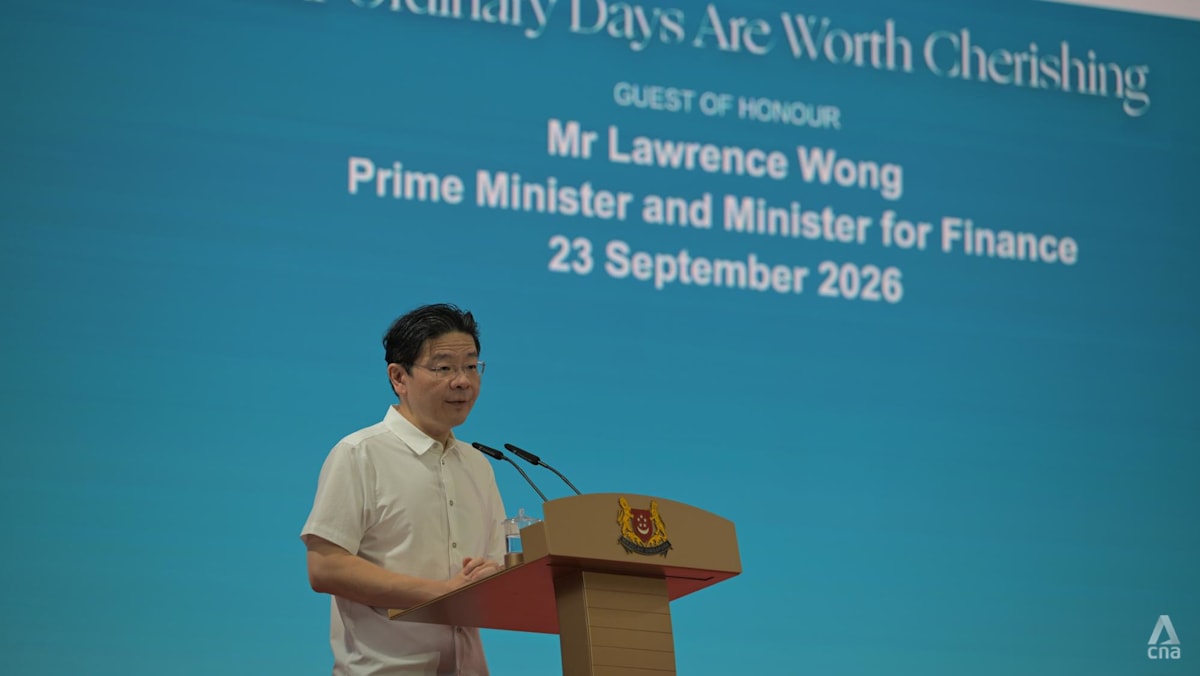
Marking the 10th anniversary of the SGSecure movement, Prime Minister Lawrence Wong warned Singaporeans against complacency and taking the country’s peace and security for granted.
Prime Minister Lawrence Wong speaking at Our Tampines Hub on Sep 23, 2026. (Photo: CNA/Lim Li Ting)
This audio is generated by an AI tool.
SINGAPORE: Whenever Prime Minister Lawrence Wong is briefed about cases of radicalised individuals whose plans to carry out public attacks are thwarted, his first reaction is relief.
But terrorism is still a major concern, and the threats facing Singapore are now broader, Mr Wong said on Wednesday (Sep 23).
“So far we have been fortunate. Our security agencies have worked tirelessly behind the scenes. They have detected individuals who posed a danger, disrupted plots, and intervened before anyone was harmed,” he said at an event to mark the 10th anniversary of SGSecure.
“But I also worry. Because there were very close calls in some cases. We managed to intervene in time before anyone was hurt. But things could have turned out very differently,” he added.
CNA Games Guess Word Crack the word, one row at a time Buzzword Create words using the given letters Mini Sudoku Tiny puzzle, mighty brain teaser Mini Crossword Small grid, big challenge Word Search Spot as many words as you can Show More Show Less Launched in September 2016, SGSecure is the national movement to prepare Singaporeans to respond in the event of a terrorist attack. Mr Wong said that “we cannot predict exactly where the danger will come from, or when it might strike”. Speaking at the event at Our Tampines Hub, he acknowledged the progress Singapore has made, but emphasised that there is more to be done. “In this next phase of SGSecure, we will step up our efforts,” he said. “We will widen our outreach to neighbourhoods, schools and workplaces. We will mobilise more volunteer advocates to reach out to the people around them, and encourage more Singaporeans to do their part.” He also told the 200 partners, volunteers, community leaders and officials at the event that they play a critical role in the SGSecure efforts. Also present were Minister for Culture, Community and Youth David Neo, Law Minister Edwin Tong, Second Minister for Home Affairs Sim Ann, Acting Minister-in-charge of Muslim Affairs Zaqy Mohamad, and Minister of State for Culture, Community and Youth Dinesh Vasu Dash.
Launched in September 2016, SGSecure is the national movement to prepare Singaporeans to respond in the event of a terrorist attack.
Mr Wong said that “we cannot predict exactly where the danger will come from, or when it might strike”.
Speaking at the event at Our Tampines Hub, he acknowledged the progress Singapore has made, but emphasised that there is more to be done.
“In this next phase of SGSecure, we will step up our efforts,” he said.
“We will widen our outreach to neighbourhoods, schools and workplaces. We will mobilise more volunteer advocates to reach out to the people around them, and encourage more Singaporeans to do their part.”
He also told the 200 partners, volunteers, community leaders and officials at the event that they play a critical role in the SGSecure efforts.
Also present were Minister for Culture, Community and Youth David Neo, Law Minister Edwin Tong, Second Minister for Home Affairs Sim Ann, Acting Minister-in-charge of Muslim Affairs Zaqy Mohamad, and Minister of State for Culture, Community and Youth Dinesh Vasu Dash.
The SGSecure 10th Anniversary exhibition at Our Tampines Hub on Sep 23, 2026. (Photo: CNA/Lim Li Ting)
NEXT PHASE OF SGSECURE
The Ministry of Home Affairs (MHA) said on Wednesday that while Singaporeans generally report high threat awareness and alertness, public complacency and youth radicalisation remain key concerns.
In a press release, the ministry said it will review the content of its advisories to ensure they adequately responds to evolving threats – particularly youth radicalisation – and resonate with different audiences.
A new integrated marketing and communications campaign will be launched next year, with a new tagline and refreshed messaging, said MHA.
“We are also in the process of reviewing SGSecure’s touchpoints across different domains, to ensure that we reach Singaporeans, particularly those whom we have been less successful in reaching before,” it said.
For instance, the SGSecure Advocate Programme will be expanded from the pilot at institutes of higher learning to schools and the wider community, including workplaces and other organisations.
The programme aims to build a network of members who can spread SGSecure messages, such as recognising potential threats and identifying and reporting potentially radicalised individuals.
MHA is also trialling an artificial intelligence-enabled training chatbot on WhatsApp to better support SGSecure advocates, volunteers and frontline officers in their engagements with the public.
Communication efforts will spread across radio, digital and online platforms, along with more collaborations with content creators, media and community partners, said MHA.
There will also be efforts to reach vernacular-speaking audiences, preschoolers and young families, as well as new modes of digital engagement, such as through online gaming platform Roblox, said MHA.
DO NOT LET GUARD DOWN
In his speech, Mr Wong said he is concerned that after years of peace and security, Singaporeans may be starting to let their guard down.
“Perhaps we see an unattended bag in a public place, and assume someone else will deal with it. Or we notice a friend or family member becoming drawn to extremist material online, and ignore it,” he said.
“Or we see behaviour that does not seem quite right, but we hesitate to speak up because we do not want to be seen to overreact.”
While it may turn out to be nothing most of the time, that small warning sign may matter sometimes and people should not simply look away, said Mr Wong.
“To be clear, we do not want Singaporeans to live in fear, or to be suspicious of everyone around them,” he said.
“We want to continue going about our lives with confidence and peace of mind. But we can only do so only if we are alert and prepared, and take sensible action when something does not seem right.”
Mr Wong said that “no security system can give us a 100 per cent guarantee”. People cannot become complacent about safety and security in Singapore.
He noted that people are used to Singapore being safe, and go about their daily lives without constantly worrying about danger.
“Our children go to school and come back safely. We take public transport, go to work, attend religious services and community events without fear. We can walk around our neighbourhoods late at night and still feel secure,” he said.
“These things feel normal to us. But look around the world, and you realise that what we regard as normal in Singapore is really exceptional.”
This is possible only through the efforts of the country’s security agencies, and by building preparedness and trust across society, said Mr Wong.
Through SGSecure, more Singaporeans now know what to do in a crisis, with strengthened emergency preparedness in neighbourhoods, workplaces, schools, religious and community organisations, said Mr Wong.
Stronger bonds of trust have been built across Singapore’s society, he said.
“These bonds become especially important if an attack is motivated by race or religion,” he said.
Mr Wong cited the 2024 incident when the Internal Security Department detained a self-radicalised 17-year-old who was planning an attack at a neighbourhood centre in Tampines.
The Tampines GRC Community Response Roundtable quickly brought religious leaders together to denounce the plot.
“That is the resilience we need. If something does happen, our emergency and security services will of course respond quickly. But the people already at the scene will be ordinary Singaporeans.”
Noting that “an ordinary day in Singapore is nothing dramatic”, Mr Wong said it shows how people in Singapore have become accustomed to peace and security.
“We should cherish that. But we should never take that for granted,” he said.
Get our pick of top stories and thought-provoking articles in your inbox
Stay updated with notifications for breaking news and our best stories
Join our channel for the top reads for the day on your preferred chat app
为纪念“SGSecure”运动十周年,总理黄循财警告新加坡人不要自满,不要把国家的和平与安全视为理所当然。
2026年9月23日,总理黄循财在淡滨尼天地发表讲话。(图片:CNA/林丽婷)
这段音频是由人工智能工具生成的。
新加坡:每当总理黄循财听到有关激进分子企图发动公共袭击的计划被挫败的案例汇报时,他的第一反应都是松一口气。
但黄先生周三(9月23日)表示,恐怖主义仍然是一个主要问题,新加坡现在面临的威胁范围更广。
“到目前为止,我们很幸运。我们的安全机构在幕后不懈努力,他们发现了构成危险的人员,挫败了阴谋,并在任何人受到伤害之前进行了干预。”他在SGSecure成立10周年纪念活动上说道。
“但我同时也感到担忧。因为有些情况非常危急。我们及时介入,才避免了人员伤亡。但事情原本可能完全不同,”他补充道。
CNA游戏 猜词游戏 逐行破解单词 流行词游戏 用给定的字母组成单词 迷你数独 小谜题,脑力挑战 迷你填字游戏 小方格,大挑战 单词搜索 尽可能多地找出单词 显示更多 显示更少 SGSecure于2016年9月启动,是一项旨在帮助新加坡人做好应对恐怖袭击准备的全国性运动。黄先生表示,“我们无法准确预测危险会从哪里来,也无法预测它何时发生”。在淡滨尼天地举行的活动上,他肯定了新加坡取得的进展,但也强调还有更多工作要做。“在SGSecure的下一阶段,我们将加大力度,”他说。“我们将扩大宣传范围,覆盖社区、学校和工作场所。我们将动员更多志愿者倡导者与他们身边的人接触,并鼓励更多新加坡人尽自己的一份力。”他还告诉出席活动的200位合作伙伴、志愿者、社区领袖和官员,他们在SGSecure项目中发挥着至关重要的作用。文化、社区及青年部长梁振英、律政部长唐振辉、内政部第二部长沈颖、主管回教事务的署理部长扎基·穆罕默德以及文化、社区及青年部政务部长迪内什·瓦苏·达什也出席了活动。
SGSecure 于 2016 年 9 月启动,是一项旨在让新加坡人做好应对恐怖袭击准备的全国性运动。
黄先生表示,“我们无法准确预测危险会从哪里来,或者何时会发生”。
他在淡滨尼天地的活动上发表讲话时,肯定了新加坡取得的进步,但强调还有更多工作要做。
“在SGSecure的下一阶段,我们将加大力度,”他说。
“我们将扩大宣传范围,覆盖社区、学校和工作场所。我们将动员更多志愿者倡导者接触身边的人,并鼓励更多新加坡人尽自己的一份力。”
他还告诉参加活动的 200 位合作伙伴、志愿者、社区领袖和官员,他们在 SGSecure 的工作中发挥着至关重要的作用。
出席者还有文化、社区及青年部长梁振英、律政部长唐振辉、内政部第二部长沈颖、主管回教事务的代部长扎基·穆罕默德以及文化、社区及青年部政务部长迪内什·瓦苏·达什。
SGSecure 十周年纪念展览将于2026年9月23日在淡滨尼天地举行。(图片:CNA/林丽婷)
SGSECURE的下一阶段
新加坡内政部周三表示,虽然新加坡人普遍表示对威胁有较高的认识和警惕性,但公众的麻痹大意和青年激进化仍然是主要问题。
该部在一份新闻稿中表示,将审查其安全建议的内容,以确保其能够充分应对不断变化的威胁(特别是青年激进化),并引起不同受众的共鸣。
内政部表示,明年将推出一项新的整合营销传播活动,采用新的标语和更新的信息。
“我们目前也在审查 SGSecure 在不同领域的接触点,以确保我们能够触达新加坡人,特别是那些我们以前触达得不太成功的人群,”声明中写道。
例如,SGSecure 倡导者计划将从高等院校的试点扩展到中小学和更广泛的社区,包括工作场所和其他组织。
该计划旨在建立一个成员网络,以便传播 SGSecure 信息,例如识别潜在威胁以及识别和举报潜在的激进化个人。
内政部还在 WhatsApp 上试用人工智能训练聊天机器人,以更好地支持 SGSecure 的倡导者、志愿者和一线工作人员与公众互动。
MHA表示,沟通工作将扩展到广播、数字和在线平台,同时还将与内容创作者、媒体和社区合作伙伴开展更多合作。
内政部表示,还将努力接触讲地方语言的受众、学龄前儿童和年轻家庭,以及新的数字互动模式,例如通过在线游戏平台 Roblox。
不要放松警惕
黄先生在演讲中表示,他担心新加坡在经历了多年的和平与安全之后,新加坡人可能开始放松警惕。
他说:“也许我们在公共场所看到无人认领的包,就以为会有人处理。或者我们注意到朋友或家人开始接触网上的极端主义内容,却置之不理。”
“或者我们看到一些行为似乎不太对劲,但我们却犹豫不决,不敢说出来,因为我们不想被认为反应过度。”
黄先生说,虽然大多数时候可能什么事也没发生,但这种小小的警告信号有时可能很重要,人们不应该视而不见。
“需要明确的是,我们不希望新加坡人生活在恐惧之中,也不希望他们对周围的每个人都抱有怀疑,”他说。
“我们希望继续充满信心、安心地生活。但只有保持警惕、做好准备,并在发现任何异常情况时采取明智的行动,才能做到这一点。”
黄先生表示,“没有任何安保系统能够提供百分之百的保障”。在新加坡,人们不能对安全问题掉以轻心。
他指出,人们已经习惯了新加坡的安全环境,可以安心地过着日常生活,不必时刻担心危险。
“我们的孩子能安全上学,也能安全回家。我们乘坐公共交通工具,上班,参加宗教活动和社区活动,都无需担心安全问题。即使深夜在社区里散步,我们也感到很安全。”他说道。
“这些事情对我们来说很正常。但放眼世界,你会发现我们在新加坡习以为常的事情,实际上却是非常特殊的。”
黄先生表示,这只有通过国家安全机构的努力,以及在全社会建立准备和信任才能实现。
黄先生表示,通过 SGSecure,更多新加坡人现在知道在危机中该怎么做,社区、工作场所、学校、宗教和社区组织的应急准备工作也得到了加强。
他表示,新加坡社会各界已经建立了更牢固的信任关系。
他说:“如果袭击的动机是种族或宗教,那么这些联系就显得尤为重要。”
黄先生提到了2024年的一起事件,当时内部安全局拘留了一名自我激进化的17岁少年,他计划在淡滨尼的一个邻里中心发动袭击。
淡滨尼集选区社区响应圆桌会议迅速召集宗教领袖共同谴责这一阴谋。
“这正是我们需要的韧性。如果真的发生什么事,我们的应急和安全部门当然会迅速做出反应。但第一时间赶到现场的将是普通的新加坡民众。”
黄先生指出,“新加坡的普通一天没有什么戏剧性的事情发生”,这表明新加坡人民已经习惯了和平与安全。
“我们应该珍惜这一切,但我们永远不应该将其视为理所当然,”他说。
订阅我们的邮件,即可获取精选热点新闻和引人深思的文章。
订阅通知,第一时间获取突发新闻和精彩报道。
加入我们的频道,即可在您常用的聊天应用上获取当日热门文章。