Singapore's core inflation rises to nearly two-year high of 2.2% in August新加坡8月份核心通胀率升至2.2%,创近两年新高。
Consumers could face higher prices in the months ahead as energy costs remain elevated.
Consumers could face higher prices in the months ahead as energy costs remain elevated.
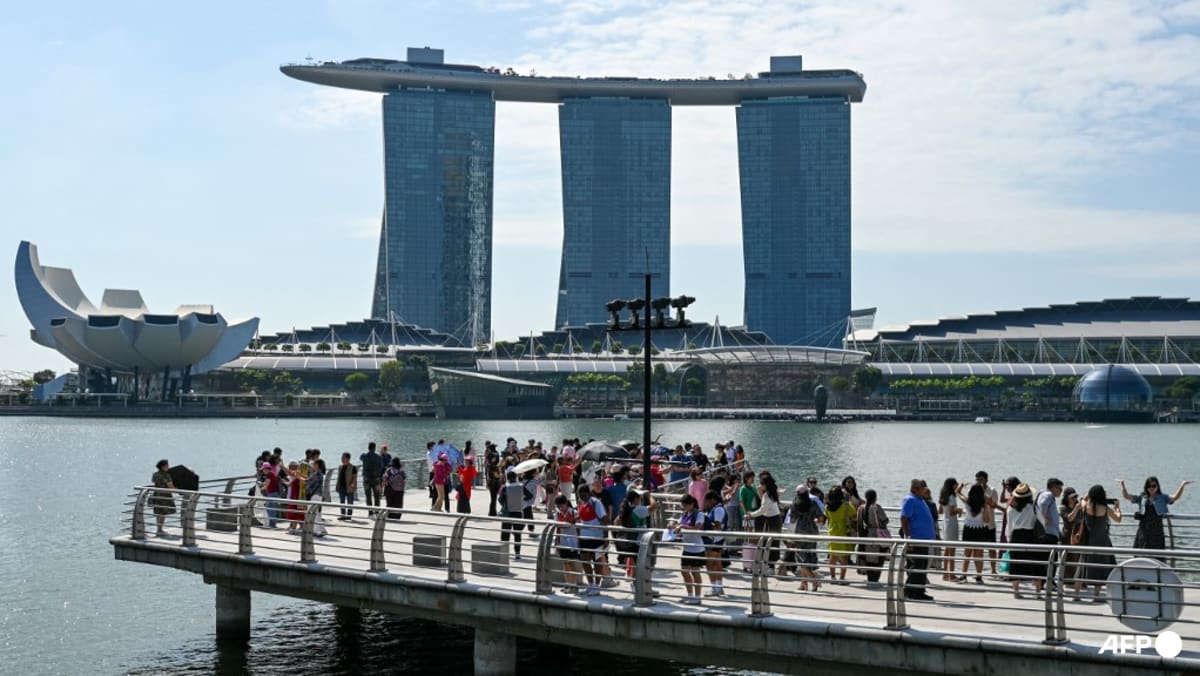
People take pictures at the waterfront in Singapore on Mar 24, 2026. (Photo: AFP/Roslan Rahman)
This audio is generated by an AI tool.
SINGAPORE: Singapore’s core inflation rose to 2.2 per cent year-on-year in August, up from 2 per cent in July , according to official data released on Wednesday (Sep 23).
The figure is the highest since September 2024.
This was driven by higher inflation for services, retail and other goods and food, the Monetary Authority of Singapore (MAS) and Ministry of Trade and Industry (MTI) said in a joint media release.
On a month-on-month basis, core prices - which exclude accommodation and private transport – increased by 0.3 per cent in August.
CNA Games Guess Word Crack the word, one row at a time Buzzword Create words using the given letters Mini Sudoku Tiny puzzle, mighty brain teaser Mini Crossword Small grid, big challenge Word Search Spot as many words as you can Show More Show Less Overall inflation, as measured by the Consumer Price Index-All Items, increased to 2.3 per cent in August from 2.2 per cent in July, due to higher core inflation which more than offset lower private transport inflation. On a month-on-month basis, overall inflation - which excludes non-consumption expenditures such as purchases of houses, shares and other financial assets and income taxes – increased by 0.6 per cent in August. SECTORS Official data released on Wednesday showed that services inflation rose to 2 per cent in August from 1.7 per cent in July as airfares and prices of point-to-point transport services increased at a faster pace. Retail and other goods inflation increased to 1.8 per cent in August from 1.4 per cent in July due to higher inflation in clothing, footwear and personal care products. Food inflation also edged up to 2.3 per cent in August from 2.2 per cent in July, reflecting higher food services inflation even as non-cooked food inflation moderated. Accommodation inflation was unchanged at 0.8 per cent, with housing rents increasing at the same pace in both August and July. Electricity and gas inflation was also unchanged at 8.7 per cent as prices rose at a similar pace in both August and July. MAS and MTI noted that the regulated electricity tariff for each quarter is set based largely on the average natural gas prices in the first two and a half months of the preceding quarter, among other factors. “The increase in the regulated electricity tariff in the third quarter of 2026 is thus the result of the spike in global energy prices over the period of April to mid-June 2026,” the authorities said. Private transport inflation eased to 7.5 per cent in August from 8 per cent in July due to a smaller increase in car prices.
Overall inflation, as measured by the Consumer Price Index-All Items, increased to 2.3 per cent in August from 2.2 per cent in July, due to higher core inflation which more than offset lower private transport inflation.
On a month-on-month basis, overall inflation - which excludes non-consumption expenditures such as purchases of houses, shares and other financial assets and income taxes – increased by 0.6 per cent in August.
Official data released on Wednesday showed that services inflation rose to 2 per cent in August from 1.7 per cent in July as airfares and prices of point-to-point transport services increased at a faster pace.
Retail and other goods inflation increased to 1.8 per cent in August from 1.4 per cent in July due to higher inflation in clothing, footwear and personal care products. Food inflation also edged up to 2.3 per cent in August from 2.2 per cent in July, reflecting higher food services inflation even as non-cooked food inflation moderated.
Accommodation inflation was unchanged at 0.8 per cent, with housing rents increasing at the same pace in both August and July.
Electricity and gas inflation was also unchanged at 8.7 per cent as prices rose at a similar pace in both August and July. MAS and MTI noted that the regulated electricity tariff for each quarter is set based largely on the average natural gas prices in the first two and a half months of the preceding quarter, among other factors.
“The increase in the regulated electricity tariff in the third quarter of 2026 is thus the result of the spike in global energy prices over the period of April to mid-June 2026,” the authorities said.
Private transport inflation eased to 7.5 per cent in August from 8 per cent in July due to a smaller increase in car prices.
The authorities noted that elevated global energy prices led to increases in Singapore’s electricity and gas tariffs and higher transportation fares.
“Global oil prices remain high and volatile, while adverse weather conditions are expected to lower agricultural yields and raise Singapore’s imported food prices,” said MAS and MTI.
The prices of a wider range of Singapore’s imported goods and services are expected to pick up in the coming quarters as higher input costs pass through global supply chains, the ministries added.
On the domestic front, services unit labour costs are likely to rise at a slower pace amid sustained productivity growth and moderating nominal wage growth.
Enhanced government subsidies will also continue to have a dampening effect on services inflation, the authorities said.
Taking into account these factors, core inflation and overall inflation are expected to average 1.5 per cent to 2.5 per cent in 2026, in line with MAS' full-year forecast range .
Core inflation is expected to remain elevated into 2027 before moderating more discernibly from around mid-2027, alongside the expected easing in global energy prices.
“At this juncture, the risks to the inflation outlook remain tilted to the upside. Renewed disruptions in global energy supplies or worse-than-expected weather conditions could raise Singapore’s imported costs by more than anticipated,” said MAS and MTI.
Inflation could also be more persistent than projected if robust IT investment growth generates stronger demand spillovers globally and in Singapore, the authorities added.
“However, downside risks remain. An unexpected tightening in global financial conditions or a pullback in AI-related investment could lead to a slowdown in economic activity and, in turn, lower inflation.”
Get our pick of top stories and thought-provoking articles in your inbox
Stay updated with notifications for breaking news and our best stories
Join our channel for the top reads for the day on your preferred chat app
由于能源成本居高不下,未来几个月消费者可能面临更高的价格。
2026年3月24日,人们在新加坡海滨拍照。(图片:法新社/罗斯兰·拉赫曼)
这段音频是由人工智能工具生成的。
新加坡:根据周三(9月23日)公布的官方数据,新加坡8月份核心通胀率同比上升至2.2%,高于7月份的2%。
这是自 2024 年 9 月以来的最高数字。
新加坡金融管理局 (MAS) 和贸易与工业部 (MTI) 在一份联合新闻稿中表示,这是由于服务、零售和其他商品及食品的通胀上升所致。
8 月份,核心价格(不包括住宿和私人交通)环比上涨 0.3%。
CNA游戏 猜词游戏 逐行破解单词 流行词游戏 用给定的字母组成单词 迷你数独 小谜题,脑力挑战 迷你填字游戏 小方格,大挑战 单词搜索 尽可能多地找出单词 显示更多 显示更少 8月份,以消费者价格指数(所有项目)衡量的总体通胀率从7月份的2.2%升至2.3%,主要原因是核心通胀率上升,抵消了私人交通通胀率的下降。按月计算,剔除购房、股票和其他金融资产购买以及所得税等非消费支出后的总体通胀率在8月份上升了0.6%。 行业 周三公布的官方数据显示,由于机票和点对点交通服务价格上涨速度加快,8月份服务业通胀率从7月份的1.7%升至2%。由于服装、鞋类和个人护理产品价格上涨,8月份零售和其他商品通胀率从7月份的1.4%升至1.8%。 8月份食品通胀率从7月份的2.2%小幅上升至2.3%,反映出餐饮服务业通胀率上升,尽管非熟食通胀有所缓和。住宿通胀率维持在0.8%不变,8月份的房屋租金涨幅与7月份相同。电力和天然气通胀率也维持在8.7%不变,8月份的价格涨幅与7月份相近。新加坡金融管理局(MAS)和贸工部(MTI)指出,每个季度的管制电价主要根据上一季度前两个半月的平均天然气价格以及其他因素来设定。当局表示:“因此,2026年第三季度管制电价的上涨是由于2026年4月至6月中旬全球能源价格飙升所致。”由于汽车价格涨幅放缓,8月份私人交通通胀率从7月份的8%降至7.5%。
以消费者价格指数(所有项目)衡量的总体通胀率从7月份的2.2%上升至8月份的2.3%,主要原因是核心通胀率上升,抵消了私人交通通胀率的下降。
8 月份,总体通胀率(不包括房屋、股票和其他金融资产购买以及所得税等非消费支出)环比上涨 0.6%。
周三公布的官方数据显示,由于机票价格和点对点交通服务价格上涨速度加快,8 月份服务业通胀率从 7 月份的 1.7% 升至 2%。
受服装、鞋类和个人护理用品价格上涨的影响,8月份零售及其他商品通胀率从7月份的1.4%升至1.8%。食品通胀率也从7月份的2.2%小幅上升至8月份的2.3%,反映出餐饮服务价格上涨,尽管生鲜食品价格上涨有所缓和。
住宿通胀率维持在 0.8% 不变,8 月份的住房租金涨幅与 7 月份相同。
电力和天然气价格通胀率也维持在8.7%不变,8月份和7月份的价格涨幅相近。新加坡金融管理局(MAS)和贸工部(MTI)指出,每个季度的受管制电价主要根据上一季度前两个半月的平均天然气价格以及其他因素来设定。
当局表示:“2026 年第三季度监管电价上涨,是由于 2026 年 4 月至 6 月中旬全球能源价格飙升所致。”
由于汽车价格涨幅收窄,8 月份私人交通通胀率从 7 月份的 8% 降至 7.5%。
当局指出,全球能源价格上涨导致新加坡的电力和天然气价格上涨,交通费用也随之上涨。
“全球油价依然高企且波动不定,而恶劣的天气状况预计将降低农业产量,并推高新加坡进口食品价格,”新加坡金融管理局和贸工部表示。
各部门补充说,随着投入成本上升并传导至全球供应链,预计未来几个季度新加坡更多种类的进口商品和服务价格将会上涨。
在国内方面,由于生产率持续增长和名义工资增长放缓,服务业单位劳动力成本的增长速度可能会放缓。
当局表示,政府加大补贴力度也将继续抑制服务业通胀。
考虑到这些因素,预计 2026 年核心通胀率和整体通胀率平均为 1.5% 至 2.5%,与新加坡金融管理局的全年预测范围一致。
预计核心通胀率将持续高位至 2027 年,然后从 2027 年年中左右开始明显回落,同时全球能源价格预计也将有所下降。
“目前来看,通胀前景的风险仍然偏向上行。全球能源供应再次中断或天气状况比预期更糟,都可能导致新加坡的进口成本上升幅度超过预期,”新加坡金融管理局和贸工部表示。
当局补充说,如果强劲的 IT 投资增长在全球和新加坡产生更强劲的需求溢出效应,那么通货膨胀的持续时间可能会比预期更长。
“然而,下行风险依然存在。全球金融环境意外收紧或人工智能相关投资回落都可能导致经济活动放缓,进而导致通胀下降。”
订阅我们的邮件,即可获取精选热点新闻和引人深思的文章。
订阅通知,第一时间获取突发新闻和精彩报道。
加入我们的频道,即可在您常用的聊天应用上获取当日热门文章。