NEA to use autonomous pavement sweepers at more parks, including at Esplanade and East Coast国家环境局将在更多公园使用自动清扫车,包括滨海艺术中心和东海岸公园。
But there's a dip in satisfaction with the cleanliness of shared spaces and public toilets, says new SMU survey. Read more at straitstimes.com.
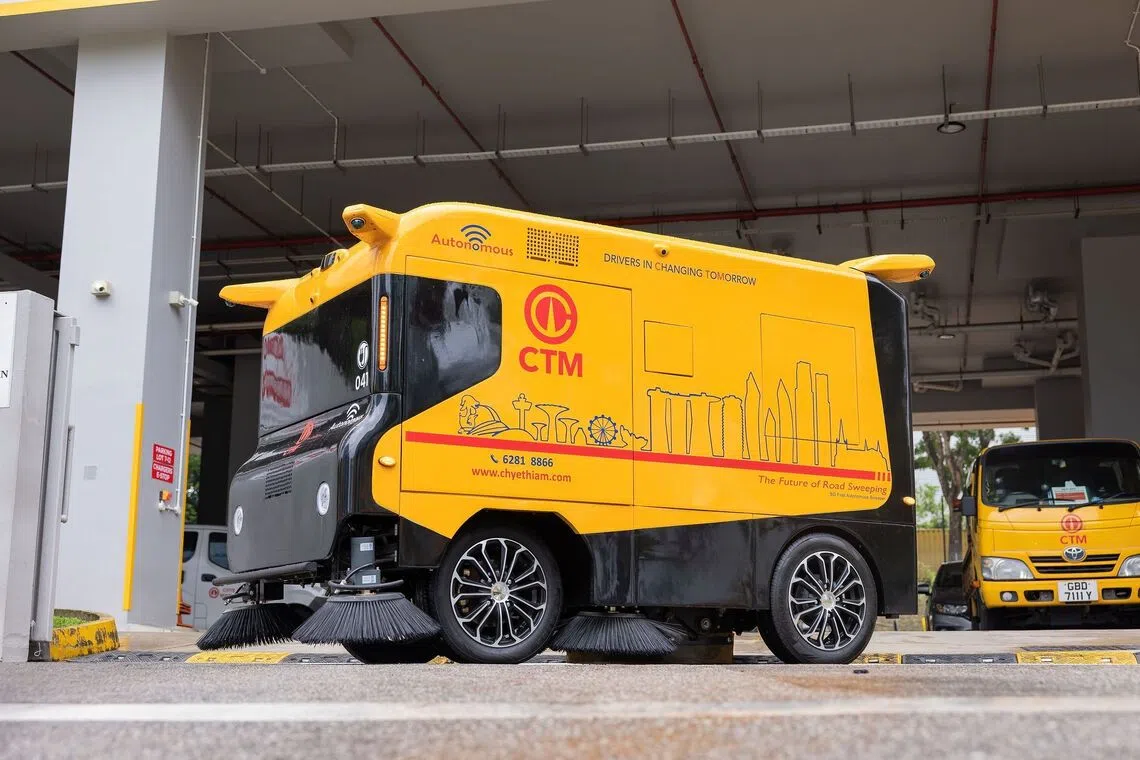
More autonomous pavement sweepers have been deployed by the National Environment Agency.
PHOTO: CHYE THIAM MAINTENANCE
Published Sep 04, 2026, 04:50 PM
Updated Sep 04, 2026, 04:50 PM
NEA has expanded autonomous pavement sweepers in more parks to improve cleaning productivity and ease manual labour.
Public satisfaction with cleanliness dropped in void decks, corridors, lift lobbies, and public toilets, the Singapore Management University's latest Public Cleanliness Satisfaction Survey has found. The satisfaction level for public toilets in coffeeshops remained the lowest-rated, tumbling from 60.2 per cent in 2023 to just 48.3 per cent in 2025.
The survey continues to show increased social responsibility in returning trays, but declining willingness to volunteer for community cleanliness.
SINGAPORE – Autonomous pavement sweepers have been progressively deployed to clean up Esplanade Park and East Coast Park since April, the National Environment Agency (NEA) revealed in a Sept 4 update on its public cleanliness efforts.
The machines are being trialled as part of the agency’s push to improve cleaning productivity and reduce reliance on manual labour. “(They) could potentially deliver up to 30 per cent productivity savings for routine pavement cleaning,” NEA told The Straits Times.
Such sweepers were first deployed in Bishan-Ang Mo Kio Park, in July 2025, and have remained in operation there.
The agency plans to roll out the robots to more parks and park connectors deemed suitable for the technology, it added without providing a timeline.
Amid NEA’s efforts, there has been a dip in Singapore residents’ satisfaction with the cleanliness of shared spaces and public toilets, according to the results of a public survey also released on Sept 4.
The Singapore Management University’s (SMU) latest Public Cleanliness Satisfaction Survey, which is in its seventh edition, found that the 91 per cent of respondents reported satisfaction of the cleanliness of public spaces, according to a composite measure of satisfaction across 20 public spaces.
This figure dropped from 94 per cent in 2023.
Void decks, corridors, and lift lobbies suffered the most significant drop among public spaces, falling from 89.7 per cent in 2023 to 80.9 per cent in 2025.
The drop was bigger for public toilets in coffee shops, which remained the lowest-rated among public toilets , tumbling from 60.2 per cent in 2023 to just 48.3 per cent in 2025.
These coffee shop amenities have been a focus area for NEA.
In the first half of 2026, about 150 enforcement actions were taken against poor-performing coffee shop owners, the agency said in its Sept 4 update.
In 2025 alone, more than 200 enforcement actions were taken against coffee shop owners for offences like failing to keep toilets clean and failing to maintain sanitary fittings in good working condition.
Increasing use of tech
Apart from the autonomous pavement sweepers, NEA is also using technology in other areas to enhance its cleaning operations and inspections.
More high-rise litterbugs have been caught with the use of a software that can trace the path of objects thrown from flats, it said.
The tracing software, which was deployed in July 2025, was showcased at a media seminar on Sept 1. It is applied to surveillance camera footage to track objects ranging from tissue paper to bottles, supporting evidence-led investigation and enforcement.
Since July 2025, technology that can trace the path of objects thrown from high-rise units has helped the National Environment Agency (NEA) identify offenders. PHOTO: SCREENGRAB FROM NEA
Since July 2025, technology that can trace the path of objects thrown from high-rise units has helped the National Environment Agency (NEA) identify offenders.
PHOTO: SCREENGRAB FROM NEA
High-rise litterbugs are hard to catch because surveillance footage has to record these unpredictable acts and the unit they originate from.
In 2025, NEA conducted roughly 2,200 camera deployments for high-rise littering, up from about 2,100 in 2024. This resulted in about 500 enforcement actions for such offences, which remained around the same as the previous year.
Tray return becoming a social norm
On a positive note, the agency issued fewer warning letters and fines to diners who failed to clear their used trays, crockery and litter on the table.
In first half of 2026, the average rate of tray and crockery return was 94 per cent at hawker centres, considerably higher than the 65 per cent in August 2021 before the start of table littering enforcement.
NEA issued 52 warning letters, which are issued to first-time offenders, a drop from 628 of such letters handed out in the first half of 2025 and 2,984 in the first half of 2024.
The number of fines given to repeat offenders also decreased from seven annually in the first half of both 2025 and 2024, to three in the same period in 2026.
NEA’s results regarding tray return mirror what was found in SMU’s latest survey, where 95.5 per cent of respondents declared that they did so.
Returning trays and crockery appears to have become a social norm for Singapore’s residents, said sociologists Paulin Tay Straughan and Mathew Mathews, both of whom led the SMU survey.
The survey was carried out from December 2025 to April 2026 among 2,007 Singaporeans and permanent residents aged 21 and above.
As in SMU’s previous surveys, most respondents claimed that they return their trays and crockery because it is the socially responsible thing to do, rather than to avoid being fined.
Social responsibility was the most commonly cited motivation for returning trays and crockery, at 77.7 per cent.
This was despite a decline in awareness of the enforcement, with 92.2 per cent aware that not returning trays incurred a fine, down from 95.2 per cent in 2023.
Mathews, principal research fellow at the Institute of Policy Studies, said: “That’s partly because I think a lot of people have internalised the fact that actually we all do it, so why do we need (enforcement) ? But I think this will be a different story if we’re talking about a decade ago or some years before the enforcement, when a lot of people did not even feel that they were responsible for (returning their trays).”
In the 2021 wave of the survey , before a fine was introduced in 2022 for those who did not return their trays , 58 per cent of respondents felt that individual patrons using the tables were primarily responsible for tray return. This figure stood at 83.3 per cent in the latest survey.
However, there was less motivation to participate in wide community efforts to clean up.
The survey found that while the majority of respondents viewed that residents and cleaners had a shared responsibility for keeping areas clean, fewer were willing towards actively participating in community cleanliness exercises.
The proportion of those willing to volunteer with a neighbourhood cleanliness group dropped to 49.6 per cent in 2025, from 63.5 per cent in 2023. Support for community litter-picking exercises also fell, from 83.7 per cent to 76 per cent.
Straughan, professor of sociology (practice) at SMU, said the findings show that the challenge now is to move from awareness about cleanliness to action, embedding a culture where individual and community efforts to keep shared places clean are routine, visible, and valued .
She said: “If we want more proactive action, intervention and partnership from people who use these spaces regularly, then we have to work with them to empower them to own them.”
National Environment Agency
国家环境局已部署更多无人驾驶路面清扫车。
照片:CHYE THIAM 维护
发布于2026年9月4日下午4:50
更新于2026年9月4日下午4:50
新加坡国家环境局已在更多公园推广使用自动人行道清扫车,以提高清洁效率并减轻人工劳动强度。
新加坡管理大学最新发布的《公共清洁满意度调查》显示,公众对组屋底层、走廊、电梯厅和公共厕所的清洁满意度有所下降。其中,咖啡店公共厕所的满意度最低,从2023年的60.2%骤降至2025年的48.3%。
调查结果持续显示,人们在归还餐盘方面的社会责任感有所增强,但参与社区清洁志愿服务的意愿却有所下降。
新加坡——国家环境局 (NEA) 在 9 月 4 日发布的公共清洁工作最新进展中透露,自 4 月以来,已逐步部署自动人行道清扫车来清理滨海艺术中心公园和东海岸公园。
作为该机构提高清洁效率、减少对人工依赖举措的一部分,这些机器正在进行试用。“(它们)有望在日常人行道清洁方面节省高达30%的生产力,”国家环境局告诉《海峡时报》。
此类清扫车于 2025 年 7 月首次部署在碧山-宏茂桥公园,并一直在那里运行。
该机构计划将机器人推广到更多适合该技术的公园和公园连接道,但并未提供时间表。
尽管新加坡国家环境局 (NEA) 做出了努力,但根据 9 月 4 日发布的一项公众调查结果显示,新加坡居民对公共空间和公共厕所的清洁度满意度有所下降。
新加坡管理大学 (SMU) 最新发布的《公共清洁满意度调查》(第七版)显示,根据对 20 个公共场所的综合满意度衡量,91% 的受访者对公共场所的清洁度表示满意。
这一数字从 2023 年的 94% 下降。
在公共空间中,底层架空层、走廊和电梯大堂的面积减少最为显著,从 2023 年的 89.7% 下降到 2025 年的 80.9%。
咖啡店的公共厕所的降幅更大,其评分仍然是公共厕所中最低的,从 2023 年的 60.2% 骤降至 2025 年的 48.3%。
这些咖啡店配套设施一直是美国国家环境局 (NEA) 的重点关注领域。
该机构在 9 月 4 日的最新报告中表示,2026 年上半年,对经营不善的咖啡店老板采取了约 150 项执法行动。
仅在 2025 年,就有 200 多家咖啡店因未保持厕所清洁、未保持卫生设施处于良好工作状态等违法行为而受到执法部门的处罚。
技术使用日益增多
除了自动清扫车外,国家环境局还在其他领域运用科技来加强其清洁作业和检查工作。
报道称,利用能够追踪从公寓楼扔出的物品路径的软件,抓获了更多在高层建筑乱扔垃圾的人。
该追踪软件于 2025 年 7 月部署,并于 9 月 1 日在媒体研讨会上进行了展示。它应用于监控录像,可以追踪从纸巾到瓶子等各种物体,从而支持以证据为导向的调查和执法。
自2025年7月起,能够追踪从高层建筑投掷物体轨迹的技术已帮助国家环境局(NEA)识别违法者。图片:NEA截图
自 2025 年 7 月以来,能够追踪从高层建筑抛掷物体路径的技术帮助国家环境局 (NEA) 识别违法者。
图片:美国国家艺术基金会截图
高层建筑乱扔垃圾者很难被抓获,因为监控录像必须记录下这些不可预测的行为以及它们发生的单元。
2025年,国家环境局针对高层建筑乱扔垃圾行为部署了约2200个摄像头,高于2024年的约2100个。这导致了约500起针对此类违法行为的执法行动,与上一年基本持平。
餐盘归还正成为一种社会规范
从积极的方面来看,该机构对未清理餐桌上用过的托盘、餐具和垃圾的用餐者发出的警告信和罚款减少了。
2026 年上半年,小贩中心的餐盘和餐具回收率平均为 94%,远高于 2021 年 8 月开始实施餐桌乱扔垃圾执法之前的 65%。
国家环境局发出了 52 封警告信,这些警告信是发给初犯的,比 2025 年上半年发出的 628 封和 2024 年上半年发出的 2984 封有所下降。
对屡犯者处以的罚款数量也从 2025 年和 2024 年上半年的每年 7 起减少到 2026 年同期的 3 起。
NEA 关于餐盘回收率的调查结果与 SMU 最新调查的结果相吻合,95.5% 的受访者表示他们会回收餐盘。
社会学家保琳·泰·斯特劳恩和马修·马修斯表示,归还餐盘和餐具似乎已成为新加坡居民的一种社会规范。他们二人均领导了新加坡管理大学的这项调查。
该调查于 2025 年 12 月至 2026 年 4 月期间进行,调查对象为 2007 名 21 岁及以上的新加坡公民和永久居民。
与新加坡管理大学之前的调查一样,大多数受访者表示,他们归还餐盘和餐具是因为这是出于社会责任感,而不是为了避免被罚款。
社会责任是人们归还餐盘和餐具时最常提及的动机,占比高达 77.7%。
尽管人们对执法的认识有所下降,92.2% 的人知道不归还餐盘会被罚款,而 2023 年这一比例为 95.2%。
政策研究所首席研究员马修斯表示:“部分原因是,我认为很多人已经接受了这样一个事实:实际上我们都会这样做,所以为什么还需要(强制执行)呢?但如果我们谈论的是十年前或强制执行之前的几年,情况就不同了,那时很多人甚至不觉得自己有责任(归还餐盘)。”
在2021年的调查中(2022年对未归还餐盘者处以罚款之前),58%的受访者认为,使用餐桌的顾客应承担归还餐盘的主要责任。而在最新的调查中,这一比例上升至83.3%。
然而,人们参与大规模社区清洁活动的积极性较低。
调查发现,虽然大多数受访者认为居民和清洁工对保持区域清洁负有共同责任,但愿意积极参与社区清洁活动的人却较少。
到 2025 年,愿意参加社区清洁小组志愿服务的人数比例从 2023 年的 63.5% 下降到 49.6%。对社区捡垃圾活动的支持率也从 83.7% 下降到 76%。
南方卫理公会大学 (SMU) 社会学(实践)教授斯特劳恩表示,研究结果表明,现在的挑战是从对清洁的意识转向行动,建立一种文化,在这种文化中,个人和社区为保持公共场所清洁所做的努力是常规的、可见的和受重视的。
她说:“如果我们希望经常使用这些空间的人们采取更积极的行动、干预和合作,那么我们就必须与他们合作,赋予他们权力,让他们拥有这些空间。”
国家环境局