Johor entrepreneur turns RM8,000 into unmanned used clothing store柔佛州企业家用8000令吉打造无人二手服装店
JOHOR BAHRU, Sept 23 — The use of small retail spaces, cashless payment systems, and closed-circuit television (CCTV) monitoring is enabling micro-entrepreneurs to explore the...
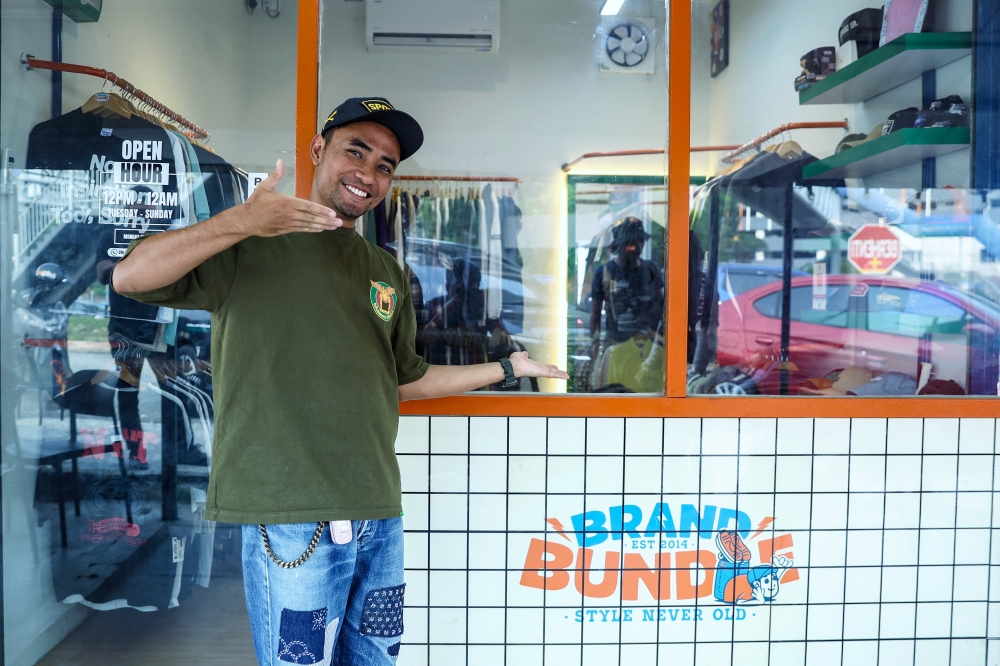
Micro-entrepreneurs in Johor Bahru are adopting the unmanned store concept using small spaces, cashless payments, and CCTV to reduce operating costs.
Mohd Idham Zamzuri's used clothing shop operates without staff, using QR codes for self-service purchases, inspired by Japan's unmanned store model.
Customers appreciate the clear product information and payment process, suggesting this cost-effective concept could expand to other sectors.
JOHOR BAHRU, Sept 23 — The use of small retail spaces, cashless payment systems, and closed-circuit television (CCTV) monitoring is enabling micro-entrepreneurs to explore the unmanned store concept as a strategy to lower operating costs.
This model has been adopted by, among others, a used clothing shop in Kampung Melayu Majidee here, which operates in a space measuring just “10 feet by 10 feet (10x10)” with no attendant on site.
Its proprietor Mohd Idham Zamzuri said the self-service concept helps control operating costs by using less space, while also letting customers select items and pay themselves using QR (quick response) codes.
He said three CCTV cameras have been installed to monitor operations, while every item is equipped with price tags and product information to help customers choose without staff assistance.
“I drew inspiration from the concept of unmanned stores in Japan and saw that this approach could be implemented on a small scale here.
“The capital to set up this shop was around RM8,000, including renovation work that I did on my own,” he told Bernama recently.
Mohd Idham said that about 80 per cent of the items at the premises are sold for under RM100, alongside “combo” deals — such as two pieces for RM50 or three for RM100 — designed to encourage stock turnover while simultaneously managing the risk of loss.
Commuting daily between Pasir Gudang and Majidee, he also inspects the premises and replenishes stock about twice a week.
Reflecting on his business journey, Mohd Idham said he started in 2013 at age 19 with an initial capital of RM300 — generated from selling pre-owned (or pre-loved) goods — before gradually growing that capital.
He then continued the business through physical sales locations and online platforms before opening the self-service premises last May.
Meanwhile, a customer Ghazali Md Rawi said the concept is practical because customers can still clearly access product information and make payments themselves, even without a shop attendant present.
“In my view, this concept can be extended to other sectors, as it can decrease operating costs without compromising customer comfort,” he said.
A Bernama visit to the unmanned shop found that a telephone number is also provided, allowing customers to contact the operator should they encounter difficulties while making a purchase. — Bernama
Malaysia Airlines extends A330ceo maintenance support deal with Airbus
Ringgit ends higher against major currencies, weakens versus US dollar
KLIA remains Asia-Pacific’s most connected megahub, fourth globally, according to OAG index
UUCA replacement Bill expected to be tabled in December, says Zambry
ADB raises Malaysia’s 2026, 2027 growth forecasts to 4.9pc, 4.7pc
SPR: Postal voting applications for Melaka polls open today
新山的微型企业家们正在采用无人商店的概念,利用小空间、无现金支付和闭路电视监控来降低运营成本。
Mohd Idham Zamzuri 的二手服装店没有员工,顾客可以通过扫描二维码自助购买,其灵感来自日本的无人商店模式。
顾客对清晰的产品信息和支付流程表示赞赏,这表明这种经济高效的理念可以推广到其他行业。
新山,9月23日讯——小型零售空间、无现金支付系统和闭路电视监控的使用,使微型企业家能够探索无人商店的概念,以此作为降低运营成本的策略。
这种模式已被包括本地甘榜马来马吉迪的一家二手服装店在内的多家店铺采用,该店的经营空间仅为“10英尺乘10英尺(10x10)”,且店内没有店员。
其所有者 Mohd Idham Zamzuri 表示,自助服务理念有助于通过减少空间占用来控制运营成本,同时还可以让顾客选择商品并使用二维码(快速响应码)自行付款。
他表示,店内安装了三台闭路电视摄像头来监控运营情况,每件商品都配有价格标签和产品信息,以便顾客无需工作人员协助即可进行选择。
“我从日本的无人商店概念中汲取了灵感,并发现这种方法可以在这里小规模实施。
“开设这家店的启动资金大约是 8000 令吉,包括我自己做的装修工作,”他最近告诉马新社。
莫哈末·伊德汉表示,店内约 80% 的商品售价低于 100 令吉,同时还提供“组合”优惠——例如两件 50 令吉或三件 100 令吉——旨在促进库存周转,同时控制损失风险。
他每天往返于巴西古当和马吉迪之间,每周大约两次巡视店铺并补充库存。
回顾自己的创业历程,Mohd Idham 表示,他于 2013 年 19 岁时开始创业,初始资本为 300 令吉,这笔钱来自出售二手(或旧物)商品,之后逐步增加了资本。
之后,他通过实体销售点和在线平台继续开展业务,直到去年五月开设了自助服务场所。
与此同时,顾客 Ghazali Md Rawi 表示,这种模式很实用,因为即使没有店员在场,顾客仍然可以清楚地获取产品信息并自行付款。
“我认为,这一理念可以推广到其他行业,因为它可以在不影响客户舒适度的前提下降低运营成本,”他说道。
马新社记者走访这家无人商店发现,店内也提供了电话号码,方便顾客在购物过程中遇到任何问题时联系客服。——马新社
马来西亚航空公司与空客续签A330ceo维护支持协议
令吉兑主要货币收高,兑美元收低
根据OAG指数,吉隆坡国际机场仍然是亚太地区互联互通程度最高的超级枢纽,在全球排名第四。
赞布里表示,UUCA替代法案预计将于12月提交。
亚洲开发银行将马来西亚2026年和2027年的经济增长预期分别上调至4.9%和4.7%。
新加坡人民共和国通讯社:马六甲州选举邮寄投票申请今日开放