The Hunt For A Soviet Submarine Desperately Trying To Sneak Through The Strait Of Gibraltar搜寻一艘试图偷偷穿过直布罗陀海峡的苏联潜艇
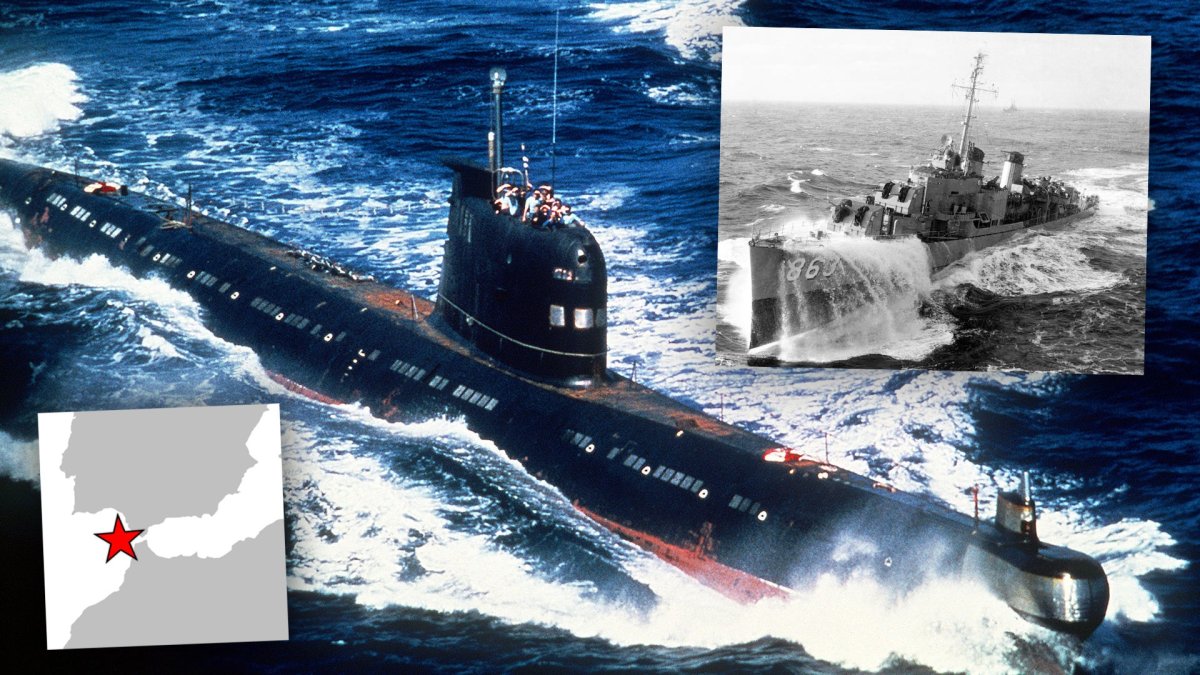
The Cold War cat-and-mouse game of anti-submarine warfare became very hot as the USS Steinaker approached the Mediterranean in January of 1967.
Updated Apr 23, 2021 12:00 AM EDT
In the North Atlantic on the evening of January 20, 1967, four U.S. Navy destroyers steamed east in a line abreast at 20 knots, heading for the Strait of Gibraltar . It was a Friday and we had departed the big naval base in Norfolk, Virginia nearly two weeks earlier to participate in a large naval exercise. We were now headed off on a multi-month Mediterranean cruise. It was the height of the Cold War and tensions between the Soviet Union and the United States were extremely high. We were not going there to sightsee.
My ship, the USS Steinaker (DD-863) was a Gearing class destroyer, and like the others, it had been built during the closing months of World War II. It was 390 feet long and was powered by two steam turbines producing 60,000 shaft horsepower and driving two 14-foot propellers. Our main purpose was anti-submarine warfare, or ASW. Our top speed was 36.8 knots—destroyers are known as “Greyhounds” for a reason.
A few years prior to my arrival aboard Steinaker, the decades-old ship had undergone a major fleet rehabilitation and modernization program, or FRAM, where new weapon systems and a new AN/SQS-23 sonar system had been installed.
USS Steinaker. , USN
As we headed east, our sonars were all in active mode, all with a peak output power of 50,000 watts. Each sonar was tuned to a slightly different frequency to reduce mutual interference. The entire northeastern Atlantic was probably ringing with bottom bounce echoes and reverberations, and any hostile submarines, along with every whale, porpoise, and sea turtle within 20 miles was probably trying its best to get away from us as we approached.
Our sonars were so powerful that at night they sometimes caused plankton to phosphoresce as a pulse swept over them, producing expanding green concentric circles of light radiating outward at the speed of sound from our enormous bow-mounted 30-foot sonar domes.
The AN/SQS-23 sonar system had a maximum display setting of 40,000 yards, or 20 nautical miles. That would suggest that it could transmit enough acoustic energy to bounce off a submarine 20 miles away and the echo from its hull would return enough energy to allow detection. In practice our emissions could be detected by an adversary long before any echoes would be strong enough to be detected back aboard our ship. Normally, the sub would simply move far enough from our path to remain undetected, keeping it safe from attack, but also rendering it ineffective and irrelevant to us.
SQS-26 sonar seen in 1961., USN
My involvement with the Steinaker began on a miserably cold and rainy October evening when I arrived at the destroyer and submarine piers at Naval Station Virginia, the largest navy base in the world. I showed up straight out of boot camp, and I was about to become the lowest-ranking sailor on the ship—a newly minted Seaman Apprentice. I was what was called an “immediate active duty” reservist.
Man, it does not get much worse than that!
As a civilian, I had been working as an electronics technician for a small company that manufactured pressure transducers for the NASA space program and for a classified U.S. Air Force program, but since I had no Navy training I started my new life on the deck force. These guys are called Boatswain Mates. In port we maintained the exterior of the ship, mostly chipping paint, and repainting. We were also responsible for loading equipment and stores aboard the ship. Underway we stood watch as lookouts and served on the bridge as Helmsmen. We were also responsible for underway refueling and replenishments. In the old days Boatswain Mates handled the sails and rigging.
There was a lot to learn and being the Helmsman underway was challenging. Handling a ship with 60,000 horsepower in heavy weather and staying on course required focus, and as I learned I began to enjoy it.
Since I did arrive with some useful technical skills, I was eventually assigned to work with the sailors that operated and maintained the ASROC (Anti-Submarine Rocket), which was added during the FRAM upgrade. It was an all-weather, gyro-stabilized, all sea condition, standoff ASW weapon system with a six-mile range. We also had torpedo tubes on the main deck, but the ASROC was our primary ASW weapon system.
ASROC launch from the Steinaker sometime in late 1966., Photo courtesy Juan Rivera
I took the picture above during an exercise against one of our submarines. The ASROC launcher contained eight sealed launch tubes which could each contain either a Mk 46 acoustic homing torpedo, armed with a 99-pound PBXN high-explosive warhead, or a 10-kiloton W44 nuclear depth charge, both of which would be transported to the target area by RUR-5 rocket. With our sonar we should have been able to keep an enemy submarine far enough away to avoid a torpedo attack while allowing us to silently drop one of these torpedoes on him by parachute.
The Mk 46 torpedo had a cylindrical-shaped no-escape zone several thousand yards in diameter and 1,500 feet deep. With a top speed of 45 knots, it would have been deadly against a diesel-electric sub anywhere inside that zone. The sub would probably not hear the small splash as the torpedo descended to the water, detached from its parachute, and then sank silently to its pre-programmed top search depth. Their first indication of trouble might have been when the torpedo went active and began hunting them. Of course, if we opted for the nuclear depth charge it would not matter if the sub heard the splash or not.
After a few months working on the ASROC system, I was again transferred, this time to the Operations Division where I began learning to become a Radarman.
On the evening of January 20, 1967, and after about six months of on-the-job experience, I was on watch in the Combat Information Center, referred to as CIC or simply “Combat.” I was manning the surface search radar repeater. In that position, it was my responsibility to track every surface contact within 20 miles and determine its course and speed as well as its closest point of approach, or CPA. If neither vessel changed its course or speed, how close would that other ship get to our ship, and when and where would this occur? Our goal was to never let another ship get within 2,000 yards, or one nautical mile. If the CPA was determined to be less than that minimum, we would calculate an alteration to either our course or speed to increase the CPA to that minimum and pass it to the bridge. Enlisted men cannot tell an officer what to do, but the officer of the deck always accepted our recommendation without question.
Of course, altering either course or speed to deal with one ship would alter the CPA of all the other ships in the area. It could get extremely complicated, and we did all the calculations using a grease pencil on our radar scopes or with pencil and graph paper. There were no iPads or digital computers in those days.
Approaching the entrance to the Mediterranean Sea from the Atlantic was a busy time for us, with the four destroyers and many civilian merchant ships all converging on or departing from the same narrow Strait of Gibraltar. Using a sound-powered headset, I would have been talking to the lookouts as well as the bridge talker, whose job it was to repeat everything I told him to the Officer of the Deck on the bridge and write it on a plexiglass status board. I might also have been working with the electronic countermeasures (ECM) operator. We memorized the characteristics of all major Soviet radars—both sea and land-based. He would have been especially alert for detecting the Soviet SS-2 submarine surface search radar.
Lastly, I would have also been keeping an eye out for “sinkers.” A sinker was any radar contact that appeared for one or two sweeps and then disappeared. That could indicate that a submarine had briefly exposed its periscope or ECM antenna for a quick look around.
Working that position could be extremely intense and sometimes things were happening so fast that you were literally the only person on the ship that really knew the big picture completely—we called it the BFP [Big Fucking Picture]. Occasionally you had so much information in your head that you simply could not keep up and your mind would just go blank. You had become task saturated, and you had lost the BFP. It was a horrifying feeling, looking down at all those little contacts and grease pencil lines that you had made and realizing that you no longer knew which were which.
Underway, Radarmen worked almost continuously. We usually lived on three or four hours of sleep a day, sometimes for weeks at a time. Our sleep was broken into two short naps between watches in the CIC, and, in this case, we had just come off two weeks’ involvement in that big naval exercise.
If I was not on watch or involved in an underway replenishment, a refueling, or dragooned into some other essential task like polishing brass, I would have been desperately trying to get some sleep. Sometimes, after coming off watch, I was so spun up that I just lay in my rack trying to calm down and sleep, and then it was time to go back on watch again. It is a miserable feeling being both mentally and physically exhausted, knowing that you only have a few hours to recuperate, but being unable to sleep.
Other positions in the CIC were a lot less stressful and we rotated off that position after one hour. When things were hectic that was about all anyone could deal with. Other times there might only be one other contact within 20 miles and that would usually be a Soviet electronic intelligence (ELINT) trawler. We were almost always shadowed by at least one.
It was a cat and mouse game on both sides. All a Soviet submarine had to do was to check for the US Navy’s AN/SPS-10 surface search radar. Every Navy ship used it continuously. The sub would have been able to detect any US Navy ship within 20 miles in seconds—one reason that we had never detected a Soviet submarine before.
It was just another day at sea, until around 8:00 PM local time, and probably about 50 miles from the entrance to the Strait of Gibraltar, when Sonar announced that they had a contact—a possible submarine.
We immediately went to condition 1-AS. 1-AS is a modified General Quarters condition where anyone associated with anti-submarine warfare activities would immediately head to their duty stations to replace or supplement the existing watchstanders. All the Sonarmen and Radarmen would head for the CIC. The Helmsmen and other bridge personnel would be replaced with the most experienced crew members. While the ASW Attack Team was effectively at general quarters and ready for war, the rest of the crew might be down on the mess deck watching a movie.
We needed to quickly declutter the area. As the ranking officer, our captain had command of our destroyer group. He sent two of the four destroyers towards their destination in Italy. That left my ship, tactical call sign “Tom Boy,” and the USS Wallace L. Lind (DD-703), tactical call sign “Tidal Wave.”
I always resented Lind . They had a great tactical call sign, but ours was lame. Why couldn’t we be “Claw Hammer,” or “Wrecking Ball?” I’m sorry, but I’ve been carrying this resentment for over 50 years and I had to get it off my chest!
USS Wallace L. Lind (DD-703)., USN
Anyway, we may have had the Lind temporarily shut down its active sonar and clear the immediate area while we attempted to classify the contact.
Back in 1967 there was no precision navigation, which made this a tricky process. The contact seemed to be moving slowly away from the coast at two knots. But it was possible that we were in a two-knot current and had detected an uncharted pinnacle—an isolated pillar-like elevation rising off the seafloor. Were we in a two-knot current or not? There was no easy way to answer that question in that age and the answer was critically important.
I did not know this, but we had a sonar mode that could determine the outline of the object we were tracking by passing directly over it and doing a raster scan. It was called “Aspect Mode.” This was done, and the object it traced out had the distinct shape of a submarine with diving planes.
OK… We are tracking a submarine, but who does it belong to? By now, this contact was generating a lot of interest up the chain of command and in short order we were informed that there were no US or NATO submarines in our area.
Meanwhile, Sonar had been attempting to contact the sub using an underwater acoustic communication system called “Gertrude.” Gertrude, which I had never heard of until then, was a system that had been in use on most U.S. Navy ships for many years. Presumably, all U.S., and most NATO submarines used this system too.
Anyway, this is when I found out that one of my shipmates had a hidden talent. He spoke Russian, but there was no response from the sub in Russian or in English. Not good! The contact was now classified as hostile, and we set about treating it as such. It was still maintaining its course and heading out into the Atlantic at a steady two knots.
A lot of radio traffic was passing back and forth from headquarters and within a few hours we knew that this sub was a Russian Foxtrot (its NATO designation). It was a diesel-electric submarine that the Navy had been tracking for some time in the Med. It had managed to slip away and make a submerged transit of the Strait undetected, only to get caught in our sonar web.
The Foxtrot had three shafts and three propellers. Its maximum depth was just over 900 feet, and it could stay submerged for at least four days without snorkeling. Submerged, its three main electric motors could produce 5,400 horsepower and drive it through the water at 15 knots, but that would drain the batteries quickly. It also had a separate low-power electric motor called a “creep motor” that would minimize drain on the batteries and help keep the sub very quiet, but the maximum speed using the creep motor was just two knots. The creep motor was rated at only 180 horsepower. The sub displaced 2,515 tons. It was amazing that it could make any headway at all on 180 horsepower.
Soviet Foxtrot diesel-electric submarine., USN
The Strait of Gibraltar is 36 miles long and seven miles wide at its narrowest. Over 200,000 ships pass through it each year, and many are huge. The water in the Strait consists of a deep layer of salty Mediterranean water flowing west, and a less salty upper layer of Atlantic water flowing east. It sounds simple, like two opposing lanes of traffic on a road, but these two opposing currents produce a chaotic, complex, and ever-changing environment for a submarine.
Before attempting a submerged transit of the Strait, the sub would have established their exact position near the eastern entrance by taking bearings to known objects on opposite shores through their periscope and marking up their chart. Their position would be where all the bearing lines crossed.
Once submerged to clear surface traffic they would have used dead reckoning to navigate—a process of determining current position from the sub’s heading and estimates of distance traveled based on speed, and time. It is not hard to see that as time passed this method of navigating becomes less and less accurate. Worst of all, they would have suffered from the same navigational limitations that we had—it would have been impossible for them to tell if the submarine was in a current.
The sub’s only option would have been to stay deep enough to avoid a collision with a surface vessel and make enough turns to ensure that they were really moving west and were not being pushed backwards by the easterly current. Running at nine or ten knots to insure forward progress against any current, and running on their main motors, they would be draining their batteries quickly, but they had no choice. The captain would have calculated that they would have enough remaining charge to make it out into the Atlantic and clear of shipping where they could surface or snorkel to ventilate the boat and recharge their batteries.
Strait of Gibraltar from the air., Florian Sauerland/wikicommons
The Foxtrot ’s captain was obviously a very skilled submariner. He had already broken contact with the U.S. Navy in the Med and had begun a submerged transit of the Strait. As he was headed east, there was no way he could have known we were headed directly towards him from the Atlantic, but once out of the Strait and into the Atlantic, he should have heard us coming when we were still at least an hour away.
Why didn’t he move to avoid us?
It is critically important to both destroyers and submarines that they always know the water conditions that they operate in. At regular intervals, we did a “BT drop.” BT stands for bathythermograph—a device that was dropped from the fantail of the ship on a long steel cable. It recorded depth and water temperature as it was lowered. Submarines would measure temperature versus depth continuously during normal operations.
We would both be looking for a layer in the water column where the temperature changed abruptly over a small difference in depth. This is called a thermocline. It can cause active sonar, or any other sounds from the surface, such as a ship’s engines, to bounce off instead of passing through the layer. That acoustic energy would then be trapped between the layer and the sea surface and could travel long distances. A submarine would normally stay above that layer where it could hear danger approaching, and then duck under it to hide. But, if he was hidden under that layer, how did we find him?
At this point in my story, I had exhausted my knowledge of underwater acoustics and I could not answer that question. I needed to do more research. Among the large amount of information available on the Internet, I found an abstract of a research study that was done by the Acoustical Society of America. Here is a quote from the very first sentence:
“ Measurements were made at sea of the changes in acoustic intensity in passing from a shadow zone through the limiting ray and into the directly ensonified region .”
One sentence into this abstract and I already had to stop and look up ensonified! Ensonify (Verb): to fill with sound.
That sounded important! but I was also confronted with two more new terms!
Shadow Zones, Limiting Rays, and the directly ensonified region
The horizontal axis is compressed to fit on the page., Juan Rivera’s Illustration
There is something called a limiting ray. Think of it as a mythical being like a unicorn. When sound reaches the layer, it can either pass through the layer or bounce off like a flat stone tossed across a smooth lake. It all depends on the angle. At angles greater than the limiting ray, sound will pass through the layer and into an area called the directly ensonified region. Remember, ensonify means “to fill with sound.” Submarines will want to avoid this area for obvious reasons.
At angles less than the limiting ray, sound will reflect off the layer back towards the surface, creating an area bounded by the layer and the limiting ray called the shadow zone. In the shadow zone, little sonar energy will penetrate, and submarines often use this area to hide and attempt to avoid detection. In my illustration above I would need to make it about four feet wide to be accurate, and the angle between the limiting ray and the layer would be only a few degrees.
AN/SQS-23 Sonar Operator Performance Standards Guide for Detection and Tracking, April 13, 1979., DTIC online document
Theories are important, but actual test data is hard to beat. I was lucky to find a report of a real-world test that was conducted using the same AN/SQS-23 sonar that we had on our ship. It included the graph above.
During the test, the submarine’s depth was 600 feet and there was a layer at 300 feet. The theoretical data I found would suggest that the limiting ray was like a light switch—on one side nothing would penetrate the layer and on the other side sound would flood in as if there was no layer at all. The graph above suggests otherwise.
Looking at the graph It appears that the transition between the directly ensonified region and the shadow zone (the limiting ray) occurs about 3,000 yards from the ship. But instead of cutting off abruptly, the transition between the directly ensonified region closest to the ship, and the shadow zone, appears to be about one mile wide. In the directly ensonified region, the chance of detection is close to 100 percent. In the shadow zone it quickly drops to 10 percent or less. And in a space of just 500 yards, the chance of detection rose from 30 percent to 85 percent. At 20 knots we would cover that distance in 45 seconds. The graph also shows that some subs are occasionally detected in that shadow zone, so it is not a perfect hiding place for them.
I think this explains why we were almost on top of that sub before we detected its presence. As our limiting ray passed over them at 20 knots, the shadow zone that was hiding them was also moving with the ship and it was quickly replaced by the directly ensonified region. Suddenly we had a strong sonar contact. As for the sub, as the song goes, “If it weren’t for bad luck they wouldn’t have no luck at all.”
After all the Foxtrot crew had gone through to this point, they probably were not in the best of shape when we detected them. I think they knew we were headed directly towards them long before we arrived, and if they had a fully charged battery they could have sprinted away to safety at 15 knots submerged. But I believe they simply did not have the remaining battery capacity, so they ducked below the layer and hoped for the best.
Once detected, the Foxtrot captain had to be asking himself, “how much longer can I stay submerged before my air goes bad and my batteries go completely dead?” Meanwhile, back on the surface, we had organized ourselves and we were preparing for a lengthy engagement.
We had all the time in the world.
Our active bow-mounted sonar was our only tracking tool and it had limits. There is always a blind sector directly behind the ship called the baffles, where the hull of the ship and its turbulent wake block the sonar.
In those days, when two destroyers were prosecuting a sonar contact, it was critical that as one ship passed over the contact and then lost it in the baffles, the other ship was inbound and was able to regain contact quickly. Close coordination was critical, and a lot of things could go wrong when two warships were maneuvering at high speed near each other at night. We used two VHF voice nets to coordinate—PRITAC and SECTAC (Primary and Secondary Tactical.) Our two bridges would have been in constant contact on PRITAC and the two CICs would have been using SECTAC. These days every ship in the area would probably be on an encrypted mesh network with a satellite link back to headquarters.
During this delicate dance, the inbound ship was called “Brother” and the outbound ship, that had lost contact in its baffles, was called “Sister.” Brother is in charge. The two of us maneuvered in separate circles like two meshed gears—one in the clockwise direction and the other moving counter-clockwise. As the inbound ship (Brother) passed over the contact, its CIC would mark the datum over the SECTAC net. Sister would update their datum based on Brother’s exact radar position when datum was called out. Each would then adjust their track to pass over the new datum on the next pass. Communications might go something like this:
“Tidal Wave this is Tom Boy. I am Brother. You are Sister. Stand by for datum. Now, Now, NOW!… Contact lost in baffles. You are Brother. I am Sister…” And then, as we swung around to regain contact, the cycle would repeat with Tidal Wave as Brother.
A word of explanation is in order here. The datum is the last known location of the contact. It starts out as a point, but rapidly expands into a widening circular Area of Uncertainty, or AoU, based on the passage of time and the maximum speed of the sub. In our case, it probably took at least 30 seconds between the time one ship lost contact in its baffles, and reacquisition by the incoming ship.
At a maximum submerged speed of 15 knots, the sub could sprint about 265 yards in 30 seconds, which means that the datum would expand to an AoU of just over 500 yards in diameter, or one quarter of a mile before the next ship could attempt to reacquire the contact. Based on those 1979 test results, the sub might have had a reasonable chance of losing us if he could have made it three miles while we chased a decoy or were confused by a noise maker. I think he came close several times.
There were no datalinks, and all this action was coordinated over the two tactical voice nets and sound-powered phones talking between each CIC and their respective bridges. All documentation would have been by hand in paper logs and using a DRT (Dead Reckoning Tracer).
Actual DRT trace showing the last few hours of the engagement., Juan Rivera
The DRT was an electromechanical system that projected colored spots up and onto a piece of thin tracing paper that was firmly taped to the glass top surface of the DRT cabinet. The projector ran on a pair of X/Y axis jackscrews. It was driven by the gyrocompass and the pitot log, so it followed the path of the ship across the ocean surface. The various colored dots were assigned to track the ship’s position, as well as inputs from radar and sonar data. You manually marked up the paper with a pencil by following the colored dots and annotating the trace with details such as the time or target ID.
When you look at the plot, all the circular paths are the two destroyers and the straighter line in the middle of it all is the sub. Notice how crazy things look in the upper right as the submarine became increasingly desperate.
The fleeing Foxtrot was probably reaching the end of its endurance—the air was probably barely breathable, and the batteries were probably almost exhausted. Its crew tried everything it could to lose their two tormentors. They tried going deep, launching a decoy, then backing up their own wake and sprinting off in a new direction. Nothing they tried worked for long.
The next morning a Lockheed P-3 Orion ASW aircraft joined us from our naval base at Rota, Spain. The P-3 was a four-engine turboprop, and once on station it could shut down and feather one or two engines to reduce fuel consumption and increase endurance for up to 17 hours. It carried a host of offensive weapons in its bomb bay plus sonobuoys and a Magnetic Anomaly Detector (MAD) that looked like a big stinger that protruded from the tail. When using the MAD gear, it flew very low and when it detected an anomaly, it could be set to automatically drop a flare at night or a smoke pot during daylight hours. That was extremely helpful as the bridge crews could use the last flare or smoke pot as the datum and steer for it when making each new pass.
A P-3 over Gibraltar. , USN
By the night of the 22nd, the sub’s crew must have been completely demoralized, exhausted and miserable. Our sonar pings and our high-speed propellers could all easily be heard throughout the sub, just as it is depicted in every World War II submarine movie. Meanwhile, we had perfected our routine and were prepared to continue indefinitely, or until the sub gave up and surfaced.
It was just a matter of time…
At this point we had been tracking the sub for 26 hours. Actually “tracking” does not describe what we had been doing to that submarine crew psychologically. Essentially, we had been conducting a continuous 26-hour depth charge attack and making it crystal clear that in a real engagement they would have all been dead after our first pass the previous evening.
Finally, at around 10:00 PM that night sonar heard hull popping sounds. The sub’s pressure hull was expanding as it rose towards the surface.
They were giving up.
We took up station 1,000 yards on either side of its position and waited…
After the Foxtrot surfaced, the P-3 lit it up with a 70-million candlepower searchlight and made several photo passes. Their humiliation was complete.
At the time, small disposable film cameras were popular. They used a little flash bulb the size of a peanut. Several of my shipmates lined the deck and were flashing away at that small black sub half a mile away in the dark. Those little flash bulbs barely lit up the lifeline a few feet in front of them. That was a funny sight!
A Foxtrot surfaced. This image is not taken during the incident being described, but gives an idea of what one looks like when surfaced and some of its crew are getting some much needed fresh air., USN
Eventually, we all began to lose interest. The P-3 was low on fuel and headed back to Rota, and we broke off contact and turned towards Gibraltar. Half an hour later, the P-3 returned unexpectedly and told us that they had been instructed to maintain contact until a fresh P-3 arrived to replace them. They asked us for a vector back to the sub. We had lost it on radar quite some time ago and we had no idea where it was.
If the sub took off at its maximum snorkeling speed, the area of uncertainty would have grown to about 15 miles in diameter.
Oh, well. I think we had made our point. As the song goes, “If you see me comin,’ better step aside. A lotta men didn’t, a lotta men died.”
The following morning, we received congratulations from the Commander of the Sixth Fleet and the Commander of Anti-Submarine Forces in the Atlantic.
Messages sent to Steinaker on January 22, 1967, Courtesy of Juan Rivera
There were a total of 75 Foxtrot subs built between 1958 and 1979. It is hard to tell how many were active in January 1967, but Soviet deck logs show that at least 10 were in the Mediterranean that year. This is B-840, a Project 641 class sub—its deck log says it was forced to surface in the northeastern Atlantic in 1967. That fits, but the rest of the single-sentence log entry does not.
B40/B-840 log entry., Via Juan Rivera (Translated)
B-840, Project 641., Public Domain
Was this our sub? We may never know for sure.
Contact the author: dd863juan@gmail.com
Contact the editor: Tyler@thedrive.com
Comments couldn’t be loaded. Please refresh the page.
更新于美国东部时间2021年4月23日凌晨12:00
1967年1月20日傍晚,在北大西洋上,四艘美国海军驱逐舰并排向东航行,航速20节,驶向直布罗陀海峡。那天是星期五,我们大约两周前离开位于弗吉尼亚州诺福克的大型海军基地,参加一次大规模的海军演习。现在,我们即将开始为期数月的地中海巡航。当时正值冷战高峰期,美苏关系高度紧张。我们此行并非观光游览。
我的舰艇,斯坦纳克号驱逐舰(DD-863),是一艘基林级驱逐舰,和其他同级舰艇一样,是在二战末期建造的。它长390英尺,由两台蒸汽轮机提供动力,可产生6万轴马力,驱动两副14英尺的螺旋桨。我们的主要任务是反潜作战。我们的最高航速为36.8节——驱逐舰被称为“灰狗”是有原因的。
在我抵达施泰纳克号之前几年,这艘服役数十年的军舰经历了一次重大的舰队改造和现代化计划(FRAM),其中安装了新的武器系统和新的 AN/SQS-23 声呐系统。
美国海军“斯坦纳克”号驱逐舰
我们向东航行时,所有声呐都处于激活状态,峰值输出功率均为5万瓦。每台声呐都调谐到略微不同的频率,以减少相互干扰。整个东北大西洋可能都回荡着海底反射的回声和混响,方圆20英里内的所有敌对潜艇,以及鲸鱼、海豚和海龟,可能都在竭尽全力地逃离我们。
我们的声呐威力强大,夜间,当脉冲扫过浮游生物时,有时会使浮游生物发出磷光,产生不断扩大的绿色同心圆光,从我们巨大的船首安装的 30 英尺声呐圆顶以声速向外辐射。
AN/SQS-23声呐系统的最大显示距离为40,000码,即20海里。这意味着它可以发射足够的声能,使声波在20海里外被潜艇反射回来,而潜艇船体反射的回波能量足以被探测到。但实际上,敌方可能在回波强度足以被我方舰艇探测到之前很久就探测到我方的声呐发射。通常情况下,潜艇会游离我方航线足够远,从而避免被探测到,既能保证自身安全,又能使其对我方失去作用,变得无关紧要。
1961年拍摄的SQS-26声呐,美国海军
我与“斯坦纳克”号的缘分始于一个阴冷多雨的十月夜晚。那天晚上,我抵达了弗吉尼亚海军基地的驱逐舰和潜艇码头,那是世界上最大的海军基地。我刚从新兵训练营出来就直接来了,即将成为这艘船上军衔最低的水兵——一名新晋水兵学徒。我当时属于所谓的“即刻现役”预备役人员。
天哪,这简直糟透了!
作为一名平民,我曾在一家为NASA太空计划和美国空军一项机密项目生产压力传感器的小公司担任电子技术员。但由于我没有接受过海军训练,我的新生活是从甲板部队开始的。这些人被称为水手长。在港口,我们负责维护船体外部,主要是清除剥落的油漆并重新粉刷。我们还负责将设备和物资装载到船上。航行中,我们担任瞭望员,并在舰桥上担任舵手。我们还负责海上加油和补给。在过去,水手长还负责操作帆和索具。
要学的东西很多,在航行中担任舵手也很有挑战性。在恶劣天气下操控一艘6万马力的巨轮并保持航向需要高度集中注意力,随着学习的深入,我开始享受这份工作。
由于我具备一些实用的技术技能,最终被分配到负责操作和维护ASROC(反潜火箭)的水兵队伍中。ASROC是在FRAM升级过程中加装的,它是一种全天候、陀螺稳定、全海况、射程达六英里的远程反潜武器系统。虽然主甲板上也有鱼雷发射管,但ASROC才是我们主要的反潜武器系统。
1966 年末,ASROC 火箭从斯坦纳克号航母上发射升空。照片由胡安·里维拉提供。
上面的照片是我在一次针对我方潜艇的演习中拍摄的。ASROC 发射器包含八个密封发射管,每个发射管可以装载一枚 Mk 46 声导鱼雷(配备 99 磅 PBXN 高爆弹头)或一枚 10 千吨 W44 核深水炸弹,两者都将由 RUR-5 火箭运送到目标区域。凭借我们的声呐系统,我们应该能够将敌方潜艇控制在足够远的距离,使其免受鱼雷攻击,同时使我们能够悄无声息地用降落伞投放其中一枚鱼雷。
Mk 46鱼雷的圆柱形禁区直径数千码,深度1500英尺。其最高航速可达45节,对禁区内的任何柴电潜艇都具有致命威胁。潜艇很可能听不到鱼雷下沉入水时发出的轻微水花声,鱼雷脱离降落伞后会静静地沉至预设的最高搜索深度。潜艇察觉到危险的第一时间,或许是鱼雷启动并开始攻击潜艇之时。当然,如果我们选择使用核深水炸弹,潜艇是否听到水花声就无关紧要了。
在 ASROC 系统工作几个月后,我又被调到了作战部门,在那里我开始学习成为一名雷达兵。
1967年1月20日晚,在积累了大约六个月的实战经验后,我在作战信息中心(简称CIC或“作战中心”)值班。我负责操作水面搜索雷达复示器。我的职责是追踪20海里范围内所有水面目标,确定其航向、航速以及最近接近点(CPA)。如果双方舰艇均不改变航向或航速,对方舰艇会接近到什么程度?何时何地会发生这种情况?我们的目标是绝不让其他舰艇靠近到2000码(约1海里)以内。如果确定CPA小于这个最小值,我们会计算出调整航向或航速的方案,以使CPA达到最小值,并将结果提交给舰桥。士兵不能对军官指手画脚,但值班军官总是毫不质疑地接受我们的建议。
当然,为了应对一艘船而改变航向或航速,也会改变该区域内所有其他船只的最近交点位置(CPA)。情况会变得极其复杂,我们只能用油性笔在雷达屏幕上或用铅笔和方格纸进行计算。那时候还没有iPad或电脑。
从大西洋驶入地中海入口时,我们非常忙碌,四艘驱逐舰和许多民用商船都汇聚或驶离狭窄的直布罗陀海峡。我戴着声控耳机,与瞭望员和舰桥通讯员通话。通讯员的职责是将我告诉他的所有内容复述给舰桥值班军官,并记录在有机玻璃状态板上。我可能还会与电子对抗(ECM)操作员合作。我们熟记所有主要苏联雷达——包括海基和陆基雷达——的特性。他尤其会警惕探测苏联的SS-2反潜水面搜索雷达。
最后,我还会留意“消失目标”。“消失目标”指的是雷达屏幕上出现一两次扫描后就消失的目标。这可能表明潜艇短暂地露出了潜望镜或电子对抗天线,以便快速环顾四周。
担任那个职位压力极大,有时事情发生得太快,以至于你几乎是船上唯一一个真正掌握全局的人——我们称之为“大局观”(BFP)。偶尔,你脑子里的信息太多,根本跟不上,大脑一片空白。你被任务压得喘不过气,失去了对全局观的把握。那种感觉真是糟透了,看着自己之前用油性铅笔画的那些细小的联系人和线条,却发现自己根本分不清它们之间的联系。
航行期间,雷达兵几乎不停地工作。我们通常每天只睡三四个小时,有时甚至连续几周都是如此。我们的睡眠被分割成两次短暂的午睡,两次午睡是在作战信息中心值班的间隙进行的。而且,当时我们刚刚结束了为期两周的大型海军演习。
如果我不是在值班,或者参与海上补给、加油,又或者被临时拉去干些其他诸如擦黄铜之类的必要工作,我肯定会拼命想睡一会儿。有时候,下班后我兴奋得睡不着,就躺在床上试图平静下来,然后又得重新值班。那种身心俱疲、明明只有几个小时的休息时间,却又睡不着的感觉真是糟透了。
作战信息中心的其他岗位压力小得多,我们每值班一小时就轮换一次。忙乱的时候,大家能应付的也就只有这些了。有时候方圆20英里内可能只有另一个联络点,而且通常是苏联的电子情报(ELINT)拖网渔船。我们几乎总是至少被一艘苏联渔船跟踪。
双方都玩起了猫捉老鼠的游戏。苏联潜艇只需探测美国海军的AN/SPS-10水面搜索雷达即可。每艘美国海军舰艇都持续使用这种雷达。潜艇只需几秒钟就能探测到20英里范围内的任何美国海军舰艇——这也是我们之前从未发现过苏联潜艇的原因之一。
那天海上航行一切如常,直到当地时间晚上 8 点左右,距离直布罗陀海峡入口大约 50 英里时,声纳宣布他们发现了目标——可能是一艘潜艇。
我们立即进入1-AS状态。1-AS是一种改良版的战斗警戒状态,所有参与反潜作战的人员都应立即前往各自的岗位,接替或补充现有值班人员。所有声呐兵和雷达兵都应前往作战信息中心(CIC)。舵手和其他舰桥人员将由经验最丰富的船员接替。当反潜攻击小组处于战斗警戒状态并做好战斗准备时,其余船员可能正在餐厅甲板上看电影。
我们需要迅速清理该区域。作为级别最高的军官,我们的舰长指挥着我们的驱逐舰编队。他派出了四艘驱逐舰中的两艘前往意大利的目的地。这样就只剩下我的舰艇,战术呼号为“汤姆男孩”,以及“华莱士·L·林德”号驱逐舰(DD-703),战术呼号为“巨浪”。
我一直很讨厌林德空军基地。他们的战术呼号很棒,而我们的却很逊。为什么我们不能叫“铁锤”或者“破坏球”呢?抱歉,但我这份怨恨已经积压了50多年,我必须把它说出来!
美国海军“华莱士·L·林德”号驱逐舰(DD-703)。
总之,我们可能让“林德”号暂时关闭了其主动声呐,并清理了附近区域,以便我们尝试对接触目标进行分类。
1967年还没有精确导航技术,这使得探测过程异常棘手。目标似乎正以两节的速度缓慢远离海岸。但也有可能我们正处于两节的洋流中,探测到了一座未知的海蚀柱——一座从海底拔地而起的孤立柱状隆起。我们究竟是否处于两节的洋流中?在那个年代,这个问题难以解答,而答案却至关重要。
我之前并不知道,我们有一种声呐模式,可以通过直接飞越目标上方进行栅格扫描来确定目标的轮廓。这种模式叫做“轮廓模式”。我们采用了这种模式,扫描结果显示目标轮廓清晰,是一艘带有俯冲舵的潜艇。
好的……我们正在追踪一艘潜艇,但它属于谁呢?此时,这一发现已经引起了上级的高度关注,很快我们就被告知,我们所在的区域内没有美国或北约的潜艇。
与此同时,声呐一直在尝试使用一种名为“格特鲁德”(Gertrude)的水下声学通信系统与潜艇取得联系。“格特鲁德”系统我之前从未听说过,它在美国海军的大多数舰艇上已经使用了多年。据推测,所有美国潜艇以及大多数北约潜艇也都使用这套系统。
总之,就在这时,我发现我的一个船员竟然有一项隐藏的才能。他会说俄语,但潜艇方面既没有用俄语也没有用英语回应。情况不妙!我们立即将这次接触定性为敌对目标,并开始采取相应的应对措施。潜艇仍然保持着航向,以稳定的两节速度驶向大西洋。
总部与潜艇之间频繁进行无线电通讯,几个小时后,我们就确认这艘潜艇是一艘俄罗斯的“狐步舞”级潜艇(北约代号)。这是一艘柴电潜艇,海军已经在地中海追踪它一段时间了。它设法溜走,潜航穿越了海峡而未被发现,结果却落入了我们的声呐网。
“狐步”号潜艇有三根轴和三个螺旋桨。它的最大潜水深度略超过900英尺(约274米),无需呼吸管即可在水下停留至少四天。在水下,它的三台主电机可以产生5400马力,驱动潜艇以15节的速度航行,但这会迅速耗尽电池电量。它还有一个独立的低功率电机,称为“蠕行电机”,可以最大限度地减少电池电量的消耗,并有助于保持潜艇的静音运行,但使用蠕行电机时的最高速度只有2节。蠕行电机的额定功率仅为180马力。这艘潜艇的排水量为2515吨。令人惊叹的是,它仅凭180马力就能取得任何进展。
苏联福克斯特级柴电潜艇,美国海军
直布罗陀海峡长36英里,最窄处宽7英里。每年有超过20万艘船只通过,其中不乏巨型船舶。海峡内的水体由两层组成:一层是向西流动的咸水,另一层是向东流动的咸度较低的大西洋水。听起来很简单,就像道路上两条相对的车道,但对于潜艇而言,这两股水流却构成了一个复杂、混乱且瞬息万变的环境。
在尝试潜航穿越海峡之前,潜艇会先通过潜望镜测量对岸已知目标的方位角,并在海图上做好标记,从而确定其在东入口附近的确切位置。潜艇的位置就是所有方位角线的交点。
为了避开水面船只,潜艇下潜后会使用航位推算法进行导航——即根据潜艇的航向和速度、时间估算的航程来确定当前位置。不难看出,随着时间的推移,这种导航方法的精度会越来越低。更糟糕的是,他们也会面临和我们一样的导航局限性——他们根本无法判断潜艇是否处于水流中。
潜艇唯一的选择就是保持在足够深的水域,以避免与水面船只相撞,并进行足够的转向,确保真正向西航行,而不是被东向洋流推向后方。为了确保逆流而上,潜艇以9到10节的速度航行,并依靠主发动机驱动,电池电量会迅速耗尽,但他们别无选择。艇长估计剩余电量足够他们驶入大西洋,远离船只,在那里他们可以浮出水面或通过通气管为潜艇通风并充电。
从空中俯瞰直布罗陀海峡。, Florian Sauerland/wikicommons
“狐步”号的舰长显然是一位技艺精湛的潜艇兵。他当时已经在地中海与美国海军失去了联系,并开始潜航穿越海峡。由于他当时正向东航行,所以不可能知道我们正从大西洋直奔他而来;但是一旦驶出海峡进入大西洋,即使我们当时距离他至少还有一小时的航程,他也应该能听到我们的动静。
他为什么不搬走避开我们?
对于驱逐舰和潜艇而言,时刻掌握作战水域的状况至关重要。我们定期进行“BT投放”作业。BT是深海温度计的缩写,它是一种用长钢缆从舰尾投放的装置,用于记录下沉过程中的深度和水温。潜艇在正常作战期间会持续测量水温与深度的关系。
我们俩都在寻找水体中温度在很小深度范围内发生剧烈变化的层,这叫做温跃层。它会导致主动声呐或其他来自水面的声音,例如船舶引擎的轰鸣声,被温跃层反射,而不是穿过它。这些声能会被困在温跃层和海面之间,从而传播很远的距离。潜艇通常会停留在温跃层上方,以便探测到接近的危险,然后潜入温跃层下方躲藏。但是,如果他藏在温跃层下方,我们又是如何找到他的呢?
故事讲到这里,我已经穷尽了所有关于水声学的知识,无法回答这个问题。我需要做更多的研究。在互联网上浩如烟海的信息中,我找到了一份美国声学学会的研究摘要。以下是摘要的第一句话:
“在海上测量了声波从阴影区穿过限制射线进入直接声波照射区域时声强的变化。”
摘要才读了一句话,我就不得不停下来查一下“ensonified”是什么意思!Ensonify(动词):充满声音。
听起来很重要!但我同时还遇到了另外两个新术语!
阴影区、限制射线和直接照射区域
为了适应页面,水平轴被压缩了。——胡安·里维拉插图
有一种东西叫做极限射线。你可以把它想象成独角兽之类的神话生物。当声音到达声层时,它要么穿过声层,要么像一块扁平的石头扔过平静的湖面一样被反射回来。这完全取决于入射角。当入射角大于极限射线时,声音会穿过声层,进入一个叫做直接声波化区域的地方。记住,“声波化”的意思是“充满声音”。潜艇出于显而易见的原因会避开这个区域。
当入射角小于极限射线时,声波会从该层反射回水面,形成一个由该层和极限射线围成的区域,称为阴影区。在阴影区内,声呐能量几乎无法穿透,潜艇经常利用该区域进行隐蔽,以避免被发现。在我上面的示意图中,为了准确起见,阴影区的宽度需要大约为四英尺,极限射线与该层之间的角度也只有几度。
AN/SQS-23 声纳操作员探测与跟踪性能标准指南,1979 年 4 月 13 日,DTIC 在线文档
理论固然重要,但实际测试数据才是最可靠的。我很幸运地找到了一份使用与我们舰上相同的AN/SQS-23声呐进行的实际测试报告,其中包含了上图。
测试期间,潜艇下潜深度为600英尺,在300英尺处存在一个阻隔层。我找到的理论数据表明,限制射线就像一个开关——一侧阻隔层,任何声音都无法穿透;另一侧则能畅通无阻地传入,仿佛阻隔层根本不存在。但上面的图表却显示并非如此。
从图中可以看出,直接照射区域和阴影区(极限射线)之间的过渡点距离舰船约3000码。但并非突然中断,靠近舰船的直接照射区域和阴影区之间的过渡区域宽度约为1英里。在直接照射区域,探测概率接近100%。在阴影区,探测概率迅速下降到10%甚至更低。而在短短500码的距离内,探测概率就从30%上升到85%。以20节的航速航行,只需45秒即可到达这段距离。图中还显示,偶尔也会在阴影区探测到潜艇,因此这里并非潜艇的理想藏身之处。
我想这就能解释为什么我们几乎已经接近那艘潜艇才探测到它的存在。当我们的声呐束以20节的速度掠过它时,遮蔽它的阴影区也随着舰船移动,并迅速被直接声呐照射区域所取代。突然间,我们获得了强烈的声呐探测信号。至于那艘潜艇,正如歌里唱的,“如果不是运气不好,他们根本就没运气。”
经历了种种磨难之后,当我们发现“狐步号”的船员时,他们的状态可能已经大不如前了。我想他们早在我们到达之前就知道我们会径直朝他们驶来,如果他们的电池电量充足,他们完全可以以15节的速度潜航逃生。但我相信他们当时的电池电量已经耗尽,所以他们只能潜入水下,听天由命。
一旦被发现,福克斯特罗特号的船长肯定在想:“我的氧气瓶快用完了,电池也快没电了,我还能潜多久?”与此同时,在水面上,我们已经整顿完毕,准备迎接一场持久战。
我们当时有的是时间。
我们唯一的跟踪工具是船首主动声呐,但它也有局限性。船后始终存在一个盲区,称为“挡浪板”,船体及其产生的湍流尾流会阻挡声呐信号。
在那个年代,当两艘驱逐舰同时追踪声呐目标时,至关重要的是,当一艘舰艇驶过目标上方并因声呐挡板而失去目标信号时,另一艘舰艇必须立即驶近并迅速重新建立联系。密切协调至关重要,因为两艘军舰在夜间高速近距离机动时,很多环节都可能出错。我们使用两个甚高频语音网络进行协调——PRITAC 和 SECTAC(主战术和辅助战术)。我们的两个舰桥会通过 PRITAC 保持持续联系,而两个作战信息中心(CIC)则会使用 SECTAC。如今,该区域内的所有舰艇可能都会接入加密网状网络,并通过卫星链路与总部保持联系。
在这场微妙的配合中,进港舰被称为“兄弟”,出港舰(由于雷达挡板而失去联系)被称为“姐妹”。“兄弟”负责指挥。我们两艘舰像两个啮合的齿轮一样,各自绕着不同的轨道飞行——一艘顺时针旋转,另一艘逆时针旋转。当进港舰(“兄弟”)飞越目标点时,其作战信息中心(CIC)会在SECTAC网络上标记基准点。“姐妹”会在“兄弟”发出基准点呼叫时,根据其雷达的精确位置更新自身的基准点。然后,两艘舰都会调整航迹,以便在下一次飞越时飞越新的基准点。通信内容可能如下所示:
“潮汐波,我是汤姆小子。我是哥哥,你是妹妹。等待数据。现在,现在,现在!……通讯中断。你是哥哥,我是妹妹……”然后,当我们转身重新建立联系时,这个循环又会重复,这次潮汐波扮演哥哥的角色。
这里需要解释一下。数据点是最后一次已知的接触位置。它最初是一个点,但会随着时间的推移和潜艇的最大速度迅速扩展成一个不断扩大的圆形不确定区域(AoU)。就我们这次的情况而言,一艘潜艇在其干扰系统中失去联系到另一艘潜艇重新接收到信号,可能至少间隔了30秒。
以15节的最大水下航速,这艘潜艇可以在30秒内冲刺约265码,这意味着目标区域会扩大到直径略超过500码(约457米),也就是四分之一英里(约400米),之后下一艘舰艇才能尝试重新建立联系。根据1979年的测试结果,如果潜艇在我们追逐诱饵或被噪音干扰时能够游出三英里(约4.8公里),它很有可能会失去我们的目标。我认为它有好几次都差点成功。
当时没有数据链路,所有行动都是通过两个战术语音网和声波电话进行协调的,这些电话连接着各个作战信息中心(CIC)和各自的舰桥。所有记录都只能手工记录在纸质日志中,并使用航位推算仪(DRT)。
实际的DRT跟踪记录显示了交战的最后几个小时。——胡安·里维拉
DRT(动态航迹追踪系统)是一种机电系统,它将彩色光点投射到一张薄薄的描图纸上,这张描图纸牢固地粘贴在DRT机柜的玻璃顶面上。投影仪由一对X/Y轴千斤顶驱动。它由陀螺罗经和皮托管驱动,因此能够追踪船舶在海面上的航迹。不同的彩色光点用于追踪船舶的位置,以及雷达和声呐数据。用户需要用铅笔沿着彩色光点在纸上手动标记,并在轨迹上标注时间或目标ID等信息。
从图中可以看出,所有圆形路径代表两艘驱逐舰,中间那条较直的线代表潜艇。注意右上角的情况,随着潜艇处境越来越危急,画面看起来有多么混乱。
逃窜的“狐步”号可能已经筋疲力尽——空气可能污浊不堪,电池也可能即将耗尽。船员们想尽一切办法摆脱那两个纠缠他们的家伙。他们尝试潜入深海,放飞诱饵,然后倒退着驶向新的方向。但他们尝试的所有方法都未能持久奏效。
第二天早上,一架洛克希德P-3“猎户座”反潜巡逻机从我们在西班牙罗塔的海军基地飞来与我们汇合。P-3是一架四引擎涡轮螺旋桨飞机,一旦到达指定位置,它就可以关闭并顺桨一到两台发动机,以降低油耗,并将续航时间延长至17小时。它的弹舱内携带了大量进攻性武器,此外还有声呐浮标和一个磁异常探测器(MAD),后者看起来像一根从尾部伸出的大型毒刺。使用MAD装置时,飞机飞行高度极低,一旦探测到异常情况,它可以设定在夜间自动投掷照明弹,或在白天自动投掷烟雾弹。这非常有用,因为舰桥人员可以利用上次投掷的照明弹或烟雾弹作为基准,在每次新的飞行中以此为准进行导航。
一架P-3反潜巡逻机飞越直布罗陀。(美国海军)
到了22日晚,潜艇上的艇员们想必已经彻底丧失了士气,精疲力竭,痛苦不堪。正如所有二战潜艇电影里描绘的那样,我们的声呐信号和高速螺旋桨的轰鸣声在潜艇内清晰可闻。与此同时,我们已经将作战流程磨练得炉火纯青,并做好了无限期地坚持下去的准备,直到潜艇放弃抵抗浮出水面为止。
这只是时间问题……
此时我们已经跟踪这艘潜艇26个小时了。实际上,“跟踪”这个词不足以形容我们对潜艇艇员造成的心理创伤。本质上,我们进行了长达26小时的持续深水炸弹攻击,让他们清楚地意识到,如果真的交战,在前一天晚上我们第一次攻击之后,他们就会全部丧命。
最后,当晚大约10点,声呐探测到潜艇船体发出爆裂声。潜艇的耐压壳体在上升过程中膨胀。
他们放弃了。
我们在目标位置两侧各1000码处占据有利位置,静候佳音……
“狐步”号浮出水面后,P-3 侦察机用功率高达 7000 万烛光的探照灯将其照亮,并进行了多次拍照。他们的颜面尽失。
当时,一次性胶卷相机很流行。它们使用花生米大小的闪光灯泡。我的几个船友排成一排站在甲板上,对着半英里外黑暗中的那艘黑色小潜艇不停地闪光。那些小小的闪光灯泡勉强照亮了他们面前几英尺远的救生索。那景象真是滑稽!
一艘“狐步”级潜艇浮出水面。这张照片并非拍摄于所描述的事件期间,但可以大致了解潜艇浮出水面时的样子,照片中一些船员正在呼吸急需的新鲜空气。(美国海军)
最终,我们都开始失去兴趣。P-3飞机燃料不足,正返回罗塔港,我们也断开了联系,转向直布罗陀。半小时后,P-3飞机意外返回,告诉我们他们接到指示,要保持联系,直到另一架P-3飞机前来接替。他们请求我们指引他们返回潜艇。我们很久以前就在雷达上失去了潜艇的踪迹,完全不知道它在哪里。
如果潜艇以最大潜水速度起飞,不确定区域直径将扩大到约 15 英里。
哦,好吧。我想我们已经表达清楚了。正如歌里唱的,“如果你看到我走过来,最好让开。很多人没让开,结果很多人都死了。”
第二天早上,我们收到了第六舰队司令官和大西洋反潜部队司令官的祝贺。
1967年1月22日发给斯坦纳克的信件,由胡安·里维拉提供
从1958年到1979年,共建造了75艘“狐步”级潜艇。很难确定1967年1月有多少艘在役,但苏联的航海日志显示,当年至少有10艘在地中海。这艘是B-840号,一艘641型潜艇——它的航海日志显示,1967年它被迫在东北大西洋浮出水面。这一点符合实际情况,但日志中剩下的一句话却不符。
B40/B-840 飞行日志条目,由 Juan Rivera 翻译
B-840,641号项目,公共领域
这是我们的潜艇吗?我们可能永远无法确定。
联系作者:dd863juan@gmail.com
联系编辑:Tyler@thedrive.com
评论加载失败,请刷新页面。