Companies in S’pore with over 200 employees must have certified HR professional from July 2028自2028年7月起,新加坡拥有超过200名员工的公司必须配备经认证的人力资源专业人员。
From July 2028, companies with over 200 employees must have at least one certified HR professional to enhance workforce management and standards. Read more at straitstimes.com.
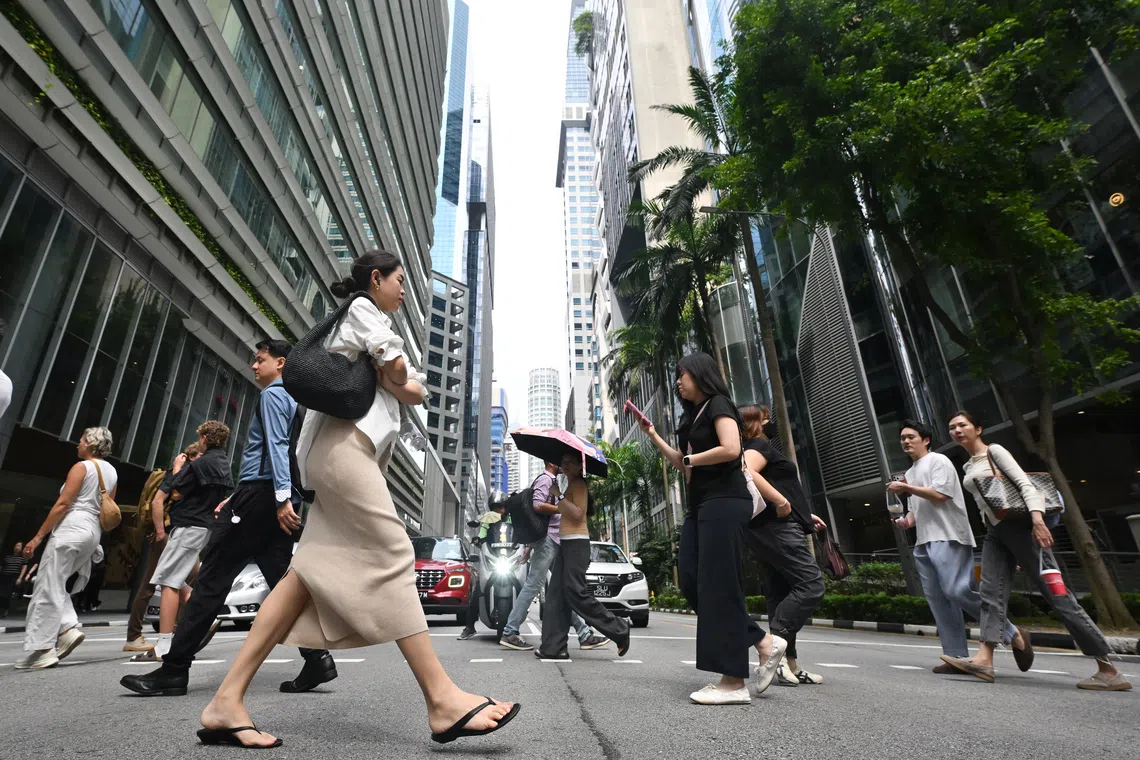
The Government will support HR certification through subsidies and SkillsFuture credits, aiming to double the number of certified HR professionals to 18,000 by 2030.
ST PHOTO: LIM YAOHUI
Published Sep 24, 2026, 10:00 AM
Updated Sep 24, 2026, 01:25 PM
From July 1, 2028, companies in Singapore with over 200 employees must employ at least one certified HR professional to raise HR standards and support workers amidst workplace changes.
The government will support HR certification through subsidies and SkillsFuture credits, aiming to double certified HR professionals to 18,000 by 2030.
Other initiatives include AI tools for HR, job redesign, the Singapore Opportunity Index for career mobility, and leadership programmes launching in 2027 to develop future people leaders.
SINGAPORE – Organisations with more than 200 employ ees will be required to have at least one suitably certified huma n resources (H R) professional from July 1, 20 28, as part of a wider push to raise HR standards and help businesses and workers navigate changes in the workplace.
The requirement is among a series of initiatives arising from recommendations by the Tripartite Workgroup on Human Capital Capability Deve lopment (T WG-HC), which the Government has accepted.
Responding to queries from The Straits Times, Institute for Human Resource Professionals (IHRP) chief executive Aslam Sardar said the certification requirement would help create greater consistency and quality in HR practices, as HR professionals increasingly make decisions involving workforce strategy, skills and organisational transformation.
A common professional baseline would also give employers greater confidence in workforce decisions, he added.
The TWG-HC, co-chaired by the Ministry of Manpower, National Trades Union Congress and Singapore National Employers Fed eration (SNE F), launched its report on Sept 24 at the IHRP’s Peop le Behin d People forum.
In his welcome address at the forum, Sardar said the flagship event was “by far the biggest” that had taken place since its inception. Its inaugural edition was held in December 2020.
The report that was launched on Sept 24, titled Opportunity By Design: Strengthening Human Capital In Every Workplace For Every Worker, said a good job is defined not only by the role or salary it offers today, but also by the opportunities it creates for workers over time.
It also said workers increasingly want fair treatment, room to grow, flexibility to accommodate other priorities in their lives and careers that can last.
It added that “opportunity is not a matter of chance but of design”, with top-performing organisations in the Singapore Opportunity Index distinguished by deliberate choices about how jobs are designed, employees are developed and leaders act.
On artificial intelligence , the report said businesses that fail to pay sufficient attention to their people may struggle to turn AI investments into lasting value, while workers may experience the changes mainly as disruption.
When adopted deliberately, however, AI could augment workers’ roles, improve performance and create better opportunities for them.
IHRP head of professional standards and development Karina Kuok, in response to separate queries, said HR professionals would need to understand when to use AI, how to challenge its outputs and “when a human decision must remain at the centre”.
The T WG-HC was convened in February 2025 to address trends reshaping work and workplaces, including rapid technological advancement and rising longevity.
Over 1½ years, the work group engaged more than 1, 000 e mployers, workers, HR professionals and representatives from trade associations and chambers, HR institutions, academia and government agencies.
Its recommendatio ns aim to benefit more than two million workers, support at least 2 ,000 en terprises and build the capabilities of 20,000 HR professionals and people leaders.
Under the new requirement, organisations with more than 2 00 emp loyees must have at least one HR professional certified at the IHRP Certified Professional (IHRP-CP) level or higher.
Equivalent certifications from other international HR professional bodies recognised by IHRP will also be accepted, subject t o b ridging requirements.
Minister of State for Manpower and Trade and Industry Foo Cexiang said in his opening address at the forum that certification would give employers confidence that their HR teams can advise leaders well, while giving workers greater assurance that decisions affecting their careers are guided by recognised professional and ethical standards.
(From left) Minister of State for Manpower and Trade and Industry Foo Cexiang, Singapore National Employers Federation president Kuah Boon Wee, NTUC assistant secretary-general Patrick Tay and Kenny Tan, deputy secretary (workforce) at the Ministry of Manpower, at the launch of the Tripartite Workgroup on Human Capital Capability Development report. ST PHOTO: GIN TAY
(From left) Minister of State for Manpower and Trade and Industry Foo Cexiang, Singapore National Employers Federation president Kuah Boon Wee, NTUC assistant secretary-general Patrick Tay and Kenny Tan, deputy secretary (workforce) at the Ministry of Manpower, at the launch of the Tripartite Workgroup on Human Capital Capability Development report.
“As technology makes workforce decisions more complex, this foundation of trust matters much more,” said Foo.
He said the move, together with other tripartite efforts, is expected to grow the pool of certified HR professionals from 9,000 to a round 18,00 0, or 40 per cent of the HR workforce, by 2030.
He added that the TWG-HC’s five recommendations, which the Government has accepted, fall under three broad thrusts: making opportunity visible and measurable, putting people at the heart of business transformation, and strengthening the HR profession and people leadership.
Additional support to encourage certification
The Government will also provide additional support to encourage HR professionals to obtain certification ahead of the requirement.
On top of existing subsidies for Singapore residents, an additional $100 subsidy will be provided from Oct 1, 2 026, to Jun e 30, 2028.
This will bring the fees down to $16 3.50 for IHRP-CP certification and $272.50 for IHRP Senior Professional certification. Both certifications are valid for three years.
Organisations will be able to use their SkillsFuture Enterprise Credits to offset the remaining out-of-pocket fees for their HR professionals.
The work group’s other recommendations include initiatives aimed at helping companies redesign jobs, adopt AI and create better career opportunities for workers.
AI ‘starter kits’ for HR
One initiative is the People-Centred AI Transformation for HR, or PATH, a multi-agency effort to help businesses and HR professionals navigate the impact of AI on jobs, skills and workforce practices.
Under PATH, IHRP and the Skills and Workforce Development Agency will develop AI “starter kits” for HR, bringing together suitable AI solutions with practical implementation guidance, consultancy, training and funding support to help enterprises apply AI to HR use cases.
IHRP will also work with training providers to introduce more accredited programmes aligned with 12 new IHRP AI Fluency Skills Badges.
Adrenalin Group managing director Jeremy Tan, in response to separate queries from ST, said the biggest challenge for small and medium-sized enterprises was “bandwidth”, with lean teams already juggling growth, costs, customers and manpower needs.
He said AI adoption and workforce development should be “the same journey”, with AI used to remove repetitive work and allow employees to focus on higher-value tasks.
Foo cautioned that companies have to consider how AI adoption affects the development of workers, particularly those starting their careers.
“If we automate every entry-level task, we may improve efficiency today but weaken the pipeline of expertise for tomorrow,” he said.
Companies should instead redesign jobs and learning pathways together, using AI to augment experienced workers while giving newer workers structured exposure and progressively more complex responsibilities.
“There is no shortcut to judgment. Before we can expect workers to connect the dots, we must make sure they first have the opportunity to collect the dots,” Foo said.
Another recommendation centres on the Singapore Opportunity Index launched in 2025 as a national benchmark for the opportunities that employers create for workers.
Using verified administrative data to measure how career mobility is shaped in the workplace, the index aims to help workers make more informed career decisions and employers assess the impact of their human capital strategies.
‘Good workforce practices do more than fill jobs’
Foo added that workers should look beyond salary and job titles when evaluating opportunities, including whether employers provide opportunities to learn and progress.
“Good workforce practices do more than fill jobs. They widen horizons and shape careers,” he said.
The remaining recommendations include helping enterprises build people capabilities into their growth strategies and developing people leaders for the future.
An inaugural human capital programme by the Human Capital Leadership Institute and its partners will be launched in 2027 to develop the next generation of senior people leaders. The Government will provide funding support for Singaporean HR and business leaders.
Separately at the Sept 24 forum, Ngee Ann Polytechnic unveiled its new Centre for Workplace Well-being , or coWELL, to help organisations support workers through change and build a more resilient workforce.
政府将通过补贴和技能创前程补助金支持人力资源认证,目标是到 2030 年将获得认证的人力资源专业人员数量翻一番,达到 18,000 人。
ST 照片:林耀辉
发布于2026年9月24日上午10:00
更新于2026年9月24日下午1:25
从 2028 年 7 月 1 日起,新加坡拥有 200 名以上员工的公司必须至少聘用一名获得认证的人力资源专业人员,以提高人力资源标准,并在工作场所变化中为员工提供支持。
政府将通过补贴和技能创前程培训补助来支持人力资源认证,目标是到 2030 年将获得认证的人力资源专业人员数量翻一番,达到 18,000 人。
其他举措包括人力资源人工智能工具、工作重新设计、新加坡职业流动性机会指数,以及将于 2027 年启动的领导力培养计划,旨在培养未来的领导者。
新加坡——从 2028 年 7 月 1 日起,拥有 200 名以上员工的机构将被要求至少配备一名合格的人力资源 (HR) 专业人员,这是提高人力资源标准并帮助企业和员工应对工作场所变化的更广泛举措的一部分。
这项要求是政府接受的人力资本能力发展三方工作组(T WG-HC)建议的一系列举措之一。
针对《海峡时报》的询问,人力资源专业人士协会 (IHRP) 首席执行官 Aslam Sardar 表示,认证要求将有助于提高人力资源实践的一致性和质量,因为人力资源专业人士越来越多地参与涉及劳动力战略、技能和组织转型的决策。
他还补充说,统一的专业标准也能让雇主对用工决策更有信心。
由人力部、全国职工总会和新加坡全国雇主联合会(SNEF)共同主持的TWG-HC于9月24日在IHRP的“人背后的人”论坛上发布了其报告。
萨达尔在论坛的欢迎致辞中表示,此次旗舰活动是自创办以来规模“迄今为止最大”的一次。该论坛的首届活动于2020年12月举行。
9 月 24 日发布的这份题为《通过设计创造机会:加强每个工作场所中每个员工的人力资本》的报告指出,一份好工作的定义不仅在于它今天提供的职位或薪水,还在于它随着时间的推移为员工创造的机会。
报告还指出,员工越来越希望获得公平的待遇、发展空间、灵活的工作安排以兼顾生活中的其他优先事项,以及能够长久的职业生涯。
报告还指出,“机会并非偶然,而是精心设计的”,新加坡机会指数中表现最佳的组织之所以脱颖而出,是因为它们在工作设计、员工培养和领导者行为方面都经过了深思熟虑。
报告指出,关于人工智能,如果企业未能充分关注员工,可能难以将人工智能投资转化为持久价值,而员工可能会将这些变化主要视为干扰。
然而,如果运用得当,人工智能可以增强员工的作用,提高绩效,并为他们创造更好的机会。
IHRP 专业标准与发展主管 Karina Kuok 在回答其他问题时表示,人力资源专业人士需要了解何时使用人工智能,如何质疑其输出结果,以及“何时必须以人为决策为中心”。
T WG-HC 于 2025 年 2 月召开,旨在应对正在重塑工作和工作场所的趋势,包括技术的快速进步和寿命的延长。
在一年半的时间里,该工作组与 1000 多名雇主、工人、人力资源专业人士以及来自行业协会和商会、人力资源机构、学术界和政府机构的代表进行了交流。
该机构的建议旨在惠及超过 200 万名员工,支持至少 2000 家企业,并提升 2 万名人力资源专业人员和人事领导者的能力。
根据新规定,拥有 200 名以上员工的组织必须至少有一名人力资源专业人员获得 IHRP 认证专业人员 (IHRP-CP) 级别或更高级别的认证。
经 IHRP 认可的其他国际人力资源专业机构颁发的同等证书也将被接受,但需满足桥梁要求。
人力及贸易工业部政务部长傅策祥在论坛开幕致辞中表示,认证将使雇主相信其人力资源团队能够为领导者提供良好的建议,同时也将使员工更加确信,影响其职业生涯的决策是按照公认的专业和道德标准指导的。
(从左至右)人力部兼贸易及工业部政务部长符策祥、新加坡全国雇主联合会主席郭文伟、全国职工总会助理秘书长郑文杰以及人力部副秘书长(劳动力)陈建国出席人力资本能力发展三方工作组报告发布会。海峡时报摄影:金泰
(从左至右)人力部兼贸易及工业部政务部长傅策祥、新加坡全国雇主联合会主席郭文伟、全国职工总会助理秘书长郑德源和人力部副秘书长(劳动力)陈建国在人力资本能力发展三方工作组报告发布会上合影。
“随着科技的发展,劳动力决策变得越来越复杂,这种信任基础就显得更加重要了,”Foo说道。
他表示,这项举措,加上其他三方努力,预计到 2030 年,认证人力资源专业人员的数量将从 9,000 人增加到约 18,000 人,占人力资源从业人员的 40%。
他还补充说,政府已经接受了TWG-HC的五项建议,这些建议主要围绕三个方面:使机会可见且可衡量,将人置于业务转型的核心,以及加强人力资源专业和人员领导力。
为鼓励认证提供额外支持
政府还将提供额外支持,鼓励人力资源专业人士在要求生效前获得认证。
除了新加坡居民现有的补贴外,从 2026 年 10 月 1 日至 2028 年 6 月 30 日,还将额外提供 100 美元的补贴。
这将使IHRP-CP认证费用降至163.50美元,IHRP高级专业人员认证费用降至272.50美元。两种认证的有效期均为三年。
企业可以使用技能创前程企业培训补助金来抵消其人力资源专业人员剩余的自付费用。
工作组的其他建议包括旨在帮助公司重新设计工作岗位、采用人工智能以及为员工创造更好的职业发展机会的举措。
面向人力资源的AI“入门套件”
其中一项举措是“以人为本的人力资源人工智能转型”(PATH),这是一项多机构合作项目,旨在帮助企业和人力资源专业人士应对人工智能对工作、技能和劳动力实践的影响。
在 PATH 计划下,IHRP 和技能与劳动力发展署将开发用于人力资源的 AI“入门套件”,将合适的 AI 解决方案与实际实施指导、咨询、培训和资金支持结合起来,以帮助企业将 AI 应用于人力资源用例。
IHRP 还将与培训机构合作,推出更多与 12 个新的 IHRP 人工智能熟练度技能徽章相一致的认证课程。
Adrenalin Group 董事总经理 Jeremy Tan 在回复《海峡时报》的单独询问时表示,中小企业面临的最大挑战是“带宽”,精简的团队已经疲于应对增长、成本、客户和人力需求。
他表示,人工智能的应用和劳动力发展应该是“同一条道路”,人工智能可以用来消除重复性工作,让员工专注于更有价值的任务。
Foo 提醒说,企业必须考虑人工智能的应用会对员工的发展产生怎样的影响,尤其是那些刚开始职业生涯的员工。
他说:“如果我们把所有入门级任务都自动化,我们或许能提高今天的效率,但却会削弱未来人才的储备。”
企业应该重新设计工作岗位和学习路径,利用人工智能增强经验丰富的员工的能力,同时为新员工提供结构化的工作机会和逐步增加的复杂职责。
“判断没有捷径。在我们期望员工能够将各个环节联系起来之前,我们必须确保他们首先有机会收集这些信息,”Foo说道。
另一项建议是,新加坡将于 2025 年推出“新加坡机会指数”,作为衡量雇主为员工创造机会的国家基准。
该指数利用经过验证的行政数据来衡量职场中职业流动性的形成方式,旨在帮助员工做出更明智的职业决策,并帮助雇主评估其人力资本战略的影响。
良好的人力资源管理实践不仅仅能填补职位空缺。
Foo补充说,员工在评估工作机会时,除了薪资和职位头衔之外,还应该考虑雇主是否提供学习和晋升的机会。
“良好的用工制度不仅仅能填补职位空缺,还能拓宽视野,塑造职业生涯,”他说道。
其余建议包括帮助企业将人才能力融入其增长战略,以及为未来培养人才领导者。
由人力资本领导力研究院及其合作伙伴共同发起的首个人力资本计划将于2027年启动,旨在培养下一代高级人力资源领导者。政府将为新加坡的人力资源和商业领袖提供资金支持。
在 9 月 24 日的论坛上,义安理工学院还推出了新的工作场所福祉中心(coWELL),旨在帮助企业支持员工应对变革,并建立更具韧性的员工队伍。