ACM's new exhibition brings Mogao Caves and over 1,000 years of Silk Road art to SingaporeACM 的新展览将莫高窟和一千多年的丝绸之路艺术带到新加坡
At the Asian Civilisations Museum's Sacred Caves: Dunhuang, Buddhism, and the Silk Road exhibition, visitors can explore Silk Road artefacts, an original soundscape, interactive digital experiences and an island-spanning stamp trail.
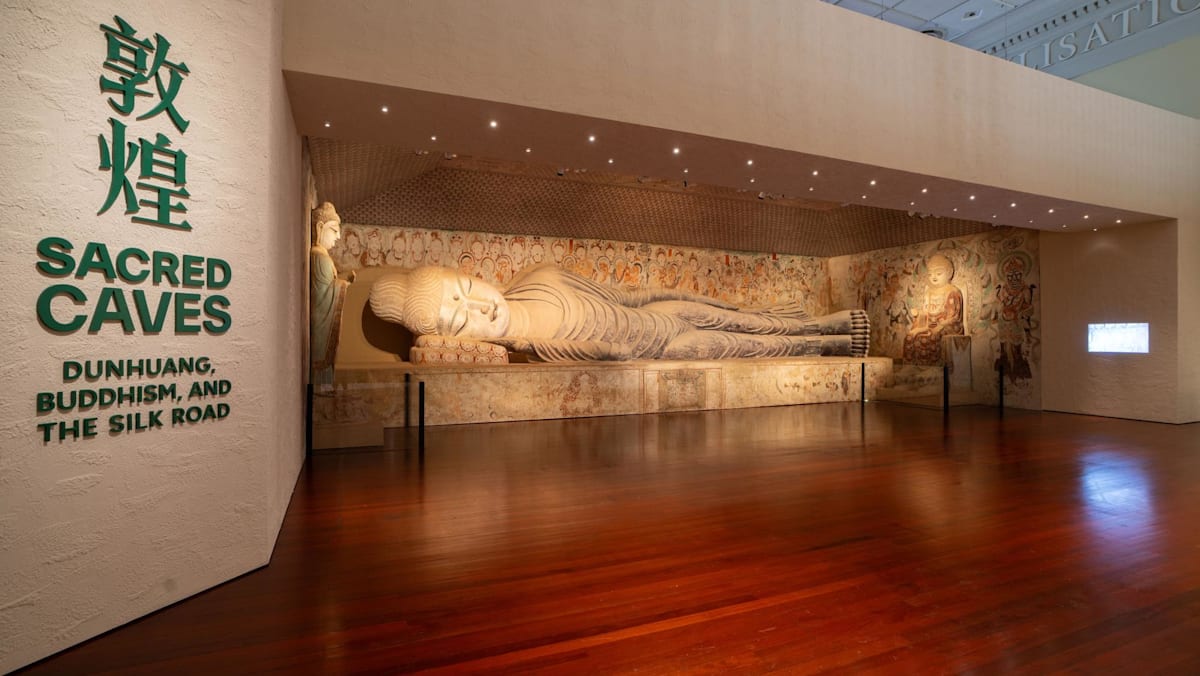
At the Asian Civilisations Museum's Sacred Caves: Dunhuang, Buddhism, and the Silk Road exhibition, visitors can explore Silk Road artefacts, an original soundscape, interactive digital experiences and an island-spanning stamp trail.
Bringing together original paintings, sculptures, manuscripts, textiles, and devotional objects, Sacred Caves: Dunhuang, Buddhism, and the Silk Road runs from Sep 25, 2026 to Mar 7, 2027. (Photo: Asian Civilisations Museum)
This audio is generated by an AI tool.
Four life-size reproductions of China's Mogao Caves are coming to Singapore for the first time as part of a new exhibition at the Asian Civilisations Museum (ACM).
Titled Sacred Caves: Dunhuang, Buddhism, and the Silk Road, the exhibition is presented in collaboration with the Dunhuang Academy and brings together the cave reproductions with paintings, sculptures, manuscripts, textiles and devotional objects spanning more than a thousand years of Buddhist art and cultural exchange.
It runs from Sep 25, 2026 to Mar 7, 2027 across ACM's Level 2 Foyer and Special Exhibitions Gallery.
Located in northwestern China, Dunhuang was an important crossroads along the Silk Road, connecting China with Central Asia, India, the Middle East and Europe. Buddhism's rise in the region led to the Mogao Caves, a vast complex of Buddhist cave temples created between the fourth and 14th centuries.
The Mogao Caves, a UNESCO World Heritage Site, preserve a record of life in Dunhuang along with art and cultural trade along the Silk Road. (Photo: UNESCO/Neville Agnew)
Three of the four caves recreated for the exhibition are either restricted or completely closed to visitors at the original site in Dunhuang.
The largest reproduction, Cave 158, will occupy ACM's Level 2 Foyer. Dating to the Tang dynasty, the cave contains the largest reclining Buddha at Mogao, depicting the historical Buddha Shakyamuni entering nirvana as mourners from different regions grieve around him.
Inside the Special Exhibitions Gallery, visitors can explore reproductions of other caves.
Cave 249 brings together figures from Buddhist and Chinese mythology in its depiction of the cosmos, while Cave 45 centres on a Tang dynasty sculptural ensemble. Cave 3, meanwhile, is known for the fluid brushwork of its wall paintings.
A ceiling painting with three hares in Cave 407. (Photo: Asian Civilisations Museum)
Beyond the caves themselves, the exhibition looks at the people, beliefs and movement of ideas that shaped the city of Dunhuang.
The gallery is divided into three themes – City, Devotion and People – examining Dunhuang as a centre of trade, religious life at the Mogao Caves and the communities that created and sustained them.
Among the objects on display are a Tang dynasty travel pass and a coin from Sassanid Iran. Visitors can also see depictions of rulers, monks and powerful women, as well as artists' tools revealing how the sculptures at Mogao were constructed. The latter is being shown outside Dunhuang for the first time.
Visitors can also take part in a digital trail associated with Dunhuang as they move through the museum. (Photo: Asian Civilisations Museum)
The exhibition also incorporates sound and interactive elements.
Composer Sulwyn Lok has created three original pieces inspired by the musical cultures of Dunhuang and the Silk Road, using instruments including the bansuri, yangqin, dizi, ruan, cello, saron and bonang.
Visitors can also take part in a digital trail using RFID-enabled paintbrushes to "collect" colours associated with Dunhuang as they move through the museum. The colours can then be used to create a digital wallpaper and a portrait of themselves dressed in Mogao cave-inspired costumes.
A separate stamp rally extends beyond ACM to the Bank of China and The Fullerton Hotel. From Oct 2, visitors who collect at least six stamps can redeem a blind-box apsara figurine.
Outside the museum, a six-metre inflatable apsara installation will also serve as a photo spot on ACM Green.
For more information on the exhibition and its ticketing fees, visitors can visit the official website .
A single handpicked story that we think you shouldn't miss. Just one a day.
在亚洲文明博物馆的“神圣石窟:敦煌、佛教与丝绸之路”展览中,参观者可以探索丝绸之路文物、原创音景、互动数字体验以及横跨全岛的集邮路线。
“神圣石窟:敦煌、佛教与丝绸之路”展览汇集了绘画、雕塑、手稿、纺织品和宗教用品等原作,展期为2026年9月25日至2027年3月7日。(图片:亚洲文明博物馆)
这段音频由人工智能工具生成。
作为亚洲文明博物馆(ACM)新展览的一部分,中国莫高窟的四个等比例复制品将首次来到新加坡。
本次展览名为“神圣的石窟:敦煌、佛教与丝绸之路”,由敦煌研究院协办,展出了石窟复制品以及绘画、雕塑、手稿、纺织品和宗教用品,涵盖了一千多年的佛教艺术和文化交流。
展览将于 2026 年 9 月 25 日至 2027 年 3 月 7 日在 ACM 的 2 楼大厅和特别展览馆举行。
敦煌位于中国西北部,是丝绸之路上的重要十字路口,连接中国与中亚、印度、中东和欧洲。佛教在该地区的兴起促成了莫高窟的建造,莫高窟是一座规模庞大的佛教石窟寺庙群,始建于公元4世纪至14世纪之间。
莫高窟是联合国教科文组织世界遗产,它保存了敦煌古城的生活记录,以及丝绸之路沿线的艺术和文化交流。(图片:联合国教科文组织/内维尔·阿格纽)
为本次展览而复原的四个洞窟中,有三个在敦煌原址要么受到限制,要么完全不对游客开放。
最大的复制品——158窟——将位于ACM二层大厅。该窟可追溯至唐代,洞内有莫高窟最大的卧佛,描绘了释迦牟尼佛涅槃的场景,来自各地的哀悼者环绕在他周围。
在特展馆内,参观者可以探索其他洞穴的复制品。
第249窟将佛教和中国神话中的人物形象融合在一起,描绘了宇宙万物;第45窟则以唐代雕塑群为中心;而第3窟则以其流畅的壁画笔法而闻名。
407窟洞顶壁画,描绘了三只兔子。(图片:亚洲文明博物馆)
除了石窟本身,展览还着眼于塑造敦煌这座城市的人民、信仰和思想运动。
展厅分为三个主题——城市、信仰和人民——探讨敦煌作为贸易中心、莫高窟的宗教生活以及创造和维系这些场所的社群。
展品包括唐代通行证和萨珊王朝时期的伊朗钱币。参观者还可以看到统治者、僧侣和杰出女性的画像,以及揭示莫高窟雕塑制作工艺的艺术家工具。后者是首次在敦煌以外的地方展出。
参观者在参观敦煌博物馆的同时,还可以参与与敦煌相关的数字导览活动。(图片:亚洲文明博物馆)
展览还融入了声音和互动元素。
作曲家洛克·苏尔温以敦煌和丝绸之路的音乐文化为灵感,创作了三首原创作品,使用的乐器包括班苏里笛、扬琴、笛子、阮、大提琴、沙龙琴和波南琴。
参观者还可以参与一项数字体验活动,使用配备RFID功能的画笔在博物馆内“收集”与敦煌相关的颜色。这些颜色随后可用于制作数字壁纸,以及一张身着莫高窟风格服饰的自画像。
另一项集章活动不仅限于亚洲文化中心,还包括中国银行和富丽敦酒店。从10月2日起,集齐至少六枚印章的游客即可兑换一个盲盒仙女雕像。
博物馆外,ACM Green 上还将设立一个 6 米高的充气仙女装置,作为拍照打卡点。
有关展览及其门票费用的更多信息,参观者可以访问官方网站。
每天一篇,我们精心挑选一篇您不容错过的精彩故事。