Singapore to support mRNA flu vaccine pilot to strengthen pandemic preparedness新加坡将支持mRNA流感疫苗试点项目,以加强应对疫情的准备工作
The initiative is part of Singapore's efforts to build adaptable vaccine capabilities, said Health Minister Ong Ye Kung.
The initiative is part of Singapore's efforts to build adaptable vaccine capabilities, said Health Minister Ong Ye Kung.
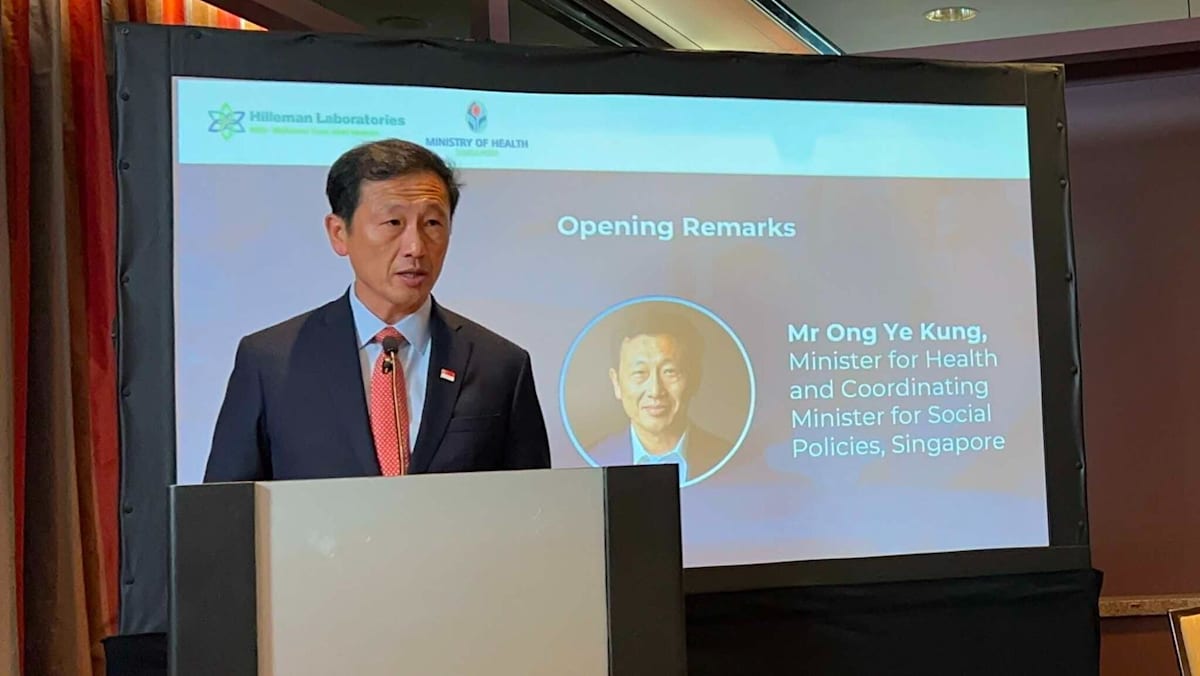
Mr Ong Ye Kung, Minister for Health and Coordinating Minister for Social Policies, speaking at the United Nations General Assembly side event on Outbreak Preparedness and Response by the Ministry of Health Singapore and Hilleman Laboratories in New York on Sep 23, 2026. (Photo: MOH)
This audio is generated by an AI tool.
SINGAPORE: Singapore plans to support the mRNA influenza vaccine pilot initiative in the country, Health Minister Ong Ye Kung said on Wednesday (Sep 23).
Speaking at the United Nations General Assembly side event on Outbreak Preparedness and Response in New York, Mr Ong said the initiative would serve a "peacetime need", while helping Singapore build up adaptable capabilities.
He added that he hoped Hilleman Laboratories could support the effort.
Hilleman, a vaccine research organisation, officially opened its US$20 million vaccine manufacturing facility in Singapore in 2023.
CNA Games Guess Word Crack the word, one row at a time Buzzword Create words using the given letters Mini Sudoku Tiny puzzle, mighty brain teaser Mini Crossword Small grid, big challenge Word Search Spot as many words as you can Show More Show Less Mr Ong said that Singapore is also working with companies such as Sanofi, GSK, Moderna and Thermo Fisher Scientific, which have capabilities across vaccine platforms and manufacturing. He noted that in a crisis, even a country's best plans and investments may not yield the most effective vaccine. "In fact I would say, most are not likely to. It may be discovered and developed by any of the many research teams around the world," Mr Ong said. Therefore, vaccine production facilities must be able to secure a licence, receive technology transfer and adapt their production lines quickly. Such facilities must remain "warm" in peacetime by producing needed vaccines and maintaining operational readiness, Mr Ong said. "You cannot simply turn on a dormant factory during an emergency and expect it to run smoothly," he added, noting that "preparedness is a living capability". POSSIBLE BUNDIBUGYO EBOLA VACCINE Mr Ong also announced that Hilleman’s Singapore facility is adapting manufacturing know-how from MSD's Zaire Ebola virus vaccine, ERVEBO, to accelerate the Bundibugyo vaccine candidate alongside support from the Coalition for Epidemic Preparedness Innovations (CEPI). There are currently no approved vaccines or drugs for the Bundibugyo Ebola virus The facility will produce material for early clinical trials, with the first batch available by the end of this year. Mr Ong said that Hilleman's production capacity could produce a drug substance equivalent to 50 to 60 million doses, or 12 million doses of drug product annually for this vaccine. Depending on needs, Hilleman could also make arrangements for the transfer of technology to a larger-scale manufacturer in the region. Mr Ong said that this showed "preparedness in action". "Existing science, an operating facility that is kept warm, and trusted partners to scale up – all of which shorten the path from threat to a full response," he added. "It offers us a possible approach in response to Disease X in future." Disease X is the name given to an unknown pathogen that could emerge in future and cause a serious international epidemic or pandemic, according to CEPI.
Mr Ong said that Singapore is also working with companies such as Sanofi, GSK, Moderna and Thermo Fisher Scientific, which have capabilities across vaccine platforms and manufacturing.
He noted that in a crisis, even a country's best plans and investments may not yield the most effective vaccine.
"In fact I would say, most are not likely to. It may be discovered and developed by any of the many research teams around the world," Mr Ong said.
Therefore, vaccine production facilities must be able to secure a licence, receive technology transfer and adapt their production lines quickly.
Such facilities must remain "warm" in peacetime by producing needed vaccines and maintaining operational readiness, Mr Ong said. "You cannot simply turn on a dormant factory during an emergency and expect it to run smoothly," he added, noting that "preparedness is a living capability".
POSSIBLE BUNDIBUGYO EBOLA VACCINE
Mr Ong also announced that Hilleman’s Singapore facility is adapting manufacturing know-how from MSD's Zaire Ebola virus vaccine, ERVEBO, to accelerate the Bundibugyo vaccine candidate alongside support from the Coalition for Epidemic Preparedness Innovations (CEPI).
There are currently no approved vaccines or drugs for the Bundibugyo Ebola virus
The facility will produce material for early clinical trials, with the first batch available by the end of this year.
Mr Ong said that Hilleman's production capacity could produce a drug substance equivalent to 50 to 60 million doses, or 12 million doses of drug product annually for this vaccine.
Depending on needs, Hilleman could also make arrangements for the transfer of technology to a larger-scale manufacturer in the region.
Mr Ong said that this showed "preparedness in action".
"Existing science, an operating facility that is kept warm, and trusted partners to scale up – all of which shorten the path from threat to a full response," he added.
"It offers us a possible approach in response to Disease X in future."
Disease X is the name given to an unknown pathogen that could emerge in future and cause a serious international epidemic or pandemic, according to CEPI.
"FOCUSED CONTRIBUTION"
Should regional efforts stall during an emergency, Singapore could make a "focused contribution" together with its partners, Mr Ong said.
He outlined several areas, one being a vigilant global surveillance system that detects dangerous pathogens early, which rests on platforms where scientists and governments are willing to share data willingly and quickly.
Singapore already works closely with GISAID, a leading international repository of genomic data for SARS-CoV-2, mpox and influenza viruses.
Mr Ong highlighted how Singapore’s National Public Health Laboratory, in late July, detected a recombinant form of SARS-CoV-2, the coronavirus that causes COVID-19, through routine genomic surveillance.
At the time of assessment, it was the only such sequence detected in Singapore, with no closely matching sequence identified in GISAID’s database.
Mr Ong noted that the patient had mild illness and recovered, and no further local cases were detected, while the sequence was submitted on the GISAID platform for global analysis.
"A country that reports an unusual pathogen may worry ... about reputational or economic consequences," said the minister.
"The answer is not to delay reporting, but to build international norms that recognise transparency as responsible conduct."
Mr Ong also called for support for CEPI's 100-day mission, noting that it has made significant progress towards developing safe, effective and accessible vaccines for initial authorisation and manufacturing at scale within 100 days of identifying a pandemic threat.
"The strategy is to do as much work as possible before the crisis, by building prototype vaccine libraries for representative viruses, validating adaptable platforms, and preparing laboratories, clinical-trial networks, manufacturers and regulators to move in concert."
Singapore is aligning its vaccine development efforts under its Prepvax research initiative with CEPI's mission, Mr Ong said. PrepVax is a national programme established by the Ministry of Health to organise vaccine development capabilities across Singapore's public and private institutions.
Lastly, vaccines must be evaluated, approved and deployed quickly without compromising safety and quality.
Trust built in peacetime allows authorities to rely on one another’s assessments, share workloads and reduce duplication, because during a crisis, regulators tend to operate with "urgency and incomplete information", Mr Ong noted.
The nature of Disease X is likely be novel, deadly and fast-spreading, but the minister said mRNA could offer the greatest flexibility in development and time to market, which is why Singapore plans to support the mRNA influenza vaccine pilot initiative
"To prepare for Disease X, we must resist denial, stigma, unfairness and the temptation to retreat behind national borders when global co-operation is most needed," he added.
"We need to cooperate with each other, place our confidence in science and put in place overlapping and complementary plans ahead of time.
"The next outbreak will not wait for us to smoothen every kink and settle every disagreement. Preparedness must therefore be built now - patiently, practically and together."
Get our pick of top stories and thought-provoking articles in your inbox
Stay updated with notifications for breaking news and our best stories
Join our channel for the top reads for the day on your preferred chat app
卫生部长王乙康表示,这项举措是新加坡为建立适应性疫苗接种能力而努力的一部分。
2026年9月23日,新加坡卫生部长兼社会政策统筹部长王乙康先生在纽约联合国大会期间,出席由新加坡卫生部和希勒曼实验室联合举办的“疫情防范与应对”边会并发表讲话。(图片:新加坡卫生部)
这段音频由人工智能工具生成。
新加坡:新加坡卫生部长王乙康周三(9月23日)表示,新加坡计划支持该国的mRNA流感疫苗试点计划。
王乙康先生在纽约举行的联合国大会疫情防范和应对边会上发表讲话时表示,该倡议将满足“和平时期的需求”,同时帮助新加坡建立适应能力。
他还表示,希望希勒曼实验室能够支持这项工作。
疫苗研究机构 Hilleman 于 2023 年在新加坡正式启用其价值 2000 万美元的疫苗生产设施。
CNA游戏 猜词游戏 逐行破解单词 流行词游戏 用给定的字母组成单词 迷你数独 小谜题,脑力挑战 迷你填字游戏 小方格,大挑战 单词搜索 尽可能多地找出单词 显示更多 显示更少 王先生表示,新加坡也在与赛诺菲、葛兰素史克、莫德纳和赛默飞世尔科技等公司合作,这些公司在疫苗平台和生产方面拥有强大的能力。他指出,在危机时期,即使是一个国家最好的计划和投资也可能无法产生最有效的疫苗。“事实上,我认为大多数国家都不太可能。它可能是由世界各地众多研究团队中的任何一个发现和开发的,”王先生说。因此,疫苗生产设施必须能够获得许可证、接受技术转让并迅速调整其生产线。王先生表示,这些设施必须在和平时期保持“运转”,生产所需的疫苗并维持运营准备状态。“你不能在紧急情况下简单地启动一个闲置的工厂,并期望它能顺利运行,”他补充道,并指出“准备是一种动态的能力”。可能的邦迪布焦埃博拉疫苗 翁先生还宣布,希勒曼公司位于新加坡的工厂正在借鉴默沙东公司扎伊尔埃博拉病毒疫苗ERVEBO的生产技术,在流行病防范创新联盟(CEPI)的支持下,加速邦迪布焦埃博拉候选疫苗的研发。目前尚无获批的邦迪布焦埃博拉病毒疫苗或药物。该工厂将生产用于早期临床试验的原料,首批原料将于今年年底前交付。翁先生表示,希勒曼公司的产能每年可生产相当于5000万至6000万剂疫苗的原料药,或1200万剂疫苗制剂。根据需要,希勒曼公司还可以安排将技术转让给该地区规模更大的生产商。翁先生表示,这体现了“积极应对的准备”。他补充道:“现有的科学技术、保持温暖的运行设施以及值得信赖的合作伙伴,共同扩大规模——所有这些都缩短了从威胁到全面应对的路径。这为我们未来应对X疾病提供了一种可能的方案。”根据流行病防范创新联盟(CEPI)的定义,X疾病是指未来可能出现并引发严重国际流行病或大流行病的未知病原体。
王先生表示,新加坡也在与赛诺菲、葛兰素史克、莫德纳和赛默飞世尔科技等公司合作,这些公司在疫苗平台和生产方面都拥有强大的能力。
他指出,在危机时期,即使一个国家拥有最好的计划和投资,也可能无法获得最有效的疫苗。
“事实上,我认为大多数人不太可能做到。世界各地的众多研究团队中的任何一个都有可能发现并开发它,”翁先生说。
因此,疫苗生产设施必须能够获得许可证、接受技术转让并迅速调整其生产线。
王先生表示,此类设施在和平时期必须保持“运转状态”,生产所需的疫苗并维持运行准备状态。他补充说:“你不能简单地在紧急情况下启动一家闲置的工厂,就指望它能顺利运转。”他还指出,“准备工作是一种动态能力”。
可能的本迪布焦埃博拉疫苗
Ong 先生还宣布,Hilleman 的新加坡工厂正在借鉴 MSD 的扎伊尔埃博拉病毒疫苗 ERVEBO 的生产技术,在流行病防范创新联盟 (CEPI) 的支持下,加速 Bundibugyo 疫苗候选产品的研发。
目前尚无获批的疫苗或药物用于治疗邦迪布焦埃博拉病毒
该工厂将生产用于早期临床试验的材料,首批材料将于今年年底前交付。
Ong 先生表示,Hilleman 的生产能力每年可生产相当于 5000 万至 6000 万剂的药物原料,或 1200 万剂疫苗制剂。
根据需要,希勒曼还可以安排将技术转让给该地区规模更大的制造商。
王先生表示,这表明“准备工作正在付诸行动”。
“现有的科学技术、保持温暖的运行设施以及值得信赖的合作伙伴来扩大规模——所有这些都缩短了从威胁到全面应对的路径,”他补充道。
“它为我们未来应对X疾病提供了一种可能的方法。”
根据流行病防范创新联盟(CEPI)的说法,X 疾病是指未来可能出现并引起严重的国际流行病或大流行病的未知病原体的名称。
“专注贡献”
王乙康先生表示,如果区域合作在紧急情况下停滞不前,新加坡可以与其合作伙伴一起做出“有针对性的贡献”。
他概述了几个领域,其中之一是建立警惕的全球监测系统,以便及早发现危险病原体,而这依赖于科学家和政府愿意自愿、迅速地共享数据的平台。
新加坡已与 GISAID 建立了密切的合作关系,GISAID 是国际领先的 SARS-CoV-2、痘病毒和流感病毒基因组数据存储库。
王先生强调,新加坡国家公共卫生实验室在7月下旬通过常规基因组监测,检测到了SARS-CoV-2(导致COVID-19的冠状病毒)的重组形式。
评估时,这是在新加坡检测到的唯一此类序列,GISAID 数据库中没有发现密切匹配的序列。
Ong 先生指出,该患者病情轻微,已经康复,并且没有发现其他本地病例,同时该序列已提交到 GISAID 平台进行全球分析。
这位部长说:“一个国家如果报告发现不寻常的病原体,可能会担心……声誉或经济后果。”
“解决之道不是拖延报告,而是建立将透明度视为负责任行为的国际规范。”
王先生还呼吁支持流行病防范创新联盟(CEPI)的百日计划,并指出该联盟在发现大流行病威胁后的100天内,在开发安全、有效且易于获取的疫苗方面取得了重大进展,以便进行初步授权和大规模生产。
“我们的策略是在危机爆发前尽可能多地开展工作,包括为代表性病毒构建原型疫苗库、验证可适应的平台,以及让实验室、临床试验网络、制造商和监管机构做好协同行动的准备。”
王乙康先生表示,新加坡正通过其PrepVax研究计划,调整疫苗研发工作,使其与流行病防范创新联盟(CEPI)的使命保持一致。PrepVax是新加坡卫生部设立的一项国家计划,旨在整合新加坡公立和私立机构的疫苗研发能力。
最后,必须在不影响安全性和质量的前提下,快速对疫苗进行评估、批准和部署。
王先生指出,和平时期建立的信任使当局能够依靠彼此的评估,分担工作量,减少重复劳动,因为在危机期间,监管机构往往是在“紧急且信息不完整”的情况下运作。
X疾病的特性很可能是新型的、致命的且传播迅速,但部长表示,mRNA技术在研发和上市时间方面具有最大的灵活性,因此新加坡计划支持mRNA流感疫苗试点项目。
“为了应对X疾病,我们必须抵制否认、污名化、不公平以及在全球合作最为迫切的时候退守国界的诱惑,”他补充道。
“我们需要互相合作,相信科学,并提前制定重叠和互补的计划。”
“下一次疫情爆发不会等我们把所有问题都解决、所有分歧都消除。因此,现在就必须做好准备——耐心、务实、齐心协力。”
订阅我们的邮件,即可获取精选热点新闻和引人深思的文章。
订阅通知,第一时间获取突发新闻和精彩报道。
加入我们的频道,即可在您常用的聊天应用上获取当日热门文章。