New AI tool for SBST buses aims to tackle uneven bus arrival times, to be rolled out in early 2027新加坡公交公司(SBST)将推出一款新的人工智能工具,旨在解决公交车到站时间不规律的问题,该工具将于2027年初投入使用。
SBS Transit trials AI tool FlowOS to manage bus intervals by combining live data and human judgement for improved service reliability and efficiency. Read more at straitstimes.com.
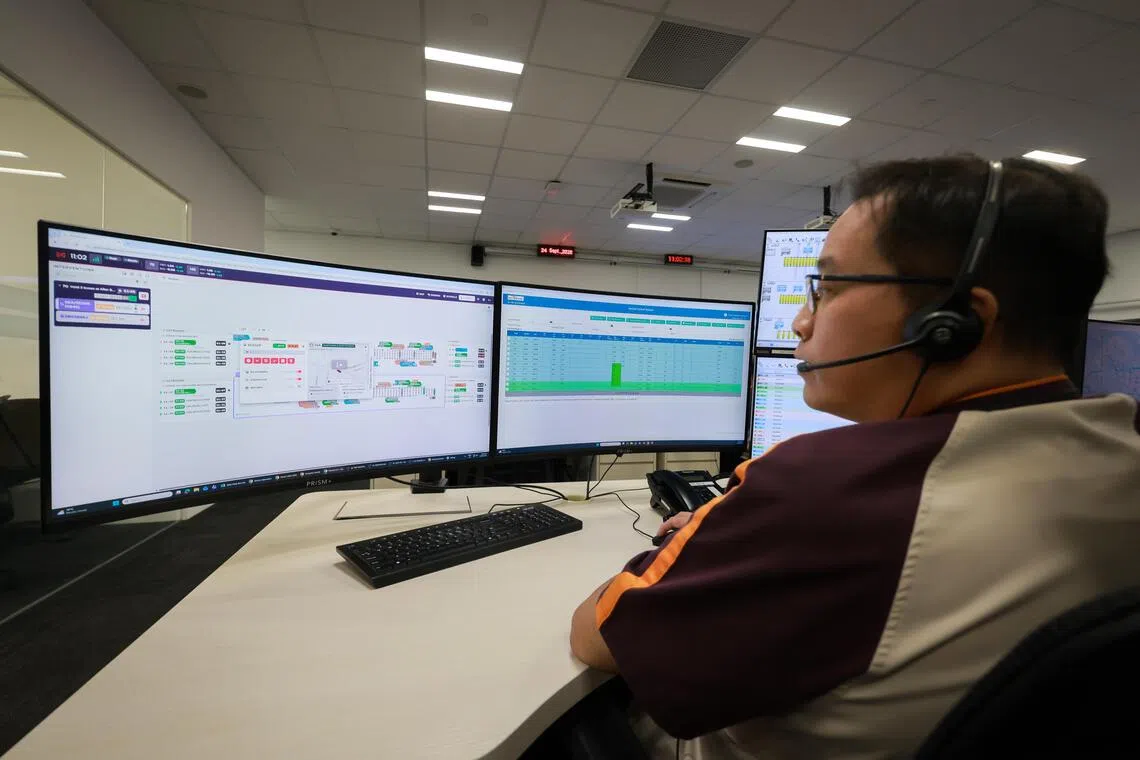
SBS Transit senior service controller Calvin Chan scanning recommendations made by AI at Seletar Bus Depot.
Published Sep 24, 2026, 03:57 PM
Updated Sep 24, 2026, 03:57 PM
SINGAPORE – An artificial intelligence co-pilot will soon be deployed by SBS Transit as part of efforts to tackle issues like bus bunching, when two or more buses arrive together instead of at regular intervals.
The AI tool, called FlowOS, is now undergoing trials on bus service 70 and 145. It will undergo trials on seven other bus routes over time before the trial wraps up in March 2027.
It will then be deployed to the entire SBST bus fleet in the second quarter of the year.
The AI tool combines historical data – including any observable patterns across different days and times – with live information, such as the current location of a bus.
If two buses plying the same route get too close to each other, the system alerts a service controller to signal that steps need to be taken, and provides suggestions on what steps can help solve the problem.
The person manning the controls makes the final decision, and can choose to accept the AI tool’s suggestions, reject it or modify it before giving out instructions to bus drivers on the road.
SBS Transit group chief executive Jeffrey Sim said the tool is meant to help its service controllers make better-informed decisions and respond more effectively when there are any issues.
“Keeping buses running at regular intervals is one of the most complex aspects of bus operations, especially when conditions on the road can be dynamic and unpredictable,” he added .
On Sept 24, reporters were given a first-hand look at how FlowOS works during a visit to Seletar Bus Depot in Yio Chu Kang.
Senior service controller Calvin Chan, 45, said he had to manually scan his screen to check if buses were bunching up b efore the AI tool came along.
Chan, who usually oversees between 60 and 80 buses spread across five different routes, said the tool has been a great help.
Ong Jack Sen, the head of operations control and support for SBS Transit’s bus business, said: “Feedback from service controllers was that it was cognitively challenging to monitor so many buses.”
Chan said the sheer volume of vehicles meant he sometimes missed those that needed him to take action, especially since he also needed to contact the drivers and ask them to slow down or stop for a few minutes.
FlowOS, however, automatically identifies buses that need attention, listing them on the extreme left of the screen, and thus removing the need for constant manual monitoring.
It also suggests when buses should be deployed from interchanges.
With 10 years of experience under his belt, Chan said there are times when he chooses to reject the AI tool’s suggestions.
He said: “I use my experience and judgement to decide the best response for the service.
“If the algorithm recommends slowing a bus down by four minutes, I might ask the driver to slow down by two minutes, depending on my instinct.”
Aqil Hamzah is a transport journalist at The Straits Times. He is also interested in issues related to crime and technology.
AI/artificial intelligence
新捷运高级服务主管陈先生正在查看实里达巴士车厂人工智能提出的建议。
发布于 2026 年 9 月 24 日下午 3:57
更新于2026年9月24日下午3:57
新加坡——新捷运公司(SBS Transit)即将部署人工智能副驾驶系统,以解决诸如公交车扎堆(即两辆或多辆公交车同时到达,而不是按固定时间间隔到达)等问题。
这款名为 FlowOS 的人工智能工具目前正在 70 路和 145 路公交线路上进行试验。在 2027 年 3 月试验结束之前,它将陆续在其他七条公交线路上进行试验。
随后,该系统将于今年第二季度部署到整个 SBST 公交车队。
该人工智能工具将历史数据(包括不同日期和时间的任何可观察模式)与实时信息(例如公交车的当前位置)相结合。
如果两辆行驶同一路线的公交车靠得太近,系统会向服务控制员发出信号,表明需要采取措施,并提供有助于解决问题的建议。
操作员做出最终决定,可以选择接受人工智能工具的建议、拒绝建议或修改建议,然后再向路上的公交车司机发出指令。
新捷运集团首席执行官沈志伟表示,该工具旨在帮助其服务控制人员做出更明智的决策,并在出现任何问题时做出更有效的应对。
他补充说:“保持公交车按时发车是公交运营中最复杂的方面之一,尤其是在道路状况瞬息万变、难以预测的情况下。”
9月24日,记者们在义顺实里达巴士总站参观时,亲眼见识了FlowOS的工作原理。
45岁的高级服务主管陈嘉文表示,在人工智能工具出现之前,他必须手动扫描屏幕来检查公交车是否拥挤。
陈先生通常负责管理分布在五条不同路线上的 60 至 80 辆公交车,他说这个工具对他帮助很大。
新捷运巴士业务运营控制与支持主管王杰森表示:“服务控制人员的反馈是,监控这么多巴士在认知上具有挑战性。”
陈先生表示,由于车辆数量庞大,他有时会错过那些需要他采取行动的车辆,尤其是他还必须联系司机,要求他们减速或停车几分钟。
然而,FlowOS 会自动识别需要关注的公交车,并将它们列在屏幕的最左侧,从而无需持续进行人工监控。
它还提出了何时应该从换乘站派出公交车。
陈先生拥有10年的工作经验,他表示有时他会选择拒绝人工智能工具的建议。
他说:“我运用我的经验和判断力来决定对该服务的最佳回应。”
“如果算法建议公交车减速四分钟,我可能会根据我的直觉要求司机减速两分钟。”
阿基尔·哈姆扎是《海峡时报》的交通记者。他也对犯罪和科技相关议题感兴趣。
人工智能