Death of British man on SQ321 caused by cardiac failure resulting from severe turbulence, UK inquest hears英国验尸庭获悉,一名英国男子在SQ321航班上因严重湍流导致心脏衰竭而死亡。
Mr Geoff Kitchen died on flight SQ321 in May 2024 after the plane experienced a sudden drop in altitude while travelling from London's Heathrow Airport to Singapore.
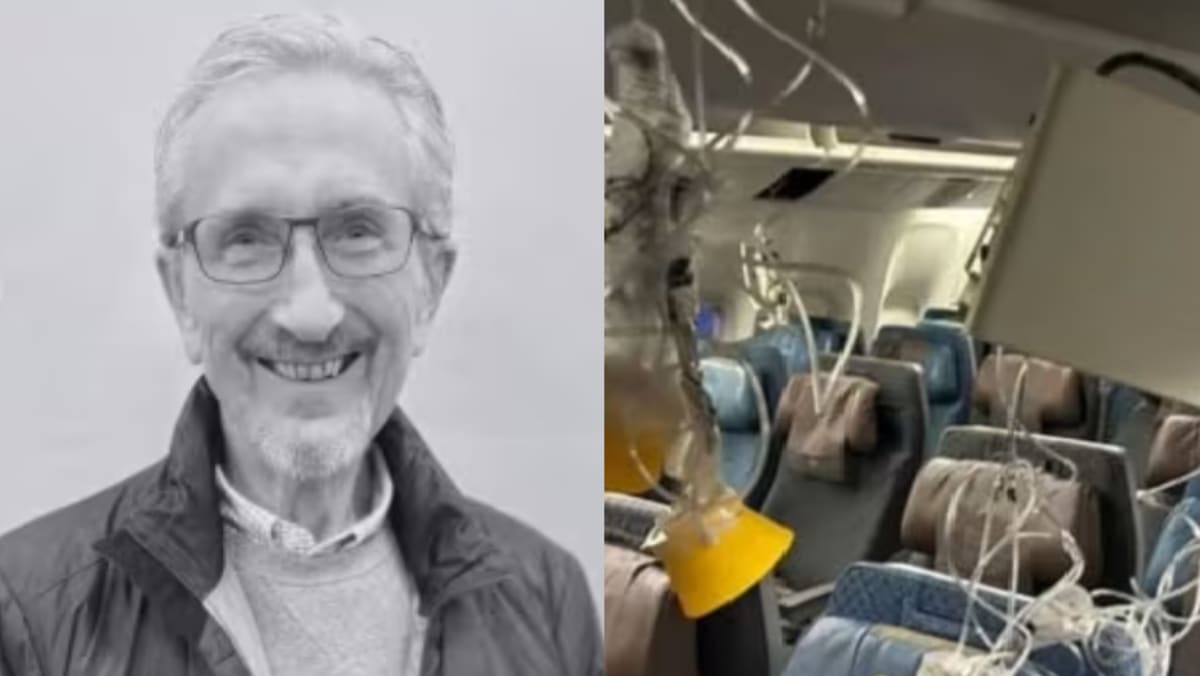
Mr Geoff Kitchen died on flight SQ321 in May 2024 after the plane experienced a sudden drop in altitude while travelling from London's Heathrow Airport to Singapore.
Mr Geoffrey Kitchen died on flight SQ321 on May 21, 2024, after it was hit by severe turbulence. (File photos: Facebook/Thornbury Musical Theatre Group, Reuters)
This audio is generated by an AI tool.
SINGAPORE: The death of a British national on board a Singapore Airlines (SIA) flight in 2024 was caused by cardiac failure resulting from severe turbulence, an inquest in the United Kingdom heard on Wednesday (Sep 23).
Mr Geoff Kitchen died on flight SQ321 after the plane experienced a sudden drop in altitude near Myanmar's southwestern region while travelling from London's Heathrow Airport to Singapore.
Dr Peter Harrowing told an inquest at the Avon Coroners' Court that he was satisfied that it was "the physiological effect of the aircraft turbulence which precipitated the cardiac arrest and ultimately Geoff's demise", reported the BBC.
The court's area coroner said Mr Kitchen, who had a history of coronary artery disease, had been "thrown from his seat and landed on an adjacent passenger" during the incident.
CNA Games Guess Word Crack the word, one row at a time Buzzword Create words using the given letters Mini Sudoku Tiny puzzle, mighty brain teaser Mini Crossword Small grid, big challenge Word Search Spot as many words as you can Show More Show Less "At first blush one might consider natural causes being an appropriate cause of death. That does not take account of the events that occurred of the severe turbulence to which Geoff was subjected," news outlet The Independent reported Dr Harrowing as saying. In the record of the inquest, Dr Harrowing wrote that Mr Kitchen "died of cardiac failure as a result of the aircraft for which he was a passenger encountering severe turbulence". In response to a request for comment from CNA, SIA said that it was unable to comment on matters before the courts.
"At first blush one might consider natural causes being an appropriate cause of death. That does not take account of the events that occurred of the severe turbulence to which Geoff was subjected," news outlet The Independent reported Dr Harrowing as saying.
In the record of the inquest, Dr Harrowing wrote that Mr Kitchen "died of cardiac failure as a result of the aircraft for which he was a passenger encountering severe turbulence".
In response to a request for comment from CNA, SIA said that it was unable to comment on matters before the courts.
Mr Kitchen, 73, was travelling with his wife Linda on May 21, 2024, for a six-week holiday to Singapore, Indonesia and Australia when turbulence hit their flight.
Mr Kitchen died and his wife suffered a broken back while dozens of others were also injured.
An initial post-mortem examination held in Thailand found that Mr Kitchen died from congestive heart failure, reported the BBC.
The inquest was told that he had undergone an operation to fit stents to his right coronary artery in April 2019 but was found to have returned to "normal exercise capacity" after a review in October that year.
The pathologist who performed an additional post-mortem examination on Kitchen's body in Bristol said his cause of death had been cardiac failure due to coronary artery atheroma and the physiological effects of turbulence, reported the BBC.
In May 2026, a final report released by Singapore's Transport Safety Investigation Bureau (TSIB) said Mr Kitchen suffered heart failure and pulmonary oedema, which is a condition involving a build-up of fluid in the lungs.
Mrs Kitchen told the inquest in a statement that her husband fell on her lap before two passengers moved him back into his seat, where his head "flopped forward", The Independent reported.
According to the BBC, she said Mr Kitchen was moved to the front of the plane to be given CPR, but nobody told her he had died until two days later.
The Kitchen family has taken legal action against SIA. In August, The Independent reported that they filed two claims, one by Mrs Kitchen and another by her on behalf of her husband’s estate.
The airline is also facing legal action from several other passengers, including Bradley Richards, Jack Jenkins, Hannah Fullerton, Andrew Dawood, Bryan Matthews, and Pauline and Michael Rainey, the news outlet reported.
Flight SQ321 was carrying 211 passengers and 18 crew members when the incident occurred.
TSIB found that the turbulence was convectively induced and likely associated with a rapidly growing cloud capable of producing significant updrafts and downdrafts.
The pilots saw no bad weather on their navigational displays in the minutes before the incident, and visual checks indicated a clear flight path.
Investigators concluded that the aircraft's weather radar likely did not detect the bad weather before the turbulence struck, although the radar manufacturer said it found no evidence that the system had failed to detect and display weather during the flight.
The seat belt sign had been switched on after the aircraft began experiencing turbulence, but severe turbulence struck just 17 seconds later, leaving no time for the flight crew to make a cabin announcement.
Rapid changes in gravitational force sent some passengers who were not wearing seat belts airborne before they fell back down.
Apart from Mr Kitchen, 56 people suffered serious injuries and 23 had minor injuries, while 149 were uninjured.
Get our pick of top stories and thought-provoking articles in your inbox
Stay updated with notifications for breaking news and our best stories
Join our channel for the top reads for the day on your preferred chat app
2024 年 5 月,杰夫·基钦先生在 SQ321 航班上不幸身亡。当时飞机在从伦敦希思罗机场飞往新加坡的途中,突然遭遇高度下降。
杰弗里·基钦先生于2024年5月21日乘坐SQ321航班时遭遇严重湍流后不幸遇难。(资料图片:Facebook/Thornbury Musical Theatre Group,路透社)
这段音频由人工智能工具生成。
新加坡:英国周三(9月23日)举行的死因调查听证会获悉,一名英国公民于2024年在新加坡航空公司(SIA)航班上死亡,死因是严重湍流导致的心脏衰竭。
杰夫·基钦先生在SQ321航班上不幸遇难,当时飞机正从伦敦希思罗机场飞往新加坡,在缅甸西南部地区附近突然下降高度。
据英国广播公司报道,彼得·哈罗温医生在埃文验尸法庭的调查中表示,他确信是“飞机湍流的生理影响引发了心脏骤停,并最终导致了杰夫的死亡”。
法院的地区验尸官表示,基钦先生有冠状动脉疾病史,在事故中“被甩出座位,落在了旁边的一名乘客身上”。
CNA游戏 猜词游戏 逐行破解单词 流行词游戏 用给定的字母组成单词 迷你数独 小小的谜题,强大的脑力挑战 迷你填字游戏 小方格,大挑战 单词搜索 尽可能多地找出单词 显示更多 显示更少 “乍一看,人们可能会认为自然死亡是合适的死因。但这并没有考虑到杰夫所经历的严重湍流,”据《独立报》报道,哈罗温医生说道。在验尸记录中,哈罗温医生写道,基钦先生“因他乘坐的飞机遭遇严重湍流而导致心脏衰竭死亡”。针对CNA的置评请求,新加坡航空公司表示,无法对正在审理的案件发表评论。
据《独立报》报道,哈罗温医生表示:“乍一看,人们可能会认为自然死亡是合理的死因。但这并没有考虑到杰夫所遭受的严重湍流事件。”
在验尸记录中,哈罗温医生写道,基钦先生“因乘坐的飞机遭遇严重湍流而导致心脏衰竭死亡”。
针对 CNA 的置评请求,新加坡航空公司表示,无法对正在审理的案件发表评论。
73 岁的基钦先生于 2024 年 5 月 21 日与妻子琳达一起前往新加坡、印度尼西亚和澳大利亚进行为期六周的假期,结果他们的航班遭遇了气流颠簸。
基钦先生不幸身亡,他的妻子背部骨折,另有数十人受伤。
据英国广播公司报道,在泰国进行的初步尸检发现,基钦先生死于充血性心力衰竭。
验尸官获悉,他于 2019 年 4 月接受了右冠状动脉支架植入手术,但在同年 10 月的复查中发现,他的运动能力已恢复到“正常水平”。
据英国广播公司报道,在布里斯托尔对基钦的遗体进行额外尸检的病理学家表示,他的死因是冠状动脉粥样硬化和湍流的生理影响导致的心力衰竭。
2026 年 5 月,新加坡交通安全调查局 (TSIB) 发布的最终报告称,基钦先生患有心力衰竭和肺水肿,这是一种肺部积液的疾病。
据《独立报》报道,基钦夫人向验尸官发表声明称,她的丈夫摔倒在她腿上,之后两名乘客将他扶回座位,他的头“向前耷拉了下来”。
据 BBC 报道,她说基钦先生被转移到飞机前部接受心肺复苏术,但直到两天后才有人告诉她他已经去世了。
基钦家族已对新加坡航空公司提起诉讼。据《独立报》8月份报道,他们提交了两份索赔申请,一份由基钦夫人本人提出,另一份则由她代表其丈夫的遗产提出。
据该新闻媒体报道,该航空公司还面临着其他几名乘客的法律诉讼,其中包括 Bradley Richards、Jack Jenkins、Hannah Fullerton、Andrew Dawood、Bryan Matthews 以及 Pauline 和 Michael Rainey。
事发时,SQ321航班上有211名乘客和18名机组人员。
TSIB 发现湍流是由对流引起的,可能与能够产生明显上升气流和下降气流的快速增长的云有关。
事发前几分钟,飞行员的导航显示器上没有显示任何恶劣天气,目视检查也表明飞行路线畅通无阻。
调查人员得出结论,飞机的气象雷达可能在湍流来袭之前没有探测到恶劣天气,尽管雷达制造商表示,他们没有发现任何证据表明该系统在飞行过程中未能探测和显示天气。
飞机开始遭遇湍流后,安全带指示灯亮起,但仅仅 17 秒后就遭遇了严重的湍流,机组人员根本没有时间进行客舱广播。
重力的快速变化使一些未系安全带的乘客腾空而起,然后才落回地面。
除了基钦先生之外,还有 56 人受重伤,23 人受轻伤,149 人未受伤。
订阅我们的邮件,即可获取精选热点新闻和引人深思的文章。
订阅通知,第一时间获取突发新闻和精彩报道。
加入我们的频道,即可在您常用的聊天应用上获取当日热门文章。