National Arts Council seeks operator for new 1,000-seat Tanglin theatre国家艺术理事会为新建的拥有1000个座位的唐林剧院寻找运营商。
Applicants must allocate at least 30 per cent of the theatre’s utilised days to local arts groups, while bringing in high-quality international acts.
新闻视频
Applicants must allocate at least 30 per cent of the theatre’s utilised days to local arts groups, while bringing in high-quality international acts.
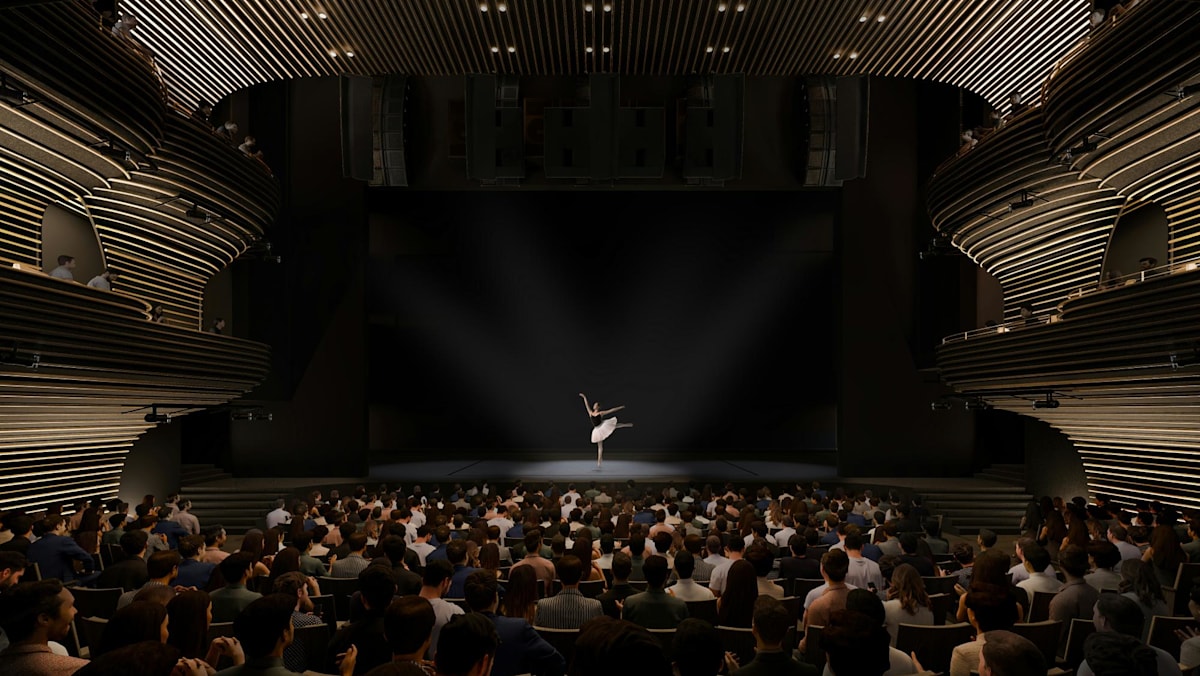
An artist’s impression of the performing arts theatre that will be part of the redeveloped Tanglin Shopping Centre, slated for completion by 2030. (Image: Pacific Eagle Real Estate)
This audio is generated by an AI tool.
SINGAPORE: The National Arts Council (NAC) is seeking an operator for the upcoming 1,000-seat theatre in Tanglin , with the successful applicant expected to bring in high-quality international acts while supporting the local arts ecosystem.
Supported by the Ministry of Culture, Community and Youth (MCCY), NAC launched an Expression of Interest (EOI) on Wednesday (Sep 23), open to local and international venue operators, arts organisations and cultural institutions.
The operator will be responsible for areas including artistic direction and programming, venue management and financial sustainability, while overseeing functions such as food and beverage, technical production and facilities.
Applicants must also allocate at least 30 per cent of the theatre’s utilised days each year to at least four local arts groups, while supporting Singapore’s arts ecosystem with initiatives such as residencies and mentorships.
They must also demonstrate experience in financially managing operations of a similar scale.
CNA Games Guess Word Crack the word, one row at a time Buzzword Create words using the given letters Mini Sudoku Tiny puzzle, mighty brain teaser Mini Crossword Small grid, big challenge Word Search Spot as many words as you can Show More Show Less
But arts observers said the scale of the project and its requirements could pose challenges for local groups hoping to operate the venue.
“I think the requirements are demanding,” said Dr Samuel Wong, co-founder and creative director of The TENG Company, a non-profit arts organisation.
“For local groups, the hard part isn't artistry or ambition. It's actually having to run a venue at this scale, and the capital and the international reach that comes with such a venue.”
He added that not many local groups have the “firepower and the weight” to take on such a project and may need to partner or collaborate with an international operator or a consortium of several local organisations.
Still, such partnerships could give homegrown arts groups access to international networks and expertise, said Ms Usha Chandradas, co-founder of online art magazine Plural Art Mag.
“Local partners that come on board get a chance to see what business looks like from the international organisations' perspective,” said Ms Chandradas, who is also a former Nominated Member of Parliament (NMP).
For Dr Wong, such global partnerships could help local arts groups take their works overseas.
“Works are commissioned and they're premiered here, and then they are toured out to the region and the world,” he said.
“So, it's not just international acts coming into Singapore, but that the operator has networks ... to bring local works out from Singapore to the world as well.”
Dr Samuel Wong said global partnerships could help local arts groups tap wider international networks to take their works overseas. (Image: CNA)
LOCAL PARTNERSHIP REQUIRED
International organisations can bid to operate the theatre, but they must have a local arts partner in roles such as artistic direction.
For joint ventures or consortiums, domestic arts companies must account for at least 30 per cent of ownership or co-investment.
Dr Wong said the requirement could help prevent the venue from gravitating towards commercially safer imported productions but pointed out that meeting a quota alone would not necessarily translate into meaningful native support.
“We are looking at not the amount of local work but the depth of local work. To me, we need to invest in local talent, which includes commissioning, residencies, rehearsal space, co-productions,” he said.
Ms Usha Chandradas said the requirements do not specify how dates allocated to local arts groups should be distributed. (Image: CNA)
Ms Chandradas also noted that the requirement stipulates how many days local groups should receive, but offers no guidance on how those dates are allocated.
“If you want to really be quite cynical about it, you might say, well, the international operators may take all the good commercially viable dates and just sort of allocate the less commercially viable dates to the local operators,” she said.
However, she noted that such issues could be monitored once the theatre begins operating.
BALANCING INTERNATIONAL AND LOCAL ACTS
Dr Wong said bringing major international productions to Singapore need not come at the expense of local artists.
“If they are done well, they actually create an engine that pays for and platforms local work,” he said.
“Let's say a sold-out show on Friday gives us the freedom to be able to take a risk on a Singaporean premiere on a Tuesday, for example. So, if we think of venues in such a perspective, there's a win-win that we can create from this.”
BEYOND THE BOTTOM LINE
Pacific Eagle Real Estate (PERE), which is funding and building the theatre, had earlier announced a waiver of the base rent for the 20-year tenancy period.
“The waiver of the rental is quite a substantial factor. It's a huge fixed cost that's taken out of the picture,” said Ms Chandradas.
But she noted that the operator would still have to bear operating costs and other obligations, including asset management and upgrades.
The operator will be chosen through a two-stage selection process, with the successful applicant expected to be announced in the second quarter of 2027.
For Ms Chandradas, the bigger question is what the new theatre could ultimately bring to Singapore’s arts scene.
“If at the end of this scheme, we are able to do things in the local art scene that we were not able to do before, that to me would be a very, very good measure of success,” she said.
Get our pick of top stories and thought-provoking articles in your inbox
Stay updated with notifications for breaking news and our best stories
Join our channel for the top reads for the day on your preferred chat app
申请者必须将剧院至少 30% 的使用天数分配给当地艺术团体,同时引进高质量的国际演出。
这是艺术家绘制的表演艺术剧院效果图,该剧院将成为重建后的东陵购物中心的一部分,预计将于2030年竣工。(图片:太平洋鹰地产)
这段音频由人工智能工具生成。
新加坡:国家艺术理事会(NAC)正在为即将落成的位于东陵的1000座剧院寻找运营商,成功的申请人有望引进高质量的国际演出,同时支持本地艺术生态系统的发展。
在文化、社区及青年部 (MCCY) 的支持下,国家艺术理事会 (NAC) 于周三(9 月 23 日)启动了意向征询 (EOI),面向本地和国际场馆运营商、艺术组织和文化机构开放。
该运营方将负责艺术指导和节目策划、场地管理和财务可持续性等领域,同时监督餐饮、技术制作和设施等职能。
申请者还必须将剧院每年至少 30% 的使用天数分配给至少四个本地艺术团体,同时通过驻场艺术家和导师计划等举措支持新加坡的艺术生态系统。
他们还必须证明自己有管理类似规模业务的财务经验。
CNA游戏 猜词游戏 逐行破解单词 流行词游戏 用给定的字母组成单词 迷你数独 小小谜题,挑战你的大脑 迷你填字游戏 小方格,大挑战 单词搜索 尽可能多地找出单词 显示更多 显示更少
但艺术观察人士表示,该项目的规模及其要求可能会给希望运营该场馆的当地团体带来挑战。
“我认为这些要求很苛刻,”非营利艺术组织 TENG 公司的联合创始人兼创意总监 Samuel Wong 博士说。
“对于本地团体来说,难点不在于艺术造诣或抱负,而在于如何运营如此规模的场馆,以及随之而来的资金和国际影响力。”
他还补充说,很多地方团体没有足够的“实力和影响力”来承担这样的项目,可能需要与国际运营商或几个地方组织的联盟合作。
线上艺术杂志《Plural Art Mag》的联合创始人乌莎·钱德拉达斯女士表示,尽管如此,这样的合作关系仍能让本土艺术团体接触到国际网络和专业知识。
“加入的本地合作伙伴有机会从国际组织的角度了解商业运作,”钱德拉达斯女士说道,她本人也是一名前国会议员。
黄博士认为,这样的全球合作可以帮助本地艺术团体将他们的作品推向海外。
他说:“作品是委托创作的,在这里首演,然后到该地区乃至全世界巡演。”
“所以,不仅仅是国际艺人来到新加坡,而且运营商还拥有网络……可以将新加坡的本土作品推向世界。”
黄思远博士表示,全球合作可以帮助本地艺术团体拓展国际网络,将作品推向海外。(图片:CNA)
需要本地合作伙伴
国际组织可以竞标运营该剧院,但他们必须有当地艺术合作伙伴担任艺术指导等角色。
对于合资企业或联合体,国内艺术公司必须占至少 30% 的所有权或共同投资。
黄博士表示,这项要求可能有助于防止该场地倾向于商业上更安全的进口作品,但他指出,仅仅达到配额并不一定能转化为有意义的本土支持。
他说:“我们关注的不是本地作品的数量,而是本地作品的深度。在我看来,我们需要投资本地人才,包括委约创作、驻场计划、排练场地和联合制作。”
乌莎·钱德拉达斯女士表示,相关规定并未明确规定分配给本地艺术团体的演出日期应如何分配。(图片来源:CNA)
Chandradas 女士还指出,该要求规定了地方团体应获得多少天,但没有提供关于如何分配这些日期的指导。
“如果你真的想对此抱持一种愤世嫉俗的态度,你可能会说,国际运营商可能会拿走所有商业上可行的好日期,然后把商业上不太可行的日期分配给当地运营商,”她说。
不过她指出,一旦剧院开始运营,这些问题就可以得到监控。
平衡国际和地方行动
黄博士表示,将国际大型制作项目引入新加坡,并不一定要以牺牲本地艺术家的利益为代价。
“如果做得好,它们实际上可以创造一个引擎,为当地工作提供资金和平台,”他说。
“比如说,周五的演出门票售罄,就让我们有余力去冒险,比如周二在新加坡举办首映。所以,如果我们从这个角度考虑演出场地,就能实现双赢。”
超越底线
负责剧院建设和融资的太平洋鹰房地产公司(PERE)此前宣布,将免除20年租期内的基本租金。
钱德拉达斯女士说:“免除租金是一个非常重要的因素。这是一笔巨大的固定成本,现在省掉了。”
但她指出,运营商仍需承担运营成本和其他义务,包括资产管理和升级。
运营商将通过两阶段遴选程序选出,预计将于 2027 年第二季度公布中标者。
对于 Chandradas 女士来说,更大的问题是这座新剧院最终能为新加坡的艺术界带来什么。
“如果这项计划结束时,我们能够在当地艺术界做一些以前做不到的事情,对我来说,这将是衡量成功的非常非常好的标准,”她说。
订阅我们的邮件,即可获取精选热点新闻和引人深思的文章。
订阅通知,第一时间获取突发新闻和精彩报道。
加入我们的频道,即可在您常用的聊天应用上获取当日热门文章。