The Time When A Burning B-52 Nearly Caused A Nuclear Catastrophe “Worse than Chernobyl”一架燃烧的B-52轰炸机险些引发比切尔诺贝利更严重的核灾难
A simple shift in wind direction would have destroyed the nuclear weapons inside, scattering radioactive plutonium for miles around, or worse.
新闻视频
By Joseph Trevithick
Updated Jan 19, 2020 12:08 AM EST
Nearly four decades ago, a U.S. Air Force B-52H bomber, armed with eight nuclear-tipped AGM-69A Short Range Attack Missiles and four B28 nuclear gravity bombs, burned for hours at Grand Forks Air Force Base in North Dakota. Years later, despite previous assurances that the risk of a nuclear accident had been low, the director of the Lawrence Livermore National Laboratory, a key U.S. nuclear weapons research and development facility, testified that the incident had actually come very close to being “worse than Chernobyl.”
The bomber and its six-person crew, assigned to the 319th Bomb Wing, were sitting on alert status at Grand Forks on the night of Sept. 15, 1980. The aircraft’s number five engine burst into flames during an engine start at around 9:00 PM local time. The crew immediately evacuated the aircraft and firefighters ultimately battled the blaze for three hours before getting it under control.
Winds were high that night, blowing to the southwest with gusts registering between 26 and 35 miles per hour. The blasts of air kept the massive cone of flame from the burning engine blowing forward of the aircraft. In the end, three firefighters suffered minor injuries and another one, along with a member of the bomber’s crew, received treatment for smoke inhalation after the accident.
A subsequent investigation found that maintenance personnel had improperly reassembled a fuel strainer, which exists in the aircraft’s fuel system to catch any particulate matter before it enters the engine, which could potentially cause damage of its own. The result was additional fuel flowing into the engine, leading to the fire. The nature of the fuel leak contributed to the difficulty in putting out the fire, as the number three wing tank in the fully fueled bomber kept feeding the flames.
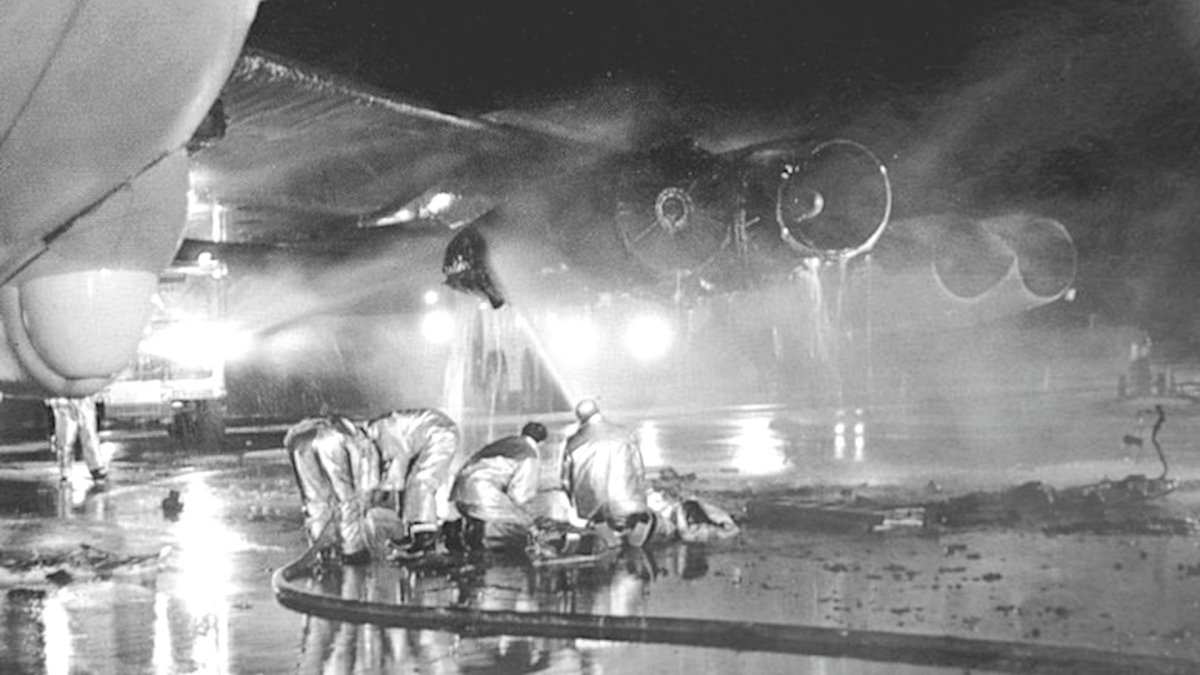
One of the few photos available from the accident. Even in this low-resolution picture, the intensity, as well as the direction of the wind-fanned flames is clearly visible., USAF
Between 1969 and 1991, the Air Force kept some number of B-52 bombers armed with nuclear weapons on alert at all times to try to ensure that they could rapidly get airborne and escape any potential first strike on their operating bases and then be available to retaliate. You can read more about this doctrine in this past War Zone piece . This alert posture on the ground had replaced a previous policy of keeping a force nuclear-armed bombers airborne at all times, known as Operation Chrome Dome , which ran from 1960 to 1968.
The bomber’s loadout was standard for the time and the two different types of weapons would have served complimentary purposes during any actual mission. By the 1960s, it was already increasingly clear that B-52s would have trouble penetrating dense hostile air defenses, such as those in the Soviet Union, in order to get to their assigned targets.
Starting in 1972, the bombers began carrying the AGM-69A Short Range Attack Missiles or SRAMs, with plans to fire them at enemy air defense sites along the route to their primary objectives. Each one carried a W69 thermonuclear warhead, with an estimated yield of between 170 and 200 kilotons. The aircraft would then drop traditional nuclear gravity bombs, such as the B28s, variants of which had estimated yields up to 1.45 megatons, on their main targets. You can read more about this doctrine and the SRAMs themselves in this past War Zone piece .
AGM-69A SRAMs on a rotary launcher, at rear, and B28 bombs, in front, inside a B-52’s bomb bay., USAF
At the time of the accident, the Air Force informed the public that there had been little danger of either the SRAMs or the B28 bombs detonating in a thermonuclear explosion. With no fatalities or serious injuries and the damage largely limited to the bomber itself, the incident quickly passed from the public’s consciousness.
“There have been thousands of accidents involving U.S. nuclear weapons. In most cases, we can thank good engineering or smart personnel decisions for keeping things from becoming catastrophic,” Stephen Schwartz, a nonresident fellow at the Bulletin of the Atomic Scientists and an expert on American nuclear weapons programs, told The War Zone . “In the case of the September 1980 B-52 fire at Grand Forks AFB, it was sheer luck that kept an engine fire from leading utter disaster.”
In 1988, Dr. Roger Batzel, then-director of the Lawrence Livermore National Laboratory, or LLNL, in California, testified before the Senate Appropriations Subcommittee on Defense in a closed session. A redacted transcript subsequently became available to the public.
Then-Lawrence Livermore National Laboratory Director Dr. Roger Batzel, at right, shakes hands with then-Vice President Nelson Rockefeller in 1977. Nuclear physicist and “father of the hydrogen bomb” Dr. Edward Teller stands in between them., LLNL
“You are talking about something that in one respect could be probably worse than Chernobyl,” Batzel told the subcommittee members . Two years earlier, an explosion and subsequent meltdown at the Chernobyl Nuclear Power Plant in what was then Soviet Ukraine led to what experts still consider the worst nuclear disaster in human history. The full scope and scale of that incident, the subject of a recent and immensely popular HBO miniseries, would not become public knowledge for many years after LLNL’s director made the comparison in his remarks to American legislators. An exclusion zone remains in place in present-day Ukraine around the plant.
“Do you know that through testing?” Dennis DeConcini, then-Democrat Senator from Arizona, asked Batzel. “Yes, sir,” Batzel replied.
Batzel informed the subcommittee that if the wind had been blowing in almost any other direction, then the intense fire would have likely incinerated the aircraft and the weapons inside its bomb bays. The plane’s crew would likely not have survived either. This is almost exactly what happened in January 1983, when another fire completely destroyed a B-52G bomber at Grand Forks, killing five maintenance personnel. Thankfully that plane was not carrying nuclear weapons at the time.
The aftermath of the 1983 B-52 fire at Grand Forks., USAF
If this had happened in the 1980 accident, the rocket motors in the SRAMs, as well as the conventional explosives inside their W69 warheads, used to initiate the thermonuclear reaction, would very likely have exploded. While this may not have triggered a nuclear explosion, it would have thrown a plume of highly radioactive plutonium into the air, easily covering a 60 square mile area, which would have included parts of North Dakota and Minnesota.
As many as 70,000 people living within 20 miles of Grand Forks could have been exposed to high doses of radiation. Depending on the exact circumstances and weather patterns, radioactive material may have been blown even further across communities to the southwest. The nuclear material would also have contaminated the ground and potentially gotten into water supplies causing further, long-term environmental impacts.
With the rate of decay of the plutonium from the nuclear weapons on the B-52s, affected areas would have seen elevated levels of radiation for tens of thousands of years and an extensive clean-up and disposal effort would have been required to make them habitable again. An exclusion zone, such as that around Chernobyl, might have been necessary to seal off the most seriously impacted locations.
“You have plutonium in the soil and on the soil, which you have to clean up,” Batzel said. “I wouldn`t want either one.”
Inert SRAMs for ground training purposes., USAF
Concerns about safety risks associated with the SRAMs and their W69 warheads were known as early as 1974. Senior officials within America’s nuclear enterprise had warned that the warheads, in particular, had been built with relatively loose safety requirements and lacked fire- and explosion-resistant features that had become increasingly common in U.S. nuclear weapons over the years. Testing had also called into question the safety of the rocket motors under similar conditions.
U.S. military officials had reportedly rebuffed these concerns on multiple occasions from officials from the Department of Energy, including Batzel and retired U.S. Navy Admiral James Watkins, who had become President George H.W. Bush’s Secretary of Energy in 1989. Another round of Senate hearings in 1990, plus the public disclosure of Batzel’s testimony, pushed then-Secretary of Defense Dick Cheney to finally call a meeting with Watkins, then-Chairman of the Joint Chiefs of Staff U.S. Army General Colin Powell, and senior Air Force officials.
That meeting occurred on May 26, 1990. Cheney had ordered all of the SRAMs removed from B-52s sitting on alert and placed in secure storage by June 9. President Bush ended the policy of keeping the bombers on alert status entirely in 1991.
The United States began removing the weapons from its nuclear stockpile for good in 1992. The National Nuclear Security Administration (NNDA), part of the Department of Energy, completed an initial dismantlement process on all of the W69s by 1999, but did not finish completely dismantling their component parts until 2016.
An official infographic showing the history of the W69 warhead’s construction and subsequent dismantlement. , NNSA
The SRAMs weren’t the only risk during the accident at Grand Forks in 1980, though. “Worse still – and unmentioned by Batzel – a design flaw in the B28 bomb meant that if exposed to prolonged heat, two wires too close to the casing could short circuit, arm the bomb, trigger an accidental detonation of the HE [high explosives] surrounding the core, and set off a nuclear explosion,” Schwartz wrote on Twitter on the most recent anniversary of the accident.
The B28s remained in service until 1991. Though the process of dismantling these weapons began shortly thereafter, it is not immediately clear if the NNSA has finished breaking them down completely.
Using NUKEMAP , an interactive map that nuclear weapons historian Alex Wellerstein, a professor at Stevens Institute of Technology in New Jersey, first created in 2012, we can get a sense of the potential immediate damage if one or more of the B28s had gone off that night in September nearly 40 years ago. Modeling based on a single 1.45 megaton surface detonation, the fireball could have touched everything within a mile of the base. The immediate shockwave, enough to severely damage or even destroy heavily built concrete structures, would have struck anything within a mile and a half from where the bomb was sitting.
Thermal radiation could have caused severe injuries to anyone within a 16 mile-wide circle around ground zero. This is to say nothing of the effects from the resulting fallout and how it might travel on the wind. NUKEMAP’s projections, based on more recent weather conditions, suggest that the spread of radiation would have traveled more than 250 miles northeast, into Minnesota and Canada.
The southwesterly wind in 1980 would have pushed that plume in the other direction, at least initially, potentially covering a wide swath of predominantly rural farmland in North and South Dakota, potentially contaminating the Missouri River and countless farms. This could have produced farther-reaching impacts in the long term. Regardless, more than 60,000 people might have died instantly, or within days from burns or radiation, with an untold number of subsequent deaths, injuries, and long term illnesses resulting from the explosion in total.
The potential scope of effects from a single 1.45 megaton nuclear detonation in Grand Forks. The yellow inner circle represents the fireball, while the red-ringed circle is the area of most damage from the shockwave. The larger outer yellow area is the extent of thermal radiation from the blast, while the outermost circle is the full extent of the shockwave, by which point it creates only light damage, such as blowing out windows., NUKEMAP
A fallout projection, based on more recent weather conditions, from a single 1.45 megaton blast in Grand Forks from NUKEMAP., NUKEMAP
Needless to say, it’s terrifying to think what could have happened had the wind shifted at all as the B-52’s engine burned over those three hours. It’s also a sobering reminder that while nuclear deterrence requires various U.S. Air Force units, as well as Navy ballistic missile submarines, be in a heightened state of readiness to use nuclear weapons, if need be, that this also carries significant inherent risks even just from relatively mundane accidents.
This reality has become apparent again in recent decades for a number of reasons, including concerns about morale within Air Force units tasked with nuclear missions, which in turn have raised fears about whether this increases the risk of accidents occurring. Notably, in 2007 , Air Force personnel mistakenly loaded six AGM-129 Advanced Cruise Missiles , each with a W80-1 variable yield nuclear warhead, with a maximum yield estimated at 150 kilotons, onto a B-52 at Minot Air Force Base in North Dakota.
US Air Force personnel load AGM-129s onto a B-52H bomber in 2002., USAF
The plane then flew with these weapons on board, unknown to the crew, to Barksdale Air Force Base in Louisiana. In the end, the aircraft was armed with live nuclear weapons for a total of 36 hours before personnel uncovered the error and instituted appropriate security and safety precautions at Barksdale.
More recently, there has been a renewed emphasis on nuclear weapons within the U.S. government and a return to thinking about how they fit into America’s overarching military doctrine, including new discussions about how American forces might employ and operate around them during actual major conflicts. This has reinvigorated debates around nuclear surety and safety – basically, the bombs will only go off when you need them to and never when you don’t, a principle America’s nuclear enterprise refers to as “ always/never .”
These fears are hardly limited to the United States. Russia, especially, has been pushing ahead in the development of a number of novel and controversial nuclear weapon systems in recent years, many of which have equally unique risks associated with them . Just in August 2019, an explosion during a test of what appears to have been nuclear-powered cruise missile killed at least seven people at a Russian military test site. The full scope of the incident, including potential releases of radiation into the atmosphere, remains unclear more than a month later.
“The more nuclear weapons we have and the more we have on alert, the greater the risk of accidents. We were extremely lucky during the Cold War that no nuclear weapons ever accidentally exploded and no crises got completely out of hand,” Schwartz told The War Zone . “But human beings are fallible, as are the systems they have designed to control nuclear weapons. Accordingly, there will be more mistakes and accidents and crises in the future.”
The B-52 fire at Grand Forks in 1980 underscores just how easy it might be for a relatively simple accident to turn into a major catastrophe under the right circumstances.
Contact the author: joe@thedrive.com
Comments couldn’t be loaded. Please refresh the page.
作者:约瑟夫·特雷维西克
更新于美国东部时间2020年1月19日凌晨12:08。
近四十年前,一架美国空军B-52H轰炸机在北达科他州大福克斯空军基地起火燃烧数小时,机上载有八枚AGM-69A短程攻击导弹和四枚B28核重力炸弹。多年后,尽管此前曾保证核事故风险很低,但美国重要的核武器研发机构——劳伦斯·利弗莫尔国家实验室的主任作证称,该事件实际上非常接近“比切尔诺贝利更严重”。
1980年9月15日晚,这架隶属于第319轰炸机联队的轰炸机及其六名机组人员在格兰德福克斯机场处于警戒状态。当地时间晚上9点左右,飞机启动时五号发动机突然起火。机组人员立即撤离飞机,消防员奋战三个小时才将大火控制住。
当晚风力强劲,西南风阵风风速达每小时26至35英里。强劲的气流阻止了燃烧的发动机喷出的巨大火锥向前蔓延。最终,三名消防员受轻伤,另有一名消防员和一名轰炸机机组人员在事故后因吸入浓烟接受了治疗。
后续调查发现,维修人员错误地重新组装了燃油滤清器。该滤清器位于飞机燃油系统中,用于拦截可能造成自身损坏的颗粒物。结果导致更多燃油流入发动机,引发火灾。由于这架满油轰炸机的三号机翼油箱持续向外扩散燃油,加剧了灭火难度。
这是事故现场为数不多的照片之一。即使在这张低分辨率照片中,也能清晰地看到火焰的强度以及被风吹动的火焰方向。(美国空军)
1969年至1991年间,美国空军始终保持一定数量的B-52轰炸机处于核武器武装状态,以确保它们能够迅速升空,躲避任何可能对其作战基地造成的先发制人打击,并随时准备进行反击。您可以在之前的“战区”文章中了解更多关于这一战略的信息。这种地面警戒状态取代了此前一项名为“铬穹行动”(Operation Chrome Dome)的政策,该政策要求始终保持一支携带核武器的轰炸机部队处于空中待命状态,实施时间为1960年至1968年。
这架轰炸机的武器配置在当时是标准的,两种不同的武器在任何实际任务中都能发挥互补作用。到了20世纪60年代,人们越来越清楚地认识到,B-52轰炸机很难突破敌方密集的防空系统,例如苏联的防空系统,从而抵达预定目标。
从1972年开始,轰炸机开始携带AGM-69A短程攻击导弹(SRAM),计划在飞往主要目标的途中用其攻击敌方防空阵地。每枚导弹都携带一枚W69型热核弹头,估计当量在170至200千吨之间。之后,飞机将向主要目标投掷传统的核重力炸弹,例如B-28型核弹,其改进型的当量估计可达1.45兆吨。您可以在之前的《战区》文章中阅读更多关于这一作战理论和SRAM导弹本身的信息。
美国空军
事故发生时,空军向公众通报称,无论是SRAM导弹还是B28炸弹,发生热核爆炸的危险性都很小。由于无人死亡或重伤,且损失主要局限于轰炸机本身,这起事件很快就淡出了公众的视野。
“美国核武器事故数以千计。在大多数情况下,我们都应该感谢良好的工程设计或明智的人员决策,才避免了灾难性的后果,”《原子科学家公报》非常驻研究员、美国核武器项目专家斯蒂芬·施瓦茨告诉《战区》杂志。“以1980年9月格兰德福克斯空军基地发生的B-52轰炸机起火事故为例,纯属幸运,才避免了发动机起火引发彻底的灾难。”
1988年,时任加利福尼亚州劳伦斯利弗莫尔国家实验室(LLNL)主任的罗杰·巴泽尔博士在参议院拨款委员会国防小组委员会的闭门会议上作证。随后,一份经过删减的证词记录公之于众。
1977年,时任劳伦斯·利弗莫尔国家实验室主任罗杰·巴泽尔博士(右)与时任副总统纳尔逊·洛克菲勒握手。核物理学家、“氢弹之父”爱德华·泰勒博士站在他们中间。(图片来源:LLNL)
“你们谈论的这件事,在某些方面可能比切尔诺贝利还要糟糕,”巴泽尔对小组委员会成员说。两年前,位于当时苏联乌克兰境内的切尔诺贝利核电站发生爆炸和随后的堆芯熔毁,这场灾难至今仍被专家们认为是人类历史上最严重的核灾难。近期HBO推出了一部非常受欢迎的迷你剧,讲述了这场灾难的全部范围和规模。然而,在劳伦斯利弗莫尔国家实验室主任向美国立法者发表讲话,将切尔诺贝利核电站与切尔诺贝利进行比较之后,多年以后,公众才了解到这场灾难的全部情况。如今,在乌克兰境内,切尔诺贝利核电站周围仍然设有禁区。
“你是通过测试得出这个结论的吗?”时任亚利桑那州民主党参议员丹尼斯·德孔西尼问巴泽尔。“是的,先生,”巴泽尔回答道。
巴泽尔向小组委员会报告说,如果风向稍有不同,那么猛烈的火势很可能会将飞机及其弹舱内的武器全部烧毁。机组人员也极有可能遇难。1983年1月,大福克斯机场一架B-52G轰炸机也遭遇了类似的火灾,五名维护人员不幸遇难。所幸的是,那架飞机当时并未携带核武器。
1983年美国空军大福克斯B-52轰炸机起火事故的后续情况
如果1980年的事故中也发生这种情况,SRAM火箭发动机以及用于引发热核反应的W69弹头内的常规炸药很可能会发生爆炸。虽然这可能不会引发核爆炸,但会将大量高放射性钚喷射到空中,轻易覆盖60平方英里的区域,其中包括北达科他州和明尼苏达州的部分地区。
格兰德福克斯方圆20英里内多达7万人可能暴露于高剂量辐射中。根据具体情况和天气模式,放射性物质甚至可能被吹向更西南方向的社区。这些核材料还会污染土壤,并有可能进入水源,造成更长期的环境影响。
根据B-52轰炸机上核武器所含钚的衰变速度,受影响地区可能在数万年内都处于高辐射水平,需要进行大规模的清理和处置工作才能使其恢复适宜居住的状态。或许有必要设立类似切尔诺贝利那样的禁区,以隔离受影响最严重的地区。
巴泽尔说:“土壤里和土壤表面都有钚,你得清理干净。这两种我都不想要。”
用于地面训练的惰性SRAM,美国空军
早在1974年,人们就已意识到SRAM火箭及其W69核弹头存在安全隐患。美国核能机构的高级官员曾警告说,这些核弹头的设计安全要求相对宽松,缺乏近年来美国核武器日益普遍的防火防爆性能。此外,在类似条件下进行的测试也对火箭发动机的安全性提出了质疑。
据报道,美国军方官员曾多次驳斥能源部官员提出的这些担忧,其中包括巴泽尔和退役美国海军上将詹姆斯·沃特金斯,沃特金斯于1989年成为老布什总统的能源部长。1990年,参议院再次举行听证会,加上巴泽尔的证词被公开,促使时任国防部长迪克·切尼最终召集沃特金斯、时任参谋长联席会议主席、美国陆军上将科林·鲍威尔以及空军高级官员举行会议。
那次会议于 1990 年 5 月 26 日举行。切尼下令在 6 月 9 日前将所有处于警戒状态的 B-52 轰炸机上的 SRAM 拆除并存放于安全仓库中。布什总统于 1991 年彻底终止了让轰炸机保持警戒状态的政策。
美国于 1992 年开始从其核武库中彻底移除这些武器。能源部下属的国家核安全管理局 (NNDA) 于 1999 年完成了所有 W69 的初步拆除工作,但直到 2016 年才完成其组成部分的完全拆除。
一份官方信息图,展示了W69核弹头的制造和后续拆解历史。(美国国家核安全管理局)
然而,1980年格兰德福克斯事故中,SRAM(同步辐射模块)并非唯一的风险。“更糟糕的是——巴泽尔没有提及——B28炸弹的设计缺陷意味着,如果长时间暴露在高温下,两根距离外壳过近的导线可能会短路,导致炸弹启动,引发核心周围高爆炸药的意外引爆,从而引发核爆炸,”施瓦茨在事故周年纪念日当天在推特上写道。
B28型轰炸机一直服役到1991年。虽然拆除这些武器的工作在此之后不久就开始了,但目前还不清楚美国国家核安全管理局是否已经完全拆除了它们。
利用核武器历史学家、新泽西州史蒂文斯理工学院教授亚历克斯·韦勒斯坦于2012年首次创建的交互式地图NUKEMAP,我们可以大致了解如果近40年前的那个9月夜晚,一枚或多枚B-28轰炸机爆炸,可能造成的直接破坏。根据单枚1.45兆吨级炸弹在地面爆炸的模型,火球可能波及基地方圆一英里内的所有目标。瞬间产生的冲击波足以严重破坏甚至摧毁坚固的混凝土建筑,其影响范围将覆盖炸弹所在位置方圆一英里半内的所有目标。
热辐射可能对爆炸中心周围16英里半径范围内的任何人造成严重伤害。这还不包括放射性尘埃的影响以及它可能随风传播的方式。根据最近的气象条件,NUKEMAP的预测表明,辐射扩散范围可能向东北方向延伸超过250英里,进入明尼苏达州和加拿大。
1980年的西南风至少在初期会将烟羽吹向相反的方向,可能覆盖北达科他州和南达科他州大片以乡村为主的农田,并可能污染密苏里河和无数农场。从长远来看,这可能会造成更深远的影响。无论如何,爆炸可能导致超过6万人当场死亡,或在数日内因烧伤或辐射而丧生,而爆炸造成的后续死亡、受伤和长期疾病总数将难以估量。
这张图展示了在格兰德福克斯市进行一次1.45兆吨核爆炸可能造成的影响范围。黄色内圈代表火球,红色外圈代表冲击波造成的最大破坏区域。较大的黄色外圈代表爆炸产生的热辐射范围,而最外圈则代表冲击波的完整范围,此时冲击波只会造成轻微破坏,例如震碎窗户。(核爆地图)
根据 NUKEMAP 提供的基于近期天气状况的辐射尘埃沉降预测图,该预测图显示了格兰德福克斯市一次 1.45 兆吨级核爆炸造成的辐射尘埃沉降范围。
毋庸置疑,想到如果B-52轰炸机发动机在燃烧的三个小时里风向稍有改变,后果不堪设想,令人不寒而栗。这也警醒我们,虽然核威慑要求美国空军各部队以及海军弹道导弹潜艇保持高度戒备状态,以便在必要时使用核武器,但这同时也蕴含着巨大的固有风险,即使是相对普通的事故也可能导致这种风险。
近几十年来,由于多种原因,这一现实再次凸显出来,其中包括对执行核任务的空军部队士气的担忧,而士气低落又引发了人们对核事故风险增加的担忧。值得注意的是,2007年,空军人员在北达科他州迈诺特空军基地错误地将六枚AGM-129先进巡航导弹装载到一架B-52轰炸机上,每枚导弹都装有一枚W80-1可变当量核弹头,最大当量估计为150千吨。
2002年,美国空军人员将AGM-129导弹装载到一架B-52H轰炸机上。
随后,这架飞机在机组人员不知情的情况下,携带这些武器飞往路易斯安那州的巴克斯代尔空军基地。最终,这架飞机携带实弹核武器飞行了共计36小时,之后巴克斯代尔基地的人员才发现错误并采取了相应的安全防范措施。
近年来,美国政府重新重视核武器,并开始思考如何将其融入美国的整体军事战略,包括重新探讨美军在实际重大冲突中如何运用和运用核武器。这再次引发了关于核保障和安全的辩论——简而言之,核弹只会在需要时引爆,绝不会无故爆炸,美国的核力量将这一原则称为“始终/永不”。
这些担忧并非美国独有。尤其值得一提的是,俄罗斯近年来一直在大力推进多种新型且备受争议的核武器系统的研发,其中许多系统都伴随着独特的风险。就在2019年8月,俄罗斯一处军事试验场发生爆炸,疑似核动力巡航导弹的试验造成至少7人死亡。时隔一个多月,事故的全部影响,包括可能向大气中释放的辐射,仍然不明。
“我们拥有的核武器越多,处于戒备状态的核武器越多,发生事故的风险就越大。冷战期间我们非常幸运,没有发生过核武器意外爆炸,也没有危机完全失控,”施瓦茨告诉《战区》杂志。“但人会犯错,他们设计的核武器控制系统也一样。因此,未来会出现更多的错误、事故和危机。”
1980 年大福克斯发生的 B-52 轰炸机起火事件凸显了在特定情况下,一起相对简单的事故很容易演变成一场重大灾难。
联系作者:joe@thedrive.com
评论加载失败,请刷新页面。