Investment alone not enough for ASEAN firms to capture opportunities: Gan Kim Yong颜金勇:仅靠投资不足以让东盟企业抓住机遇
ASEAN firms must upgrade capabilities and skills to seize new opportunities amid rising competition, says Gan Kim Yong at FutureChina Global Forum. Read more at straitstimes.com.
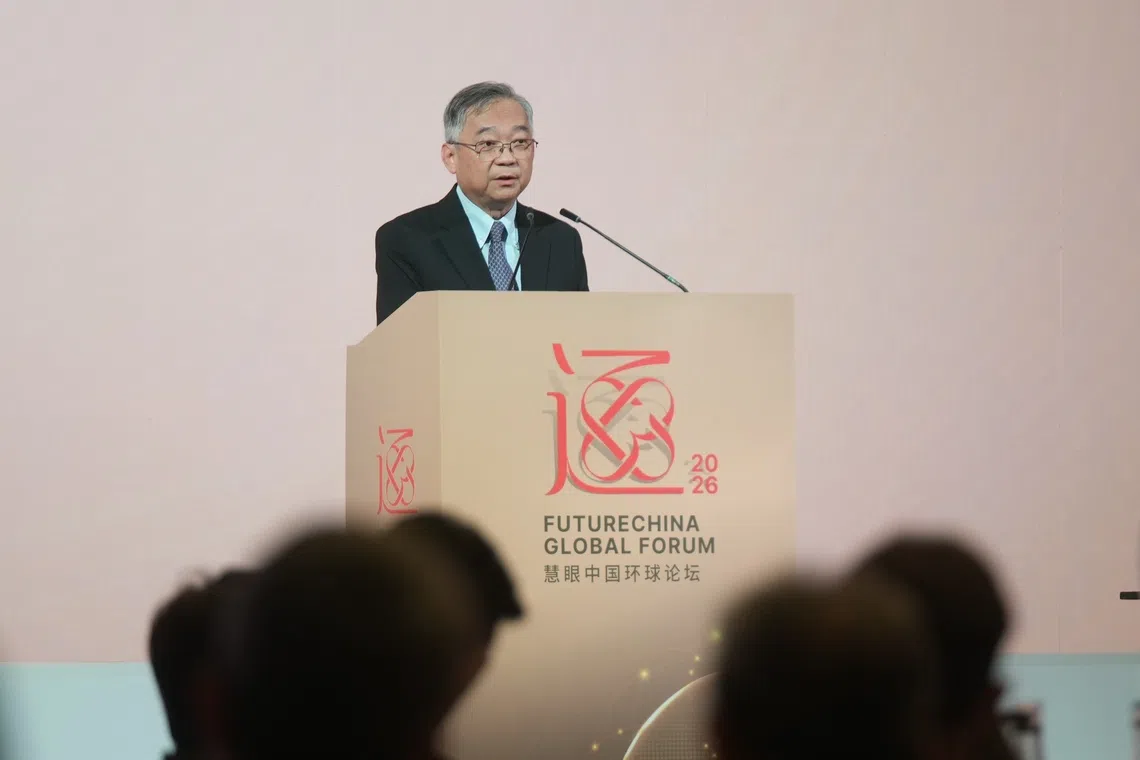
Deputy Prime Minister Gan Kim Yong noted that businesses need more than investment to capture new opportunities.
PHOTO: LIANHE ZAOBAO
Published Sep 25, 2026, 09:49 AM
Updated Sep 25, 2026, 11:42 AM
ASEAN firms face tougher path for industrial upgrading, and require more than investment to move up the value chain: Gan Kim Yong
Trade between China and ASEAN is strong, exceeding US$1 trillion for the first time in 2025.
Singapore aims to deepen ASEAN integration as 2027 chair, promoting open markets, stronger local capabilities, and regional resilience.
SINGAPORE – ASEAN faces a harder path to industrial upgrading as its businesses are facing intensifying competition, with automation reducing the advantage of lower labour costs, said Deputy Prime Minister Gan Kim Yong.
This comes as digital platforms are introducing competition while opening up new markets for firms, added Gan, who is also Minister for Trade and Industry (Trade).
Delivering an opening keynote at the FutureChina Global Forum at the Sands Expo and Convention Centre on Sept 25, he noted that businesses need more than investment to capture new opportunities.
“More trade and investment, by themselves, will not be enough,” he said.
“We must also help local enterprises move up the value chain to benefit from these opportunities, and workers acquire the skills needed to take on new roles. ”
Gan added that developing a stronger and more resilient ASEAN should be a shared priority for Singapore and China. This is because a more prosperous region presents Singapore and Chinese businesses with growing markets, more resilient supply chains and stronger partners.
China has been ASEAN’s largest trading partner since 2009, while ASEAN has been China’s largest trading partner since 2019.
Trade between China and ASEAN exceeded US$1 trillion (S$1.28 trillion) for the first time in 2025, according to official statistics.
Since then, China and ASEAN recorded US$744.4 billion in trade in the first seven months of 2026. The region also accounted for almost 22 per cent of China’s total foreign trade over the same period, data from China’s commerce ministry showed.
Gan said the latest upgrade to the ASEAN-China Free Trade Area, which was formally signed in October 2025 , is an opportunity for China and Singapore to work with ASEAN partners in areas including the digital and green economies , as well as supply chain connectivity.
Connectivity is a key part of the equation, he added, while pointing to the International Land-Sea Trade Corridor linking western China with South-east Asia and beyond.
Better transport links and supporting services can help ASEAN firms reach customers in China, and give logistics firms new business, Gan said.
These connections will also bring about new capabilities, he added, as investors can work with local suppliers to improve quality standards, methods and products.
Technology partners can also help smaller firms to adopt digital tools, while developing capabilities to adapt and maintain them.
Meanwhile, green projects can create opportunities to grow local enterprises and train workers.
Gan said: “The aim is not for every economy to do exactly the same thing. It is for businesses across the region to find a competitive niche in the value chains, and for workers to see pathways to progression.
“That is how regional integration becomes more relevant and resilient. When local firms gain customers and capabilities, and workers gain better opportunities, they will have a reason to support continued trade and investment.”
He also noted that open markets have been a powerful engine of development for Asia, but the model is under tremendous strain because of factors such as geopolitical rivalry.
Businesses and workers are also questioning whether they have received a fair share of benefits from growth and technological change.
Gan acknowledged that the concerns can fuel demands for protection and cause economies to look inwards and close up.
However, he said protectionism can make it harder for businesses to reach new markets, acquire capabilities and seize new opportunities.
He added: “We cannot simply counter openness by closing up. We have to make openness work better for businesses and for people.”
One way to do this is by making openness more resilient, by building stronger capabilities at home while expanding connections abroad.
Gan said people and businesses should also be given a stake in the progress and prosperity of countries.
He added that Singapore will work with ASEAN member states to deepen integration and strengthen the group’s capacity to respond to change, as it assumes the ASEAN chairmanship in 2027 .
The Republic is set to take over the role from the Philippines on Jan 1.
Gan said: “We want an ASEAN that remains open to the world, with the capabilities, connections and agency to shape our own future.
“Singapore and China have spent decades building trust through mutually beneficial cooperation. We should now draw on that trust to build capabilities – in Singapore and across ASEAN.”
Annabelle Liang is a business correspondent at The Straits Times, where she specialises in trade and macroeconomics.
越南副总理颜金勇指出,企业要想抓住新机遇,需要的不只是投资。
图片来源:联合早报
发布于 2026 年 9 月 25 日上午 9:49
更新于2026年9月25日上午11:42
甘金勇表示,东盟企业在产业升级方面面临更严峻的挑战,仅靠投资无法实现价值链提升。
中国与东盟之间的贸易强劲,预计到2025年将首次突破1万亿美元大关。
新加坡作为 2027 年东盟轮值主席国,旨在深化东盟一体化,促进开放市场、增强本地能力和提高区域韧性。
新加坡——副总理颜金勇表示,随着自动化削弱劳动力成本优势,东盟企业面临日益激烈的竞争,产业升级之路将更加艰难。
甘先生补充说,随着数字平台引入竞争,同时也为企业开辟了新的市场,这促使贸易及工业部长(贸易)也开始关注这一问题。
9月25日,他在金沙会展中心举行的“未来中国全球论坛”开幕式上发表主题演讲时指出,企业要想抓住新的机遇,需要的不仅仅是投资。
他说:“单靠增加贸易和投资是不够的。”
“我们还必须帮助本地企业提升价值链,从这些机遇中受益,并帮助工人获得承担新角色所需的技能。”
颜金勇补充道,建设一个更强大、更具韧性的东盟应是新加坡和中国的共同优先事项。这是因为一个更加繁荣的地区将为新加坡和中国企业带来不断增长的市场、更具韧性的供应链和更强大的合作伙伴。
自 2009 年以来,中国一直是东盟最大的贸易伙伴;而自 2019 年以来,东盟一直是中国最大的贸易伙伴。
官方统计数据显示,到2025年,中国与东盟之间的贸易额将首次超过1万亿美元(1.28万亿新元)。
此后,中国与东盟在2026年前七个月的贸易额达到7444亿美元。中国商务部的数据显示,同期东盟地区也占中国对外贸易总额的近22%。
颜金勇表示,最新升级的东盟-中国自由贸易区协议于2025年10月正式签署,为中国和新加坡与东盟伙伴在数字经济、绿色经济以及供应链互联互通等领域开展合作提供了契机。
他补充说,互联互通是关键因素之一,并指出国际陆海贸易走廊连接中国西部与东南亚及其他地区。
甘先生表示,更好的交通联系和配套服务可以帮助东盟企业接触中国客户,并为物流公司带来新的业务。
他还补充说,这些联系还将带来新的能力,因为投资者可以与当地供应商合作,提高质量标准、方法和产品。
技术合作伙伴还可以帮助小型企业采用数字化工具,同时培养其适应和维护这些工具的能力。
同时,绿色项目可以创造机会发展当地企业并培训工人。
甘先生表示:“我们的目标并非让每个经济体都做完全相同的事情。而是让整个地区的企业在价值链中找到具有竞争力的定位,并让劳动者看到晋升的途径。”
“这样一来,区域一体化就变得更有意义、更有韧性。当本地企业获得客户和能力,工人获得更好的机会时,他们就有理由支持持续的贸易和投资。”
他还指出,开放的市场一直是亚洲发展的强大引擎,但由于地缘政治竞争等因素,这种模式正面临巨大的压力。
企业和员工也在质疑他们是否从经济增长和技术变革中获得了公平的利益份额。
甘承认,这些担忧可能会加剧保护主义需求,并导致各国经济转向内向型经济,封闭起来。
但他表示,保护主义可能会使企业更难进入新市场、获得能力和抓住新机遇。
他补充道:“我们不能简单地通过封闭来对抗开放。我们必须让开放更好地服务于企业和民众。”
实现这一目标的一个方法是增强开放的韧性,即在国内建立更强大的能力,同时扩大与国外的联系。
甘表示,人民和企业也应该在国家的进步和繁荣中占有一席之地。
他补充说,新加坡将在2027年担任东盟轮值主席国期间,与东盟成员国合作,深化一体化,加强该组织应对变化的能力。
共和国将于1月1日从菲律宾手中接过这一角色。
颜金勇表示:“我们希望东盟继续对世界开放,拥有塑造我们自身未来的能力、联系和自主权。”
“新加坡和中国几十年来通过互利合作建立了互信。现在我们应该利用这种互信来提升新加坡乃至整个东盟的能力。”
梁安娜贝尔是《海峡时报》的商业记者,专门报道贸易和宏观经济。