Singapore now a 'super-aged' society, with more than 1 in 5 citizens aged 65 and above新加坡如今已是一个“超老龄化”社会,超过五分之一的公民年龄在65岁及以上。
The number of Singaporeans aged 80 and above has also grown by 60 per cent over the past 10 years.
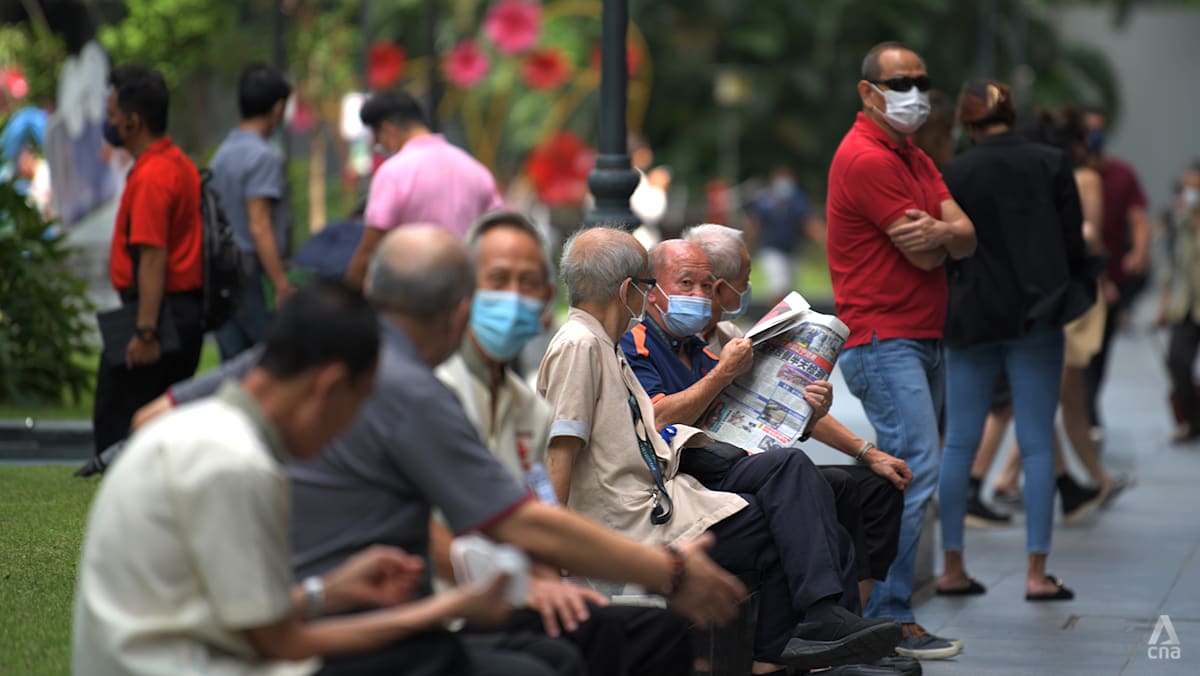
The number of Singaporeans aged 80 and above has also grown by 60 per cent over the past 10 years.
Elderly men seen outside Raffles Place MRT station on Jan 14, 2022. (File photo: CNA/Calvin Oh)
This audio is generated by an AI tool.
SINGAPORE: Singapore has reached "super-aged society" status, according to official figures released on Friday (Sep 25).
The threshold is reached when at least 21 per cent of the population is aged 65 and above.
In June 2026, 21.4 per cent of Singapore citizens were in this age group, according to this year’s Population in Brief report by the National Population and Talent Division (NPTD) of the Prime Minister’s Office and its partner agencies.
While the United Nations uses total population for its definition of a super-aged society, Singapore uses its citizen population.
CNA Games Guess Word Crack the word, one row at a time Buzzword Create words using the given letters Mini Sudoku Tiny puzzle, mighty brain teaser Mini Crossword Small grid, big challenge Word Search Spot as many words as you can Show More Show Less The latest figures also showed Singapore’s total population grew to 6.21 million that month, marking a 1.6 per cent increase from June last year. But citizen marriages and births declined in 2025 compared with 2024, the report said. Marriages fell 5.6 per cent in 2025, while births dropped 10.8 per cent.
The latest figures also showed Singapore’s total population grew to 6.21 million that month, marking a 1.6 per cent increase from June last year.
But citizen marriages and births declined in 2025 compared with 2024, the report said. Marriages fell 5.6 per cent in 2025, while births dropped 10.8 per cent.
SUPER-AGED POPULATION
Singapore’s population has been ageing, with the proportion of citizens aged 65 and above rising faster than in the previous decade.
In 2016, 13.7 per cent of the citizen population belonged to this age group. This rose to 21.4 per cent in 2026.
Over the past 10 years, the number of citizens aged 80 and above also increased by 60 per cent, climbing from 95,000 in 2016 to 152,000 in 2026, said the report.
It estimated that more than 1 in 4 Singaporeans would be aged 65 and above by 2035.
However, the proportion of citizens aged 20 to 64 is expected to remain broadly stable between 2030 and 2035.
"This is due to smaller cohorts ageing into the 65 and above age band, balanced by an inflow of younger cohorts into the 20 to 64 age band, including from managed immigration inflows," the report said.
The median age for Singaporeans as of June was 44.1, up from 43.7 in June 2025. There were also 2.8 citizens aged 20 to 64 for every citizen aged 65 and above in 2026, down from 4.7 in 2016. This old-age support ratio is projected to fall further to 2.2 by 2035.
Singapore’s total population growth was mainly driven by a rise in the non-resident population, particularly in work permit holders, said the report.
The citizen population grew by 0.7 per cent from June 2025 to June 2026, from 3.66 million to 3.68 million, while the permanent resident population remained relatively stable at 0.55 million.
Meanwhile, the non-resident population rose by 3.7 per cent to 1.98 million.
Foreign employment growth was higher from June 2025 to June 2026 than in the preceding 12 months, primarily because of an increase in work permit holders.
The report highlighted the construction sector in particular, saying more work permit holders were needed for projects such as Changi Airport’s Terminal 5, the expansion of Marina Bay Sands, and a ramp-up in housing supply and other transport infrastructure.
The annualised population growth rate from 2021 to 2026 was also higher than in the preceding five years, partly because the COVID-19 pandemic had resulted in a lower population base in 2021, the report said. Singapore granted citizenship to 25,094 people and permanent residency to 35,352 people in 2025.
From 2021 to 2025, an average of 22,400 citizenships and 34,600 permanent residencies were granted each year, up from annual averages of 20,600 and 31,200 respectively from 2016 to 2020.
The report said many of the new citizens and PRs either shared family ties with Singaporeans or had studied, worked or lived in the country for some time.
"Immigration helps to moderate the impact of ageing and low birth rates on our citizen population, and keeps the citizen population from shrinking over the long term," it said.
FEWER MARRIAGES AND BIRTHS
Singapore had 21,671 citizen marriages last year, down 5.6 per cent from 22,955 in 2024.
The average number of citizen marriages per year from 2023 to 2025 was 23,000, lower than the annual average of 23,500 from 2016 to 2019.
Singaporeans have also been getting married later. The median ages for first-time grooms and brides were 30.8 and 29.1, respectively, in 2025, up from 30.1 and 27.9, in 2015.
Of the citizen marriages last year, transnational marriages accounted for 37 per cent while inter-ethnic marriages made up 19 per cent, said the report.
The proportions of these marriages have remained largely stable since 2015, though transnational marriages dipped from 2020 to 2022 during the COVID-19 pandemic.
Singles in Singapore are also making up a larger share of the citizen population. Between 2015 and 2025, the proportion of singles rose across most male and female age groups, particularly for those aged 25 to 29 and 30 to 34, said the report.
Citizen births fell 10.8 per cent from 29,237 in 2024 to 26,071 last year, while the resident fertility rate dropped to 0.87.
The average number of births per year from 2021 to 2025 was lower than from 2016 to 2020, said the report.
At the same time, the median age of Singaporean mothers during their first birth has increased, climbing from 30.3 in 2015 to 31.9 in 2025.
While citizen births declined, the number of children granted citizenship by descent increased notably in 2025.
These children were born overseas to at least one Singaporean, and 1,646 received citizenship last year, as compared to 1,409 in 2024.
Get our pick of top stories and thought-provoking articles in your inbox
Stay updated with notifications for breaking news and our best stories
Join our channel for the top reads for the day on your preferred chat app
过去十年间,新加坡 80 岁及以上人口的数量也增长了 60%。
2022年1月14日,几位老年男子出现在莱佛士坊地铁站外。(资料照片:CNA/Calvin Oh)
这段音频是由人工智能工具生成的。
新加坡:根据周五(9月25日)公布的官方数据,新加坡已进入“超老龄化社会”阶段。
当至少 21% 的人口年龄在 65 岁及以上时,就达到了阈值。
根据总理公署国家人口与人才署(NPTD)及其合作伙伴机构发布的今年的《人口简报》,到 2026 年 6 月,新加坡公民中有 21.4% 属于这个年龄段。
联合国以总人口数来定义超老龄化社会,而新加坡则以公民人口数来定义超老龄化社会。
CNA游戏 猜词游戏 逐行破解单词 流行词游戏 用给定的字母组成单词 迷你数独 小谜题,脑力挑战 迷你填字游戏 小方格,大挑战 单词搜索 尽可能多地找出单词 显示更多 显示更少 最新数据显示,新加坡总人口当月增长至621万,较去年6月增长1.6%。但报告指出,与2024年相比,2025年公民结婚和出生人数均有所下降。2025年结婚人数下降5.6%,出生人数下降10.8%。
最新数据显示,新加坡当月总人口增长至 621 万,比去年 6 月增长 1.6%。
但报告指出,与2024年相比,2025年公民的结婚人数和出生人数均有所下降。2025年结婚人数下降了5.6%,出生人数下降了10.8%。
超老龄化人口
新加坡人口老龄化问题日益严重,65岁及以上公民的比例增长速度比过去十年更快。
2016年,该年龄段公民占总人口的13.7%。预计到2026年,这一比例将上升至21.4%。
报告称,过去 10 年,80 岁及以上公民的数量也增加了 60%,从 2016 年的 95,000 人增加到 2026 年的 152,000 人。
据估计,到 2035 年,超过四分之一的新加坡人将年满 65 岁及以上。
然而,预计 2030 年至 2035 年间,20 至 64 岁公民的比例将保持大致稳定。
报告称:“这是因为进入 65 岁及以上年龄段的人口数量较少,而进入 20 至 64 岁年龄段的人口数量则相对较少,其中包括通过有管理的移民流入。”
截至6月,新加坡公民的年龄中位数为44.1岁,高于2025年6月的43.7岁。此外,到2026年,每位65岁及以上公民对应2.8位20至64岁的公民,低于2016年的4.7。预计到2035年,这一养老比例将进一步下降至2.2。
报告称,新加坡总人口增长主要由非居民人口增加推动,尤其是工作准证持有者的增长。
从 2025 年 6 月到 2026 年 6 月,公民人口增长了 0.7%,从 366 万增至 368 万,而永久居民人口则保持相对稳定,为 55 万。
与此同时,非居民人口增长了3.7%,达到198万人。
2025 年 6 月至 2026 年 6 月期间,外国就业增长高于前 12 个月,这主要是由于工作许可证持有者人数增加。
该报告特别强调了建筑业,称樟宜机场 5 号航站楼、滨海湾金沙扩建以及住房供应和其他交通基础设施的增加等项目需要更多的工作许可证持有者。
报告指出,2021年至2026年的年均人口增长率也高于前五年,部分原因是新冠疫情导致2021年人口基数下降。新加坡计划在2025年授予25,094人公民身份,并授予35,352人永久居留权。
从 2021 年到 2025 年,每年平均授予 22,400 个公民身份和 34,600 个永久居留权,高于 2016 年至 2020 年的年均 20,600 个和 31,200 个。
报告称,许多新公民和永久居民要么与新加坡人有家庭关系,要么曾在该国学习、工作或生活过一段时间。
“移民有助于缓解人口老龄化和低出生率对我国公民人口的影响,并防止公民人口长期萎缩,”声明中写道。
结婚和生育数量减少
新加坡去年共有 21,671 对公民结婚,比 2024 年的 22,955 对减少了 5.6%。
2023 年至 2025 年,公民每年平均结婚人数为 23,000 人,低于 2016 年至 2019 年的年均 23,500 人。
新加坡人的结婚年龄也越来越晚。到2025年,初婚新郎和新娘的平均年龄分别为30.8岁和29.1岁,高于2015年的30.1岁和27.9岁。
报告称,去年公民婚姻中,跨国婚姻占 37%,跨种族婚姻占 19%。
自 2015 年以来,这些婚姻的比例基本保持稳定,尽管在 COVID-19 大流行期间,2020 年至 2022 年跨国婚姻有所下降。
报告指出,新加坡单身人士在公民人口中所占比例也在不断上升。2015年至2025年间,大多数男性和女性年龄段的单身人士比例均有所上升,尤其是在25至29岁和30至34岁年龄段。
公民出生人数从 2024 年的 29,237 人下降 10.8% 至去年的 26,071 人,而居民生育率下降至 0.87。
报告称,2021年至2025年每年的平均出生人数低于2016年至2020年。
与此同时,新加坡母亲初次生育时的年龄中位数有所上升,从 2015 年的 30.3 岁上升到 2025 年的 31.9 岁。
虽然公民出生率下降,但 2025 年通过血统获得公民身份的儿童人数显著增加。
这些儿童在海外出生,父母至少有一位是新加坡公民。去年有 1646 名儿童获得公民身份,而 2024 年这一数字为 1409。
订阅我们的邮件,即可获取精选热点新闻和引人深思的文章。
订阅通知,第一时间获取突发新闻和精彩报道。
加入我们的频道,即可在您常用的聊天应用上获取当日热门文章。