What happens after an animal dies at the Singapore Zoo? Meet the vet who investigates every death新加坡动物园的动物死亡后会发生什么?来认识一下负责调查每起死亡事件的兽医吧。
Dr Hsu Chia-Da is the only pathologist at Mandai Wildlife Group. CNA follows him inside the post-mortem room to see how clues uncovered after death can help zookeepers and veterinarians improve animal care.
新闻视频
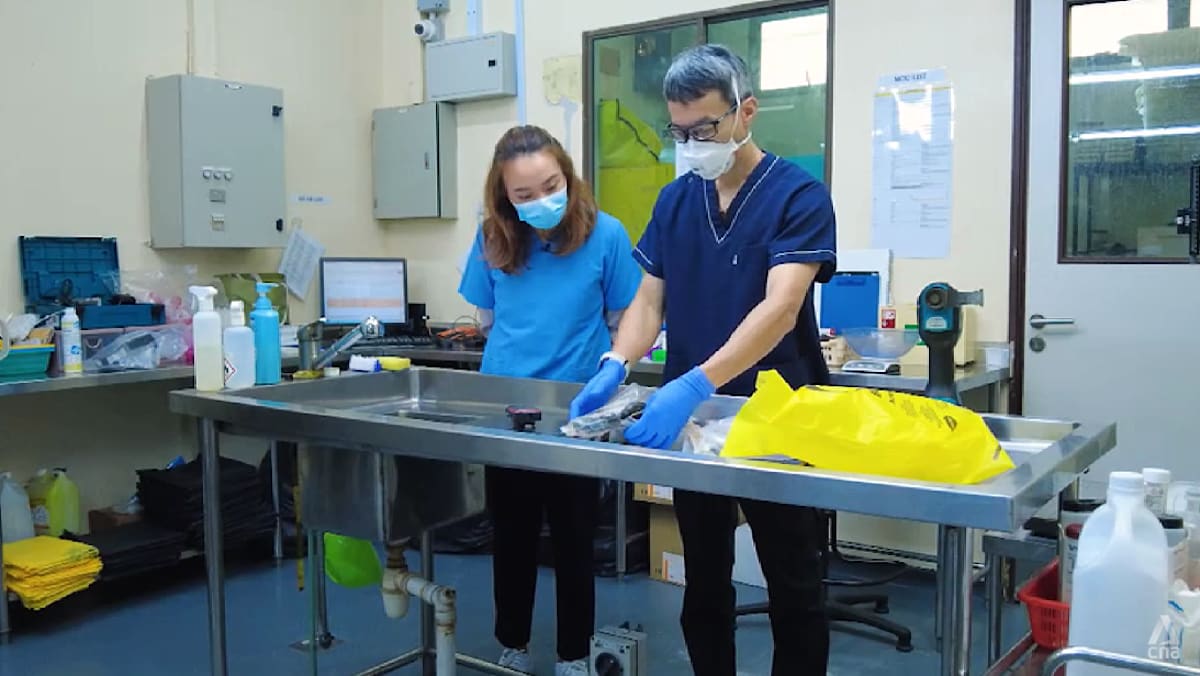
Dr Hsu Chia-Da is the only pathologist at Mandai Wildlife Group. CNA follows him inside the post-mortem room to see how clues uncovered after death can help zookeepers and veterinarians improve animal care.
Dr Hsu Chia-Da (right), senior veterinary pathologist at Mandai Wildlife Group, unwraps the carcass of a yellow-spotted river turtle for post-mortem examination. (Image: CNA)
This audio is generated by an AI tool.
SINGAPORE: Two yellow-spotted river turtles were found dead in the same week at the Singapore Zoo about a month ago.
For Dr Hsu Chia-Da, the timing immediately raised a troubling possibility: Could there be a disease outbreak?
“When two animals die back-to-back, (we) always think maybe there’s a disease outbreak,” said the senior veterinary pathologist at Mandai Wildlife Group.
“But sometimes, it just happens.”
CNA Games Guess Word Crack the word, one row at a time Buzzword Create words using the given letters Mini Sudoku Tiny puzzle, mighty brain teaser Mini Crossword Small grid, big challenge Word Search Spot as many words as you can Show More Show Less Finding out which was the case fell to the 43-year-old. For one of the turtles, determining what had killed it was complicated by the condition in which it had been found – it had been in water overnight before its carcass was discovered. In Singapore’s heat, decomposition can happen quickly. “The longer the carcass is outside, the more … bacteria starts to grow, and we cannot find out the (cause that) killed the animal,” Dr Hsu said. “The main issue in Southeast Asia is that the temperature is always hot, so they decompose much faster.” After examining the turtles, Dr Hsu could rule out some possibilities but could not give a definitive answer. “There’re no obvious signs of trauma and infection,” he said, adding that however, he could not conclusively rule out potential infection. As a precaution, he suggested keepers closely monitor the enclosure for a period of time and bring in any animal showing symptoms of illness, such as a loss of appetite. EVERY DEATH COMES TO HIM For the past decade, Dr Hsu has been searching for answers in what animals leave behind, examining their bodies for clues that can help veterinarians and keepers provide better care. Unlike clinical veterinarians, who diagnose and treat living animals, his work only begins after death.
Finding out which was the case fell to the 43-year-old.
For one of the turtles, determining what had killed it was complicated by the condition in which it had been found – it had been in water overnight before its carcass was discovered. In Singapore’s heat, decomposition can happen quickly.
“The longer the carcass is outside, the more … bacteria starts to grow, and we cannot find out the (cause that) killed the animal,” Dr Hsu said.
“The main issue in Southeast Asia is that the temperature is always hot, so they decompose much faster.”
After examining the turtles, Dr Hsu could rule out some possibilities but could not give a definitive answer.
“There’re no obvious signs of trauma and infection,” he said, adding that however, he could not conclusively rule out potential infection.
As a precaution, he suggested keepers closely monitor the enclosure for a period of time and bring in any animal showing symptoms of illness, such as a loss of appetite.
EVERY DEATH COMES TO HIM
For the past decade, Dr Hsu has been searching for answers in what animals leave behind, examining their bodies for clues that can help veterinarians and keepers provide better care.
Unlike clinical veterinarians, who diagnose and treat living animals, his work only begins after death.
Dr Hsu speaks to CNA during an interview at his office. He says he does not become emotionally attached to the animals he examines, and concentrates on staying objective and finding answers instead. (Image: CNA)
Every animal that dies at the zoo eventually comes to him – from its largest denizens like Nile hippopotamuses to tiny ones including butterflies, stick insects and Madagascar cockroaches.
Each carcass is labelled with information including its species, origin and date of death.
Dr Hsu assigns each case a number and photographs the carcass at every stage for documentation.
He starts his examination on the outside, searching for any unusual signs.
“Sometimes, it’s very obvious, like trauma – they have bleeding somewhere or bite wounds on the body,” he said. “But most times, we have to open them.”
CLUES BENEATH THE SURFACE
The colour and condition of organs can offer clues, while tissue samples can be processed in the laboratory and examined under a microscope to reveal changes invisible to the naked eye.
For living animals, however, detecting such problems can be much harder, even with sophisticated diagnostic tools.
“You can use an X-ray to see fractures (when) we suspect there may be trauma. But internal bleeding, unless you use a scope to see … it's very difficult to say,” he explained.
That difficulty is magnified in species with very different anatomies from humans.
“(For example) snakes – they are so long, where are you going to check?” Dr Hsu asked.
A recent case involving a rescued python showed just how difficult this can be.
The snake had been bleeding from its mouth for days. Veterinarians suspected internal bleeding, though its extent and cause could not be determined.
Despite treatment, the rescued python’s condition deteriorated, and a decision was made to euthanise the reptile .
The python was found in the wild. Besides animals from the zoo, Dr Hsu also handles wildlife brought in by animal rescue organisations and other parks.
During the post-mortem examination, the pathologist first looked for external signs of trauma, such as injuries that might indicate the snake had been struck or run over.
Its exterior appeared smooth, with no lacerations or puncture wounds.
Inside, however, was a very different picture.
Dr Hsu found extensive haemorrhaging around the snake’s stomach, heart and lungs. Its liver had turned a pale grey.
“The liver is … supposed to be red in colour. (But) there's not enough blood, that's why it became so pale, so greyish. It means the haemorrhage is really, really severe. So severe (it) changed the colour of the organ,” he said.
Dr Hsu examines a python during a post-mortem examination.
His findings pointed to an impact to the snake’s stomach area that had caused severe internal bleeding.
The post-mortem findings also helped confirm what the veterinarians had suspected. Dr Hsu said this could help them become more confident when diagnosing and treating cases in future.
“We don’t know what happened, but we try our best to find out. This can help the vets. The next time they see similar things, they know what to look for,” he said.
WHEN ONE DEATH HELPS OTHERS
Sometimes, what Dr Hsu finds in one animal can lead to changes affecting an entire enclosure.
In a separate turtle case, he noticed that the animal’s liver did not look healthy. Under the microscope, the reason became apparent.
“(Its) liver cells are all filled up by fat. This is a typical fatty liver case,” he said.
The discovery helped inform changes in how the turtles were cared for. Their diet was adjusted to include more fibre, while additional feeding stations encouraged them to move around more.
"It’s a progressive thing. Now, we don’t see this kind of issue anymore,” Dr Hsu said.
Such findings can also reveal patterns across species. Certain animals may be more susceptible to particular conditions, he said.
Dr Hsu Chia-Da works at his microscope in his office, where he examines tissue samples for changes that may not be visible to the naked eye. (Image: CNA)
Cats, for example, can be prone to kidney problems, while young turtles may develop metabolic bone disease if they do not receive enough calcium.
The information gathered by him is shared beyond Mandai with the global zoo community, allowing knowledge from one animal to potentially benefit others elsewhere.
For critically endangered species, that information can be especially valuable. Death, while a loss to an already small population, can provide specialists with a rare opportunity to collect information that might otherwise be impossible to obtain.
Some animals also continue contributing to science after Dr Hsu's examination.
Specimens or samples may be preserved for scientific or museum purposes, particularly in the case of rarer wildlife.
THE LAST VET TO SEE EACH ANIMAL
Originally from Taiwan, Dr Hsu has spent the past decade honing his profession in Singapore.
His interest in pathology began at veterinary school, when he discovered an aptitude for recognising patterns. But patterns do not make the work predictable.
“Every single case is different from the previous one. Even among the same species in the same environment, two animals die differently, they give you different results. You have to find out. It's a puzzle, and I like to solve puzzles” he said.
Dr Hsu visits the Singapore Zoo's Tortoise Shell-ter, a sanctuary for tortoises and other reptiles. (Image: CNA)
The nature of the job means he spends his working days surrounded by death.
But Dr Hsu says he does not become emotionally attached to the animals he examines, allowing him to concentrate on finding answers.
“I don't get emotional attachment … so I can focus on the situation. (Then) I won’t feel so sad while doing post mortem,” he said.
“I’m the last person looking at the animal. I have to be objective.”
For the people who cared for the animals, those answers matter deeply, said Dr Hsu.
Keepers who spend every day with their animals want to understand why they died, while veterinarians who treated them want to know whether their diagnoses were correct, and what they might do differently the next time they encounter a similar case.
“We collect data, and the animal care team … can use the information to enhance animal welfare in their day-to-day work,” Dr Hsu said.
For Dr Hsu, that is what makes each new case worth solving – it may be too late for the animal on his examination table, but what he learns from its death could help many others.
Get our pick of top stories and thought-provoking articles in your inbox
Stay updated with notifications for breaking news and our best stories
Join our channel for the top reads for the day on your preferred chat app
许嘉达博士是万代野生动物集团唯一的病理学家。亚洲新闻台记者跟随他进入尸检室,了解死后发现的线索如何帮助动物园管理员和兽医改善动物护理。
曼代野生动物保护小组高级兽医病理学家许嘉达博士(右)正在打开黄斑河龟的尸体进行尸检。(图片:中央社)
这段音频是由人工智能工具生成的。
新加坡:大约一个月前,新加坡动物园在同一周内发现了两只黄斑河龟的尸体。
对于许嘉达医生来说,这个时间点立刻引发了一个令人担忧的可能性:会不会爆发疾病?
“当两只动物相继死亡时,我们总是会想到可能爆发了疾病,”万代野生动物集团的高级兽医病理学家说。
“但有时候,这种事就是会发生。”
CNA游戏 猜词游戏 逐行破解单词 流行词游戏 用给定的字母组成单词 迷你数独 小小的谜题,强大的脑力挑战 迷你填字游戏 小方格,大挑战 单词搜索 尽可能多地找出单词 显示更多 显示更少 找出究竟是哪种情况,就落在了这位43岁的医生身上。对于其中一只海龟来说,确定它的死因十分复杂,因为它被发现时的状态很特殊——它的尸体在被发现前已经在水中浸泡了一夜。在新加坡炎热的气候下,尸体腐烂的速度很快。“尸体在外面停留的时间越长,细菌滋生就越多,我们就无法确定动物的死因了,”许医生说。“东南亚的主要问题是气温常年炎热,所以它们腐烂得更快。” 检查完海龟后,许医生排除了一些可能性,但无法给出确切的答案。“没有明显的创伤和感染迹象,”他说,但他补充说,他也不能完全排除感染的可能性。作为预防措施,他建议饲养员密切观察动物圈舍一段时间,并将任何出现疾病症状(例如食欲不振)的动物带回医院。过去十年,许博士一直在动物遗骸中寻找答案,检查它们的尸体,寻找可以帮助兽医和饲养员提供更好护理的线索。与诊断和治疗活体动物的临床兽医不同,他的工作始于动物死亡之后。
查明真相的重任落在了这位43岁的男子身上。
其中一只海龟的死因难以确定,因为它被发现时的状态很特殊——尸体在水中浸泡了一夜才被发现。在新加坡炎热的气候下,尸体腐烂的速度很快。
许医生说:“动物尸体在外面放置的时间越长,细菌就会滋生,我们就无法查明动物的死因。”
“东南亚的主要问题是气温常年炎热,所以它们腐烂得更快。”
徐博士检查了这些乌龟后,可以排除一些可能性,但无法给出确切的答案。
“没有明显的创伤和感染迹象,”他说,但他补充说,他无法完全排除感染的可能性。
作为预防措施,他建议饲养员密切观察一段时间,并将任何出现疾病症状(如食欲不振)的动物带回饲养室。
一切死亡都临到他。
过去十年,许博士一直在动物遗骸中寻找答案,检查它们的尸体,寻找可以帮助兽医和饲养员提供更好护理的线索。
与诊断和治疗活体动物的临床兽医不同,他的工作只在动物死后才开始。
许医生在办公室接受中央社采访时表示,他不会对所诊治的动物产生情感依恋,而是专注于保持客观,寻找病因。(图片:中央社)
动物园里死去的每一只动物最终都会来到他这里——从像尼罗河河马这样体型最大的动物,到包括蝴蝶、竹节虫和马达加斯加蟑螂在内的小动物。
每具动物尸体上都贴有标签,标明物种、产地和死亡日期等信息。
许医生给每个病例分配一个编号,并在每个阶段拍摄尸体照片以作记录。
他从外部开始检查,寻找任何异常迹象。
“有时候,伤口很明显,比如外伤——身上某处有出血点或者咬伤,”他说。“但大多数时候,我们都必须打开伤口进行检查。”
隐藏在表面之下的线索
器官的颜色和状况可以提供线索,而组织样本可以在实验室中进行处理,并在显微镜下进行检查,以揭示肉眼无法看到的变化。
然而,对于活体动物来说,即使使用先进的诊断工具,检测出这类问题也难上加难。
“当怀疑有外伤时,可以用X光检查来发现骨折。但是,除非用内窥镜观察,否则很难判断是否存在内出血,”他解释说。
对于解剖结构与人类截然不同的物种来说,这种困难会更加突出。
“(例如)蛇——它们那么长,你要检查哪里呢?”许医生问道。
最近一起获救蟒蛇的案例表明,这有多么困难。
这条蛇的嘴巴已经流血好几天了。兽医怀疑是内出血,但出血量和出血原因都无法确定。
尽管接受了治疗,获救蟒蛇的病情还是恶化了,最终决定对这只爬行动物实施安乐死。
这条蟒蛇是在野外发现的。除了动物园里的动物,许博士还负责照料动物救援组织和其他公园送来的野生动物。
在尸检过程中,病理学家首先寻找外部创伤迹象,例如可能表明蛇曾被击打或碾压的伤口。
它的表面光滑,没有撕裂伤或穿刺伤。
然而,里面的情况却截然不同。
许医生发现蛇的胃、心脏和肺部周围大面积出血,肝脏呈淡灰色。
“肝脏……原本应该是红色的。(但是)由于血液不足,它变得如此苍白,如此灰暗。这意味着出血非常非常严重。严重到改变了器官的颜色,”他说。
许医生在尸检过程中检查一条蟒蛇。
他的发现表明,这条蛇的胃部受到了撞击,导致严重的内出血。
尸检结果也证实了兽医们的怀疑。许医生表示,这有助于他们在未来诊断和治疗病例时更有信心。
“我们不知道发生了什么,但我们会尽力查明。这可以帮助兽医。下次他们遇到类似情况时,就知道该注意些什么了。”他说。
当一个人的死亡帮助了其他人
有时,许博士在一只动物身上发现的问题可能会导致整个动物圈舍发生改变。
在另一起龟类病例中,他注意到这只龟的肝脏看起来不太健康。在显微镜下,原因显而易见。
“(它的)肝细胞都被脂肪填满了。这是典型的脂肪肝病例,”他说。
这一发现促使人们改变了对海龟的照料方式。它们的饮食被调整,增加了纤维含量,同时增设了喂食站,鼓励它们更多地活动。
“这是进步的迹象。现在,我们已经不再遇到这类问题了。”许医生说。
这些发现还可以揭示不同物种之间的共性模式。他表示,某些动物可能更容易受到特定疾病的影响。
许嘉达医生在他的办公室里用显微镜检查组织样本,寻找肉眼无法观察到的变化。(图片:CNA)
例如,猫容易患肾脏疾病,而幼龟如果钙摄入不足,可能会患上代谢性骨病。
他收集到的信息不仅在万代动物园内共享,还与全球动物园界分享,使来自一只动物的知识有可能造福其他地方的动物。
对于极度濒危物种而言,这些信息尤为宝贵。死亡虽然会给本已数量稀少的种群带来损失,但却能为专家们提供一个难得的机会,收集到一些原本可能无法获得的信息。
一些动物在许博士检查后仍然继续为科学做出贡献。
标本或样本可以保存下来用于科学研究或博物馆用途,尤其是一些较为稀有的野生动物标本或样本。
最后一位接诊每只动物的兽医
许医生原籍台湾,过去十年一直在新加坡磨练医术。
他对病理学的兴趣始于兽医学院,当时他发现自己有识别模式的天赋。但模式并不意味着工作就可预测。
“每个案例都与前一个案例不同。即使是同一物种、同一环境下的动物,死亡方式也可能不同,结果也会不同。你必须找出原因。这就像解谜一样,而我喜欢解谜。”他说道。
许博士参观了新加坡动物园的龟壳园,这是一个为陆龟和其他爬行动物提供的保护区。(图片:CNA)
由于工作性质,他每天都与死亡为伴。
但许博士表示,他不会对所检查的动物产生情感依恋,这使他能够专注于寻找答案。
“我不会产生情感上的依恋……所以我可以专注于实际情况。(这样)我在进行尸检时就不会感到那么悲伤了,”他说。
“我是最后一个观察这只动物的人。我必须保持客观。”
许博士说,对于那些照顾动物的人来说,这些答案意义重大。
每天与动物朝夕相处的饲养员想要了解它们的死因,而治疗它们的兽医则想知道他们的诊断是否正确,以及下次遇到类似病例时可以采取哪些不同的做法。
许博士说:“我们收集数据,动物护理团队……可以利用这些信息在日常工作中提高动物福利。”
对于许医生来说,正是这一点让每个新病例都值得解决——对于他检查台上的动物来说可能已经太晚了,但他从它的死亡中学到的东西可以帮助许多其他动物。
订阅我们的邮件,即可获取精选热点新闻和引人深思的文章。
订阅通知,第一时间获取突发新闻和精彩报道。
加入我们的频道,即可在您常用的聊天应用上获取当日热门文章。