Govt reviewing property purchases by rail planning officers between 2007 and 2011 after working paper allegations政府正在审查铁路规划官员在2007年至2011年间的房产购买行为,此前有工作文件提出了相关指控。
The statistical patterns are concerning, but do not by themselves establish whether officers had access to non-public information about MRT stations or if it influenced property purchases, says the Public Service Division.
新闻视频
The statistical patterns are concerning, but do not by themselves establish whether officers had access to non-public information about MRT stations or if it influenced property purchases, says the Public Service Division.
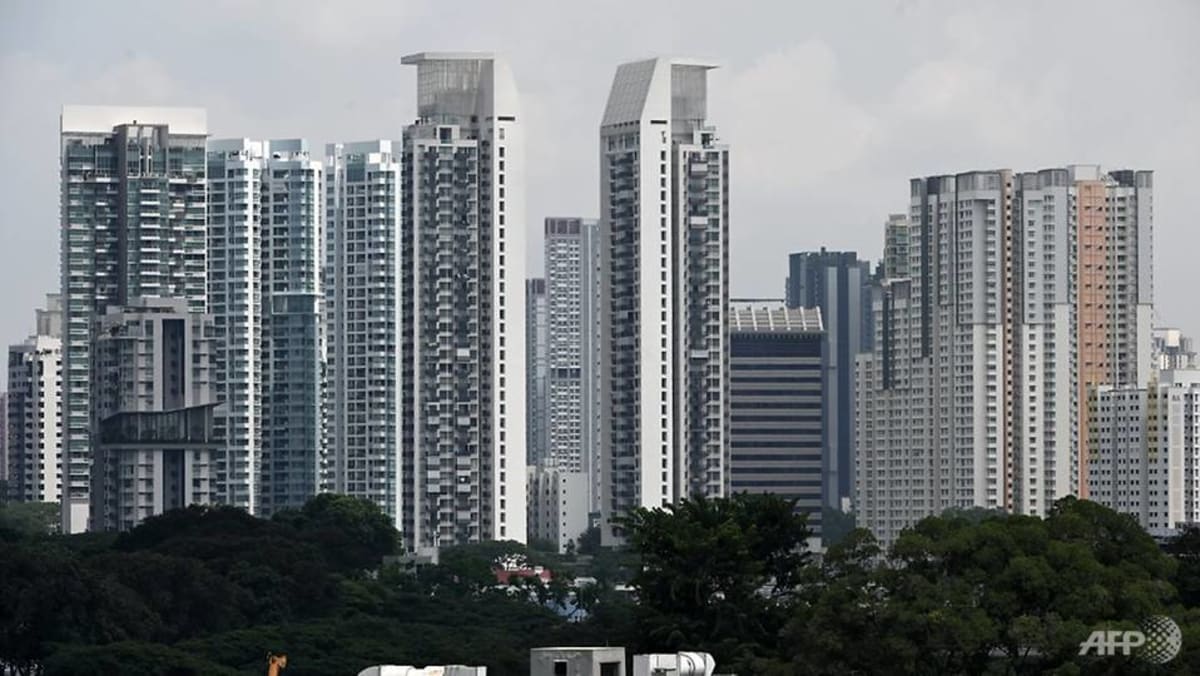
Apartment buildings in Singapore. (File photo: AFP/Roslan Rahman)
This audio is generated by an AI tool.
SINGAPORE: The government is reviewing property purchases made between 2007 and 2011 by officers involved in rail planning to assess if there was "actual misconduct", after a working paper alleged "informed trading by civil servants" who "disproportionately" bought homes near unannounced MRT stations.
The Public Service Division (PSD) said on Friday (Sep 25) that the statistical patterns in the paper were concerning, but "do not by themselves establish whether any individual officer actually had access to non-public information on MRT station locations at the relevant time, or whether such information influenced a property purchase".
"For example, information or speculation about planned MRT lines and stations may already be in the public domain or used to market new property developments," PSD said in a media release.
"An officer may have purchased a unit in such a development for reasons unrelated to any non-public information. These possibilities do not remove the need for scrutiny, but underscore why each transaction must be examined carefully before any conclusion is drawn."
CNA Games Guess Word Crack the word, one row at a time Buzzword Create words using the given letters Mini Sudoku Tiny puzzle, mighty brain teaser Mini Crossword Small grid, big challenge Word Search Spot as many words as you can Show More Show Less The review will cover property purchases between 2007 and 2011, which is the period highlighted in the paper, and where the properties were close to locations subsequently announced as MRT stations. PSD said it would need time to retrieve the available records and examine the circumstances of each case as the transactions took place some time ago. "If we find evidence that an officer used non-public information to make a property purchase for personal benefit, the case will be referred to the police for further investigation," said the division, which sits under the Prime Minister's Office. PSD said on Sep 14 that it was reviewing the data and methodology within the paper, and would refer matters to the Corrupt Practices Investigation Bureau "if there is a material basis to do so". RULES AND SAFEGUARDS PSD said that the public service has long had rules and safeguards to prevent officers from using non-public information for personal benefit. This includes a requirement for public officers to declare their property purchases, controls over access to sensitive information and established channels for reporting suspected wrongdoing. These rules and safeguards have been strengthened over time, added PSD. "Today, officers with non-public information that may be relevant to a proposed personal transaction – whether involving property, vehicles or financial instruments – must declare this and obtain approval before proceeding," it said. "The government expects all public officers to uphold the highest standards of integrity. "Where there are grounds to suspect that an officer has misused non-public information for personal benefit, the matter will be investigated and appropriate action taken. "At the same time, conclusions of wrongdoing must be based on evidence and the facts of each case."
The review will cover property purchases between 2007 and 2011, which is the period highlighted in the paper, and where the properties were close to locations subsequently announced as MRT stations.
PSD said it would need time to retrieve the available records and examine the circumstances of each case as the transactions took place some time ago.
"If we find evidence that an officer used non-public information to make a property purchase for personal benefit, the case will be referred to the police for further investigation," said the division, which sits under the Prime Minister's Office.
PSD said on Sep 14 that it was reviewing the data and methodology within the paper, and would refer matters to the Corrupt Practices Investigation Bureau "if there is a material basis to do so".
RULES AND SAFEGUARDS
PSD said that the public service has long had rules and safeguards to prevent officers from using non-public information for personal benefit.
This includes a requirement for public officers to declare their property purchases, controls over access to sensitive information and established channels for reporting suspected wrongdoing.
These rules and safeguards have been strengthened over time, added PSD.
"Today, officers with non-public information that may be relevant to a proposed personal transaction – whether involving property, vehicles or financial instruments – must declare this and obtain approval before proceeding," it said.
"The government expects all public officers to uphold the highest standards of integrity.
"Where there are grounds to suspect that an officer has misused non-public information for personal benefit, the matter will be investigated and appropriate action taken.
"At the same time, conclusions of wrongdoing must be based on evidence and the facts of each case."
The paper, titled Do Social Norms Substitute for Enforcement? Evidence from Public Officials' Home Purchases in Singapore, was published this month by the US-based National Bureau of Economic Research (NBER).
The authors of the paper, which has not been peer-reviewed, are Professor Tomasz Piskorski of Columbia University, Professor Amit Seru and Mr Chun Zhao of Stanford University, and Associate Professor Jian Zhang of the University of Hong Kong.
NBER is a private, non-profit research organisation largely funded by research grants, as well as investment portfolio income and philanthropy.
The researchers said they wanted to study whether social norms that are pro-integrity can replace formal enforcement in deterring misconduct by public officials.
They compared private property transactions filed with the Registry of Land Titles between January 1995 and December 2019 with three sources of data to observe property trading activity of public officials and other individuals.
These sources were: the Singapore Government Directory Interactive online database of public officers; the Council for Estate Agencies' public register of licensed real estate agents; and a proprietary dataset of demographic details and residential addresses for a large sample of Singaporean residents as of 2013.
The researchers examined private property purchases near planned MRT stations that took place before the stations were publicly announced, as a "proxy for access to privileged location information".
They drew circular buffers around proposed stations and classified homes within them as "target" properties, using a 1km radius in the main analysis.
They then compared the transactions of the public officials against a control group closely matching the officials in age, gender, marital status and ethnicity.
"We find clear evidence of informed trading by civil servants," said the authors.
"Purchase intensity near planned MRT stations is higher for civil servants than for matched controls, with the difference concentrated one to two years before public announcements."
Against the control group, the authors estimated - based on statistical modelling - that public officials would have made about 50 additional purchases of target properties two years before plans were announced, and 63 additional purchases one year before.
After announcements, civil servants and the control group exhibited similar trading behaviour, which the authors said pointed to pre-emptive buying in anticipation of the station announcements.
"A back-of-the-envelope calculation yields approximately S$138 million in gross target-property acquisition value associated with the excess pre-announcement purchases," they said.
Using ChatGPT to help tag the public officials' ranks, they found that "informed purchases are concentrated among mid-level officials".
They posited that mid-level officials have enough resources to make the purchases, unlike junior officials, and expect lower scrutiny and reputational costs than senior officials.
They also found that "informed purchases" were more prevalent among officials employed in agencies involved in planning of MRT lines.
The researchers also looked up the co-occupants or co-registrants of the officials' residential addresses to identify connected people, whom they called "relatives" for expositional convenience and not because of family ties.
They observed that "relatives of civil servants engage in informed purchases, earn excess benchmark-adjusted returns, and, on average, exit their investments earlier than matched controls".
"Together, these findings indicate that public officials and their relatives derive substantial private financial benefits from informed home purchases," they said.
In the paper's acknowledgements, the authors said they "benefited immensely" from discussions with four academics: University of Chicago economists Chang-tai Hsieh and Luigi Zingales, and Harvard University economists Li Shengwu and Jesse Shapiro. Li is also the estranged nephew of former prime minister Lee Hsien Loong.
Some Singapore academics who are thanked in the authors' acknowledgements have since distanced themselves from the paper , with two from the National University of Singapore asking to have their names removed.
Get our pick of top stories and thought-provoking articles in your inbox
Stay updated with notifications for breaking news and our best stories
Join our channel for the top reads for the day on your preferred chat app
公共服务部门表示,这些统计模式令人担忧,但其本身并不能确定警员是否能够获取有关地铁站的非公开信息,也不能确定这些信息是否影响了房产购买。
新加坡的公寓楼。 (资料图:法新社/罗斯兰·拉赫曼)
这段音频是由人工智能工具生成的。
新加坡:政府正在审查参与铁路规划的官员在 2007 年至 2011 年间进行的房产购买,以评估是否存在“实际不当行为”。此前一份工作文件指控“公务员进行知情交易”,他们“不成比例地”购买了靠近未公布的地铁站的房屋。
公共服务署(PSD)于周五(9月25日)表示,报纸中的统计模式令人担忧,但“这些统计模式本身并不能确定是否有任何官员在相关时期实际接触到有关地铁站位置的非公开信息,也不能确定此类信息是否影响了房产购买”。
“例如,有关规划中的地铁线路和车站的信息或猜测可能已经公开,或者被用于推销新的房地产开发项目,”公共服务署在一份新闻稿中表示。
“一名警官可能出于与任何非公开信息无关的原因购买了此类楼盘中的房产。这些可能性并不能免除审查的必要性,但却凸显了为什么在得出任何结论之前,必须仔细审查每一笔交易。”
CNA游戏 猜词游戏 逐行破解单词 流行词游戏 用给定的字母组成单词 迷你数独 小谜题,脑力挑战 迷你填字游戏 小方格,大挑战 单词搜索 尽可能多地找出单词 显示更多 显示更少 此次审查将涵盖2007年至2011年间的房产购买情况,该时期也是报纸重点关注的时期,且这些房产均靠近后来宣布的地铁站。公共服务署表示,由于交易发生时间较早,需要时间来调取现有记录并审查每个案件的具体情况。该部门隶属于总理公署,表示:“如果我们发现有证据表明有官员利用非公开信息进行房产购买以谋取私利,案件将移交警方进一步调查。” 公共服务署于9月14日表示,正在审查报纸中的数据和方法,并将“如有实质性依据”将相关事宜移交贪污调查局。公安署表示,公共服务部门长期以来都设有规则和保障措施,以防止公务员利用非公开信息谋取私利。这些措施包括要求公务员申报其购买的房产、控制敏感信息的访问以及设立举报可疑不当行为的渠道。公安署补充说,这些规则和保障措施随着时间的推移不断加强。“如今,掌握可能与拟议的个人交易(无论涉及房产、车辆还是金融工具)相关的非公开信息的公务员,必须申报并获得批准后方可进行交易。”公安署表示,“政府期望所有公务员恪守最高的诚信标准。如有理由怀疑公务员滥用非公开信息谋取私利,相关事宜将进行调查并采取适当行动。同时,对不当行为的认定必须基于证据和个案事实。”
本次审查将涵盖 2007 年至 2011 年间的房产购买情况,这是该论文重点关注的时期,并且这些房产靠近后来宣布为地铁站的地点。
公共服务署表示,由于交易发生于一段时间以前,需要时间来调取现有记录并审查每个案件的情况。
“如果我们发现有证据表明某位官员利用非公开信息购买房产以谋取私利,该案件将移交警方进行进一步调查,”该部门隶属于总理办公室。
公共服务署于9月14日表示,正在审查该报告中的数据和方法,如果“有实质性依据”,将把相关事宜移交贪污调查局。
规则和保障措施
公共服务署表示,公共服务部门长期以来都有规章制度和保障措施,防止公务员利用非公开信息谋取私利。
这包括要求公职人员申报其财产购买情况、控制对敏感信息的访问以及建立举报涉嫌不当行为的渠道。
PSD补充说,这些规则和保障措施随着时间的推移得到了加强。
“如今,掌握可能与拟议的个人交易(无论是涉及财产、车辆还是金融工具)相关的非公开信息的官员,必须申报这些信息,并在进行交易前获得批准。”声明中写道。
政府期望所有公职人员都能秉持最高的诚信标准。
“如有理由怀疑警员滥用非公开信息谋取私利,将对此事进行调查并采取适当行动。
“与此同时,对不当行为的结论必须以证据和每个案件的事实为依据。”
这篇题为《社会规范能否替代执法?来自新加坡公职人员购房行为的证据》的论文由美国国家经济研究局 (NBER) 于本月发表。
该论文尚未经过同行评审,作者包括哥伦比亚大学的托马斯·皮斯科尔斯基教授、斯坦福大学的阿米特·塞鲁教授和赵春先生,以及香港大学的张健副教授。
NBER 是一个私营的非营利研究机构,其资金主要来自研究拨款、投资组合收益和慈善捐赠。
研究人员表示,他们想研究促进廉洁的社会规范是否可以取代正式的执法措施来阻止公职人员的不当行为。
他们将 1995 年 1 月至 2019 年 12 月期间向土地所有权登记处提交的私人财产交易与三个数据来源进行比较,以观察公职人员和其他个人的财产交易活动。
这些资料来源包括:新加坡政府互动式在线公务员数据库;房地产代理理事会的持牌房地产经纪人公共登记册;以及截至 2013 年新加坡大量居民的人口统计详情和居住地址的专有数据集。
研究人员调查了在地铁站正式公布之前,规划中的地铁站附近发生的私人房产购买情况,以此作为“获取特权位置信息的代理”。
他们在拟建车站周围画出圆形缓冲区,并将缓冲区内的房屋归类为“目标”房产,在主要分析中使用 1 公里半径。
然后,他们将这些公职人员的交易与年龄、性别、婚姻状况和种族与这些官员非常相似的对照组进行了比较。
“我们发现了公务员进行知情交易的明确证据,”作者们说。
“公务员在规划中的地铁站附近的购买强度高于对照组,这种差异集中在公开宣布前一到两年。”
与对照组相比,作者根据统计模型估计,公职人员在计划公布前两年会额外购买约 50 处目标房产,在计划公布前一年会额外购买约 63 处目标房产。
公告发布后,公务员和对照组表现出类似的交易行为,作者表示,这表明他们为了等待电台公告而提前购买股票。
他们表示:“粗略估算一下,与公告发布前的超额收购相关的目标物业总收购价值约为 1.38 亿新元。”
他们利用 ChatGPT 来帮助标记公职人员的级别,发现“知情购买行为集中在中层官员中”。
他们认为,与初级官员不同,中层官员有足够的资源进行采购,并且预计受到的审查和声誉损失成本低于高级官员。
他们还发现,“知情采购”在参与地铁线路规划的机构官员中更为普遍。
研究人员还查找了官员居住地址的共同居住者或共同登记者,以确定相关人员,为了便于说明,他们称这些人是“亲属”,而不是因为家庭关系。
他们观察到,“公务员的亲属会进行知情购买,获得高于基准调整后的收益,并且平均而言,他们退出投资的时间比对照组更早”。
他们表示:“这些研究结果共同表明,公职人员及其亲属可以通过知情购房获得可观的私人经济利益。”
在论文的致谢部分,作者表示他们从与四位学者的讨论中“受益匪浅”:芝加哥大学经济学家谢昌泰和路易吉·津加莱斯,以及哈佛大学经济学家李胜武和杰西·夏皮罗。李胜武还是前总理李显龙的侄子,两人关系疏远。
一些在作者致谢部分被感谢的新加坡学者后来与该论文划清界限,其中两名来自新加坡国立大学的学者要求删除他们的名字。
订阅我们的邮件,即可获取精选热点新闻和引人深思的文章。
订阅通知,第一时间获取突发新闻和精彩报道。
加入我们的频道,即可在您常用的聊天应用上获取当日热门文章。