HDB scales up robotics and automation solutions to increase construction productivity at BTO sites建屋发展局扩大机器人和自动化解决方案的应用规模,以提高预购组屋工地的施工效率
The government will also further standardise precast components, with productivity gains that could translate into projects being completed earlier, said Minister for National Development Chee Hong Tat.
新闻视频
The government will also further standardise precast components, with productivity gains that could translate into projects being completed earlier, said Minister for National Development Chee Hong Tat.
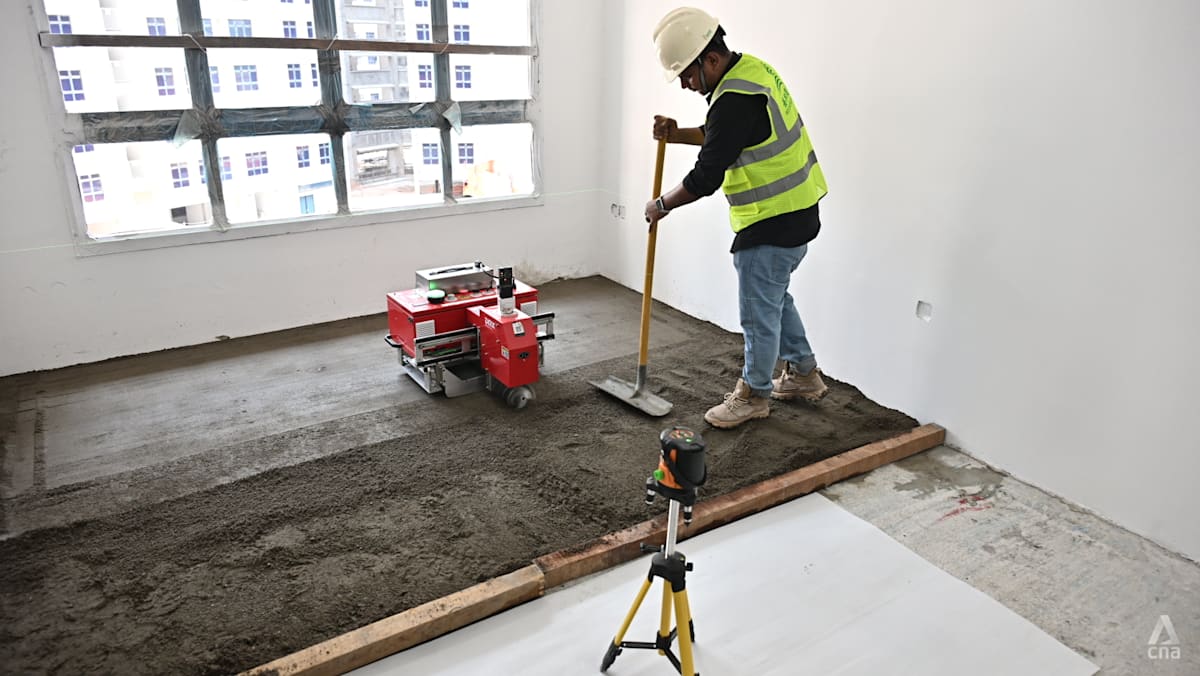
A screeding robot levels and smooths the floor before the tiling process at Woodgrove Edge BTO site on Sep 21, 2026. (Photo: CNA/Raydza Rahman)
This audio is generated by an AI tool.
SINGAPORE: With the precision of a laser, a robot no bigger than a dishwasher zigzags across the bare floor of a living room in a new four-room Build-to-Order (BTO) flat.
It carefully levels and smooths freshly laid concrete screed, creating an even floor surface to lay tiles or vinyl.
In another room, a worker bends over a mound of screed, setting out level pegs before painstakingly doing the job by hand.
The robot is not just faster; a worker can learn to operate it in a few days, compared with months of hands-on experience and repeated practice needed to master the job manually.
CNA Games Guess Word Crack the word, one row at a time Buzzword Create words using the given letters Mini Sudoku Tiny puzzle, mighty brain teaser Mini Crossword Small grid, big challenge Word Search Spot as many words as you can Show More Show Less
A worker using the conventional screeding method at Woodgrove Edge BTO site on Sep 21, 2026. (Photo: CNA/Raydza Rahman)
The screeding robot is part of the Housing and Development Board’s (HDB) roll-out of robotics and automation solutions to increase construction productivity and reduce manpower needs.
Speaking at the HDB Awards Dinner on Friday (Sep 25), Minister for National Development Chee Hong Tat said that to meet strong housing demand, the government must keep improving the way it builds flats by making better use of technology and manpower, raising productivity levels, and shortening construction timelines where possible.
“This is why our partnership with the industry is critical. We want to continue to work closely with all of you to find better ways to build, so that together, we can build more and build faster, while maintaining high standards of safety and quality,” he told attendees from the built environment sector.
Mr Chee said HDB will deploy smart hoists – automated, temporary lifts at construction sites – at about 50 per cent of all new BTO sites tendered from 2027, and scale up the use of screeding robots at more BTO sites.
“This is the next step of our scaling up efforts. But we will not stop here. I've asked HDB to work towards deploying these technologies at all new BTO sites,” he said.
Minister for National Development Chee Hong Tat speaking at the annual HDB Awards Ceremony held at Resorts World Sentosa on Sep 25, 2026. (Photo: CNA/Mak Jia Kee)
SMART HOISTS, SCREEDING ROBOTS
Mr Chee said what matters is not how sophisticated the technology is, but whether it can help to solve practical problems at worksites.
He gave the example of the Smart Passenger and Material Hoist, which HDB has been trialling at project sites in Woodlands, Yishun and Rochor.
Unlike conventional hoists, which require a dedicated operator for each hoist, smart hoists can be called directly by workers to the floor where they are needed.
The Smart Passenger and Material Hoist at Woodgrove Edge BTO site on Sep 21, 2026. (Photo: CNA/Raydza Rahman)
The smart hoist has features such as obstruction and anti-pinch sensors at the doors to enable the hoist to operate without a dedicated operator at Woodgrove Edge BTO site on Sep 21, 2026. (Photo: CNA/Raydza Rahman)
Smart hoists also have safety features, such as 2D LiDAR sensors, which scan for obstructions, and anti-pinch sensors that stop doors from closing if something is in the way.
One worker can supervise up to three smart hoists using live CCTV footage that can be viewed remotely, compared with one operator for each conventional hoist.
At a project with six smart hoists, for example, two workers would be needed instead of six, translating to a productivity gain of about 200 per cent for hoist operations, HDB said.
It added that with less manpower required for hoisting operations, workers can focus on other tasks such as supervision and quality checks.
A worker testing the anti-pinch sensors of the smart hoist at Woodgrove Edge BTO site on Sep 21, 2026. (Photo: CNA/Raydza Rahman)
“While this may sound like a relatively simple improvement, the manpower savings do add up across many blocks and many projects, leading to a sizeable overall increase in productivity,” said Mr Chee.
Mr Chee also gave the example of using robots for more repetitive and labour-intensive tasks, such as floor screeding.
“A screeding robot automates much of this process and creates a more consistent finish. Workers can then be deployed to take on other more productive tasks,” he said.
HDB said the time taken for a robot to screed a four-room flat is about a day, although actual productivity gains will depend on factors such as the unit layout and the worker’s experience in operating the robot.
The agency has conducted preliminary trials at sites in Bukit Merah and Ghim Moh, and will extend trials to at least four more BTO projects in 2027 to assess the robots under different site conditions and their potential for wider deployment.
A screeding robot levelling and smoothing the cement floors with the assistance of a laser level machine at Woodgrove Edge BTO site on Sep 21, 2026. (Photo: CNA/Raydza Rahman)
HDB said that while the initial costs of adopting robotics and automation are expected to be slightly higher, costs are expected to go down with wider adoption and economies of scale, as the technologies mature and industry capabilities develop.
It added that higher construction costs do not translate directly into higher flat prices for home buyers.
On how the adoption of technologies will impact waiting times for BTO projects, HDB said the construction methods can shorten the time needed for specific construction activities and improve overall site productivity.
However, the construction timeline of a BTO project depends on various factors, including its design and complexity and site conditions, HDB said.
GREATER STANDARDISATION
Mr Chee also announced the launch of HDB’s Enhanced Precast Components Catalogue (EPCC), which will be made available to industry partners from Sep 28 and implemented in projects tendered from December 2026.
The catalogue is a library of detailed specifications and drawings for how to fabricate 17 types of precast components – or building components manufactured off-site – that are commonly used in HDB’s BTO projects. These include precast bathroom units, household shelters and staircases.
Standardised precast components such as those used at Central Weave @ AMK, help to simplify precast production and construction.
These are productivity gains that could translate into projects being completed several months ahead of schedule, he said.
While the current catalogue covers the dimensions of commonly used precast components, the enhanced catalogue will standardise key specifications such as concrete grades, reinforcement provisions and connection details.
This will make it easier to use the same components across multiple HDB projects, Mr Chee said.
“There are benefits across the value chain. Consultants can spend less time on repetitive design work. Precasters can produce at greater scale and make better use of automation.
“Contractors can choose from a wider pool of suppliers, while workers can apply familiar construction methods across different projects,” he added.
Minister for National Development Chee Hong Tat looking at the display panels at the annual HDB Awards Ceremony held at Resorts World Sentosa on Sep 25, 2026. (Photo: CNA/Mak Jia Kee)
Mr Chee said the government expects the enhanced catalogue to reduce project manhours by up to 20 per cent and provide more sourcing options.
HDB said the enhanced catalogue groups precast components according to how far they can be standardised.
Components that typically do not require project-specific changes, such as staircases and household shelters, will use common specifications across all HDB projects.
For the first time, this creates “off-the-shelf” standardised precast components, giving precast suppliers the option of building up a stock of these components to support future supply tenders.
Precast household shelters will be standardised across all HDB projects. (Photo: HDB)
While facade components are standardised within the catalogue, consultants will still be able to design visually unique facades through the use of attachments such as canopies and fins, HDB said.
They will also be able to use tools such as formliners – an elastic mould – to create textures on the facade or painted patterns.
“I would also like to reassure everyone that greater standardisation does not mean that everything will look the same. We are not baking cookies; so we are not going to use a cookie-cutter approach,” Mr Chee said.
“We can standardise components to improve productivity, while continuing to give HDB projects, each one, its own identity and character, based on the surroundings and the community.”
Mr Chee said HDB is working closely with industry partners to find smarter ways to build.
Through the shortened time for completion scheme, contractors can propose and implement innovative construction methods and technologies.
Contractors tendering for such projects can factor the additional costs required for these technologies into their bids, and HDB will assess their proposals “holistically”, he said.
“This is one of the ways that HDB is investing a small premium into helping our industry players to try new and fresh approaches and to build new capabilities,” said Mr Chee.
He added that innovative solutions may also qualify for co-funding support by other agencies such as the Building and Construction Authority (BCA).
For example, one solution streamlines the transportation and delivery of precast components from the fabrication yard to the construction site through an inloader, which uses a hydraulic jack system. The solution reduces crane operations and manpower needs.
Another technology being piloted at a site in Tengah is a system that uses satellite positioning and digital terrain models to guide excavation more precisely.
Beyond technical innovation, Mr Chee said the government is digitalising and streamlining administrative processes to make it easier for business partners.
HDB has removed the document fee of S$250 (US$195) for building project tenders, and set up RetailerLink, a one-stop platform for businesses to access HDB’s e-Services, which will continue to be updated with more services.
“We need to press ahead on all these fronts,” said Mr Chee. “Because they share a common purpose, which is to help us to build more, build faster and build better, while continuing to deliver quality homes for Singaporeans.”
Get our pick of top stories and thought-provoking articles in your inbox
Stay updated with notifications for breaking news and our best stories
Join our channel for the top reads for the day on your preferred chat app
国家发展部长徐芳达表示,政府还将进一步规范预制构件,提高生产效率,从而加快项目完工速度。
2026年9月21日,在伍德格罗夫边缘预购组屋工地,一台刮平机器人正在铺设瓷砖前对地面进行找平整整。(图片:CNA/Raydza Rahman)
这段音频是由人工智能工具生成的。
新加坡:一台比洗碗机还小的机器人,以激光般的精准度,在新建的四房式预购组屋(BTO)客厅的地板上蜿蜒穿梭。
它能仔细地找平新铺的混凝土找平层,形成平整的地面,以便铺设瓷砖或乙烯基材料。
在另一个房间里,一名工人弯腰对着一堆找平料,先用水平木桩进行找平,然后一丝不苟地手工完成这项工作。
机器人不仅速度更快;工人只需几天就能学会操作它,而手动操作则需要数月的实际操作经验和反复练习才能掌握。
CNA游戏 猜词游戏 逐行破解单词 流行词游戏 用给定的字母组成单词 迷你数独 小小谜题,挑战你的大脑 迷你填字游戏 小方格,大挑战 单词搜索 尽可能多地找出单词 显示更多 显示更少
2026年9月21日,一名工人在伍德格罗夫边缘预购组屋工地使用传统找平方法。(图片:CNA/Raydza Rahman)
这款抹平机器人是新加坡建屋发展局 (HDB) 推广机器人和自动化解决方案的一部分,旨在提高建筑生产力并减少人力需求。
国家发展部长徐芳达在周五(9月25日)的建屋发展局颁奖晚宴上表示,为了满足强劲的住房需求,政府必须不断改进组屋的建造方式,更好地利用技术和人力,提高生产力水平,并在可能的情况下缩短施工时间。
“这就是为什么我们与业界的合作至关重要。我们希望继续与大家紧密合作,寻找更好的建造方式,以便我们能够共同建造更多、更快的建筑,同时保持高标准的安全性和质量,”他告诉来自建筑环境领域的与会者。
Chee先生表示,建屋发展局将从2027年起在所有新招标的组屋项目中,在约50%的项目上部署智能升降机(建筑工地的自动化临时升降机),并在更多组屋项目中扩大摊铺机器人的使用。
“这是我们扩大规模工作的下一步。但我们不会止步于此。我已经要求建屋发展局努力在所有新建组屋项目中部署这些技术,”他说。
国家发展部长徐芳达于2026年9月25日在圣淘沙名胜世界举行的建屋发展局年度颁奖典礼上发表讲话。(图片:CNA/麦嘉琪)
智能起重机,刮板机器人
Chee先生表示,重要的不是技术有多么先进,而是它能否帮助解决工地上的实际问题。
他举例说,建屋发展局已在兀兰、义顺和罗卓的项目现场试用了智能乘客和物料升降机。
与每台起重机都需要专门操作员的传统起重机不同,智能起重机可以由工人直接呼叫到需要的楼层。
2026年9月21日,伍德格罗夫边缘预购组屋工地的智能乘客及物料升降机。(图片:CNA/Raydza Rahman)
2026年9月21日,在伍德格罗夫边缘预购组屋(Woodgrove Edge BTO)工地,一台智能升降机配备了门上的障碍物和防夹传感器等功能,使其无需专人操作即可运行。(图片:CNA/Raydza Rahman)
智能升降机还具有安全功能,例如 2D LiDAR 传感器,用于扫描障碍物;以及防夹传感器,如果门道上有东西,可以阻止门关闭。
一名工作人员可以通过远程查看的实时闭路电视录像来监管多达三台智能起重机,而传统起重机则需要一名操作员。
建屋发展局表示,例如,在一个拥有六台智能起重机的项目中,只需要两名工人而不是六名工人,起重机操作的生产力将提高约 200%。
报告还指出,由于起重作业所需的人力减少,工人可以专注于其他任务,例如监督和质量检查。
2026年9月21日,一名工人在伍德格罗夫艾奇预购组屋工地测试智能起重机的防夹手传感器。(图片:CNA/Raydza Rahman)
Chee 先生说:“虽然这听起来像是一个相对简单的改进,但节省的人力在许多街区和许多项目中累积起来,确实能大幅提高整体生产力。”
Chee 先生还举例说,可以使用机器人来完成重复性高、劳动强度大的任务,例如地面找平。
他说:“刮平机器人可以自动化完成大部分工序,并获得更均匀的表面效果。这样一来,工人们就可以从事其他更有生产力的工作。”
建屋发展局表示,机器人平整一套四房式组屋大约需要一天时间,但实际生产力的提高将取决于单元布局和工人操作机器人的经验等因素。
该机构已在武吉美拉和金文泰的地点进行了初步试验,并将于 2027 年将试验扩展到至少四个 BTO 项目,以评估机器人在不同场地条件下的性能及其更广泛部署的潜力。
2026年9月21日,在伍德格罗夫边缘预购组屋工地,一台刮平机器人借助激光水平仪对水泥地面进行找平整整。(图片:CNA/Raydza Rahman)
建屋发展局表示,虽然采用机器人和自动化技术的初期成本预计会略高,但随着技术的成熟和行业能力的提升,随着更广泛的应用和规模经济效应,成本预计会下降。
报告还指出,更高的建筑成本并不会直接转化为更高的房价。
关于技术应用将如何影响预购组屋项目的等待时间,建屋发展局表示,施工方法可以缩短特定施工活动所需的时间,并提高整体工地生产力。
建屋发展局表示,组屋项目的建设时间表取决于多种因素,包括其设计和复杂性以及场地条件。
更高的标准化程度
Chee先生还宣布推出建屋发展局增强型预制构件目录(EPCC),该目录将于9月28日起向行业合作伙伴提供,并将于2026年12月起在招标项目中实施。
该目录收录了17种预制构件(即异地制造的建筑构件)的详细规格和图纸,这些构件常用于建屋发展局的预购组屋项目中。其中包括预制浴室单元、家庭避难所和楼梯。
像 Central Weave @ AMK 使用的那种标准化预制构件,有助于简化预制构件的生产和施工。
他表示,这些生产力提升可以转化为项目提前几个月完成。
虽然目前的目录涵盖了常用预制构件的尺寸,但增强后的目录将规范混凝土等级、钢筋配置和连接细节等关键规格。
Chee先生表示,这将使在多个组屋项目中更容易使用相同的组件。
“整个价值链都有益处。咨询顾问可以减少在重复性设计工作上花费的时间。预制构件生产商可以扩大生产规模,并更好地利用自动化技术。”
“承包商可以从更广泛的供应商中进行选择,而工人可以在不同的项目中应用熟悉的施工方法,”他补充道。
2026年9月25日,国家发展部长徐芳达在圣淘沙名胜世界举行的年度建屋发展局颁奖典礼上观看展板。(图片:CNA/麦嘉琪)
Chee先生表示,政府预计改进后的目录将减少项目工时高达20%,并提供更多采购选择。
建屋发展局表示,改进后的目录根据预制构件的标准化程度对其进行分组。
楼梯和家庭避难所等通常不需要针对特定项目进行更改的部件,将在所有建屋发展局项目中采用通用规范。
这是首次创建“现成的”标准化预制构件,使预制构件供应商可以选择建立这些构件的库存,以支持未来的供应招标。
所有组屋项目将采用标准化的预制房屋结构。(图片:建屋发展局)
建屋发展局表示,虽然产品目录中的立面组件是标准化的,但顾问仍然可以通过使用顶篷和鳍片等附件来设计视觉上独特的立面。
他们还可以使用诸如模衬(一种弹性模具)之类的工具,在建筑立面上创造纹理或绘制图案。
“我还想向大家保证,更高的标准化程度并不意味着所有东西都会千篇一律。我们不是在烤饼干,所以我们不会采用千篇一律的方法,”谢先生说。
“我们可以对组件进行标准化,以提高生产效率,同时继续赋予每个组屋项目独特的个性和特色,使其与周围环境和社区相协调。”
Chee先生表示,建屋发展局正与行业伙伴紧密合作,寻找更智能的建造方式。
通过缩短工期方案,承包商可以提出并实施创新的施工方法和技术。
他说,参与此类项目投标的承包商可以将这些技术所需的额外成本计入投标书中,建屋发展局将“全面”评估他们的方案。
Chee先生表示:“这是建屋发展局投入少量溢价,帮助我们的行业参与者尝试新的方法并建立新能力的方式之一。”
他还补充说,创新性的解决方案也可能符合其他机构(如建设局 (BCA))的共同资助条件。
例如,一种解决方案是利用装载机(配备液压千斤顶系统)简化预制构件从加工厂到施工现场的运输和交付流程。该方案减少了起重机作业和人力需求。
在登加的一个工地上,另一项正在试行的技术是利用卫星定位和数字地形模型来更精确地指导挖掘的系统。
除了技术创新之外,谢先生表示,政府正在推进行政流程的数字化和简化,以方便商业伙伴开展业务。
建屋发展局取消了建筑项目投标的 250 新元(195 美元)文件费,并设立了 RetailerLink,这是一个供企业访问建屋发展局电子服务的一站式平台,该平台将继续更新,提供更多服务。
“我们需要在所有这些方面都加大投入,”谢先生说。“因为它们有着共同的目标,那就是帮助我们建造更多、更快、更好的房屋,同时继续为新加坡人提供优质住宅。”
订阅我们的邮件,即可获取精选热点新闻和引人深思的文章。
订阅通知,第一时间获取突发新闻和精彩报道。
加入我们的频道,即可在您常用的聊天应用上获取当日热门文章。