Non-verbal, non-mobile S’pore girl joins global hackathon where experts try to solve medical mysteries新加坡一名不会说话、不会走路的女孩参加了一场全球黑客马拉松,专家们试图破解医学谜题。
Discover how a global hackathon brings experts together to diagnose rare, undiagnosed conditions and provide answers for families worldwide. Read more at straitstimes.com.
Medical Mysteries is a series that spotlights rare diseases or unusual conditions.
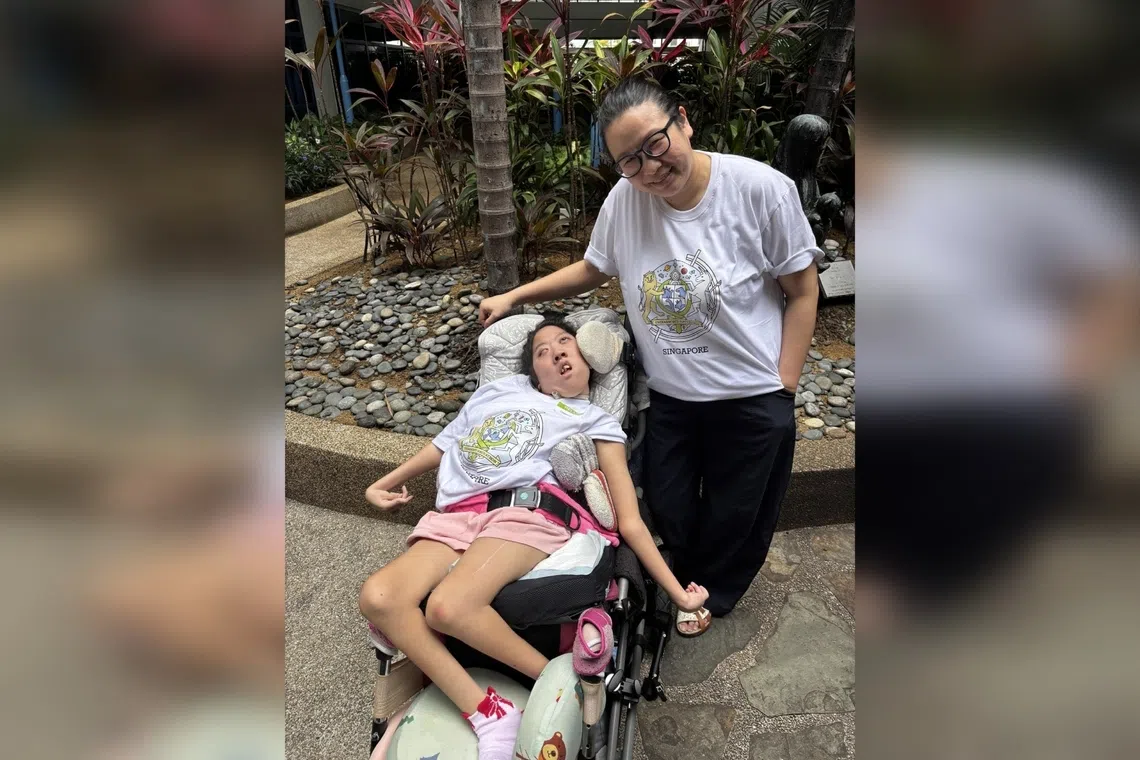
Sarah Swee was born with a condition that has still not yet been diagnosed. She and her mother Jasmine Lee joined South-east Asia’s first Undiagnosed Hackathon, hoping to find an answer after an intensive 48-hour period.
ST PHOTO: JUDITH TAN
Published Sep 26, 2026, 12:00 PM
Updated Sep 26, 2026, 12:00 PM
The Undiagnosed Hackathon is a 48-hour global event where experts collaborate intensively to diagnose rare, complex conditions that remain unexplained despite extensive testing.
The event, first held in Southeast Asia at KKH, uses clinical, genomic, phenotypic, and proteomic data to find plausible diagnoses for undiagnosed children and adults.
The Wilhelm Foundation, founded by parents who lost children to undiagnosed diseases, drives this initiative to help the 60% of rare disease patients worldwide still without a diagnosis.
SINGAPORE – When Sarah Swee was born after 38 weeks’ gestation, she made a high-pitched, wheezing sound caused by disrupted airflow through a narrowed upper airway – called stridor – and she was not able to swallow.
She also suffered from facial palsy, a loss of movement in the facial muscles on her left side.
“She was not growing normally so she was delivered by caesarean. It was then that the doctors noticed she has a receded chin and was not moving the left side of her face. This made it difficult for her latch on for breastfeeding or even bottle-feeding, so she had to be tube-fed,” said her mother Jasmine Lee.
Sarah, now 14, is non-verbal and non-mobile. Doctors still do not know what her condition is.
“(They) could only tell me about her symptoms and physical characteristics but none could come up with a diagnosis,” said Lee, whose efforts all these years to get a diagnosis for Sarah have not borne fruit.
What Koh Ai Ling, a geneticist with KK Women’s and Children’s Hospital (KKH), can say is this: Sarah has a complex medical history of brain stem disorder, congenital (facial nerve) palsy, and severe global developmental delay.
Even after Sarah underwent various genetic tests, no genetic cause explaining her symptoms could be found.
“Rare diseases can be difficult to diagnose because the symptoms do not always point neatly to one particular condition. A person may have several symptoms affecting different parts of the body . While each individual symptom may look relatively familiar to doctors , the challenge is recognising that the combination (of symptoms) may be the result of one underlying disorder,” Koh said.
Koh said doctors cannot test for every possible rare disease as there are thousands of known genetic disorders “and many are individually so uncommon that a particular doctor may never encounter one during his or her career”.
“Doctors may need to work through a long list of possibilities, review investigations that have already been performed, look for patterns that may have been missed and increasingly, use genomic data to search for genetic explanations,” she said.
For someone like Sarah, Koh said the first important breakthrough may therefore not be a treatment or cure “but simply finding out what is causing the illness”.
“A diagnosis can provide an explanation for years of symptoms, help doctors determine what should be monitored, prevent unnecessary tests or treatments, and in some cases identify a treatment that would not otherwise have been considered,” she added.
Around 7,600 genetic diseases have been identified throughout the world , and more are being discovered every year.
To increase the chances of finding the root cause of their conditions, persons living with undiagnosed diseases (PLWUD) can participate in an intensive 48-hour, hands-on diagnostic sprint called The Undiagnosed Hackathon.
This event gathers families of PLWUDs and multidisciplinary experts from around the world to work side by side on rare, complex cases that have remained unsolved despite extensive medical testing.
The first South-east Asian edition of the hackathon, and the fifth overall, was held at KKH from Sept 19 to 20, organised by the hospital and the Wilhelm Foundation in Sweden.
Koh said: “The hackathon changes the problem from recognising a rare disease by any one doctor to finding a plausible explanation by a group of collaborators combining their know-how and experience, using clinical information of the PLWUD, and modern genetic tools.
“This is particularly valuable as a typical case may contain information from many different areas – clinical observations, scans, laboratory results, family history and genetic data. One specialist may recognise something another would not immediately notice.”
Helene Cederroth, one of the founders of Wilhelm Foundation, told The Straits Times the event brought together 140 experts from 32 countries “who may otherwise not have the chance to work together during normal circumstances”.
They include clinicians, geneticists, genetic counsellors, lab specialists, bioinformaticians (who use computer programming, maths and statistics to understand complex biological and genetic data) , molecular biologists, researchers, data scientists, AI specialists, and software developers.
They worked together on 25 cases of undiagnosed children and adults from Singapore, Indonesia, Malaysia, and the Philippines.
Proteomics, the study of proteins in the body, was added for first time to the recent hackathon – complementing clinical, genomic and phenotypic information.
From grief to action
At the Undiagnosed Hackathon from Sept 19 to 20 were Helene and Mikk Cederroth (centre), founders of the Wilhelm Foundation, and geneticist Koh Ai Ling (far right), from Department of Genomic Medicine at KK Women’s and Children’s Hospital. Supporting Sarah Swee and her mother Jasmine Lee (second from right) are Dawn Lee (left), Ng En Le and Jarren (in wheelchair). ST PHOTO: JUDITH TAN
At the Undiagnosed Hackathon from Sept 19 to 20 were Helene and Mikk Cederroth (centre), founders of the Wilhelm Foundation, and geneticist Koh Ai Ling (far right), from Department of Genomic Medicine at KK Women’s and Children’s Hospital. Supporting Sarah Swee and her mother Jasmine Lee (second from right) are Dawn Lee (left), Ng En Le and Jarren (in wheelchair).
The first Undiagnosed Hackathon was held at the Karolinska Institutet in the founders’ home country of Sweden in June 2023 where four PLWUD were diagnosed.
It was inspired by the experience of Helene Cederroth and her husband Mikk, who lost two young sons, Wilhelm and Hugo, and a daughter, Emma, to undiagnosed conditions.
Wilhelm was only a few months old when he suffered severe stomach pain and was diagnosed with epilepsy.
After consulting a geneticist and going through a battery of tests, the Cederroths were told their son’s illness “was a coincidence and that the condition was not hereditary”.
Six hours after their second son Hugo was born – eight years after Wilhelm – the younger boy too experienced seizure and was also diagnosed with epilepsy.
“Having had an elder daughter who was born healthy, we were told that if we had another girl, she would be healthy. But Emma had her first seizure just 30 minutes after her birth,” Helene Cederroth said.
Despite the early onset of symptoms in three of their children, there was no diagnosis for their condition, which remained unexplained 30 years on.
Wilhelm died in 1999 at the age of 16, followed by Emma a year later at the age of six. Two years after Emma died, Hugo died at age 10.
The couple turned their grief into a call to action, starting a foundation named after their son Wilhelm to help find answers for those without a diagnosis.
Only about 40 per cent of an estimated 350 million people worldwide affected by rare diseases and conditions know the root cause.
“We want to help the remaining 60 per cent,” Helene Cederroth said.
For the past 20 years, the Cederroths have built a global network of scientists, clinicians and advocates committed to finding answers to undiagnosed and rare diseases and conditions.
They turned to the hackathon format to break through traditional medical research boundaries and accelerate answers for families living with ultra-rare, unsolved conditions.
During the working sprint, experts compare symptoms with gene findings, search medical literature, review variant data, test hypotheses and identify the strongest diagnostic leads.
A bell is rung when experts feel they have reached a threshold for possible diagnosis that fit the clinical picture and available molecular evidence. These findings must be clinically confirmed before they become diagnoses.
A total of 27 cases had been pinpointed and diagnosed as a result of Undiagnosed Hackathon.
One such rare condition was the DNA2-related Rothmund-Thomson Syndrome (RTS-4), an ultra-rare condition affecting the eyes, skin and bones, due to mutations in the DNA-2 gene. The finding ended the diagnosis odyssey of the PLWUD.
The hackathon at KKH had not yielded a diagnosis on Sept 19 and 20 for any of the 25 cases.
These cases, like the other unresolved ones from the hackathon, are funnelled through the wider international network, and the work continues.
This is especially important for South-east Asian families, because genomic reference databases have historically been less representative of Asian populations, Koh said.
Lee is still waiting for the answer to Sarah’s condition.
“I hope the teams are able to tell me what my daughter has, what we are and will be facing so we can give her the best possible care,” she said.
ST Medical Mysteries
KK Women's and Children's Hospital
《医学谜案》是一档聚焦罕见疾病或不寻常病症的系列节目。
莎拉·斯威出生时患有一种至今尚未确诊的疾病。她和母亲贾斯敏·李参加了东南亚首届“未确诊疾病黑客马拉松”,希望经过48小时的密集训练后找到答案。
《海峡时报》照片:朱迪思·谭
发布于2026年9月26日下午12:00
更新于2026年9月26日中午12:00
“未确诊疾病黑客马拉松”是一项为期 48 小时的全球性活动,专家们将密切合作,共同诊断尽管经过广泛测试仍无法解释的罕见复杂疾病。
该活动首次在东南亚的KKH医院举行,利用临床、基因组、表型和蛋白质组学数据,为未确诊的儿童和成人寻找合理的诊断。
威廉基金会由因未确诊疾病失去孩子的父母创立,旨在推动这项倡议,帮助全球 60% 的罕见病患者,因为他们仍然没有得到确诊。
新加坡——莎拉·斯威(Sarah Swee)在妊娠 38 周后出生,由于上呼吸道狭窄导致气流受阻,发出高音调的喘鸣声(称为喘鸣),而且她无法吞咽。
她还患有面瘫,左侧面部肌肉失去运动能力。
“她发育不正常,所以是剖腹产出生的。那时医生才发现她下巴后缩,左侧脸部无法活动。这使得她很难吸吮母乳,甚至奶瓶喂养也很难,所以她只能通过鼻饲管喂养,”她的母亲李茉莉说道。
现年14岁的莎拉不会说话,也无法行动。医生们至今仍不清楚她患有何种疾病。
“(他们)只能告诉我她的症状和身体特征,但没有人能做出诊断,”李说,多年来他一直努力为莎拉确诊,但都没有结果。
KK妇女儿童医院 (KKH) 的遗传学家 Koh Ai Ling 表示:Sarah 有复杂的病史,包括脑干疾病、先天性(面神经)麻痹和严重的全面发育迟缓。
即使莎拉接受了各种基因检测,也找不到任何可以解释她症状的基因原因。
“罕见病的诊断可能很困难,因为症状并不总是能明确指向某种特定疾病。一个人可能出现多种症状,影响身体的不同部位。虽然每种单独的症状对医生来说可能相对熟悉,但难点在于认识到这些症状的组合可能是由一种潜在疾病引起的,”Koh说道。
Koh表示,医生不可能检测出每一种可能的罕见病,因为已知的遗传疾病有数千种,“而且很多疾病本身就非常罕见,以至于某个医生在其职业生涯中可能永远不会遇到”。
“医生可能需要仔细审查各种可能性,回顾已经进行的调查,寻找可能被忽略的模式,并且越来越多地利用基因组数据来寻找遗传学解释,”她说。
科赫表示,对于像莎拉这样的人来说,第一个重要的突破可能不是治疗方法或治愈方法,“而是找出导致疾病的原因”。
她补充说:“诊断可以解释多年的症状,帮助医生确定应该监测哪些方面,防止不必要的检查或治疗,并且在某些情况下,还可以确定原本不会考虑的治疗方法。”
全世界已发现约 7600 种遗传疾病,而且每年都有新的疾病被发现。
为了增加找到自身病情根本原因的机会,患有未确诊疾病的人 (PLWUD) 可以参加为期 48 小时的强化实践诊断冲刺活动,称为“未确诊黑客马拉松”。
本次活动汇聚了来自世界各地的吸毒者家属和多学科专家,共同致力于解决尽管进行了广泛的医学测试,但仍然无法解决的罕见、复杂病例。
首届东南亚黑客马拉松(也是第五届)于 9 月 19 日至 20 日在 KKH 举行,由该医院和瑞典威廉基金会联合举办。
Koh 表示:“黑客马拉松将问题从任何一位医生识别罕见疾病转变为由一群合作者结合他们的知识和经验,利用 PLWUD 的临床信息和现代基因工具,找到合理的解释。”
“这一点尤其有价值,因为一个典型的病例可能包含来自许多不同领域的信息——临床观察、扫描结果、实验室结果、家族史和基因数据。一位专家可能发现另一位专家不会立即注意到的问题。”
威廉基金会创始人之一海伦·塞德罗斯告诉《海峡时报》,此次活动汇聚了来自 32 个国家的 140 位专家,“在正常情况下,他们可能没有机会一起工作”。
其中包括临床医生、遗传学家、遗传咨询师、实验室专家、生物信息学家(他们使用计算机编程、数学和统计学来理解复杂的生物和遗传数据)、分子生物学家、研究人员、数据科学家、人工智能专家和软件开发人员。
他们共同研究了来自新加坡、印度尼西亚、马来西亚和菲律宾的 25 例未确诊儿童和成人的病例。
蛋白质组学,即研究体内蛋白质的学科,首次被纳入最近的黑客马拉松——作为对临床、基因组和表型信息的补充。
从悲痛到行动
9月19日至20日举行的“未确诊疾病黑客马拉松”活动上,威廉基金会创始人海伦·塞德罗斯和米克·塞德罗斯(图中)以及来自竹脚妇幼医院基因组医学部的遗传学家许爱玲(图右一)出席了活动。支持莎拉·斯威和她的母亲李茉莉(图右二)的还有李晓(图左一)、吴恩乐和坐在轮椅上的贾伦。(海峡时报摄影:陈朱迪思)
9月19日至20日举行的“未确诊疾病黑客马拉松”活动中,威廉基金会的创始人海伦·塞德罗斯和米克·塞德罗斯(图中)以及来自KK妇女儿童医院基因组医学部的遗传学家许爱玲(最右)出席了活动。支持莎拉·斯威和她的母亲李茉莉(右二)的是李晓(左)、吴恩乐和贾伦(坐在轮椅上)。
2023 年 6 月,首届“未确诊者黑客马拉松”在创始人的祖国瑞典的卡罗林斯卡学院举行,期间有四名吸毒成瘾者被确诊。
这部影片的灵感来源于海伦·塞德罗斯和她的丈夫米克的经历,他们失去了两个年幼的儿子威廉和雨果,以及一个女儿艾玛,他们都因未确诊的疾病去世。
威廉出生仅几个月就出现严重的胃痛,并被诊断出患有癫痫。
在咨询了遗传学家并进行了一系列测试后,塞德罗斯夫妇被告知他们儿子的疾病“纯属巧合,并非遗传”。
在他们的第二个儿子雨果出生六小时后——也就是威廉出生八年后——这个小儿子也出现了癫痫发作,并被诊断出患有癫痫。
“我们之前生了一个健康的女儿,医生告诉我们,如果再生个女儿,她也会很健康。但艾玛出生仅30分钟就出现了第一次癫痫发作,”海伦·塞德罗斯说道。
尽管他们的三个孩子很早就出现了症状,但他们的病情一直没有得到诊断,30 年后,这种疾病的原因仍然无法解释。
威廉于1999年去世,年仅16岁;一年后,艾玛也去世了,年仅6岁。艾玛去世两年后,雨果也去世了,年仅10岁。
这对夫妇将悲痛化作行动的号召,成立了一个以儿子威廉命名的基金会,旨在帮助那些尚未确诊的病人找到答案。
据估计,全球约有 3.5 亿人患有罕见疾病,但只有约 40% 的人知道其根本原因。
“我们想帮助剩下的 60% 的人,”海伦·塞德罗斯说。
在过去的 20 年里,塞德罗斯夫妇建立了一个由科学家、临床医生和倡导者组成的全球网络,致力于寻找未确诊和罕见疾病及病症的答案。
他们采用黑客马拉松的形式,突破传统医学研究的界限,加速为患有极其罕见、未解疾病的家庭找到答案。
在工作冲刺阶段,专家们将症状与基因检测结果进行比较,查阅医学文献,审查变异数据,检验假设,并确定最有力的诊断线索。
当专家认为已达到符合临床表现和现有分子证据的可能诊断阈值时,就会敲响警钟。这些发现必须经过临床验证才能最终确诊。
通过“未确诊病例黑客马拉松”,共发现并确诊了 27 例病例。
其中一种罕见疾病是DNA2相关罗斯蒙德-汤姆森综合征(RTS-4),这是一种极其罕见的疾病,由于DNA-2基因突变,会影响眼睛、皮肤和骨骼。这一发现结束了吸毒者漫长的诊断历程。
9 月 19 日和 20 日,KKH 的黑客马拉松未能对 25 个病例中的任何一个做出诊断。
这些案件,就像黑客马拉松中其他未解决的案件一样,都通过更广泛的国际网络进行处理,工作仍在继续。
Koh表示,这对东南亚家庭来说尤其重要,因为基因组参考数据库历来对亚洲人群的代表性较差。
李仍在等待莎拉的病情消息。
“我希望医疗团队能够告诉我我女儿得了什么病,我们现在和将来会面临什么,这样我们才能给她最好的照顾,”她说。
ST 医学谜案
KK妇女儿童医院