Space Force Getting Lasers To Kill Drones Over Cape Canaveral Spaceport美国太空军将使用激光武器击落卡纳维拉尔角航天港上空的无人机
With the job of launching giant tubes packed with explosives and extremely expensive and national security payloads on top, if anywhere could use lasers, it's the Cape.
新闻视频
Published Sep 26, 2026 2:06 PM EDT
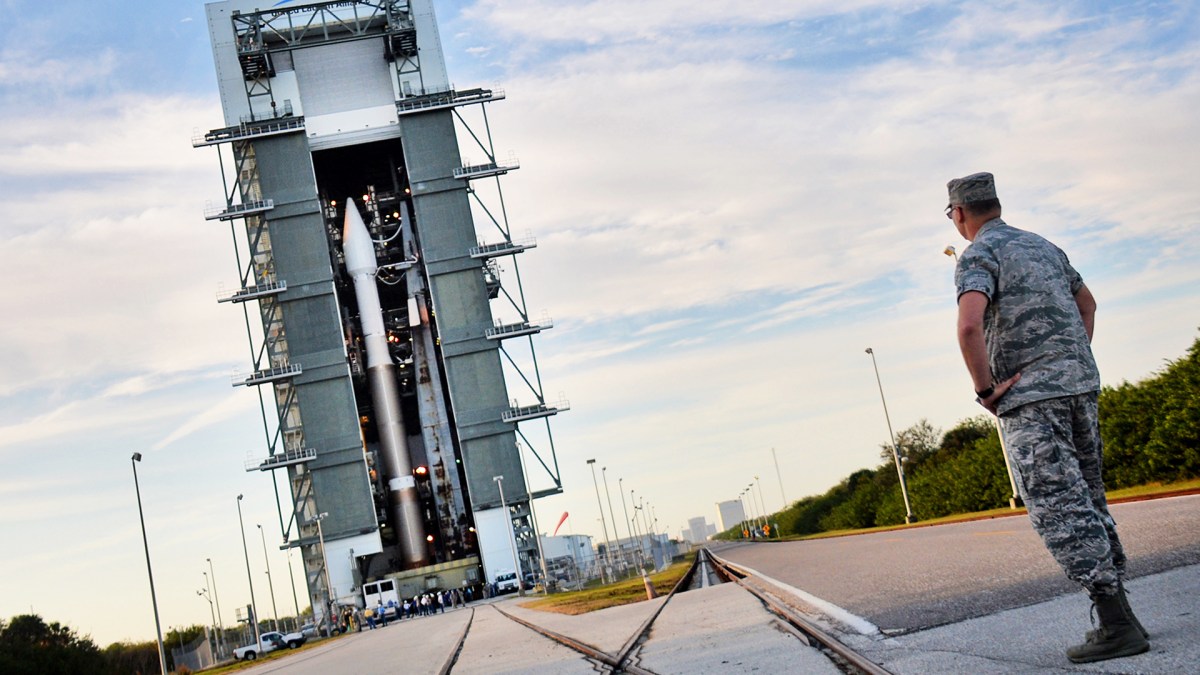
(U.S. Air Force photo/ Van Ha)
Cape Canaveral Space Force Station is getting lasers that can zap drones intruding into its airspace. When installed, the new directed energy defense system will be part of a much larger effort to protect the spaceport against drone incursions, a spokesperson for Space Launch Delta 45 (SLD 45) told us.
The idea is to ensure the safety of launches and to keep prying eyes away from an installation full of secrets about America’s military and commercial space efforts. Companies like SpaceX, United Launch Alliance, Blue Origin and Relativity Space use the installation for space launches. The base defense modernization effort comes as the Cape Canaveral region is inundated with drone incursions. There were hundreds last year.
A SpaceX Falcon 9 rocket launches from Space Launch Complex 40 at Cape Canaveral Space Force Station, Florida, on May 29, 2026. (U.S. Space Force photo by Gwen Kurzen) Gwendolyn Kurzen
“As the world’s premier spaceport continues to support an unprecedented launch tempo for national security and commercial missions, securing critical launch infrastructure from low-altitude aerial threats remains a top operational priority,” the spokesperson explained. “The ongoing security modernization integrates detection, tracking, and defensive capabilities to include directed energy systems. These will provide security forces with real-time situational awareness and the necessary tools to safeguard personnel, launch complexes, and national security payloads.”
The spokesperson did not have a timeline for when the directed energy system will be operational. Florida Today was the first to report that lasers will make up this defensive system.
Col. Brian Chatman, who commands Space Launch Delta 45, told the publication that the facility is “bringing on a directed-energy system that can do a kinetic kill against UASs (Unmanned Aircraft Systems) that are coming into the area that are having nefarious intent.”
“The Air Force Research Laboratory [AFRL]-tested system has been proven to be able to safely bring down a drone,” Florida Today noted. “This directed-energy system uses lasers to shoot down any drone that flies into restricted areas.”
Chatman didn’t name the specific system to Florida Today and the SLD 45 spokesperson declined to say.
The following video shows one such AFRL-tested system that has been used in combat before.
For the spaceport, being able to use lasers is even more important than it is for other locations needing protection from drones. That’s because the traditional method of jamming radio frequencies to interfere with drone connections to controllers could damage spacecraft.
“If you start blasting a bunch of RF energy you run into potential challenges,” Chatman explained. “You don’t want that.”
There is good reason for Chatman to be concerned about drones. The spaceport has been subjected to many unauthorized incursions, the spokesperson told us. However, there were no statistics immediately available on how many or whether they occurred during launches. There were 500 unauthorized drone flights over the adjacent Port Canaveral in 2025, Port Canaveral CEO Capt. John Murray said .
In addition, on Sept. 18, a Chinese tourist pleaded guilty to a federal misdemeanor charge after flying a drone in restricted airspace above NASA’s Kennedy Space Center (KSC) in late July. KSC is located across the Banana River from the space station.
It is unclear if the new laser system will also protect the skies over KSC. The spokesperson did not immediately know and is checking into it.
Cape Canaveral. (Google Earth)
That tourist, Xiaodong He, flew a drone that videotaped the installation, according to federal documents . The drone got within 1.56 miles of pad 39B, from where the next crewed lunar flight is expected to launch in 2028.
NASA’s Kennedy Space Center pad 39B. (NASA)
Encompassing about 25 square miles, Cape Canaveral Space Force Station is a large, unpopulated, open area with a long Atlantic Ocean shoreline. The station’s physical layout allows many vectors for drone incursions, and what’s housed there makes it a logical target for a nefarious actor.
The systems being prepared for launch and launched at the sprawling facility are extremely valuable and can take many years to build, costing billions. When they are out on the pad or being transported around, the rockets are massive tubes packed with high explosives that would cause a devastating secondary explosion if struck.
Even disrupting launches there due to a successful or even attempted attack could have major national security impacts.
Maybe the place that needs them most. Use your imagination with this one. Probably scary how little they have. https://t.co/cBww4vlB9n — Tyler Rogoway (@Aviation_Intel) September 19, 2026
Maybe the place that needs them most. Use your imagination with this one. Probably scary how little they have. https://t.co/cBww4vlB9n
The move to bring directed energy systems to protect the spaceport comes as the military is investing heavily in these systems to counter drones. Late last month, for instance, troops from the Joint Task Force-Southern Border (JTF-SB) employed an Army Multipurpose High Energy Laser (AMP-HEL) system during an operation dubbed Ardent Vanguard. The AMP-HEL was used “to engage and defeat three hostile UAS, determined to be such based on their use in direct support of activities posing a physical threat to U.S. military personnel and CBP [Customs and Border Protection] partners,” according to a media release at the time .
The shootdown was part of the U.S. government’s ongoing effort to counter drones being flown by Mexican drug cartels.
Joint Task Force – Southern Border personnel used the Army Multipurpose High Energy Laser system to engage and defeat a hostile drone. (U.S. Army Photo by Sgt. Daniel Huerta) Operation Ardent Vanguard
The military is seeking to expand its ability to counter drones with directed-energy weapons. In May, the Defense Department and Joint Interagency Task Force 401 selected five installations to participate in a directed-energy counter-unmanned aircraft systems pilot program required by the Fiscal Year 2026 National Defense Authorization Act.
“This initiative will accelerate the fielding and evaluation of advanced directed energy capabilities to protect critical infrastructure, military installations and homeland missions,” the Pentagon explained. “The locations were deliberately selected to support rigorous testing and operational assessments across diverse environments and mission sets.”
The Pentagon selected two “key southern border installations” for this program: Fort Huachuca, Arizona; and Fort Bliss, Texas. It also tabbed Naval Base Kitsap, Washington; Grand Forks Air Force Base, North Dakota; and Whiteman Air Force Base, Missouri.
Though the Pentagon is pressing forward with making directed energy a key part of counter-drone efforts, laser weapons have limitations . These include their short-term magazine depth being limited to how many successive shots they can fire before thermal loads require the system to cool down. Energy supply can also be a limiting factor. Additionally, laser systems don’t function as well in heavy cloud cover and other inclement weather .
“We can only shoot down with a laser what we can see,” Israeli Defense Forces (IDF) Brig. Gen. Yaniv Rotem once said about the IDF’s Iron Beam laser defense system, which began downing enemy drones in combat last year.
You can see the Iron Beam’s first claimed kills in the following video.
A World First — Combat-Proven Laser Defense, Powered by Rafael For the first time in history, high-power laser systems have been used to intercept aerial threats in combat. This unprecedented breakthrough took place during the Swords of Iron War — with Rafael’s advanced… pic.twitter.com/B3D6UdCJvE — Rafael Advanced Defense Systems (@RAFAELdefense) May 28, 2025
A World First — Combat-Proven Laser Defense, Powered by Rafael For the first time in history, high-power laser systems have been used to intercept aerial threats in combat. This unprecedented breakthrough took place during the Swords of Iron War — with Rafael’s advanced… pic.twitter.com/B3D6UdCJvE
At the same time, a laser weapon of this kind is very much a point-defense weapon, with its short range meaning that multiple systems will be needed to provide coverage of a significant area. In some situations, even a single, large military base like Cape Canaveral Space Force Station might require more than one to provide full defensive coverage.
In addition, there have been concerns about the safety of the systems and the authorities required to use them in the homeland.
These issues came to a head in February , when the U.S. military used AeroVironment’s LOCUST directed energy weapon to shoot down a Customs and Border Protection (CBP) drone over southwest Texas. The friendly fire incident spurred expanded airspace restrictions over the Fort Hancock area that lasted for four months. It also gave credence to the FAA’S concerns about the operational deployment of counter-drone laser weapons along the border. The same system was used to fire at suspected Mexican cartel drones flying across the southern border into Texas two weeks earlier , which resulted in a large airspace closure, general confusion and major headlines.
Safety concerns about using directed energy weapons, and especially kinetic ones, to take down drones in the U.S. have been a major factor in why they haven’t been previously used in this role. Almost two years ago, officials at U.S. Northern Command (NORTHCOM), which has coordinating authority for counter-drone efforts in the U.S., said the use of such weapons was not yet on the table . The reason is that they can create dangerous or otherwise serious collateral effects that are less of a concern in a war zone.
That the U.S. Space Force is bringing in a laser system to protect some of the nation’s most important and secret military assets is a strong indication that these concerns are being overcome.
Contact the author: howard@twz.com
Comments couldn’t be loaded. Please refresh the page.
发布于美国东部时间2026年9月26日下午2:06
(美国空军照片/范·哈)
卡纳维拉尔角太空部队基地正在安装激光武器,可以击落入侵其领空的无人机。太空发射德尔塔45号(SLD 45)的一位发言人告诉我们,这套新型定向能防御系统安装完毕后,将成为更大规模的太空港防无人机入侵行动的一部分。
此举旨在确保发射安全,并防止外界窥探这个承载着美国军事和商业航天计划诸多秘密的设施。SpaceX、联合发射联盟、蓝色起源和相对论航天公司等都使用该设施进行太空发射。与此同时,卡纳维拉尔角地区无人机入侵事件频发,去年就发生了数百起此类事件,此次基地防御现代化改造正值此时进行。
2026年5月29日,一枚SpaceX猎鹰9号火箭从佛罗里达州卡纳维拉尔角太空军基地的40号航天发射场发射升空。(美国太空军摄影师格温·库尔岑摄)格温多琳·库尔岑
发言人解释说:“作为世界首屈一指的航天发射场,我们持续以前所未有的节奏支持国家安全和商业任务的发射,因此,确保关键发射基础设施免受低空空中威胁仍然是首要任务。正在进行的安全现代化改造整合了探测、跟踪和防御能力,包括定向能系统。这些能力将为安全部队提供实时态势感知,以及保护人员、发射场和国家安全有效载荷所需的必要工具。”
发言人没有给出定向能系统何时投入使用的具体时间表。《今日佛罗里达报》率先报道了该防御系统将采用激光技术。
指挥德尔塔45号航天发射场的布莱恩·查特曼上校告诉该出版物,该设施正在“引入一种定向能系统,可以对进入该区域且怀有恶意意图的无人机系统进行动能摧毁”。
《今日佛罗里达报》指出:“经空军研究实验室(AFRL)测试,该系统已被证明能够安全地击落无人机。这套定向能系统利用激光击落任何飞入禁区的无人机。”
Chatman 没有向《今日佛罗里达报》透露具体系统名称,SLD 45 发言人也拒绝置评。
以下视频展示了 AFRL 测试过的、曾在实战中使用过的系统之一。
对于航天发射场而言,使用激光武器的重要性甚至超过了其他需要防范无人机的场所。这是因为传统的干扰无线电频率以阻断无人机与控制器连接的方法可能会损坏航天器。
“如果你开始大量发射射频能量,就会遇到一些潜在的问题,”查特曼解释说。“你肯定不想那样。”
查特曼对无人机的担忧不无道理。发言人告诉我们,航天港曾多次遭受未经授权的入侵。然而,目前尚无统计数据表明入侵次数,也不清楚这些入侵是否发生在发射期间。卡纳维拉尔港首席执行官约翰·默里船长表示,2025年,邻近的卡纳维拉尔港上空发生了500次未经授权的无人机飞行。
此外,9月18日,一名中国游客承认犯有联邦轻罪,此前他于7月下旬在NASA肯尼迪航天中心(KSC)上空的禁飞区操控无人机。肯尼迪航天中心位于香蕉河对岸,与国际空间站隔河相望。
目前尚不清楚这套新的激光系统是否也会用于保护肯尼迪航天中心上空。发言人表示他目前还不清楚,正在对此进行调查。
卡纳维拉尔角。(谷歌地球)
根据联邦文件显示,这名游客名叫何晓东,他操控无人机拍摄了该设施的安装过程。无人机最远到达距离39B发射台1.56英里(约2.5公里)处,下一次载人登月飞行预计将于2028年从该发射台发射。
NASA 肯尼迪航天中心 39B 号基地。 (美国宇航局)
卡纳维拉尔角太空军基地占地约25平方英里,是一片广袤无垠、人烟稀少的开阔地带,拥有漫长的海岸线。该基地的物理布局使其极易遭受无人机入侵,而基地内的设施也使其成为不法分子的理想目标。
在这个庞大的设施中,正在准备发射和已经发射的系统都极其珍贵,建造过程可能需要数年时间,耗资数十亿美元。当它们位于发射台上或运输途中时,这些火箭就像巨大的管状物,里面装满了高爆炸药,一旦被击中就会引发毁灭性的二次爆炸。
即使仅仅是由于一次成功的或未遂的袭击而导致发射中断,也可能对国家安全造成重大影响。
或许最需要它们的地方就是这里。发挥你的想象力吧。他们拥有的资源如此匮乏,想想都可怕。https://t.co/cBww4vlB9n — Tyler Rogoway (@Aviation_Intel) 2026年9月19日
或许这里正是最需要它们的地方。发挥你的想象力吧。他们拥有的资源如此匮乏,想想都让人心惊。https://t.co/cBww4vlB9n
军方正大力投资定向能系统以对抗无人机,而此次将定向能系统引入太空港进行防护的举措,正值军方大力投资此类系统之际。例如,上月底,联合特遣部队南部边境分队(JTF-SB)的士兵在代号为“热忱先锋”(Ardent Vanguard)的行动中使用了陆军多用途高能激光(AMP-HEL)系统。根据当时发布的新闻稿,AMP-HEL系统“用于拦截并击落三架敌对无人机,这些无人机被认定为敌对无人机,是因为它们直接参与了对美国军事人员和海关与边境保护局(CBP)合作伙伴构成实际威胁的活动”。
这次击落行动是美国政府持续打击墨西哥贩毒集团无人机行动的一部分。
南部边境联合特遣部队人员使用陆军多用途高能激光系统击落并摧毁了一架敌方无人机。(美国陆军中士丹尼尔·韦尔塔摄)“炽热先锋行动”
军方正寻求扩大其利用定向能武器对抗无人机的能力。今年5月,国防部和第401联合跨部门特遣部队选定了五个军事设施参与定向能反无人机系统试点项目,该项目是根据2026财年国防授权法案的要求开展的。
五角大楼解释说:“这项计划将加速部署和评估先进定向能武器,以保护关键基础设施、军事设施和国土安全任务。这些地点经过精心挑选,旨在支持在各种环境和任务条件下进行严格的测试和作战评估。”
五角大楼为该计划选定了两个“南部边境重点设施”:亚利桑那州的华楚卡堡和德克萨斯州的布利斯堡。此外,华盛顿州的基萨普海军基地、北达科他州的大福克斯空军基地和密苏里州的怀特曼空军基地也被列入其中。
尽管五角大楼正大力推进定向能武器在反无人机作战中的关键作用,但激光武器也存在局限性。例如,其短期弹药储备有限,在热负荷导致系统冷却之前,能够连续发射的次数有限。能源供应也是一个限制因素。此外,激光系统在厚云层或其他恶劣天气条件下性能也会下降。
“我们只能用激光击落我们能看到的东西,”以色列国防军准将亚尼夫·罗特姆曾这样评价以色列国防军的“铁束”激光防御系统,该系统于去年开始在战斗中击落敌方无人机。
您可以在以下视频中看到铁光束首次取得的击杀数。
世界首创——经实战验证的激光防御系统,由拉斐尔公司提供技术支持。历史上首次在实战中使用高功率激光系统拦截空中威胁。这一前所未有的突破发生在“铁剑战争”期间——拉斐尔公司的先进技术…… pic.twitter.com/B3D6UdCJvE — 拉斐尔先进防御系统 (@RAFAELdefense) 2025年5月28日
世界首创——经实战验证的激光防御系统,由拉斐尔公司提供技术支持。历史上首次,高功率激光系统被用于拦截空中威胁。这一前所未有的突破发生在“铁剑战争”期间——拉斐尔公司的先进技术…… pic.twitter.com/B3D6UdCJvE
同时,这类激光武器本质上是一种点防御武器,其射程较短,这意味着需要多个系统才能覆盖大片区域。在某些情况下,即使是像卡纳维拉尔角太空部队基地这样的大型军事基地,也可能需要不止一套系统才能提供全面的防御覆盖。
此外,人们还对这些系统的安全性以及在国内使用这些系统所需的权限表示担忧。
这些问题在2月份达到了白热化阶段,当时美军使用AeroVironment公司的LOCUST定向能武器在德克萨斯州西南部击落了一架美国海关与边境保护局(CBP)的无人机。这起友军误伤事件导致汉考克堡地区空域限制扩大,并持续了四个月之久。这也印证了美国联邦航空管理局(FAA)此前对在边境部署反无人机激光武器的担忧。两周前,同样的系统也曾被用于攻击疑似墨西哥贩毒集团越过南部边境进入德克萨斯州的无人机,导致大范围空域关闭,引发混乱,并成为各大媒体的头条新闻。
在美国,出于对使用定向能武器(尤其是动能武器)击落无人机的安全性担忧,此类武器此前一直未被用于此用途。近两年前,负责协调美国反无人机行动的美国北方司令部(NORTHCOM)官员曾表示,使用此类武器尚未提上日程。原因是此类武器可能造成危险或其他严重的附带后果,而这些后果在战区则无需过多关注。
美国太空部队引进激光系统来保护该国一些最重要、最机密的军事资产,这有力地表明这些担忧正在得到克服。
联系作者:howard@twz.com
评论加载失败,请刷新页面。