From haze to heavy use: How often should you really be servicing your air-con?从雾霾到重度使用:空调到底应该多久保养一次?
Learn how often to service your air-con for optimal performance, especially during haze periods, with tips from Tengah’s centralised cooling system and MyTengah Care+. Read more at straitstimes.com.
Most households’ air-con systems only need a check-up every three to six months – but if yours runs hard, you may want to up the frequency
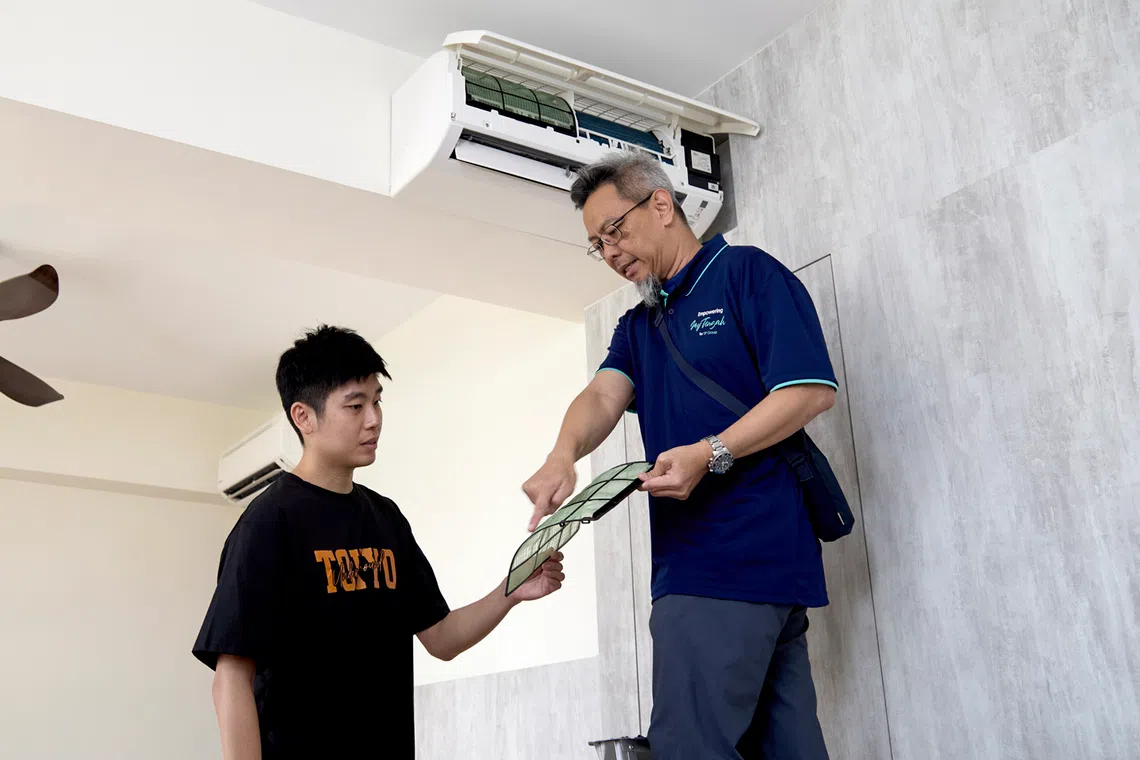
SP Group principal technical officer Amir Talib (right) showing Tengah resident Wong Zi Yang how to clean his air-con filter.
Published Sep 28, 2026, 04:00 AM
Updated Sep 28, 2026, 04:00 AM
When hazy conditions emerged in early September, pushing air quality to unhealthy levels, it was a timely reminder for residents to check when their air-conditioning units were last serviced.
This is because prolonged haze can clog air-conditioner filters, says SP Group principal technical officer Amir Talib, 55. Amir leads a team of technicians that conducts system inspections and performs fan coil unit (FCU) servicing for the Centralised Cooling System (CCS) in Tengah.
“When an air-con filter is clogged, it restricts airflow and makes the home cooling system work harder, leading to poor cooling, higher utilities bills and potential equipment damage,” says Amir.
Besides the air-con filters clogging up, another common maintenance issue faced by users is the build-up of dirt and dust in the drainpipe, causing condensation water to flow back and leak from the FCU.
Hence, air-con servicing professionals in Singapore generally recommend adjusting servicing frequency based on factors such as usage patterns, home conditions and the surrounding environment.
While servicing every three to six months is usually adequate for most households, more frequent servicing may be worthwhile during the current haze period, as well as in homes with pets, heavier air-con usage or other conditions that result in higher levels of dust and airborne particles.
A helping hand in Tengah
In Tengah, residents using the estate’s CCS are eligible for three years of complimentary regular servicing of their FCUs and can tap on technical support via the free MyTengah Care+ programme . The system and programme are both run by SP Group.
Residents on the Tengah Centralised Cooling System can get free technical support on the MyTengah app. PHOTO: SPH MEDIA
Residents on the Tengah Centralised Cooling System can get free technical support on the MyTengah app.
However, about one in five Tengah households using the CCS have not enrolled in the programme, even though it offers benefits such as free, twice-yearly servicing sessions for a customer’s FCUs, regular CCS checks and workmanship warranties on piping, trunking and insulation.
Several Tengah residents who rely on the CCS note that its high energy-efficiency has already helped them to keep utilities bills manageable – critical as air-conditioning costs are likely to spike in this period of heat and haze.
Farhana Mohamed Rasip, 37, an accountant, currently pays about $50 to $80 monthly. “This is very good for me because we turn on the air-con almost every day, for more than half a day each time or even the whole day. We have three units and use two regularly.”
Farhana Mohamed Rasip (second from left) and her family appreciate that opting for the Centralised Cooling System has helped them keep utilities bills relatively low. PHOTO: SPH MEDIA
Farhana Mohamed Rasip (second from left) and her family appreciate that opting for the Centralised Cooling System has helped them keep utilities bills relatively low.
Safety officer Joan Tan, 41, another CCS customer, appreciates the convenience of the MyTengah Care+ programme. “I can arrange for servicing or maintenance based on my schedule, and all I need to do is book the slot on the MyTengah app. It’s very fast,” she says.
The SP Group team’s quick response has impressed her too. She shares: “I once called the 24-hour hotline at 10pm when my living room air-con was dripping a little. The team came to my house within 30 minutes and found that my drainpipe was clogged.”
Clogged drainpipes are a common issue for all air-con users, whether they use CCS or a conventional system, and can be resolved through regular servicing.
“They took out some components and washed them, and everything was fine after that,” added Tan.
Fellow Tengah resident Wong Zi Yang, a 35-year-old financial advisor, has had similarly positive experiences with the MyTengah Care+ programme. He highlights: “If a CCS user is not on the programme, I would ask them, why not?”
“It is free, and residents can be assured that, with SP Group’s technicians, they are in good hands.”
Cooling support for Tengah homes
In Tengah, SP Group’s Centralised Cooling System (CCS) taps on centralised rooftop chillers to pipe chilled water to homes instead of using individual condensers. This makes it more energy-efficient compared to conventional air-conditioners.
Moreover, CCS customers can sign up for a free three-year maintenance programme, called MyTengah Care+ , which includes twice-yearly fan coil unit (FCU) servicing sessions – with each additional session currently costing just $15 per FCU – as well as regular CCS health checks and warranties on the CCS’ piping, trunking and insulation.
To find out more about the CCS and MyTengah Care+ programme, visit the MyTengah website .
大多数家庭的空调系统只需每三到六个月检查一次——但如果您的空调运行负荷较高,您可能需要增加检查频率。
SP集团首席技术官Amir Talib(右)向登加居民黄子阳展示如何清洁空调过滤器。
发布于 2026 年 9 月 28 日 上午 4:00
更新于2026年9月28日凌晨4:00
9月初,雾霾天气出现,空气质量降至不健康水平,这及时提醒居民们检查一下空调上次保养的时间。
SP集团首席技术官Amir Talib(55岁)表示,这是因为长时间的雾霾会堵塞空调过滤器。Amir带领一支技术团队,负责对登加的中央冷却系统(CCS)进行系统检查和风机盘管机组(FCU)维修。
“当空调过滤器堵塞时,会限制气流,使家用制冷系统更加费力地运转,导致制冷效果差、电费上涨,甚至可能损坏设备,”阿米尔说。
除了空调过滤器堵塞外,用户面临的另一个常见维护问题是排水管中积聚污垢和灰尘,导致冷凝水倒流并从风机盘管单元泄漏。
因此,新加坡的空调维修专业人员通常建议根据使用模式、家庭条件和周围环境等因素调整维修频率。
虽然每三到六个月进行一次保养通常对大多数家庭来说就足够了,但在当前的雾霾期间,以及有宠物、空调使用频率较高或其他导致灰尘和空气中颗粒物含量较高的情况的家庭中,更频繁的保养可能是值得的。
在登加伸出援手
在登加,使用该小区中央空调系统的居民可享受三年免费的FCU定期维护服务,并通过免费的MyTengah Care+计划获得技术支持。该系统和计划均由新加坡石油集团运营。
使用登加中央空调系统的居民可通过MyTengah应用程序获得免费技术支持。图片:新加坡报业控股
使用登加中央制冷系统的居民可以通过 MyTengah 应用程序获得免费技术支持。
然而,尽管 CCS 为用户提供每年两次的免费 FCU 服务、定期 CCS 检查以及管道、线槽和保温材料的工艺保修等福利,但使用 CCS 的 Tengah 地区约有五分之一的家庭尚未加入该计划。
一些依赖中央空调系统的登加居民指出,该系统的高能效已经帮助他们控制了水电费——这至关重要,因为在炎热和雾霾期间,空调费用可能会飙升。
37岁的会计法哈娜·穆罕默德·拉西普目前每月支付约50至80美元的电费。“这对我来说很划算,因为我们几乎每天都开空调,每次都开半天以上,甚至一整天。我们家有三台空调,经常用两台。”
法哈娜·穆罕默德·拉西普(左二)和她的家人很感激选择中央空调系统,因为它帮助他们将水电费控制在相对较低的水平。图片:新加坡报业控股
法哈娜·穆罕默德·拉西普(左二)和她的家人很感激选择中央制冷系统帮助他们将水电费保持在相对较低的水平。
41岁的安全员琼·谭(Joan Tan)也是CCS的客户,她对MyTengah Care+计划的便捷性赞不绝口。“我可以根据自己的时间安排维修或保养,只需要在MyTengah应用程序上预约即可。非常快捷,”她说。
SP集团团队的快速响应也给她留下了深刻的印象。她分享道:“有一次晚上10点,我家客厅的空调有点漏水,我拨打了24小时热线。团队30分钟内就赶到了我家,发现是我的排水管堵塞了。”
排水管堵塞是所有空调用户都会遇到的常见问题,无论他们使用的是CCS系统还是传统系统,都可以通过定期维护来解决。
“他们拆下了一些部件并清洗干净,之后一切就都正常了,”谭补充道。
同为登加居民的35岁财务顾问黄子阳也对MyTengah Care+计划有着类似的积极体验。他强调说:“如果CCS用户没有加入该计划,我会问他们为什么不加入?”
“这项服务是免费的,居民们可以放心,SP集团的技术人员会为他们提供很好的服务。”
登加住宅的制冷支持
在登加,新加坡能源集团的集中式制冷系统(CCS)利用屋顶中央冷水机组向各家各户输送冷水,而不是使用独立的冷凝器。与传统空调相比,这使其更加节能。
此外,CCS 的客户可以注册一项名为 MyTengah Care+ 的免费三年维护计划,其中包括每年两次的风机盘管机组 (FCU) 维护服务(每次额外服务目前每个 FCU 仅需 15 美元),以及 CCS 管道、线槽和保温材料的定期健康检查和保修。
要了解更多关于 CCS 和 MyTengah Care+ 计划的信息,请访问 MyTengah 网站。