Vital Logistics Ships Will Be Without Critical U.S. Navy Escorts In A Major Conflict在重大冲突中,重要的后勤船只将缺乏美国海军的关键护航。
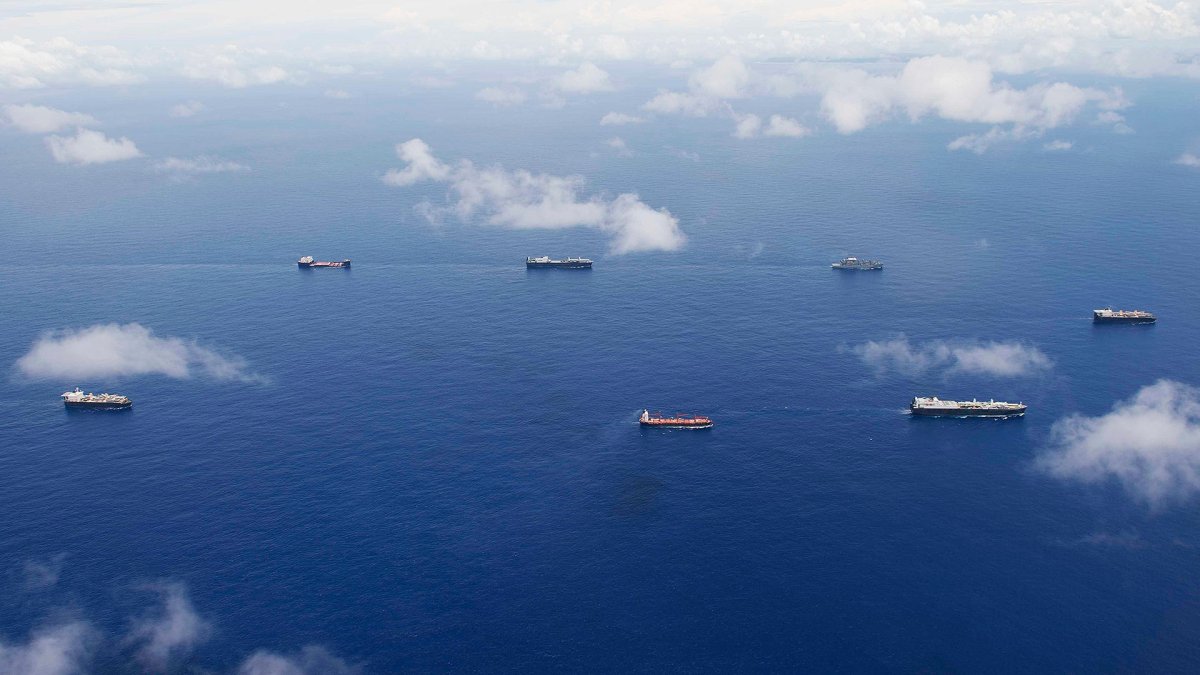
Military Sealift Command's mariners will have to 'fend for themselves' while convoying during a future high-end conflict.
新闻视频
Updated Dec 1, 2019 7:12 AM EST
In what may be one of the most important reports I have read in a long time, David Larter of Defense News lays out an incredibly inconvenient reality for Military Sealift Command and its fleet of cargo ships and the Merchant Marines that operate them—in the next big conflict they are likely to be left to fend for themselves without any protection from U.S. Navy vessels. This is an especially troubling proposition considering roughly 90 percent of the Army’s and Marine Corps’ materiel will be relegated to transport on the high seas during such a crisis.
In Larter’s piece, which you can and should read in full here , he talked at length with Mark Buzby, a retired Rear Admiral who now heads up the Department of Transportation’s Maritime Administration. His comments were both frank and unnerving:
“The Navy has been candid enough with Military Sealift Command and me that they will probably not have enough ships to escort us. It’s: ‘You’re on your own; go fast, stay quiet.’ … Adm. Mewbourn at Military Sealift Command and I have talked a lot about this and we have been trying to get the word out to people that we are going to have to do things differently… Turn your navigation lights off, turn your [Automatic Identification System] off, turn your radars off, tell your crews not to use their cell phones — all those [Emissions Condition] things that we in the Navy are familiar with that are completely foreign to a merchant mariner and are seen as an imposition. … But it harkens back to some of the hard lessons we learned in World War II where in 1942 the Germans were sinking us left and right. Even some of the equipment that’s on ships now automatically transmits data… We put new cargo-control consoles on our Kaiser -class oilers at MSC, and one of the things we discovered soon after was that those things are talking constantly. … The last bullet point on one of the slides is ‘Learn how to swim… It’s to that point. There’s not going to be a bunch of destroyers around us as we take those ships over there. We’re going to be hitting the sea buoy, cranking it up and going hell-bent for leather, hoping to stay undetected.”
“The Navy has been candid enough with Military Sealift Command and me that they will probably not have enough ships to escort us. It’s: ‘You’re on your own; go fast, stay quiet.’
Adm. Mewbourn at Military Sealift Command and I have talked a lot about this and we have been trying to get the word out to people that we are going to have to do things differently… Turn your navigation lights off, turn your [Automatic Identification System] off, turn your radars off, tell your crews not to use their cell phones — all those [Emissions Condition] things that we in the Navy are familiar with that are completely foreign to a merchant mariner and are seen as an imposition.
But it harkens back to some of the hard lessons we learned in World War II where in 1942 the Germans were sinking us left and right.
Even some of the equipment that’s on ships now automatically transmits data… We put new cargo-control consoles on our Kaiser -class oilers at MSC, and one of the things we discovered soon after was that those things are talking constantly.
The last bullet point on one of the slides is ‘Learn how to swim… It’s to that point. There’s not going to be a bunch of destroyers around us as we take those ships over there. We’re going to be hitting the sea buoy, cranking it up and going hell-bent for leather, hoping to stay undetected.”
You are probably thinking ‘but one of the Navy’s most important jobs is supposed to be keeping critical sea lanes open and to provide convoy duty to support a war effort?’ You are right, but that’s not where the Navy’s priorities have lied over the last two and a half decades or so. It’s a density and priority problem.
The Navy does not have enough surface combatant with particular capabilities to fight a high-end conflict and provide convoy duty for what would be a massive sealift operation. And clearly, America’s would-be opponents have recognized this Achilles heel, just as they have with vulnerabilities in U.S. combat doctrine in the air . Simply put, it’s much easier to kill a brigade of armor by sinking it in the middle of an ocean than facing it head-on.
Military Sealift Command fleet as of January 2018., MSC
This truth also fits with what many of us have been pounding away at for the better part of a decade or more—that the Navy’s misguided investment in Littoral Combat Ships could end up being a very bloody and strategically damning mistake. These lightly armed and even more lightly armored vessels have suffered from low availability rates , are now only capable of focusing on one key mission and lack any sort of area air defense capability at all, not to mention the range and seakeeping of more traditional surface combatants. In other words, the Navy needed a modern multi-role frigate that can handle escort duty during a time of war yesterday. A ship that can tackle lower volume threats below, on, and above the surface of the water and persist over long ranges and in heavy sea states.
That ship is finally in the works now under the FFG(X) program that intends to field its first operational frigates by around 2025. The Navy should put even more emphasis on speeding it up and expanding the program in order to reach better economies of scale that will make it as affordable as possible to procure large numbers of hulls.
America’s logistics navy provides the lifeblood to the U.S. Navy’s fighting fleet and the other services rely on it heavily as well to move their gear over huge distances, especially during a crisis. , USN
Having multi-role capable escorts is key as it’s not as if the threat to maritime convoys will come from one domain exclusively. Submarines may pose the most traditional danger when it comes to moving lines of supply vessels across the open ocean, but they don’t just launch torpedoes or lay mines. They can also fire anti-ship cruise missiles and some of them can sling dozens of them at a time. As such, a single adversary platform can represent a layered threat.
Aircraft and surface combatants are also clearly an issue. As such, an escort ship has to be able to counter a multitude of threats that could attack suddenly from a number of vectors, not just one. This means anti-submarine, anti-air, and anti-surface warfare capabilities are needed, otherwise, multiple assets would have to be assigned to do the same mission. In addition, there aren’t enough multi-billion dollar destroyers to fulfill the demands the Navy already has, let alone those that will be required during a time of war. Assigning these high-end combat ships to convoy duty isn’t just wasteful, it will likely be impossible.
Larter also points out that manpower is also a major issue that could leave America’s total force with a gutted logistical train during a time of war, he writes:
“Today, the Maritime Administration estimates that to operate both the surge sealift ships — the 46 ships in the Ready Reserve Force and the 15 ships in the MSC surge force — and the roughly 60 U.S.-flagged commercial ships in the Maritime Security Program available to the military in a crisis, the pool of fully qualified mariners is just barely enough. They need 11,678 mariners to man the shops, and the pool of available, active mariners is 11,768. That means in a crisis every one of them would need to show up for the surge, according to a recent MARAD report to Congress. In contrast, the U.S. had about 55,000 active mariners in the years prior to World War II, with that number swelling to more than 200,000 at the height of the war, according to most sources. That means that significant losses among the available pool of mariners would likely dissuade some from volunteering (bad) and would mean the loss of mariners with critical skills needed to operate the fleet for months or even years in a major contingency (worse). And even without losses, MARAD estimates the country is about 1,800 mariners short if any kind of rotational presence is needed.”
“Today, the Maritime Administration estimates that to operate both the surge sealift ships — the 46 ships in the Ready Reserve Force and the 15 ships in the MSC surge force — and the roughly 60 U.S.-flagged commercial ships in the Maritime Security Program available to the military in a crisis, the pool of fully qualified mariners is just barely enough.
They need 11,678 mariners to man the shops, and the pool of available, active mariners is 11,768. That means in a crisis every one of them would need to show up for the surge, according to a recent MARAD report to Congress. In contrast, the U.S. had about 55,000 active mariners in the years prior to World War II, with that number swelling to more than 200,000 at the height of the war, according to most sources.
That means that significant losses among the available pool of mariners would likely dissuade some from volunteering (bad) and would mean the loss of mariners with critical skills needed to operate the fleet for months or even years in a major contingency (worse). And even without losses, MARAD estimates the country is about 1,800 mariners short if any kind of rotational presence is needed.”
He also goes on to discuss some very important lessons learned during WWII and how we may be setting ourselves up for logistical failure in a future conflict.
We reached out to David to get a bit more background on how he came to reporting on this critical but nearly invisible issue, this is what he told us:
“The series I’m working on has been something I’ve been chipping away at over a number of months. It struck me that if the National Defense Strategy calls for preparing for a war with China or Russia or both, the US wouldn’t get very far without a robust sealift capability. Turns out, when you dig into the issue, the US has a serious strategic liability on its hands both in terms of the available workforce for a major surge and, like much of the rest of the military, in aging platforms in need of modernization. When you layer in the fact that the U.S. Navy is much smaller than it was in the Cold War and would be vital in opening up the sea lanes to move this equipment, responding to a Russian move in Europe or Chinese move in Asia would be very slow going. If the pace of war is speeding up, as CNO often says, this is one place where it seems the US could find itself in a logjam.”
“The series I’m working on has been something I’ve been chipping away at over a number of months. It struck me that if the National Defense Strategy calls for preparing for a war with China or Russia or both, the US wouldn’t get very far without a robust sealift capability. Turns out, when you dig into the issue, the US has a serious strategic liability on its hands both in terms of the available workforce for a major surge and, like much of the rest of the military, in aging platforms in need of modernization.
When you layer in the fact that the U.S. Navy is much smaller than it was in the Cold War and would be vital in opening up the sea lanes to move this equipment, responding to a Russian move in Europe or Chinese move in Asia would be very slow going. If the pace of war is speeding up, as CNO often says, this is one place where it seems the US could find itself in a logjam.”
Yesterday, David also reported on the not so great state of Military Sealift Command’s fleet—a significant portion of which still run on steam power —making the possibility of even sustaining a logistics chain across an ocean all that more dubious. In addition, in a tweet he reminded us that airlift is not an alternative as it has major limitations, even when it comes to the USAF’s unique ability to maintain an air-bridge between two disparate locales:
He is completely right. Take Operation Airborne Dragon in 2003. It took 30 C-17 sorties to bring in just five Abrams tanks, five Bradleys fighting vehicles, and a battalion command post, along with the personnel to man those vehicles and facilities. Keep in mind that a single tank company has 14 Abrams main battle tanks. In addition, facilities to even land those aircraft may be next to non-existent during the opening weeks or even months of a conflict—another similar hard reality the USAF is now finally coming to terms with . In addition, Sea bases can pop up virtually anywhere to work as a nexus between MSC’s largest logistics ships and the shore.
Beyond the nuts and bolts of the issue, the bigger picture here seems to be that the Pentagon is in denial of the realities surrounding its ability to rapidly move material across the globe and especially into semi-contested environments. These are supply and demand issues as much as there are survivability ones. The good news is there are solutions to this problem, which includes pumping more funds into the military’s sealift ecosystem and accelerating and widening procurement of FFG(X), but it also could include providing some organic defenses to Military Sealift Command associated ships themselves.
Containerized weapon systems are especially attractive for such applications. Some Military Sealift Command ships had Phalanx close-in weapon systems, but most, if not all now do not. Installing a more advanced but modular point air defense capability, such a containerized version of SeaRAM , would provide a robust last-ditch defense against aerial and some surface threats. Anti-submarine warfare is a much tougher nut to crack, but even modular torpedo defense systems, both active and passive, could be deployed in a similar role but to counter attacks from below the waves. Some of MSC’s most advanced ships have Nixie decoys , but others do not.
Some of MSC’s combat logistics ships, like USNS Lewis And Clark shown above, have Nixie decoys and provisions for Phalanx systems, but the majority of the vehicle and cargo haulers do not., USN
Finally, electronic warfare can go a long way in providing an affordable screen against certain kinds of attacks and from being detected by the enemy in the first place, all without actually arming cargo ships with additional kinetic weaponry. In fact, just the situational awareness the latest maritime electronic warfare systems provide could go a long way when it comes to MSC ships’ survivability, as avoiding threats is maybe the best defense of all. Expendable decoys could also be paired with an electronic warfare system, giving these big vessels a much better chance of averting an anti-ship missile strike than they have now.
It’s also worth noting that the Navy has already been eyeing outfitting some of its logistics ships with bolt-on weapon systems , including cruise missiles, as part of a ‘distributed lethality’ model of operations. But adding offensive punch to some of these ships could also work as a valuable deterrent.
USNS PFC Dewayne T. Williams (T-AK 3009) uses the Improved Navy Lighterage System Causeway Ferry system to move vehicles to shore during an exercise off the Southern California coast., USN
Hopefully, Larter’s report will help to push the Department of Defense towards taking such a glaring weakness seriously. Sealift may not be sexy, but without it, America stands little chance in a protracted peer-state conflict overseas.
They say logistics wins wars. If that is so, then the current status quo seems like a great way to lose one.
Contact the author: Tyler@thedrive.com
Comments couldn’t be loaded. Please refresh the page.
更新于美国东部时间2019年12月1日上午7:12
这篇或许是我近年来读过的最重要的报道之一,由《防务新闻》的戴维·拉特撰写。报道揭示了一个对军事海运司令部及其货船队以及操作这些货船的商船队来说极其棘手的现实:在下一次大规模冲突中,他们很可能只能孤立无援,得不到美国海军舰艇的任何保护。考虑到在危机时期,陆军和海军陆战队大约90%的物资都将依赖海上运输,这尤其令人担忧。
在拉特尔的文章中(您可以在这里阅读全文),他与马克·布兹比进行了长时间的交谈。布兹比是一位退休的海军少将,现任美国交通部海事管理局局长。他的评论既坦率又令人不安:
“海军已经坦诚地告诉军事海运司令部和我,他们可能没有足够的舰艇来护送我们。他们的意思是:‘你们自己想办法;快速前进,保持安静。’” ……我和军事海运司令部的缪伯恩海军上将就此进行了很多讨论,我们一直在努力让大家明白,我们必须改变做法……关闭导航灯,关闭自动识别系统,关闭雷达,告诉船员不要使用手机——所有这些我们海军人员熟悉的[排放条件]规定,对商船海员来说却完全陌生,而且被视为一种限制。……但这让我们回想起二战中一些惨痛的教训,1942年,德国人四处击沉我们。即使是现在船上的一些设备也会自动传输数据……我们在军事海运司令部的“凯撒”级油轮上安装了新的货物控制台,之后我们很快发现,这些设备一直在传输数据。……其中一张幻灯片上的最后一点是“学会游泳”……情况就是这样。我们周围不会有那么多驱逐舰。把那些船开过去。我们要撞上海上浮标,然后加速冲刺,希望不被发现。
“海军已经坦诚地告诉军事海运司令部和我,他们可能没有足够的舰艇来护送我们。他们的意思是:‘你们自己想办法;快速前进,保持安静。’”
我和军事海运司令部的缪伯恩海军上将就此进行了很多讨论,我们一直在努力让大家明白,我们将不得不改变一些做法……关闭导航灯,关闭自动识别系统,关闭雷达,告诉船员不要使用手机——所有这些我们海军人员熟悉的[排放条件]规定,对于商船海员来说完全陌生,而且被视为一种负担。
但这让人想起我们在二战中吸取的一些惨痛教训,1942 年,德国人左右开弓,击沉了我们的船只。
甚至现在船上的一些设备也会自动传输数据……我们在MSC的凯撒级油轮上安装了新的货物控制台,之后我们很快发现,这些设备一直在不停地传输数据。
其中一张幻灯片的最后一条是“学会游泳……事情已经到了这一步。当我们驾驶那些船只过去的时候,周围不会有一大堆驱逐舰。我们会撞上海上浮标,然后加速冲刺,全力以赴,希望不被发现。”
你或许会想,“海军最重要的任务之一不就是保障关键海上航道畅通,并为战争提供护航服务吗?”你说得对,但过去二十五年左右的时间里,海军的优先事项并非如此。这是一个人员密度和优先事项的问题。
美国海军缺乏足够数量的具备特定能力的作战水面舰艇,既无法应对高端冲突,也无法为大规模海上运输行动提供护航任务。显然,美国的潜在对手已经意识到了这一软肋,正如他们已经意识到美国空中作战理论的不足一样。简而言之,在茫茫大海中击沉一支装甲旅远比正面交锋要容易得多。
截至2018年1月,军事海运司令部(MSC)舰队。
这一事实也印证了我们许多人近十年来一直强调的观点——海军对濒海战斗舰的错误投资最终可能酿成惨重的战略灾难。这些轻型武器和装甲更薄弱的舰艇可用性低,如今只能专注于一项关键任务,完全缺乏任何区域防空能力,更不用说其航程和适航性远逊于传统水面作战舰艇。换句话说,海军急需一种现代化的多用途护卫舰,能够在战时立即执行护航任务。这种舰艇能够应对水下、水面和水面上的低强度威胁,并能在远距离和恶劣海况下持续作战。
该舰目前已在FFG(X)计划下开始建造,该计划旨在2025年左右交付首批作战护卫舰。海军应更加重视加快该计划的进度并扩大其规模,以实现更好的规模经济效益,从而尽可能降低采购大量舰体的成本。
美国的后勤海军是美国海军作战舰队的生命线,其他军种也高度依赖它来长途运输装备,尤其是在危机时期。
拥有多用途护航舰艇至关重要,因为海上护航船队的威胁并非仅来自单一领域。潜艇在远洋运输补给船队方面或许构成最传统的威胁,但它们的功能远不止发射鱼雷或布雷。它们还能发射反舰巡航导弹,有些潜艇甚至一次就能发射数十枚。因此,单一的敌方平台就可能构成多层次的威胁。
飞机和水面作战舰艇显然也是需要考虑的问题。因此,护航舰艇必须能够应对来自多个方向(而不仅仅是一个方向)的多种威胁。这意味着需要具备反潜、防空和反水面作战能力,否则就需要部署多艘舰艇来执行相同的任务。此外,价值数十亿美元的驱逐舰数量不足以满足海军目前的需求,更不用说战时的需求了。将这些高端作战舰艇用于护航任务不仅浪费资源,而且很可能根本无法实现。
拉特尔还指出,人力也是一个主要问题,这可能导致美国的整体军事力量在战争时期后勤保障体系严重受损。他写道:
“如今,海事管理局估计,要同时运作应急海运舰艇——包括预备役部队的46艘舰艇和海上安全司令部应急部队的15艘舰艇——以及危机时期可供军方使用的约60艘美国籍商船(隶属于海上安全计划),合格海员的数量仅勉强够用。他们需要11,678名海员来维持舰艇的运转,而目前可用的现役海员只有11,768人。根据海事管理局最近提交给国会的一份报告,这意味着在危机发生时,所有现役海员都必须应征入伍。相比之下,据大多数资料显示,二战前美国拥有约55,000名现役海员,而到了战争高峰期,这一数字更是飙升至200,000多人。这意味着,如果现有海员数量出现重大损失,很可能会阻碍一些人自愿参军(这是不利的),并且会导致一些拥有关键技能的海员流失,而这些技能对于维持舰队数月甚至数年的运转至关重要。”更糟糕的是,如果发生重大意外,即使没有人员伤亡,美国海事管理局估计,如果需要任何形式的轮换部署,该国仍将缺少约1800名海员。
“如今,海事管理局估计,要同时操作应急海运船——包括预备役部队的 46 艘舰艇和海上安全司令部应急部队的 15 艘舰艇——以及在危机时期可供军方使用的海上安全计划中的大约 60 艘悬挂美国国旗的商船,合格海员的数量勉强够用。
他们需要11,678名海员来维持运营,而目前可用的现役海员只有11,768人。这意味着,根据美国海事管理局(MARAD)最近提交给国会的一份报告,一旦发生危机,所有现役海员都必须应征入伍。相比之下,据大多数资料显示,二战前美国约有55,000名现役海员,而到了战争高峰期,这一数字飙升至200,000多人。
这意味着,现有海员队伍的大量损失可能会阻碍一些人自愿参战(这是坏事),而且意味着在重大突发事件中,会失去一些拥有关键技能的海员,而这些海员对于维持舰队数月甚至数年的运转至关重要(这更糟)。即使没有人员损失,美国海事管理局估计,如果需要任何形式的轮换部署,该国仍将缺少约1800名海员。
他还继续探讨了二战期间吸取的一些非常重要的教训,以及我们可能如何在未来的冲突中为后勤失败埋下隐患。
我们联系了戴维,想了解他是如何开始报道这个至关重要但几乎不为人知的问题的,以下是他的回答:
“我正在撰写的这个系列文章,我已经断断续续地写了好几个月了。我突然意识到,如果国家国防战略要求美国做好与中国或俄罗斯,或者两者同时开战的准备,那么如果没有强大的海上运输能力,美国将寸步难行。事实证明,深入研究这个问题后,你会发现美国面临着严重的战略劣势:一方面,缺乏足够的人力来应对大规模增兵;另一方面,像其他许多军种一样,美国也面临着许多亟需现代化改造的老旧装备。此外,美国海军的规模远不及冷战时期,而海军在开辟海上通道运输这些装备方面至关重要。因此,应对俄罗斯在欧洲的行动或中国在亚洲的行动将会非常缓慢。如果战争的步伐真的像海军作战部长经常说的那样正在加快,那么美国似乎很可能会在这方面陷入僵局。”
“我正在撰写的这个系列文章,我已经断断续续地写了好几个月了。我突然意识到,如果国家国防战略要求美国做好与中国或俄罗斯,或者两者同时开战的准备,那么如果没有强大的海上运输能力,美国将寸步难行。事实证明,当你深入研究这个问题时,你会发现美国面临着严重的战略劣势:一方面,它缺乏足够的人力来应对大规模增兵;另一方面,像其他许多军种一样,美国也面临着许多需要现代化改造的老旧装备。”
考虑到美国海军的规模远不及冷战时期,而海军在开辟海上航道运输这些装备方面又至关重要,因此,应对俄罗斯在欧洲或中国在亚洲的行动将会非常缓慢。如果战争节奏如海军作战部长常说的那样正在加快,那么美国似乎很可能在这方面陷入僵局。
昨天,戴维还报道了军事海运司令部船队的糟糕状况——其中相当一部分船只仍然依靠蒸汽动力——这使得跨洋维持后勤链的可能性更加令人怀疑。此外,他在推特上提醒我们,空运并非替代方案,因为它存在诸多局限性,即便美国空军拥有在两个相距遥远的地点之间维持空中桥梁的独特能力:
他的说法完全正确。以2003年的“空降龙行动”为例,仅仅运送5辆艾布拉姆斯坦克、5辆布雷德利战车、一个营级指挥所以及操作这些车辆和设施的人员,就动用了30架次C-17运输机。要知道,一个坦克连就拥有14辆艾布拉姆斯坦克。此外,在冲突爆发的最初几周甚至几个月里,能够起降这些飞机的设施可能几乎不存在——这也是美国空军如今终于开始正视的另一个严峻现实。另外,海上基地几乎可以出现在任何地方,作为海上运输司令部(MSC)最大的后勤舰船与岸上之间的枢纽。
抛开具体细节不谈,更深层次的问题在于,五角大楼似乎否认了其在全球范围内,尤其是在半对抗环境下快速运送物资的能力所面临的现实挑战。这既是供需问题,也是生存能力问题。好消息是,这个问题并非无解,解决方案包括增加对军事海运体系的投入,加快并扩大FFG(X)护卫舰的采购,同时也可能包括为军事海运司令部下属舰艇提供一些必要的防御能力。
集装箱式武器系统对这类应用尤其具有吸引力。一些美国军事海运司令部(MSC)的舰艇曾配备“密集阵”(Phalanx)近程防御武器系统,但现在大多数舰艇(如果不是全部的话)都已不再配备。安装更先进但模块化的点防空能力,例如集装箱版的“海拉姆”(SeaRAM)系统,将为抵御空中和部分水面威胁提供强有力的最后防线。反潜作战则更加棘手,但即使是模块化的鱼雷防御系统,无论是主动防御还是被动防御,都可以在类似的情况下部署,用于应对来自水下的攻击。MSC的一些最先进的舰艇配备了“尼克西”(Nixie)诱饵,但其他舰艇则没有。
MSC的部分作战后勤舰艇,例如上图所示的“刘易斯与克拉克”号,配备了尼克西诱饵和密集阵防御系统,但大多数车辆和货物运输舰艇并未配备。
最后,电子战可以在抵御某些类型攻击和防止被敌方探测方面发挥重要作用,而且无需为货船配备额外的动能武器。事实上,最新的海上电子战系统所提供的态势感知能力,对于提升MSC船舶的生存能力至关重要,因为规避威胁或许是最好的防御手段。消耗性诱饵也可以与电子战系统配合使用,使这些大型船舶比现在更有可能躲避反舰导弹的攻击。
值得注意的是,作为“分布式杀伤”作战模式的一部分,海军一直在考虑为其部分后勤舰艇配备外挂式武器系统,包括巡航导弹。但为这些舰艇增加进攻火力,也可以起到有效的威慑作用。
在南加州海岸附近的一次演习中,美国海军辅助运输舰“一等兵德韦恩·T·威廉姆斯”号(T-AK 3009)使用改进型海军驳船系统堤道渡轮系统将车辆运送到岸上。
希望拉特尔的报告能促使国防部认真对待这一显而易见的弱点。海运或许并不引人注目,但如果没有它,美国在海外与势均力敌的国家之间旷日持久的冲突中几乎没有胜算。
人们常说后勤保障决定战争的胜负。如果真是如此,那么目前的现状似乎正是导致战争失败的绝佳途径。
联系作者:Tyler@thedrive.com
评论加载失败,请刷新页面。