What do I need to know about this year’s public transport fare increase?关于今年的公共交通票价上涨,我需要了解哪些信息?
Public transport fares in Singapore will rise 7% from Dec 26 due to higher energy costs, with monthly pass prices unchanged to help frequent commuters save. Read more at straitstimes.com.
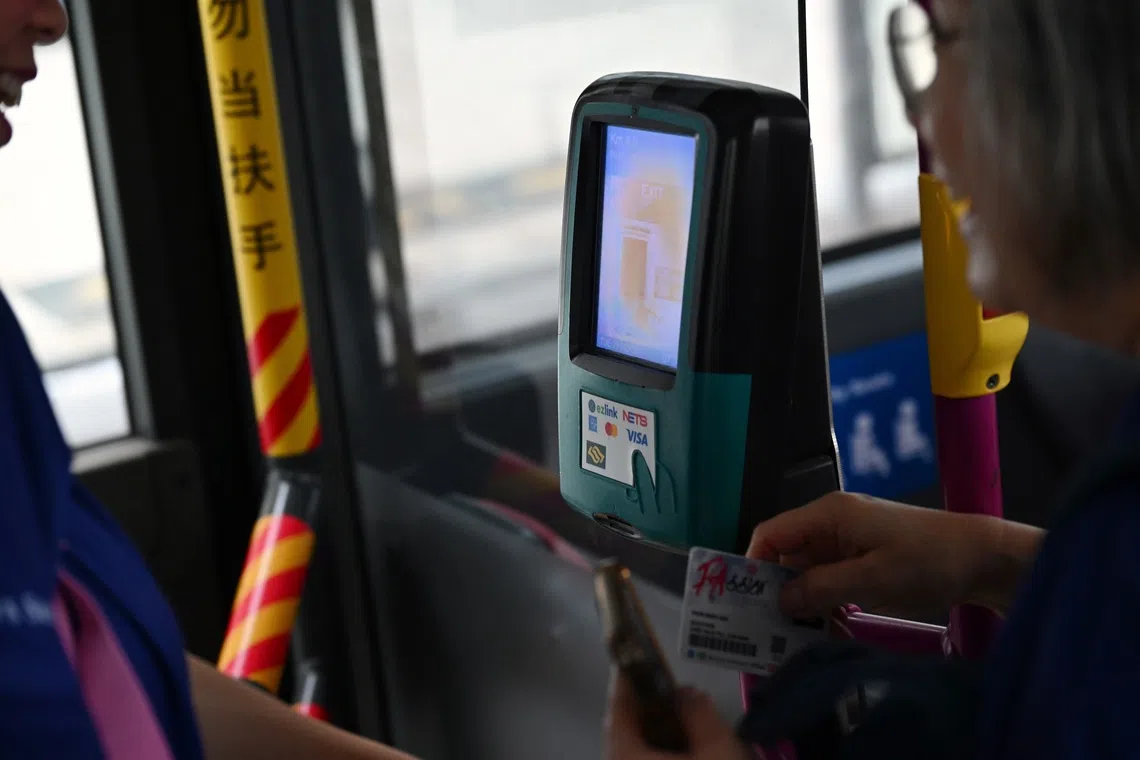
Higher energy costs brought on by the ongoing Middle East conflict contributed heavily to the higher fare increase.
ST PHOTO: KUA CHEE SIONG
Published Sep 29, 2026, 08:15 PM
Updated Sep 29, 2026, 08:15 PM
SINGAPORE – Public transport users will face a 7% hike in their bus and train fares from Dec 26, with adults paying 12 or 13 cents more , depending on the distance of their journeys.
Higher energy costs brought on by conflict in the Middle East are the primary driver of the record-high fare increases, said the Public Transport Council (PTC), which regulates fares and ticket payment services.
The Straits Times takes a closer look at how fare increases are determined, and how this affects commuters.
How is the fare hike determined?
PTC applies a formula to determine the maximum amount that bus and train fares can be adjusted , after accounting for various factors that affect public transport operations.
The formula is reviewed every five years, with the current one valid till 2027.
Five components are taken into account. These include year-on-year changes in core inflation, wages and energy prices.
There is also a fixed “capacity adjustment factor” set at 1.1% each year. This is to account for costs related to expanding the public transport system.
The final component is productivity contribution, which accounts for a 0.1% reduction each year, as operators are expected to improve their cost efficiency.
After the formula throws up a figure for adjustment, the PTC has the option to defer the amount to subsequent fare reviews, depending on social and economic conditions.
An increase of 5.3% was produced by the formula in the latest fare review exercise, which used the period between July 2025 and June 2026 as a reference.
Coupled with the 9.4% quantum deferred from the previous fare review exercise in 2025 , fares could have gone up by 14.7%.
However, the PTC chose to increase it by 7% and defer the remaining 7.7% to future fare review exercises.
How did higher energy prices affect the fare increase?
Public transport is an energy-intensive industry. The rail operators applied for the maximum allowable fare adjustment of 14.7% , citing cost pressures from geopolitical conflicts that have elevated energy prices.
Speaking to reporters on Sept 29, PTC chairperson Janet Ang said the year-on-year change in the monthly price of diesel fluctuated drastically from July 2025 to June 2026, swinging from -14% to 138%.
Daily energy prices had also increased significantly from March to June 2026, due to the Middle East conflict.
Although the energy component in the fare adjustment formula had the least weightage compared with core inflation and wages, it contributed the most to how the fare adjustment quantum was calculated.
How will the fare increase affect me?
Different groups of commuters will be impacted differently.
Adults will bear the brunt of the higher costs, paying 12 to 13 cents more for their public transport journeys if they use a card. Those using cash pay 20 cents more.
Seniors, students and people with disabilities will be paying 5 cents more when they use cards and 10 cents more with cash.
Low-wage workers who are under the Workfare Transport Concession scheme will not experience any change in fares.
The prices of monthly passes will also remain unchanged – $122 for adults and $55 for seniors and those with disabilities.
What support can I get with the fare hike?
Lower-income households with a $2,100 per capita income will be eligible for public transport vouchers valued at $80.
They will either automatically receive the vouchers from end-December, or can apply for them online or in-person at their local community centres from early 2027.
How much money can I save with a monthly travel pass?
PTC said around 110,000 commuters who are now paying by credit, debit and transport cards can save around $26 each month on average, after the 7% fare increase takes effect from Dec 26.
An adult monthly travel pass costs $122, unchanged from the previous year.
Take this example of an adult passenger who travels 16.2km via the bus and MRT every weekday between his home in Punggol Field and his office near City Hall MRT station:
He will spend $ 4.48 each day on the two-way trip from Dec 26, up from $ 4.22 .
Each month, his commutes to and from his workplace will cost $ 89.60 .
If on Saturdays and Sundays he also travels around the same distance and spends $4.48 on a two-way trip each day, his weekend excursions will total $ 35.84 each month.
This means that an adult passenger who goes out every day will rack up travel expenses of $ 125.44 .
And if he travels on an adult monthly pass costing $122, he will save around $3.
Fares are calculated based on the total distance travelled in one journey, regardless of the mode of transport used and if they are making transfers.
But for passengers who do not make two daily trips that each cover a distance of 14.3km or longer, or do not travel every single day, they may not benefit from an adult monthly pass.
More calculations have to be done as different passengers have varying travel habits and schedules.
Passengers can track their public transport expenses on the SimplyGo app, or check the potential travel fare using the Travel Guide on SimplyGo’s website or LTA’s Fare Calculator tool .
Aqil Hamzah is a transport journalist at The Straits Times. He is also interested in issues related to crime and technology.
Esther Loi is a journalist at The Straits Times, where she covers transport issues.
持续不断的中东冲突导致能源成本上升,这对票价大幅上涨起到了重要作用。
《海峡时报》摄影:郭志雄
发布于 2026 年 9 月 29 日晚上 8:15
更新于2026年9月29日晚上8:15
新加坡——从12月26日起,公共交通乘客将面临巴士和地铁票价上涨7%,成人票价将根据行程距离增加12或13分钱。
公共交通委员会 (PTC) 表示,中东冲突导致能源成本上升,这是票价创历史新高上涨的主要原因。PTC 负责监管票价和车票支付服务。
《海峡时报》深入探讨了票价上涨的决定因素,以及这对通勤者的影响。
票价上涨幅度是如何决定的?
PTC 使用公式来确定公共汽车和火车票价可以调整的最大幅度,该公式考虑了影响公共交通运营的各种因素。
该公式每五年进行一次修订,目前的公式有效期至 2027 年。
考虑的因素有五个。这些因素包括核心通胀率、工资和能源价格的同比变化。
此外,每年还设定了1.1%的固定“运力调整系数”。这是为了弥补扩建公共交通系统相关的成本。
最后一个组成部分是生产力贡献,每年减少 0.1%,因为运营商需要提高成本效益。
根据公式计算出的调整金额,PTC 可以选择将该金额推迟到后续的票价审查中,具体取决于社会和经济状况。
根据最新票价审查公式,票价上涨了 5.3%,该审查以 2025 年 7 月至 2026 年 6 月期间为参考。
加上 2025 年上次票价审查中推迟的 9.4% 的涨幅,票价原本可能上涨 14.7%。
然而,PTC 选择将其提高 7%,并将剩余的 7.7% 推迟到未来的票价审查工作中进行。
能源价格上涨对票价上涨有何影响?
公共交通是能源密集型产业。铁路运营商申请了最高允许票价调整幅度14.7%,理由是地缘政治冲突导致能源价格上涨,增加了成本压力。
9月29日,PTC主席Janet Ang在接受记者采访时表示,从2025年7月到2026年6月,柴油月价格的同比变化幅度很大,从-14%到138%不等。
受中东冲突的影响,2026 年 3 月至 6 月期间,每日能源价格也大幅上涨。
尽管在票价调整公式中,能源因素的权重与核心通货膨胀和工资相比最小,但它对票价调整幅度的计算贡献最大。
票价上涨会对我有什么影响?
不同通勤群体受到的影响也不同。
成年人将首当其冲地承受更高的成本,如果使用银行卡支付公共交通费用,每次出行需多付12至13美分;而使用现金支付则需多付20美分。
老年人、学生和残疾人使用银行卡支付将多付 5 美分,使用现金支付将多付 10 美分。
参加“工作补贴交通优惠计划”的低收入工人将不会面临票价变化。
月票价格也将保持不变——成人票价为 122 美元,老年人和残疾人票价为 55 美元。
票价上涨期间我能获得哪些支持?
人均收入低于 2100 美元的低收入家庭将有资格获得价值 80 美元的公共交通代金券。
他们要么从 12 月底开始自动收到代金券,要么从 2027 年初开始在线或亲自到当地社区中心申请。
购买月票可以节省多少钱?
PTC表示,从12月26日起,票价上涨7%后,目前使用信用卡、借记卡和交通卡支付车费的约11万通勤者平均每月可节省约26美元。
成人月票价格为 122 美元,与上年相同。
以一位成年乘客为例,他每个工作日都要乘坐巴士和地铁往返于榜鹅坊的家和市政厅地铁站附近的办公室之间,全程16.2公里:
从 12 月 26 日起,他每天往返行程的花费将为 4.48 美元,高于之前的 4.22 美元。
他每月往返工作地点的通勤费用为 89.60 美元。
如果他在周六和周日也走同样的路程,每天往返花费 4.48 美元,那么他每个月的周末出行总花费将达到 35.84 美元。
这意味着每天外出的成年乘客将累计产生 125.44 美元的旅行费用。
如果他购买价值 122 美元的成人月票,他将节省大约 3 美元。
车费是根据一次行程的总行驶距离计算的,与使用的交通方式以及是否需要换乘无关。
但对于每天出行两次,每次行程未达到 14.3 公里或更长,或者并非每天都出行的乘客来说,成人月票可能对他们没有好处。
由于不同乘客的出行习惯和行程安排各不相同,因此需要进行更多计算。
乘客可以通过 SimplyGo 应用程序跟踪公共交通费用,或使用 SimplyGo 网站上的旅行指南或 LTA 的票价计算器工具查看可能的旅行费用。
阿基尔·哈姆扎是《海峡时报》的交通记者。他也对犯罪和科技相关议题感兴趣。
埃丝特·罗伊是《海峡时报》的记者,主要报道交通运输问题。