Around 100 businesses caught buying fake reviews in largest probe by Singapore's competition watchdog新加坡竞争监管机构开展最大规模的调查,查获约100家企业购买虚假评论。
In the first phase of the investigation, 45 businesses that admitted to purchasing bogus reviews from the sole director of digital marketing firm Reputifly will have to apologise publicly and commit to removing such reviews.
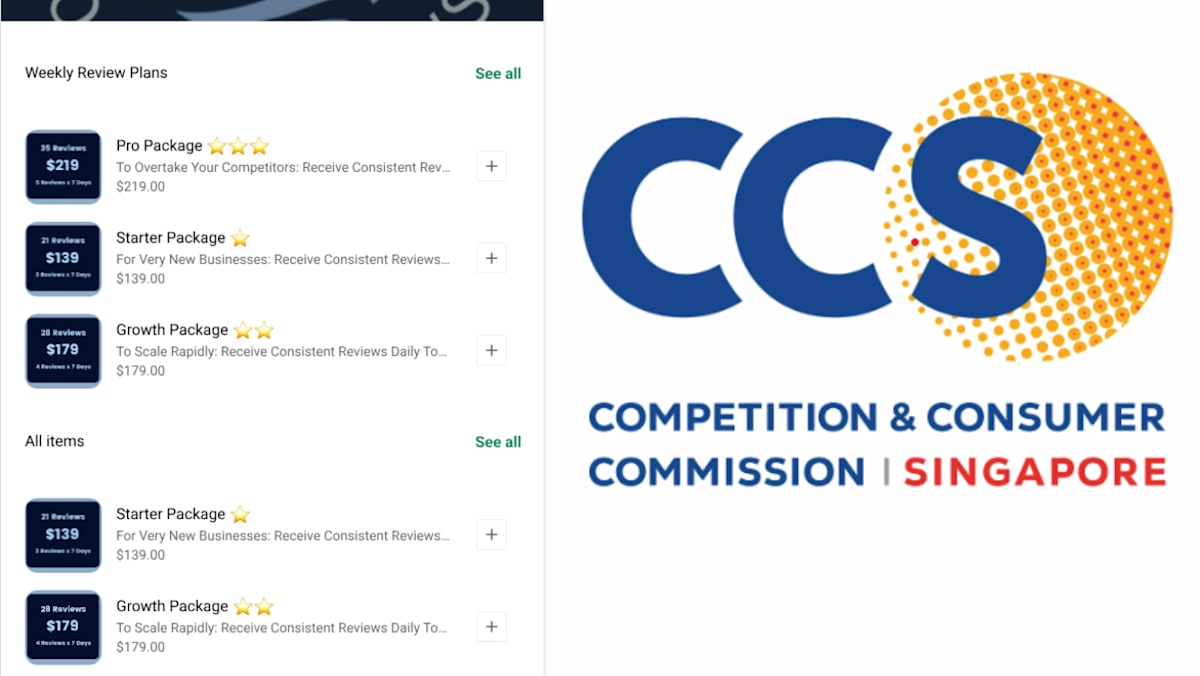
In the first phase of the investigation, 45 businesses that admitted to purchasing bogus reviews from the sole director of digital marketing firm Reputifly will have to apologise publicly and commit to removing such reviews.
The businesses that bought fake reviews range from restaurants to doctors and lawyers. (Images: Competition and Consumer Commission of Singapore)
This audio is generated by an AI tool.
SINGAPORE: Ranging from restaurants to hair salons, 45 businesses will be required to apologise publicly after admitting to purchasing bogus reviews from a supplier to boost their online ratings, Singapore’s consumer watchdog said on Wednesday (Sep 30).
These companies have committed to stop using fake reviews, and will be required to remove existing ones and report their progress in doing so, along with other measures, the Competition and Consumer Commission of Singapore (CCS) said.
These 45 companies are part of a larger group of around 100 businesses caught up in the competition watchdog’s investigation.
Calling the probe its largest one concerning fake reviews to date, CCS said these businesses were found to have bought fabricated reviews from Mr Julian Tung Yan Kai, who is the director of digital marketing firm Reputifly.
CNA Games Guess Word Crack the word, one row at a time Buzzword Create words using the given letters Mini Sudoku Tiny puzzle, mighty brain teaser Mini Crossword Small grid, big challenge Word Search Spot as many words as you can Show More Show Less Mr Tung also owns and operates BuyReviewSG and GetReviewSG, which offered fake review services to businesses. The fabricated reviews were posted on platforms such as Google, Facebook, Tripadvisor, Carousell, Yelp and Trustpilot, said the commission. Given the scale of the case, CCS is conducting its investigation in two phases. The first phase covered 47 of these companies, 45 of which admitted that they had purchased fake reviews from Reputifly. The remaining two declined to provide undertakings to the commission.
Mr Tung also owns and operates BuyReviewSG and GetReviewSG, which offered fake review services to businesses.
The fabricated reviews were posted on platforms such as Google, Facebook, Tripadvisor, Carousell, Yelp and Trustpilot, said the commission.
Given the scale of the case, CCS is conducting its investigation in two phases.
The first phase covered 47 of these companies, 45 of which admitted that they had purchased fake reviews from Reputifly. The remaining two declined to provide undertakings to the commission.
Companies that have purchased fake reviews
Apax Medical Kovan Pte Ltd
Apax Medical Pte Ltd
Atop Aesthetic Pte Ltd
Bavarian Capital Pte Ltd
BrandLoom Digital Private Limited
Certified Translation Services
Chrysalis Spa Pte Ltd
Dots 'n' Tots Interior Pte Ltd
FAS Auto Services Pte Ltd
First Security & Private Investigation (S) Pte Ltd
For the Love of Laundry Pte Ltd
Forest Darts Bishan Pte Ltd
Groupasia Hospitality Pte Ltd
Harmony Essentials Pte Ltd
Harmony Funeral Care Pte Ltd
Haven Enterprises Pte Ltd
Integral Facilities Management (IFM) Pte Ltd
J & S Management Pte Ltd
Kuisine Koncepts Pte Ltd
L E Autoshop Pte Ltd
Label-Line Corporation Pte Ltd
Le Wave Art of Hair Pte Ltd
Le Wave Hair Pte Ltd
Le Wave Hair Studio Pte Ltd
Martin Luxury Pte Ltd
MB Karaoke Solution Pte Ltd
Nails In Dulge Pte Ltd
Picasso Hair Boutique Pte Ltd
Play! Tennis Now LLP
Print Scream Pte Ltd
Sanook Group Pte Ltd
SBLab Beauty Pte Ltd
The Hamper Story Pte Ltd
TM Designers Pte Ltd
Torio Japanese Restaurant Pte Ltd
TT8 Logistics Pte Ltd
UniWise Admissions Consulting Pte Ltd
Yeo & Associates LLC
The second phase of the investigation will extend beyond the remaining businesses to include other companies that may have procured fake reviews from the provider, CCS said.
“They are not limited to any particular sector,” said Mr Kho Qin Yao, director of fair trading practices at CCS, in an exclusive interview with CNA.
“They range from doctors, lawyers, tuition agencies, restaurants,” said Mr Kho, who served as the supervising director of the investigation team.
The issue of phony online reviews in Singapore has been a longstanding one, with CCS first taking action against a furniture retailer in 2024.
On Tuesday, CNA reported that listings on Carousell are looking for people to post fake reviews or offering to post false endorsements for between S$1 (US$0.78) and S$5 on platforms like Google Maps to boost their online profile.
Under the Consumer Protection (Fair Trading) Act, it is an unfair trade practice for businesses to post false reviews to deceive or mislead a consumer.
If a court finds that a supplier has engaged in an unfair practice, it can order restitution or award the consumer damages, among other consequences.
Mr Kho Qin Yao, director of fair trading practices at CCS, was supervising director of the investigation team that looked into the fake reviews provider. (Photo: CNA/Raydza Rahman)
In its statement on Wednesday, CCS called on other fake review providers and businesses who have used such services to come forward voluntarily.
“Those who do so before CCS commences formal investigations against them will have their cooperation viewed favourably,” the commission said in a statement, adding that they may provide information at https://go.gov.sg/ccsresponse.
The 45 companies that have already admitted wrongdoing and made undertakings to CCS have promised to stop using fake reviews.
They must also identify and remove fake reviews relating to their businesses, report their progress to CCS, strengthen their compliance measures and post a public apology.
The apology must be prominent and maintained for six months on their websites, official social media accounts and at their physical premises or outlets.
The provider, Reputifly, has admitted to aiding and abetting unfair trade practices. It has also committed to stop offering fake review services, issue a public apology on its website for six months, and donate proceeds from its fake review service to a registered charity.
Reputifly will not claim any tax deductions arising from the donation to an institution of a public character.
If there is evidence that unfair practices have continued, CCS will not hesitate to take appropriate enforcement actions, including applying to court for an injunction order against such businesses, said Mr Kho.
For the two businesses that declined to provide undertakings, CCS said investigations will continue and firmer enforcement action will be taken if the facts support the case. The commission did not identify these two companies.
HOW REPUTIFLY PROVIDED FAKE REVIEW SERVICES
Reputifly is a digital marketing business that specialises in web design, search engine optimisation and paid advertisement management.
But Mr Tung also offered fake review services as an “add on”, said Mr Kho. That started sometime in or before 2023, CCS said.
The two websites, BuyReviewSG and GetReviewSG, facilitated the posting of these reviews on online platforms.
Companies could purchase packages from these sites, which later posted fake reviews at periodic intervals. For example, BuyReviewSG offered 35 five-star reviews over seven days for S$219, and promoted its ability to help companies overtake their competitors.
BuyReviewSG offered several fake review packages for businesses to choose from. (Image: Competition and Consumer Commission of Singapore)
BuyReviewSG also developed a review rating calculator for companies to determine how many five-star reviews they would need to reach their desired rating.
Reputifly’s terms and conditions stated that if reviews were removed by Google, the provider would replace up to 30 per cent of the reviews purchased.
After a company bought fake reviews, the provider would use generative artificial intelligence to create reviews “designed to resemble genuine customer experiences”, said CCS.
Generative AI was used to vary writing styles and sentence structures, include the Singapore context and introduce natural imperfections. Clients could edit the reviews before they were published.
The fake review provider later came up with a dashboard that generated, managed and tracked fake reviews. It drew from existing four- and five-star Google reviews to generate new reviews containing relevant details.
“Some fake reviews deliberately described initial reservations before recounting a positive experience, creating an illusion of authenticity,” added CCS.
The advent of AI has certainly made it easier for people to generate fake reviews, said Mr Kho.
The provider used Telegram accounts and channels to recruit people to post the fake reviews, offering payment to people willing to use their accounts to post the fabricated endorsements.
INVESTIGATING THE FAKE REVIEWS
Mr Kho said CCS usually begins investigations if it has reasonable grounds to believe that suppliers have engaged in unfair practices.
These can be because of complaints or from CCS’s horizon scanning to look for leads and actionable intel.
“For this particular case, it was a mix of both.”
After discovering the Telegram channels and websites, CCS was able to quickly identify the main operator behind them, said Mr Kho.
He said under the Consumer Protection (Fair Trading) Act, CCS has the power to compel the production of documents.
“We approached him, and we managed to get the information that we need from him, and more critically, we managed to get hold of his database,” he said.
CCS investigation officer Track Tan and CCS director Kho Qin Yao were involved in the investigation into fake reviews. (Photo: CNA/Raydza Rahman)
Mr Kho said businesses that buy fake reviews are in the minority, and that is why CCS is taking action.
“We do not want businesses to then feel forced to compete in such things by either engaging in unfair practices or posting fake reviews in order to keep up with those that have been doing so,” he said.
Besides fake review suppliers and businesses, Mr Kho said consumers also play an important role in ensuring the reviews they write and post are genuine, and reflect their own personal experiences.
If approached to post a fake review for a fee, consumers should not participate because they would be “poisoning the ecosystem”, he said.
CCS chief executive Alvin Koh said consumers increasingly rely on online reviews. Fake reviews deceive them, distort competition and disadvantage businesses that compete honestly, he said.
“Businesses should be under no illusion that paying for fake reviews is acceptable. Nor is it acceptable to profit from facilitating the creation or purchase of fake reviews; fake reviews are not a legitimate business,” he said.
“CCS will pursue not only those who buy them, but also those who profit from supplying them,” Mr Koh added.
Get our pick of top stories and thought-provoking articles in your inbox
Stay updated with notifications for breaking news and our best stories
Join our channel for the top reads for the day on your preferred chat app
在调查的第一阶段,45 家承认从数字营销公司 Reputifly 的唯一董事那里购买虚假评论的企业将不得不公开道歉,并承诺删除这些评论。
购买虚假评论的商家涵盖了从餐馆到医生、律师等各个领域。(图片来源:新加坡竞争与消费者委员会)
这段音频是由人工智能工具生成的。
新加坡:新加坡消费者监管机构周三(9月30日)表示,从餐馆到美发沙龙等45家企业将被要求公开道歉,此前这些企业承认从供应商处购买虚假评论以提高其在线评分。
新加坡竞争与消费者委员会(CCS)表示,这些公司已承诺停止使用虚假评论,并将被要求删除现有的虚假评论,并报告其在这方面的进展情况,以及其他措施。
这 45 家公司是大约 100 家卷入竞争监管机构调查的企业的一部分。
CCS称此次调查是迄今为止针对虚假评论的最大规模调查,并表示发现这些企业从数字营销公司Reputifly的董事Julian Tung Yan Kai先生那里购买了捏造的评论。
CNA游戏 猜词游戏 逐行破解单词 流行词游戏 用给定的字母组成单词 迷你数独 小谜题,脑力挑战 迷你填字游戏 小方格,大挑战 单词搜索 尽可能多地找出单词 显示更多 显示更少 董先生还拥有并运营BuyReviewSG和GetReviewSG,这两家公司向企业提供虚假评论服务。委员会表示,这些虚假评论被发布在Google、Facebook、Tripadvisor、Carousell、Yelp和Trustpilot等平台上。鉴于案件规模,CCS正在分两个阶段进行调查。第一阶段涵盖了其中47家公司,其中45家承认从Reputifly购买了虚假评论。其余两家拒绝向委员会作出承诺。
董先生还拥有并经营 BuyReviewSG 和 GetReviewSG,这两家公司向企业提供虚假评论服务。
委员会表示,这些捏造的评论被发布在谷歌、Facebook、Tripadvisor、Carousell、Yelp 和 Trustpilot 等平台上。
鉴于案件规模,CCS分两个阶段进行调查。
第一阶段调查涵盖了47家公司,其中45家承认从Reputifly购买了虚假评论。其余两家拒绝向委员会作出承诺。
购买虚假评论的公司
Apax Medical Kovan Pte Ltd
Apax Medical Pte Ltd
Atop Aesthetic Pte Ltd
巴伐利亚资本私人有限公司
BrandLoom Digital Private Limited
认证翻译服务
Chrysalis Spa Pte Ltd
Dots 'n' Tots Interior Pte Ltd
FAS汽车服务私人有限公司
第一安保与私人调查(新加坡)私人有限公司
For the Love of Laundry Pte Ltd
森林飞镖碧山私人有限公司
Groupasia Hospitality Pte Ltd
Harmony Essentials Pte Ltd
和谐殡葬服务私人有限公司
Haven Enterprises Pte Ltd
综合设施管理(IFM)私人有限公司
J & S 管理私人有限公司
Kuisine Koncepts Pte Ltd
LE Autoshop Pte Ltd
标签线有限公司
Le Wave Art of Hair Pte Ltd
Le Wave Hair Pte Ltd
Le Wave Hair Studio Pte Ltd
马丁豪华私人有限公司
MB 卡拉OK解决方案私人有限公司
Nails In Dulge Pte Ltd
毕加索美发精品私人有限公司
玩!网球现在有限责任合伙公司
Print Scream Pte Ltd
Sanook集团私人有限公司
SBLab Beauty Pte Ltd
The Hamper Story Pte Ltd
TM Designers Pte Ltd
Torio Japanese Restaurant Pte Ltd
TT8物流私人有限公司
UniWise招生咨询私人有限公司
Yeo & Associates LLC
CCS表示,第二阶段的调查范围将从剩余的企业扩展到其他可能从该提供商处购买虚假评论的公司。
“它们并不局限于任何特定行业,”中国消费者协会(CCS)公平交易实践总监许勤尧先生在接受亚洲新闻台(CNA)独家采访时表示。
“涉案人员包括医生、律师、补习机构、餐馆等等,”担任调查组主管的许先生说道。
新加坡的虚假网络评论问题由来已久,消费者保护局 (CCS) 于 2024 年首次对一家家具零售商采取行动。
周二,CNA报道称,Carousell上的商家正在寻找人发布虚假评论或在谷歌地图等平台上发布虚假推荐,费用在1新元(0.78美元)到5新元之间,以提升其在线知名度。
根据《消费者保护(公平交易)法》,商家发布虚假评论以欺骗或误导消费者属于不正当交易行为。
如果法院认定供应商存在不公平竞争行为,除其他后果外,还可以责令供应商赔偿损失或向消费者支付赔偿金。
中央证券存管局公平交易事务主管许勤尧先生是负责调查虚假评论提供商的调查小组的负责人。(图片:CNA/Raydza Rahman)
CCS在周三的声明中呼吁其他虚假评论提供商和使用过此类服务的企业主动站出来。
“在CCS对其展开正式调查之前提供信息的人,其合作将被视为有利,”该委员会在一份声明中表示,并补充说,他们可以通过https://go.gov.sg/ccsresponse提供信息。
已承认存在不当行为并向中国消费者保护委员会(CCS)作出承诺的45家公司承诺停止使用虚假评论。
他们还必须识别并删除与其业务相关的虚假评论,向CCS报告进展情况,加强合规措施,并公开道歉。
道歉声明必须醒目地在其网站、官方社交媒体账号以及实体店面或销售点保留六个月。
该服务提供商Reputifly已承认协助和教唆不正当交易行为。该公司还承诺停止提供虚假评论服务,在其网站上发布为期六个月的公开道歉声明,并将虚假评论服务所得收益捐赠给一家注册慈善机构。
Reputifly 不会就向公共机构的捐款申请任何税收减免。
科先生表示,如果有证据表明不公平做法仍在继续,CCS将毫不犹豫地采取适当的执法行动,包括向法院申请对这些企业发出禁令。
对于拒绝提供承诺书的两家企业,CCS表示调查将继续进行,如果事实属实,将采取更严厉的执法行动。委员会没有透露这两家公司的名称。
REPUTIFLY 如何提供虚假评论服务
Reputifly 是一家数字营销公司,专门从事网站设计、搜索引擎优化和付费广告管理。
但据Kho先生称,董先生还提供虚假评论服务作为一项“附加服务”。CCS表示,这项服务始于2023年或之前。
BuyReviewSG 和 GetReviewSG 这两个网站为将这些评论发布到在线平台提供了便利。
企业可以从这些网站购买套餐,这些网站随后会定期发布虚假评论。例如,BuyReviewSG 提供七天内 35 条五星好评的套餐,价格为 219 新元,并宣称其能够帮助企业超越竞争对手。
BuyReviewSG 为企业提供多种虚假评论套餐供其选择。(图片:新加坡竞争与消费者委员会)
BuyReviewSG 还开发了一款评论评分计算器,供企业确定需要多少个五星好评才能达到理想的评分。
Reputifly 的条款和条件规定,如果 Google 删除评论,服务提供商将替换最多 30% 的已购买评论。
CCS表示,在一家公司购买虚假评论后,服务提供商会使用生成式人工智能来创建“旨在模仿真实客户体验”的评论。
生成式人工智能被用于改变写作风格和句式结构,融入新加坡语境,并引入自然的瑕疵。客户可以在评论发布前进行编辑。
这家虚假评论提供商后来开发了一个控制面板,用于生成、管理和追踪虚假评论。它利用现有的四星和五星谷歌评论,生成包含相关细节的新评论。
CCS补充道:“有些虚假评论故意描述最初的保留意见,然后再讲述积极的体验,从而营造出真实性的假象。”
Kho先生表示,人工智能的出现无疑使人们更容易生成虚假评论。
该服务提供商利用 Telegram 帐户和频道招募人员发布虚假评论,并向愿意使用其帐户发布捏造的推荐的人支付报酬。
调查虚假评论
Kho先生表示,如果CCS有合理理由相信供应商存在不公平行为,通常会展开调查。
这可能是由于投诉,也可能是 CCS 进行前瞻性调查以寻找线索和可操作情报的结果。
“就这个具体案例而言,两者兼而有之。”
Kho先生表示,在发现这些Telegram频道和网站后,CCS能够迅速识别出其背后的主要运营者。
他表示,根据《消费者保护(公平交易)法》,消费者委员会(CCS)有权强制要求出示文件。
他说:“我们联系了他,并设法从他那里获得了我们需要的信息,更重要的是,我们设法获得了他的数据库。”
中央调查局调查员陈卓和局长郭勤尧参与了虚假评论的调查。(图片:CNA/Raydza Rahman)
Kho先生表示,购买虚假评论的商家只占少数,这也是CCS采取行动的原因。
他说:“我们不希望企业因此被迫参与此类竞争,要么采取不正当手段,要么发布虚假评论,以跟上那些一直在这样做的企业。”
Kho先生表示,除了虚假评论提供商和企业外,消费者在确保他们撰写和发布的评论真实可靠,并反映他们自己的个人经历方面也发挥着重要作用。
他说,如果有人付钱让消费者发布虚假评论,消费者不应该参与,因为这会“毒害生态系统”。
CCS首席执行官许文杰表示,消费者越来越依赖网络评论。他指出,虚假评论会欺骗消费者,扭曲竞争,并使那些诚实竞争的企业处于不利地位。
“企业不应抱有任何幻想,认为花钱购买虚假评论是可以接受的。通过促成虚假评论的生成或购买来牟利也是不可接受的;虚假评论并非合法的商业行为,”他说道。
Koh先生补充说:“CCS不仅会追究购买这些毒品的人的责任,还会追究那些从供应这些毒品中获利的人的责任。”
订阅我们的邮件,即可获取精选热点新闻和引人深思的文章。
订阅通知,第一时间获取突发新闻和精彩报道。
加入我们的频道,即可在您常用的聊天应用上获取当日热门文章。