Reported cases of healthcare worker abuse almost double in 2 years; reflects growing awareness两年内,医护人员虐待案件的报告数量几乎翻了一番;这反映出人们的意识正在不断增强。
Abuse and harassment cases against healthcare workers in Singapore nearly doubled, prompting new frameworks and training to improve safety and support. Read more at straitstimes.com.
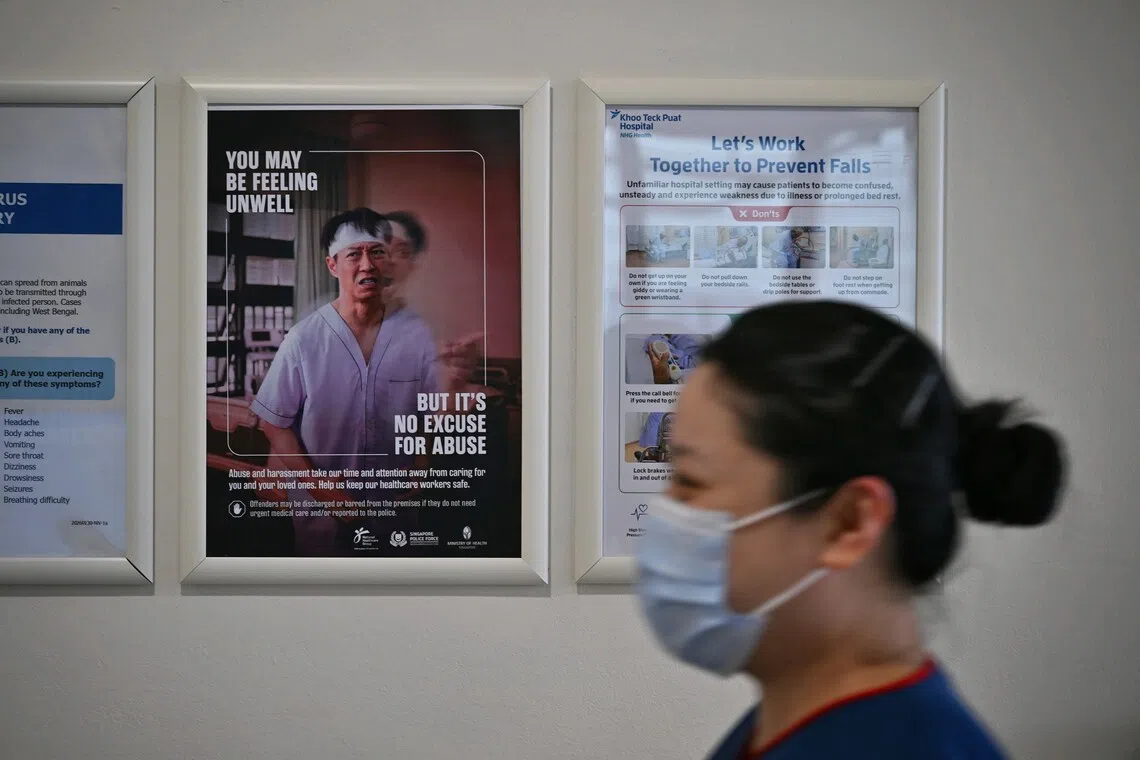
In 2025, the total number of abuse and harassment cases reported in the public healthcare sector rose to 4,200, up from 2,200 in 2023.
ST PHOTO: ARIFFIN JAMAR
Published Sep 30, 2026, 02:00 PM
Updated Sep 30, 2026, 02:00 PM
Cases of abuse and harassment against healthcare workers in Singapore's public healthcare sector nearly doubled from 2,200 in 2023 to 4,200 in 2025, with a fraction of cases reported to the Police.
A tripartite framework was launched in 2023 to define abuse, classify severity, and guide actions, leading to staff protection measures and training in de-escalation and self-defence.
Surveys show over 90% of healthcare workers feel supported in reporting abuse, and ongoing efforts aim to sustain a safe, respectful environment for all healthcare staff and patients.
SINGAPORE - Abuse and harassment cases reported in the public healthcare sector have nearly doubled over two years. Serious cases reported to the police accounted for 13% of them .
This reflects a growing awareness of unacceptable behaviour, and greater confidence among healthcare workers to speak up and take action, said Minister of State for Health Rahayu Mahzam, adviser of the tripartite workgroup for the prevention of abuse and harassment of healthcare workers.
In 2025, the total number of such reports in public healthcare institutions (PHIs) rose to 4,200, up from 2,200 in 2023. A total of 550 (about 13%) were reported to the police, compared to 350 (16%) in 2023, said Rahayu, in launching the workgroup’s final report on Sept 30.
“Everyone has a part to play in enabling safety and security... Healthcare work will sometimes involve difficult conversations, particularly when patients or caregivers are anxious or frustrated. However, abuse and harassment must never be accepted as an inevitable part of the job,” she said.
She was speaking at the annual safety and security week event organised by Khoo Teck Puat Hospital (KTPH) and Yishun Community Hospital.
The report marked the official conclusion of the workgroup’s term. It was set up in 2022 to spearhead a coordinated national effort to prevent abuse and harassment, at a time when more than two in three healthcare workers said they had witnessed or personally experienced it in the previous year.
Among its contributions, the workgroup laid out a common definition of abuse and harassment, and a consistent set of standards to safeguard healthcare workers. So long as t he worker felt intimidated, alarmed, or distressed, or that the words, actions or behaviours impeded their work, such behaviour constituted abuse and harassment.
It set out a severity classification of different incidents, and corresponding recommended actions.
In addition, abusive patients could also be asked to leave the hospital if deemed medically fit for discharge.
On their end, institutions implemented measures such as dedicated staff protection functions, including appointing chief wellness officers.
Highlighting one example of abuse, KTPH told ST that it had an “overstayer couple” who refused to be discharged because they were estranged with their daughter.
The husband in his 60s and the wife in her 50s both had several underlying medical conditions, and had multiple admissions to KTPH over several weeks.
Its nursing and medical staff were verbally abused by the wife during the course of her care, said the hospital. The woman also insisted on taking videos of the staff without consent, despite repeated reminders that this was not allowed.
On top of this, the couple demanded to leave the hospital during the day to run errands, returning to the wards only in the evening.
KTPH eventually discharged them both as they were assessed to be well enough.
Acknowledging that patients and caregivers may feel distressed or could be unhappy for various reasons, Chua Hong Choon, chief executive of KTPH and Yishun Community Hospital reiterated the need for respectful communications.
“When you act in an abusive way, it actually prevents us from helping you... There is a much better way of dealing with it, so help us to help you, and help us to hear you,” said Chua.
The tripartite framework was first implemented in the public healthcare sector, and subsequently in the community care sector through an implementation guide launched in May 2025 .
Rahayu said employers of more than 60 per cent of the community care workforce have come on board and incorporated the recommendations into their processes.
In total, more than 6,000 healthcare workers in PHIs and the community care sector have since been trained in advanced de-escalation and self-defence techniques .
Basic training is provided to all frontline staff and continues to be part of the onboarding process for new healthcare workers.
Rahayu also encouraged other healthcare providers such as private general practitioners and clinics to consider the workgroup’s recommendations to support their staff against abuse and harassment.
She said the group’s efforts will continue through a community of practice which brings together healthcare providers and partners to exchange ideas, share best practices, and co-create solutions.
Much progress had been achieved according to the workgroup’s report, including “a meaningful shift in how healthcare workers experience their workplaces”.
In 2025, the workgroup conducted a survey which found that more than 90% of PHI workers felt that their institutions encouraged the reporting of abuse and harassment incidents, and supported a safe and respectful work environment.
In addition, 86% of members of the public said they would consider stepping in if they witnessed abusive or harassing behaviour against a healthcare worker.
Nine in ten respondents felt that everyone has a part to play in preventing abuse and harassment; and almost all agreed that more should be done to protect healthcare workers from abuse and harassment.
The report also pointed out that sustaining the progress achieved will require the continued efforts of healthcare institutions, healthcare workers, patients, caregivers and the wider society.
“Together, we can continue to make our hospitals safe and secure, where every patient is cared for, and every healthcare worker feels protected, respected and empowered,” said Rahayu.
2025 年,公共医疗保健部门报告的虐待和骚扰案件总数上升至 4200 起,高于 2023 年的 2200 起。
圣路易斯照片:阿里芬·贾马尔
发布于2026年9月30日下午2:00
更新于2026年9月30日下午2:00
新加坡公共医疗保健部门医护人员遭受虐待和骚扰的案件数量从 2023 年的 2200 起几乎翻了一番,到 2025 年达到 4200 起,但只有一小部分案件向警方报案。
2023 年启动了一个三方框架,用于定义虐待、对虐待的严重程度进行分类并指导行动,从而制定员工保护措施以及降级和自卫方面的培训。
调查显示,超过 90% 的医护人员在举报虐待行为时感到受到支持,并且正在进行的努力旨在为所有医护人员和患者维持一个安全、尊重的环境。
新加坡——过去两年里,公共医疗部门报告的虐待和骚扰案件数量几乎翻了一番。向警方报案的严重案件占其中的13%。
卫生部国务部长拉哈尤·马赫扎姆(Rahayu Mahzam)是防止医护人员遭受虐待和骚扰的三方工作组顾问,他表示,这反映出人们对不可接受的行为的认识不断提高,医护人员也更有信心发声并采取行动。
拉哈尤在9月30日发布工作组最终报告时表示,2025年,公共医疗机构(PHI)此类报告的总数上升至4200起,高于2023年的2200起。其中550起(约占13%)已向警方报案,而2023年这一比例为350起(16%)。
“每个人都应为保障安全尽一份力……医疗工作有时会涉及艰难的对话,尤其是在患者或护理人员焦虑或沮丧的时候。然而,虐待和骚扰绝不能被视为工作中不可避免的一部分,”她说道。
她是在邱德拔医院(KTPH)和义顺社区医院联合举办的年度安全周活动上发表讲话的。
该报告标志着工作组任期的正式结束。该工作组成立于2022年,旨在牵头开展一项协调一致的全国性行动,以防止虐待和骚扰。当时,超过三分之二的医护人员表示,他们在过去一年中目睹或亲身经历过此类事件。
该工作组的贡献之一是制定了虐待和骚扰的共同定义,以及一套保障医护人员权益的统一标准。只要医护人员感到受到恐吓、惊吓或痛苦,或者言语、行为或举止妨碍了他们的工作,这种行为就构成虐待和骚扰。
它对不同事件的严重程度进行了分类,并提出了相应的建议措施。
此外,如果患者因身体状况适合出院,有辱骂行为的患者也可能被要求离开医院。
各机构方面则采取了诸如设立专门的员工保护职能部门等措施,包括任命首席健康官。
KTPH 向《海峡时报》举例说明了一起虐待事件,称有一对“逾期居留的夫妇”拒绝出院,因为他们与女儿关系疏远。
丈夫六十多岁,妻子五十多岁,两人都有多种基础疾病,在几周内多次入院接受治疗。
医院方面表示,这名女子在接受治疗期间曾对医护人员进行言语辱骂。尽管医护人员多次告知禁止拍摄,该女子仍坚持未经同意拍摄医护人员的视频。
除此之外,这对夫妇还要求白天离开医院去办事,只有晚上才能返回病房。
KTPH最终让他们两人出院,因为评估认为他们身体状况良好。
鉴于患者和护理人员可能因各种原因感到痛苦或不快,KTPH 和义顺社区医院首席执行官蔡鸿春重申了尊重沟通的必要性。
“当你以辱骂的方式行事时,实际上会妨碍我们帮助你……有更好的处理方式,所以请帮助我们帮助你,也请帮助我们倾听你,”蔡女士说。
三方框架首先在公共医疗保健部门实施,随后通过 2025 年 5 月发布的实施指南在社区护理部门实施。
拉哈尤表示,超过 60% 的社区护理人员的雇主已经接受这些建议,并将这些建议纳入到他们的工作流程中。
迄今为止,已有超过 6,000 名公共卫生机构和社区护理部门的医护人员接受了高级降级和自卫技巧的培训。
所有一线员工均接受基础培训,并且基础培训仍然是新医护人员入职培训的一部分。
Rahayu 还鼓励其他医疗保健提供者,如私人全科医生和诊所,考虑工作组的建议,以支持其员工免受虐待和骚扰。
她表示,该组织将继续通过实践社区开展工作,该社区汇集医疗保健提供者和合作伙伴,以交流想法、分享最佳实践并共同创造解决方案。
根据工作组的报告,已经取得了许多进展,包括“医护人员的工作场所体验发生了有意义的转变”。
2025 年,该工作组进行了一项调查,结果发现超过 90% 的 PHI 工作人员认为他们的机构鼓励举报虐待和骚扰事件,并支持安全和尊重的工作环境。
此外,86%的公众表示,如果他们目睹对医护人员的辱骂或骚扰行为,他们会考虑介入。
十分之九的受访者认为,每个人都应该为防止虐待和骚扰尽一份力;几乎所有人都同意应该采取更多措施来保护医护人员免受虐待和骚扰。
报告还指出,要保持已取得的进展,需要医疗机构、医护人员、患者、护理人员和整个社会的持续努力。
“我们齐心协力,就能继续让我们的医院安全可靠,让每一位患者都得到照顾,让每一位医护人员都感到受到保护、尊重和赋能,”拉哈尤说道。