Investing in the future of health: Singapore’s growing longevity sector投资健康未来:新加坡蓬勃发展的长寿产业
Explore Singapore’s growing longevity market offering advanced biological age testing and personalised interventions to promote healthy ageing and extend healthspan. Read more at straitstimes.com.
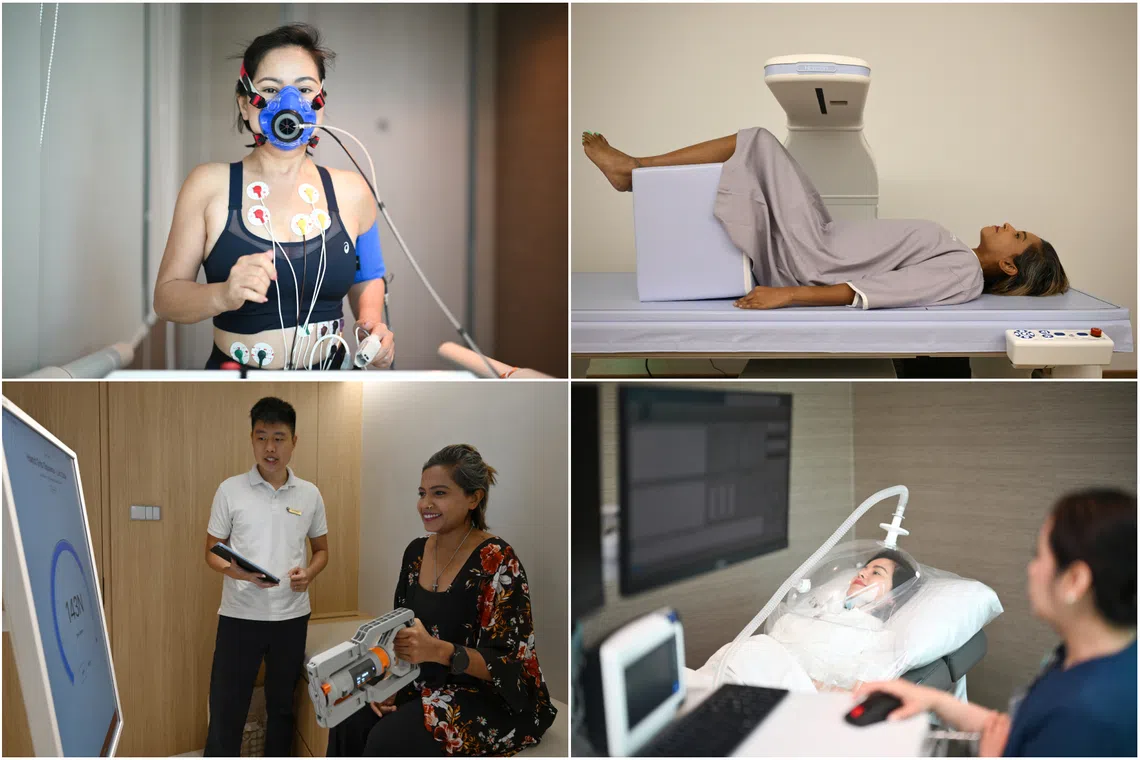
Private healthcare groups and commercial players are racing to offer biological age testing, precision diagnostics, and personalised lifestyle interventions.
ST PHOTOS: LIM YAOHUI, NG SOR LUAN
Published Sep 05, 2026, 05:00 AM
Updated Sep 05, 2026, 05:00 AM
Singapore’s Healthy Longevity Research Clinic uses advanced diagnostics and personalised lifestyle plans to manage ageing as a condition, aiming to delay health decline.
Private healthcare and wellness providers are rapidly expanding longevity services, offering biological age testing and precision diagnostics to meet growing demand.
Clinical trials show participants can reverse biological age and improve fitness through sustainable habits like balanced exercise, nutrition, and stress management, emphasising behaviour change over quick fixes.
SINGAPORE – At 72, Ivan Low boasts a grip strength of 47kg, a physical milestone that outperforms many men decades younger.
But when he first joined Alexandra Hospital’s (AH) one-year healthy longevity programme at age 71, the home gym enthusiast was surprised to learn that lifting weights wasn’t enough to safeguard his health.
Low then added spinning, or indoor cycling, to his exercise routine. A food lover, he also started to watch his diet more closely. He now eats more vegetables and fruits, and has cut down on desserts and snacking on potato chips in front of the TV.
Having entered the trial at 71 with a biological age of 67, Low managed to shaved off another two years to reach 65 by the time his chronological age hit 72.
Biological age looks at how much damage has happened to the body’s cells over the years. This damage occurs naturally with age, and is affected by a person’s genes, habits and physical environment.
Ivan Low preparing for a bioelectrical impedance analysis test, administered by senior staff nurse Eswari Sundrasagaran at Alexandra Hospital on April 28. ST PHOTO: JASON QUAH
Ivan Low preparing for a bioelectrical impedance analysis test, administered by senior staff nurse Eswari Sundrasagaran at Alexandra Hospital on April 28.
ST PHOTO: JASON QUAH
More than chronological age, biological age reflects a person’s overall health and potential longevity, with an older biological age linked to earlier development of chronic diseases from dementia to diabetes.
Low’s experience reflects a paradigm shift anchored by AH’s clinical trials: healthy longevity medicine grounded in geroscience – the interdisciplinary field that studies the biological mechanisms of ageing. This emerging discipline treats ageing as a manageable condition.
Clinicians aim to delay age-related decline by using advanced diagnostics such as biological age monitoring, microbiome analysis – which evaluates the gut’s microorganisms to assess metabolic health, immunity, and inflammation; functional measures such as cardiorespiratory fitness tests, and more. This is coupled with personalised lifestyle interventions such as targeted exercise regimes.
Private healthcare players enter longevity space
What began as a public research initiative at AH, which opened its clinic in 2023, has expanded into a broader healthcare boom across Singapore.
Driven by the nation’s shift from sick care to preventive care and backed by rising affluence, private healthcare groups and commercial players are racing to offer biological age testing, precision diagnostics, and personalised lifestyle interventions.
In early 2026, Raffles Medical Group, for one, launched a healthy longevity clinic, led by a resident family physician, and supported by a psychologist and a Traditional Chinese medicine (TCM) physician.
In July, IHH Healthcare introduced Healthspan, offering biological age testing across its Parkway Shenton clinics and advanced longevity evaluations at its executive screening centres.
Other non-medical players also entered the fray. Morrow Medical, part of wellness venture Morrow, founded by entrepreneur Allen Law opened officially in August, offering preventative screenings, while premium fitness outfit Tsquared Lab opened a longevity clinic Tsquared Health at the start of the year.
Some existing GP clinics have also started to offer biological age testing and longevity programmes on top of their traditional offerings.
For some Singaporeans, the appeal of such testing lies in knowing themselves better, inside and out. Lee Siu Yin, 73, a senior nurse mentor at AH who already exercised regularly and ate well, paid for the hospital’s longevity programme to see if her efforts were paying off.
“I would rather have quality of life than to live longer (in poor health),” Lee said. “I wanted to know: Am I ageing faster or slower?”
Lee Siu Yin and Ivan Low participated in Alexandra Hospital’s one-year healthy longevity programme. ST PHOTO: JASON QUAH
Lee Siu Yin and Ivan Low participated in Alexandra Hospital’s one-year healthy longevity programme.
How longevity testing works
Unlike standard screening tests like mammograms and stool tests which are done to exclude diseases, longevity diagnostics focus on biological ageing, organ system health, and functional resilience (the body’s ability to withstand, adapt to, and recover from physical stress or illness). Their primary purpose is not to rule out medical conditions but to guide preventive interventions.
The main draw for clients is often biological age testing, which estimates how fast their cells and organ systems are ageing compared with their calendar (chronological) age.
IHH Healthcare offers AgeQ, an advanced test developed by precision health company Lucence alongside the National University of Singapore (NUS) and A*STAR.
With it, researchers have condensed a massive library of ageing data into a streamlined panel of seven key blood biomarkers, which gives clients a fast, affordable, and easy-to-understand lifestyle score. This makes it popular with GP clinics.
Morrow’s longevity clinic offers the Dexa scan test, which is considered the gold standard in medical and fitness communities for measuring bone mineral density and body composition. ST PHOTO: NG SOR LUAN
Morrow’s longevity clinic offers the Dexa scan test, which is considered the gold standard in medical and fitness communities for measuring bone mineral density and body composition.
ST PHOTO: NG SOR LUAN
The seven blood biomarkers measure core body functions, including inflammation, metabolic health, kidney and liver health and lipid profiles, to estimate how fast you’re ageing, without needing a long list of tests.
Raffles Medical Group, meanwhile, targets clients looking for a deep-dive data audit. They utilise a test built on the LinAge2 biological age clock from NUS researchers, which analyses 60 parameters, including blood and urine tests, physical measurements and questionnaire data to highlight body systems which are at risk of ageing faster than expected.
This guides the physician on the next step, be it advanced assessments or personalised lifestyle interventions.
Not all clinics offer biological age testing. Indeed, there is no standard way of measuring it yet.
Depending on budget and which clinic you go to, longevity packages may include advanced metabolic evaluations, physical function tests such as the V02 max and the Dexa scan to assess bone strength, genomic testing or cognitive screening and more, to build a more detailed health profile.
Assessments like the HOMA-IR test can detect early insulin resistance before blood sugar levels rise while VO2 max testing evaluates your body’s capacity to deliver and utilise oxygen during high-intensity effort and is a key metric given that higher aerobic fitness directly predicts a longer lifespan.
VO2 Max assessment measures the maximum amount of oxygen the body can use per minute, reflecting the combined capacity of the heart, lungs and muscles. ST PHOTO: LIM YAOHUI
VO2 Max assessment measures the maximum amount of oxygen the body can use per minute, reflecting the combined capacity of the heart, lungs and muscles.
ST PHOTO: LIM YAOHUI
Similarly, the Dexa scan, which assesses bone density and body composition, helps to identify hidden visceral fat and conditions like early bone loss or osteoporosis.
Longevity screening can cost around $108 for an AgeQ test, or as much as $20,000 or more for comprehensive evaluations.
Going beyond the hype
As commercial interest grows, so does the hype. Although certain dedicated wellness centres and longevity clinics offer non-medical interventions, such as infrared light and hyperbaric oxygen therapies – which claim to slow or reverse cellular ageing, experts said that using them for anti-ageing purposes lacks robust proof.
Beyond unproven therapies, doctors also said that supplements should be used only when there is a deficiency. Dr Samuel Choudhury from Raffles Medical Group said he regularly sees patients blindly taking 10 to 20 supplements at a time.
“We counsel them to stop taking these supplements because they are either unnecessary, not evidence-based, or leading to over-supplementation,” he said.
“If you don’t sleep well, you don’t exercise and you drink and smoke, taking supplements will not offset the damage.”
At AH, clinicians emphasised that basic, sustainable habits matter more than biological age scores or quick fixes. The path to longevity, they stressed, is nothing glamorous.
“While biological age is nice to know, it is not the sole predictor of mortality or morbidity,” said Dr Grace Chiang, a family medicine consultant at AH’s Healthy Longevity Research Clinic.
Mild hyperbaric oxygen therapy takes place inside a specialised pressurised chamber at Raffles HealthyLongevity clinic. ST PHOTO: LIM YAOHUI
Mild hyperbaric oxygen therapy takes place inside a specialised pressurised chamber at Raffles HealthyLongevity clinic.
“In terms of healthspan, the four big pillars are really exercise, nutrition, and then, psychosocial factors, in terms of your sleep and your stress. The fourth one would be optimising your known medical conditions.
“We hear this from a young age, but implementing it is a different story and we are here to help with this.”
Exercise guidelines, for example, require precise balance. Chiang said that the ideal regime should be 50 per cent cardio, of which 80 per cent can be of low to moderate intensity and 20 per cent of a high intensity. The remaining 50 per cent should consist of strength and resistance training.
However, these baseline guidelines must be tailored to each patient’s specific health profile. “Let’s say they have joint pain, or they have a frozen shoulder, you can’t tell them to just go and lift more weights,” said Chiang.
Low learnt this first-hand when he consulted with Chiang.
“I neglected cardio (previously) because I thought strength training was enough, until the exercise physiologist told me, ‘If you want to retain your waistline, you must do cardio’.”
Lifestyle changes are key to healthy ageing
AH’s Healthy Longevity Research Clinic’s year-long programme comes under the Health Enhancing Active Living (HEAL) study, which is looking at whether tailored interventions can improve healthspan.
Based on participants who have successfully completed the one-year programme, improvements have been seen in biomarkers, fitness and biological age, said clinic head Laureen Wang.
For avid recreational cyclist Wu D.C., 64, early testing served as a crucial wake-up call.
Although he joined the trial thinking he was fairly fit, advanced assessments revealed high cholesterol and arterial stiffness, which can contribute to heart disease.
By swopping curry puffs and pastries for tuna sandwiches, starting statin medication, and adding targeted strength training, Wu brought his cholesterol to a healthy level, reduced his arterial stiffness, and regained the mobility to climb stairs effortlessly. This kept his biological age eight months below his calendar age.
“If you have good health and good mobility, that’s what matters,” Wu said.
Lee turned 73 when she finished the programme in March 2026, but biologically, she shaved a year off her already stellar biological age of 65.7 the previous year, decreasing it further to 64.7 years. She improved her bad cholesterol and blood pressure readings at the end of the programme.
Chiang said her most successful patient was one who went from unhealthy habits to someone who became disciplined in exercising, eating and sleeping well.
“He realised that there was no quick fix or magic pill; rather, ageing well depends on behaviour change and sustainable habits.”
Wang said: “More importantly, for now, our participants have reported higher energy, better sleep, and improved fitness. These short-term changes and feelings are very important to sustain their behaviour.”
For Low, his habits paid off in full by the end of his one-year programme. He gained roughly 10 per cent more muscle, cut his body fat by 5 to 6 per cent, kept his cholesterol levels under control with medication, and normalised his blood pressure. He also feels less lethargic and sleeps better these days.
He widened his biological age gap to about seven years, proving that smart habits don’t just add years to your life, but life to your years.
“ I don’t care if I live until 90 – If I’m bedridden at 80, I would rather go. It is more important to have a healthy lifespan, especially mobility, being able to walk and do things independently. That is my prime motivation.”
私营医疗集团和商业机构竞相提供生物年龄检测、精准诊断和个性化生活方式干预。
《海峡时报》照片:林耀辉、吴素銮
发布于 2026 年 9 月 5 日上午 5:00
更新于2026年9月5日上午5:00
新加坡健康长寿研究诊所利用先进的诊断技术和个性化的生活方式方案来管理衰老,旨在延缓健康衰退。
私营医疗保健和健康服务提供商正在迅速扩展长寿服务,提供生物年龄测试和精准诊断,以满足不断增长的需求。
临床试验表明,参与者可以通过养成均衡运动、营养和压力管理等可持续的习惯来逆转生物年龄并提高身体素质,强调行为改变而不是快速解决办法。
新加坡——72岁的伊万·洛的握力达到了47公斤,这一体能里程碑超越了许多比他年轻几十岁的男性。
但当他 71 岁第一次参加亚历山大医院 (AH) 为期一年的健康长寿计划时,这位家庭健身爱好者惊讶地发现,举重并不足以保障他的健康。
随后,洛在日常锻炼中加入了动感单车(室内自行车)。作为一名美食爱好者,他也开始更加注意自己的饮食。现在,他吃更多的蔬菜和水果,减少了甜点和在电视机前吃薯片的习惯。
刘特佐在71岁时参加审判,生理年龄为67岁。到他实际年龄72岁时,他设法又减龄两年,达到了65岁。
生物年龄指的是人体细胞多年来受到的损伤程度。这种损伤会随着年龄的增长自然发生,并受到个人基因、习惯和生活环境的影响。
4月28日,伊万·洛在亚历山大医院接受生物电阻抗分析测试,由高级护士埃斯瓦里·桑德拉萨加兰操作。(海峡时报摄影:杰森·夸)
4月28日,Ivan Low在亚历山大医院接受高级护士Eswari Sundrasagaran进行的生物电阻抗分析测试。
《海峡时报》摄影:JASON QUAH
生物年龄比实际年龄更能反映一个人的整体健康状况和潜在寿命,生物年龄越大,患痴呆症、糖尿病等慢性疾病的几率就越高。
Low的经历反映了以AH临床试验为基础的范式转变:以衰老科学为基础的健康长寿医学——衰老科学是一门研究衰老生物学机制的跨学科领域。这门新兴学科将衰老视为一种可控的疾病。
临床医生致力于通过先进的诊断技术来延缓与年龄相关的衰退,例如生物年龄监测、微生物组分析(评估肠道微生物以评价代谢健康、免疫力和炎症)、功能性指标(如心肺功能测试)等等。此外,他们还会提供个性化的生活方式干预措施,例如有针对性的运动方案。
私营医疗保健企业进军长寿领域
最初是 AH 的一项公共研究计划,该机构于 2023 年开设了诊所,如今已发展成为新加坡更广泛的医疗保健热潮。
在国家从疾病治疗转向预防保健的推动下,以及日益增长的财富的支持下,私营医疗集团和商业机构竞相提供生物年龄测试、精准诊断和个性化生活方式干预。
2026年初,莱佛士医疗集团开设了一家健康长寿诊所,由一名常驻家庭医生领导,并由一名心理学家和一名中医医生提供支持。
7 月,IHH Healthcare 推出了 Healthspan,在其 Parkway Shenton 诊所提供生物年龄测试,并在其高管体检中心提供高级长寿评估。
其他非医疗机构也加入了这场竞争。由企业家艾伦·劳创立的健康企业Morrow旗下的Morrow Medical于8月正式开业,提供预防性筛查服务;而高端健身机构Tsquared Lab则在年初开设了长寿诊所Tsquared Health。
一些现有的全科诊所除了提供传统服务外,也开始提供生物年龄测试和长寿计划。
对一些新加坡人来说,这类测试的吸引力在于能够更全面地了解自己。73岁的李秀妍是安康医院的一名资深护士导师,她一直坚持规律运动和健康饮食,为了检验自己的努力是否有效,她自费参加了医院的长寿计划。
李说:“我宁愿拥有高质量的生活,也不愿苟延残喘(但健康状况不佳)。我想知道:我的衰老速度是快还是慢?”
李秀妍和刘伟强参加了亚历山大医院为期一年的健康长寿计划。(海峡时报摄影:JASON QUAH)
李秀贤和刘伟强参加了亚历山大医院为期一年的健康长寿计划。
寿命测试的工作原理
与旨在排除疾病的常规筛查测试(如乳房X光检查和粪便检查)不同,长寿诊断侧重于生物衰老、器官系统健康和功能韧性(即身体承受、适应和从生理压力或疾病中恢复的能力)。其主要目的并非排除疾病,而是指导预防性干预措施。
对客户来说,主要的吸引力往往在于生物年龄测试,它可以估算出他们的细胞和器官系统衰老的速度与他们的日历(实际)年龄相比有多快。
IHH Healthcare 提供 AgeQ,这是一项由精准医疗公司 Lucence 与新加坡国立大学 (NUS) 和 A*STAR 共同开发的先进检测。
利用这项技术,研究人员将庞大的衰老数据库浓缩成一个包含七种关键血液生物标志物的精简组合,从而为客户提供快速、经济且易于理解的生活方式评分。这使得它深受全科诊所的欢迎。
莫罗长寿诊所提供双能X射线吸收法(DEXA)扫描检测,该检测被医学界和健身界视为测量骨密度和身体成分的黄金标准。(海峡时报照片:吴淑銮)
Morrow 的长寿诊所提供 DEXA 扫描测试,该测试被医学界和健身界认为是测量骨矿物质密度和身体成分的黄金标准。
圣徒照片:吴索銮
这七种血液生物标志物可以测量核心身体功能,包括炎症、代谢健康、肾脏和肝脏健康以及血脂谱,从而估算你的衰老速度,而无需进行一长串的测试。
与此同时,莱佛士医疗集团的目标客户是那些寻求深度数据审计的客户。他们采用基于新加坡国立大学研究人员开发的LinAge2生物年龄时钟的测试方法,该测试分析60个参数,包括血液和尿液检测、体格测量和问卷调查数据,以找出可能比预期更快衰老的身体系统。
这可以指导医生进行下一步操作,无论是更高级的评估还是个性化的生活方式干预。
并非所有诊所都提供生物年龄检测。事实上,目前还没有标准的测量方法。
根据预算和就诊诊所的不同,长寿套餐可能包括高级代谢评估、身体功能测试(如最大摄氧量和双能X射线吸收法扫描以评估骨骼强度)、基因组测试或认知筛查等,以建立更详细的健康档案。
HOMA-IR 测试等评估可以在血糖水平升高之前检测出早期胰岛素抵抗,而 VO2 max 测试评估你的身体在高强度运动期间输送和利用氧气的能力,这是一个关键指标,因为更高的有氧运动能力可以直接预测更长的寿命。
最大摄氧量 (VO2 Max) 评估测量的是人体每分钟能够利用的最大氧气量,反映了心脏、肺和肌肉的综合能力。ST 摄影:林耀辉
VO2 Max 评估测量人体每分钟可以利用的最大氧气量,反映了心脏、肺和肌肉的综合能力。
ST 照片:林耀辉
同样,DEXA 扫描可以评估骨密度和身体成分,有助于识别隐藏的内脏脂肪以及早期骨质流失或骨质疏松症等疾病。
长寿筛查,例如 AgeQ 测试,费用约为 108 美元;而综合评估的费用则高达 20,000 美元甚至更多。
超越炒作
随着商业利益的增长,相关宣传也愈演愈烈。虽然一些专门的健康中心和长寿诊所提供诸如红外线和高压氧疗法等非医疗干预措施——声称可以延缓或逆转细胞衰老——但专家表示,目前尚缺乏强有力的证据证明这些疗法具有抗衰老功效。
除了未经证实的疗法外,医生们还表示,只有在身体确实缺乏某种营养素时才应该服用补充剂。莱佛士医疗集团的塞缪尔·乔杜里医生说,他经常看到病人盲目地同时服用10到20种补充剂。
他说:“我们建议他们停止服用这些补充剂,因为它们要么没有必要,要么没有证据支持,要么会导致过度补充。”
“如果你睡眠不好、不运动、还喝酒抽烟,服用保健品也无法弥补这些损害。”
在AH,临床医生强调,基本的、可持续的生活习惯比生物年龄评分或速效方法更重要。他们强调,长寿之路并不光鲜亮丽。
“虽然了解生物年龄是件好事,但它并不是死亡率或发病率的唯一预测指标,”AH健康长寿研究诊所的家庭医学顾问Grace Chiang博士说。
轻度高压氧疗法在莱佛士健康长寿诊所的特制加压舱内进行。(海峡时报照片:林耀辉)
轻度高压氧疗法是在莱佛士健康长寿诊所的专用加压舱内进行的。
“就健康寿命而言,四大支柱分别是运动、营养,以及睡眠和压力等心理社会因素。第四个支柱则是优化已知的健康状况。”
“我们从小就听过这些话,但真正付诸实践又是另一回事,而我们正是来帮助我们做到这一点的。”
例如,运动指南要求精准的平衡。蒋先生表示,理想的运动方案应该是50%的有氧运动,其中80%可以是低强度到中等强度的有氧运动,20%可以是高强度有氧运动。剩余的50%应该用于力量和阻力训练。
然而,这些基本指导原则必须根据每位患者的具体健康状况进行调整。“比如说,如果他们有关节疼痛,或者患有肩周炎,你不能让他们直接去举重,”蒋医生说。
刘特佐在向蒋介石咨询时,对此有了切身体会。
“我以前忽略了有氧运动,因为我认为力量训练就足够了,直到运动生理学家告诉我,‘如果你想保持腰围,就必须做有氧运动’。”
生活方式的改变是健康老龄化的关键。
AH 的健康长寿研究诊所开展的为期一年的项目属于“促进健康的积极生活 (HEAL)”研究范畴,该研究旨在探讨有针对性的干预措施是否可以延长健康寿命。
诊所负责人劳伦·王表示,根据成功完成一年计划的参与者的情况来看,生物标志物、体能和生物年龄都有所改善。
对于 64 岁的狂热休闲自行车爱好者吴 DC 来说,早期的测试起到了至关重要的警醒作用。
虽然他参加试验时认为自己身体状况良好,但高级评估显示他胆固醇高、动脉硬化,这都可能导致心脏病。
吴先生通过用金枪鱼三明治代替咖喱角和糕点,开始服用他汀类药物,并进行针对性的力量训练,使他的胆固醇恢复到健康水平,降低了动脉硬化程度,并重新获得了轻松上下楼梯的行动能力。这使他的生理年龄比实际年龄小了八个月。
吴说:“如果你身体健康、行动方便,那才是最重要的。”
李在2026年3月完成该项目时已73岁,但从生物学角度来看,她比前一年已经非常优秀的65.7岁又年轻了一年,实际年龄降至64.7岁。项目结束时,她的坏胆固醇和血压读数都有所改善。
蒋女士说,她最成功的病人是从不健康的生活习惯转变为有规律地锻炼、饮食和睡眠的人。
“他意识到没有捷径可走,也没有灵丹妙药;相反,优雅老去取决于行为改变和可持续的习惯。”
王教授表示:“更重要的是,就目前而言,我们的参与者反映精力更充沛、睡眠质量提高、身体素质增强。这些短期变化和感受对于维持他们的行为至关重要。”
对洛来说,他养成的良好习惯在一年计划结束后得到了充分的回报。他的肌肉量增加了约10%,体脂率降低了5%到6%,通过药物控制了胆固醇水平,血压也恢复了正常。此外,他现在感觉精神焕发,睡眠质量也提高了。
他将自己的生理年龄差距扩大到大约七岁,这证明良好的习惯不仅可以延长寿命,还能提升生活质量。
“我不在乎能不能活到90岁——如果80岁就卧床不起,我宁愿就此离世。拥有健康的寿命更重要,尤其是行动能力,能够独立行走和做事。这才是我的首要动力。”