S’pore’s first bearer of bad news: Former SID directors share how intelligence agency shapes national policy新加坡首位带来坏消息的人:前新加坡情报局局长揭露情报机构如何影响国家政策
The Republic’s secretive intelligence agency is stepping into the spotlight to attract more diverse talent. Read more at straitstimes.com.
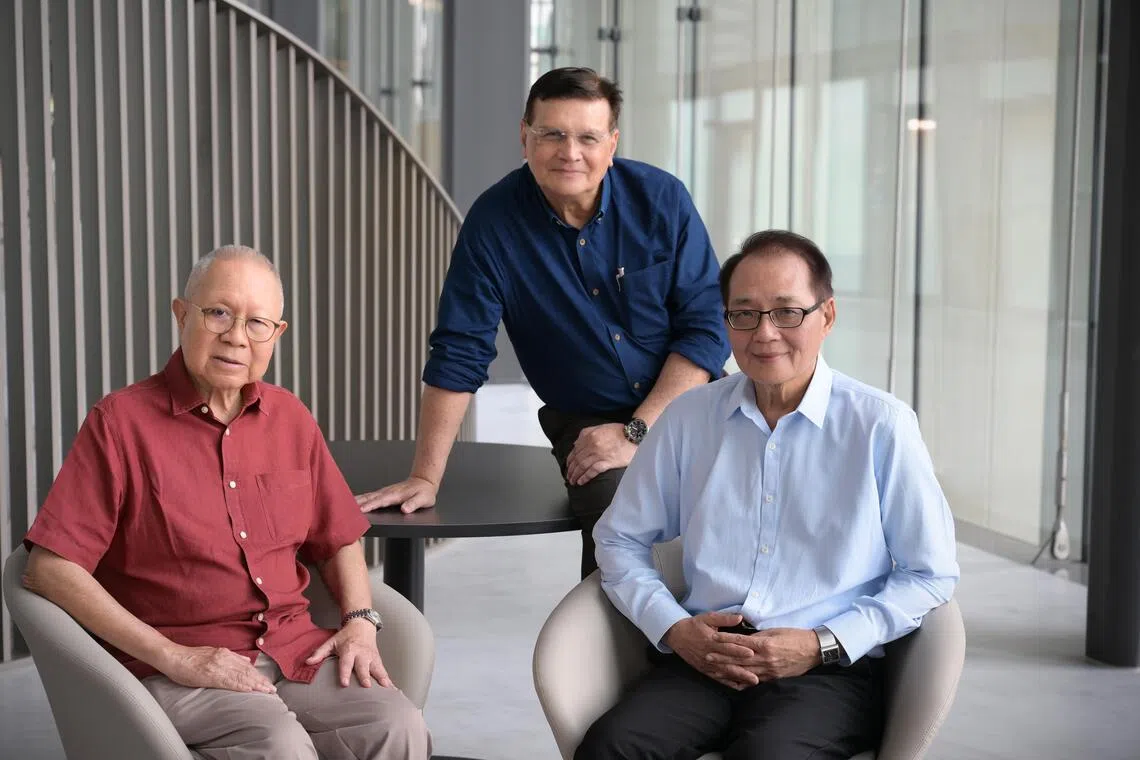
(From left) Former SID director Eddie Teo, former SID chief-of-staff Kevin Santa Maria and former SID senior director Ng Kah Meng.
ST PHOTO: NG SOR LUAN
Published Sep 05, 2026, 05:00 AM
Updated Sep 05, 2026, 05:00 AM
SID provides Singapore's top leaders with accurate intelligence to guide national security and policy decisions, including counter-terrorism efforts.
SID has helped shape Singapore's strategic response to terrorism.
SID now also counters cyberthreats and misinformation, recruits diverse professionals, and values internal recognition over public acclaim.
SINGAPORE – Not many people can say their work involves briefing their country’s top leaders. For Ng Kah Meng and his colleagues at the Security and Intelligence Division (SID) , the job involved not just regular briefings to the Cabinet, but also being grilled by Lee Kuan Yew .
Ng, a former SID senior director for counter-terrorism, recalled making trips to the Istana, where he faced Lee’s detailed questioning on national security matters.
Lee’s initial questions could drill into very minute details, as he wanted to “satisfy himself that you were not winging it”. But once Lee was satisfied, Ng said the conversation would shift into analysis mode, and then to decision-making based on the facts and assessments SID provided.
That Lee and other government leaders counted on SID’s intel to make critical policy decisions is a point of pride for three former SID directors, who the secretive agency made available for media interviews ahead of its 60th anniversary .
“We saw this first-hand: We provided the intelligence, (Lee) made the decisions, but those decisions were taken in real time, based on the information that we had given him,” said Ng, who served in SID from 1981 to 2013 .
“So we really felt the responsibility and accountability to make sure that we gave him the best possible, most accurate intelligence, and the most insightful assessments.”
Former SID senior director Ng Kah Meng said Lee Kuan Yew made decisions in real-time based on the information given to him by the SID. ST PHOTO: NG SOR LUAN
Former SID senior director Ng Kah Meng said Lee Kuan Yew made decisions in real-time based on the information given to him by the SID.
On Sept 4, a closed-door ceremony was held to commemorate the agency’s 60 years of contributions to the Republic’s success.
At the event, Prime Minister Lawrence Wong said Singapore’s external intelligence agency played an important role at critical junctures in the city-state’s history, and also at moments that “may never enter the public record, and will not be discussed, even in a closed-door setting like this”.
Among the policies that SID has helped shape is Singapore’s society-wide response to terrorism, said the three veterans.
Prime Minister Lawrence Wong said Singapore’s external intelligence agency played an important role at critical junctures in the city-state’s history. PHOTO: MINDEF
Prime Minister Lawrence Wong said Singapore’s external intelligence agency played an important role at critical junctures in the city-state’s history.
The Sept 11, 2001, attacks by Al-Qaeda and the detection of the Jemaah Islamiyah (JI) network here in the same year sounded the alarm that terrorism was a very real danger to Singapore.
Senior leaders in Government realised that a fundamental shift had occurred. “This was no longer a policeman’s problem but a problem of strategic proportions,” said Ng.
He recounted how the agency “furiously” ramped up its counter-terrorism coverage in those years, and issued a series of assessments explaining the situation to the Cabinet.
SID argued that Singapore needed a far bigger and more strategic response, and it made logical sense “to go upstream way before these elements became tangible, concrete threats”, Ng added.
Once radicalised individuals were detained, there also had to be a framework to rehabilitate them with the help of community and religious leaders, he added.
All this would come to pass. In 2002 , the authorities started the Inter-Racial and Religious Confidence Circles to build understanding between different ethnic and religious groups at the ground level.
That same year, the Inter-Agency Aftercare Group comprising a network of Muslim organisations was formed to provide emotional, social and financial support to JI detainees and their families.
In 2003, a group of Islamic scholars who had been assisting the Government to rehabilitate JI detainees came together to form the Religious Rehabilitation Group (RRG) . From providing counselling, the RRG went on to engage the wider public and address misinterpretations of Islamic concepts.
While the terror threat has waxed and waned over the years, it has never completely gone away, the interviewees noted.
Former SID chief-of-staff Kevin Santa Maria said the SID works closely with other government agencies to counter cyberthreats. ST PHOTO: NG SOR LUAN
Former SID chief-of-staff Kevin Santa Maria said the SID works closely with other government agencies to counter cyberthreats.
Former SID chief-of-staff Kevin Santa Maria recounted how SID worked with other intelligence agencies to uncover a 2016 plot by six Indonesians to launch a rocket attack against the Marina Bay Sands integrated resort from Batam .
The agency’s role included finding out more about the perpetrators, such as whether they had links to wider terror networks and other plots, he added.
Besides terrorism, the SID also scans for other geopolitical, social and economic threats, said Santa Maria. New challenges that did not exist at the agency’s inception include the threats posed by misinformation and information warfare in an increasingly digitised world.
Calling the technological front “where the real problems hitting us right now are”, he said SID works closely with other government agencies such as the Cyber Security Agency of Singapore , the Internal Security Department , and fellow MINDEF brethren at the Digital and Intelligence Service to counter cyberthreats.
In a nutshell, SID’s job has always been to be “the first bearer of bad news” for Singapore by providing the country’s leaders with early warnings of risks and dangers looming on the horizon, said Ng.
The deep institutional expertise across geographic theatres and issue domains is a big part of why SID can be the state’s voice of authenticity and accountability despite the vast amount of information floating around, he added.
This is useful when, for example, Singapore’s leaders want to understand the deeper motivations behind a foreign counterpart’s statement or policy actions.
“What we offer to the political leaders are facts that we have very thoroughly scrutinised, correlated, cross-referenced, and corroborated with a whole range of sources that are both open and non-open,” he said.
Former SID director Eddie Teo , the agency’s longest-serving director from 1979 to 1994 , said the issues may evolve, but SID’s mission will always be to keep the city-state’s policymakers well informed through objective and accurate intelligence assessments.
Former SID director Eddie Teo said the SID’s mission will always be to keep Singapore’s policymakers well-informed. ST PHOTO: NG SOR LUAN
Former SID director Eddie Teo said the SID’s mission will always be to keep Singapore’s policymakers well-informed.
This means never allowing intelligence to become politicised, as has happened in some other countries, said Teo, who in June stepped down as chairman of the Council of Presidential Advisers.
“Our role (is) to be objective, to be accurate, and not to suppress information that may not look good to our policymakers,” he added.
“We’re not telling our policymakers your policies are wrong. We’re just telling them the facts, and the facts (can) show that their assumptions may not be quite accurate.”
On why SID is being uncharacteristically public now, Santa Maria said it hopes to familiarise Singaporeans to its work keeping Singapore safe from external threats. Doing so also affirms and gives public recognition to the work of SID’s officers, who cannot speak openly about what they do due to operational security.
Another reason is to boost recruitment. After the agency launched its public website and gave media interviews in 2021 , it saw a 50 per cent increase in job applications.
The influx of mid-career professionals who have joined since 2021 – from industries as diverse as law, finance and communications – has changed the agency’s DNA, said Santa Maria, enriching the organisation with new perspectives and knowledge.
Prime Minister Lawrence Wong (right) interacting with Security and Intelligence Division alumnus Mr Eddie Teo. PHOTO: MINDEF
Prime Minister Lawrence Wong (right) interacting with Security and Intelligence Division alumnus Mr Eddie Teo.
On Sept 4, SID announced that it has launched its official LinkedIn page . Together with its website, the platforms enhance public understanding of a career with the agency and help it to better connect with Singaporeans who can contribute towards its mission, said MINDEF in a statement.
Ng said the SID will always be looking to recruit people with intellectual curiosity, honesty and humility.
“You have to keep questioning yourself about whether you could be wrong. You constantly question whether you have hidden prejudices, cognitive biases. We consciously try to avoid groupthink or ‘bossthink’,” he said.
At the same time, to be a member of this reticent organisation is to work for the good of Singapore largely away from the limelight.
Ng said that unlike diplomats and ambassadors who can become well known for their contributions, in SID “only your direct bosses know about your good work”.
For a long time, SID officers also were not allowed to get National Day awards as this was seen as a possible security risk, he added.
Santa Maria said SID officers take pride in doing very important work without public recognition. “The recognition is within the organisation itself, and that’s good enough for us.”
At the ceremony on Sept 4, PM Wong said SID must continue to sharpen its edge to keep Singapore safe and ahead. This includes understanding how countries use various economic and technological levers to advance their interests, at a time when the boundaries between security, economics and technology are becoming less distinct.
“New challenges will emerge and surprises will come. SID cannot predict everything, but SID can certainly help Singapore anticipate developments earlier, understand better, and prepare for what may come,” he said.
“For a small country like Singapore, that ability to anticipate, understand and act early is a vital source of strategic advantage. And you help contribute to this strategic advantage.”
Defence and military
(从左至右)前SID主任Eddie Teo、前SID幕僚长Kevin Santa Maria和前SID高级主任Ng Kah Meng。
圣徒照片:吴索銮
发布于 2026 年 9 月 5 日上午 5:00
更新于2026年9月5日上午5:00
新加坡情报局为新加坡最高领导人提供准确的情报,以指导国家安全和政策决策,包括反恐工作。
新加坡情报局 (SID) 帮助制定了新加坡应对恐怖主义的战略。
SID 现在也致力于打击网络威胁和虚假信息,招募多元化的专业人才,并重视内部认可而非公众赞誉。
新加坡——很少有人能说自己的工作涉及向国家最高领导人汇报。对于安全与情报司(SID)的黄家明及其同事来说,他们的工作不仅包括定期向内阁汇报,还要接受李光耀的盘问。
曾任国家安全局反恐高级主管的吴先生回忆说,他曾多次前往总统府,在那里接受了李显龙总理关于国家安全问题的详细质询。
李先生最初的问题可能会深入到非常细枝末节,因为他想“确保你不是在凭感觉行事”。但吴先生表示,一旦李先生感到满意,谈话就会转入分析阶段,然后根据SID提供的事实和评估做出决策。
李和其他政府领导人依靠SID的情报来做出关键的政策决定,这让三位前SID主任感到自豪。在SID成立60周年之际,这个秘密机构安排他们接受媒体采访。
“我们亲眼目睹了这一点:我们提供了情报,(李)做出了决定,但这些决定都是根据我们提供的信息实时做出的,”在1981年至2013年期间在SID服役的吴说道。
“因此,我们深感有责任和义务确保我们向他提供最好、最准确的情报和最有洞察力的评估。”
新加坡情报局前高级局长吴嘉明表示,李光耀会根据情报局提供的信息实时做出决策。(海峡时报照片:吴素銮)
新加坡情报局前高级局长吴嘉明表示,李光耀会根据新加坡情报局提供的信息实时做出决策。
9月4日,举行了一场闭门仪式,以纪念该机构60年来为共和国的成功所做出的贡献。
在活动中,总理黄循财表示,新加坡对外情报机构在新加坡历史上的关键时刻发挥了重要作用,而且在一些“可能永远不会进入公众视野,甚至在像这样的闭门会议上也不会被讨论”的时刻也发挥了重要作用。
三位退伍军人表示,新加坡情报局 (SID) 参与制定的政策之一是新加坡全社会对恐怖主义的应对措施。
新加坡总理黄循财表示,新加坡对外情报机构在新加坡历史的关键时刻发挥了重要作用。(图片:国防部)
新加坡总理黄循财表示,新加坡对外情报机构在新加坡历史的关键时刻发挥了重要作用。
2001 年 9 月 11 日基地组织发动的袭击以及同年在新加坡发现伊斯兰祈祷团 (JI) 网络,都敲响了警钟,表明恐怖主义对新加坡构成了非常现实的威胁。
政府高层领导意识到,情况已经发生了根本性的转变。“这不再是警察的问题,而是一个具有战略意义的问题,”吴先生说。
他回顾了该机构在那几年如何“疯狂地”加强反恐覆盖范围,并向内阁发布了一系列评估报告,解释了当时的情况。
新加坡国际发展局认为,新加坡需要采取更大、更具战略性的应对措施,而且“在这些因素成为切实存在的威胁之前就从源头入手”是合乎逻辑的,吴补充道。
他还补充说,一旦极端化人员被拘留,就必须建立一个框架,在社区和宗教领袖的帮助下对他们进行改造。
这一切都成为了现实。2002年,当局启动了种族和宗教间互信圈,旨在基层建立不同种族和宗教群体之间的相互理解。
同年,由穆斯林组织组成的跨机构后续关怀小组成立,旨在为伊斯兰祈祷团被拘留者及其家人提供情感、社会和经济支持。
2003年,一群曾协助政府对伊斯兰祈祷团(JI)被拘留者进行改造的伊斯兰学者聚集在一起,成立了宗教改造小组(RRG)。RRG最初提供咨询服务,后来逐渐扩展到更广泛的公众,并致力于纠正对伊斯兰概念的误解。
受访者指出,虽然恐怖威胁这些年来时而高涨时而低落,但从未完全消失。
前SID幕僚长凯文·圣玛丽亚表示,SID与其他政府机构密切合作,共同应对网络威胁。(海峡时报照片:吴淑銮)
前SID幕僚长凯文·圣玛丽亚表示,SID与其他政府机构密切合作,共同应对网络威胁。
前印尼国家情报局局长凯文·圣玛丽亚讲述了印尼国家情报局如何与其他情报机构合作,揭露了2016年六名印尼人密谋从巴淡岛向滨海湾金沙综合度假村发动火箭弹袭击的阴谋。
他还补充说,该机构的职责包括进一步了解犯罪者的情况,例如他们是否与更广泛的恐怖网络和其他阴谋有联系。
圣玛丽亚表示,除了恐怖主义,安全情报局还会监测其他地缘政治、社会和经济威胁。该机构成立之初并不存在的新挑战包括,在日益数字化的世界中,虚假信息和信息战带来的威胁。
他称技术方面是“我们目前面临的真正问题所在”,并表示新加坡情报局正与其他政府机构密切合作,例如新加坡网络安全局、内部安全局以及国防部数字与情报局,以应对网络威胁。
吴先生表示,简而言之,新加坡情报局的工作一直是作为新加坡“第一个带来坏消息的人”,向国家领导人提供即将到来的风险和危险的早期预警。
他补充说,尽管信息浩如烟海,但SID在各个地理区域和问题领域拥有深厚的机构专业知识,这正是SID能够成为国家真实性和问责制代言人的重要原因之一。
例如,当新加坡领导人想要了解外国同行发表声明或采取政策行动背后的深层动机时,这非常有用。
他说:“我们向政治领导人提供的,是我们已经非常彻底地审查、关联、交叉引用并与各种公开和非公开来源进行核实的事实。”
新加坡情报局前局长 Eddie Teo(1979 年至 1994 年担任该机构局长,是任期最长的局长)表示,问题可能会发生变化,但新加坡情报局的使命始终是通过客观准确的情报评估,让新加坡的决策者充分了解情况。
新加坡信息局前局长张志贤表示,信息局的使命始终是让新加坡的政策制定者充分了解情况。(海峡时报照片:黄淑銮)
新加坡信息局前局长张伟杰表示,新加坡信息局的使命始终是让新加坡的政策制定者充分了解情况。
特奥表示,这意味着绝不能允许情报工作政治化,就像其他一些国家发生的那样。特奥于今年6月辞去了总统顾问委员会主席的职务。
“我们的职责是保持客观、准确,并且不压制那些可能对政策制定者不利的信息,”他补充道。
“我们并不是说政策制定者们的政策是错误的。我们只是告诉他们事实,而事实(可能)表明他们的假设可能并不完全准确。”
圣玛丽亚解释说,新加坡安全情报局(SID)此次一反常态地公开露面,是希望借此让新加坡民众了解其在维护新加坡安全、抵御外部威胁方面所做的工作。同时,此举也肯定并公开认可了安全情报局官员的工作,由于行动安全原因,他们无法公开谈论自己的工作内容。
另一个原因是促进招聘。该机构在2021年推出官方网站并接受媒体采访后,求职申请数量增加了50%。
圣玛丽亚表示,自 2021 年以来,大量来自法律、金融和传播等不同行业的中年专业人士的加入改变了该机构的 DNA,为该组织带来了新的视角和知识。
总理黄循财(右)与安全与情报署前成员张志贤先生交流。照片:国防部
总理黄循财(右)与安全及情报部门前员工张志贤先生互动交流。
9月4日,新加坡情报局宣布正式启用其LinkedIn页面。新加坡国防部在一份声明中表示,LinkedIn平台与其网站相辅相成,有助于公众更好地了解在该机构工作的机会,并帮助其更好地与能够为机构使命做出贡献的新加坡人建立联系。
吴先生表示,新加坡情报局将始终致力于招募具有求知欲、诚实和谦逊品质的人才。
“你必须不断质疑自己是否可能犯错。你要持续反思自己是否存在隐藏的偏见或认知偏差。我们有意识地努力避免群体思维或‘老板思维’,”他说。
与此同时,成为这个低调组织的成员意味着在聚光灯之外为新加坡的福祉而努力。
吴先生表示,与外交官和大使因其贡献而广为人知不同,在新加坡情报局,“只有你的直属上司才知道你的出色工作”。
他还补充说,长期以来,特警队队员也不被允许获得国庆奖章,因为这被视为可能存在的安全隐患。
圣玛丽亚表示,SID的官员们为自己默默无闻地从事重要工作而感到自豪。“这种认可存在于组织内部,这对我们来说就足够了。”
在9月4日的仪式上,黄循财总理表示,新加坡情报局必须不断提升自身实力,以确保新加坡的安全与领先地位。这包括了解各国如何运用各种经济和技术手段来推进自身利益,尤其是在安全、经济和技术之间的界限日益模糊的当下。
“新的挑战将会出现,意想不到的事情也会发生。新加坡信息发展局(SID)无法预测所有事情,但它肯定可以帮助新加坡更早地预见事态发展,更好地了解情况,并为可能发生的事情做好准备,”他说。
“对于新加坡这样的小国来说,能够预见、理解并及早采取行动是至关重要的战略优势来源。而你们也为这种战略优势的形成做出了贡献。”
国防和军事