Govt intervention to address disruption, uncertainty must follow basic economic principles: PM Wong黄循财总理:政府干预应对混乱和不确定性必须遵循基本经济原则。
Read more at straitstimes.com.
新闻视频
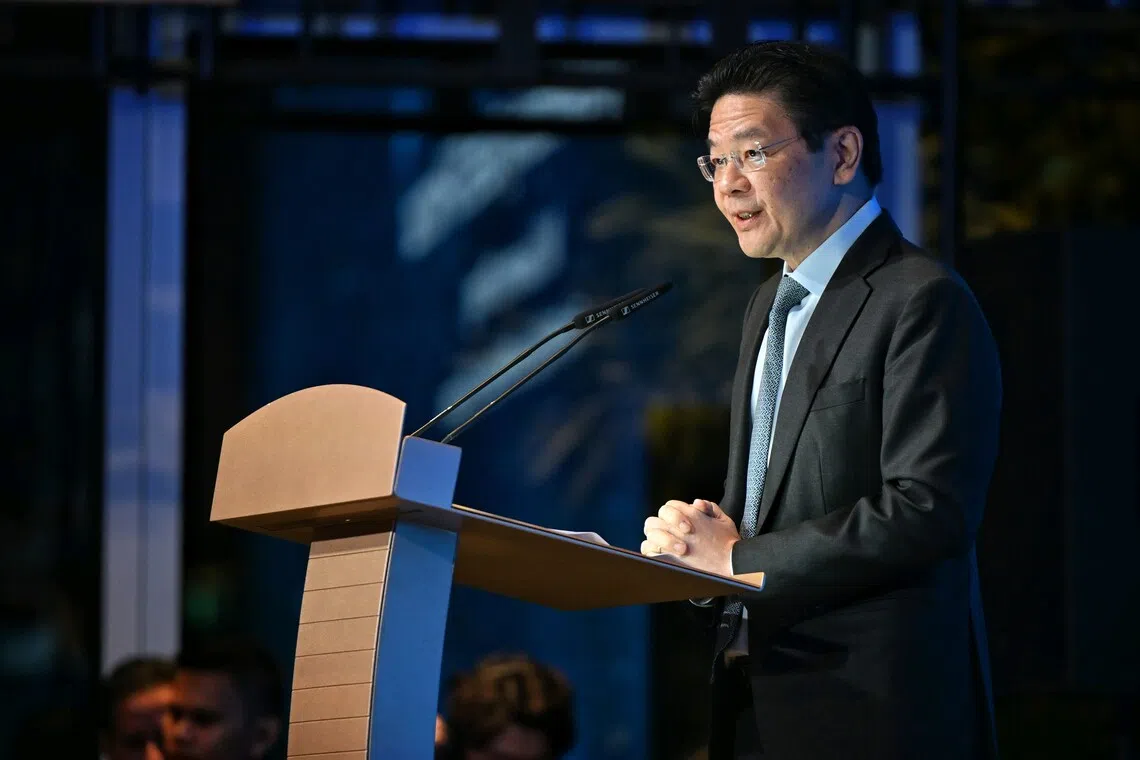
Prime Minister Lawrence Wong at the Economist Service 25th Anniversary Dinner, at PARKROYAL COLLECTION Pickering, on Sept 30.
ST PHOTO: ARIFFIN JAMAR
Published Sep 30, 2026, 10:00 PM
Updated Sep 30, 2026, 10:01 PM
PM Lawrence Wong emphasised the need for government intervention to help workers affected by AI and global uncertainty, ensuring support is guided by economic principles.
He highlighted the importance of careful policy design to avoid unintended consequences, citing examples like rent controls and price caps that can worsen problems over time.
PM Wong urged economists to maintain rigorous, honest analysis and clear communication to strengthen policymaking amid rapid change and uncertainty in Singapore's economy.
SINGAPORE - Amid disruption from artificial intelligence and global uncertainty, the Government must actively help workers and others who are adversely affected, said Prime Minister Lawrence Wong on Sep 30.
But any intervention must be done in a disciplined and careful manner, guided by a proper diagnosis of the problem, and a clear understanding of the incentives, trade-offs, and consequences that may follow, he added.
He was speaking at the 25th anniversary celebration of the Economist Service, which he said he was “proud and happy” to attend not only as Prime Minister but as an alumnus.
In a speech underscoring how economic thinking can inform government policy, he said Singapore must be prepared for more churn and disruption as the pace of change accelerates.
While this process of creative destruction is essential for driving innovation and economic growth, the costs are immediate and personal for the individual worker whose job is being displaced, he acknowledged.
“When livelihoods are affected and people feel anxious about their future, it is understandable that they will look to the Government for solutions.,” he added.
“So we must respond to these concerns. We must help those adversely affected by change, protect the vulnerable, and make sure the benefits of growth are broadly shared.”
The Singapore government has never taken a laissez-faire approach and is “not shy about intervening”, he noted. It does not leave things to the markets alone, since markets can fail and also cannot provide for all things that a society cares about.
The Government has intervened actively in many areas to correct market failures, pool risks and achieve important social objectives, he said.
But precisely because the Government intervenes, it needs to do so carefully and be clear-eyed about what works and what does not, he said.
That means diagnosing the problem correctly, understanding the incentives policies create, recognising the costs and trade-offs and thinking through any second- and third-order consequences that might result.
This discipline has served Singapore well, and maintaining it is one of the most important responsibilities of the Economist Service, said PM Wong to a ballroom full of public sector economists.
He was among the first five economists in the service when it was formally established in 2001 under the Ministry of Trade and Industry.
Recounting this in his speech at the Parkroyal Collection Pickering hotel, he said he had to double-hat in marketing and recruitment, resulting in his pictures appearing in promotional materials.
Since then, the Service has grown to more than 100 economists across over 20 government agencies and two international organisations.
PM Wong said over the years, economics has become more technical and data-driven, with models more sophisticated, econometric techniques more powerful, and datasets vastly richer.
While these advances are important, there may be a tendency to equate technical sophistication with rigour, and to treat an argument as more credible simply because it has a more complicated model behind it, he said.
He added that there was also a risk of slipping into data mining - starting with the conclusion, and search for the evidence to support it, rather than using the evidence to test whether the conclusion is right.
Cautioning against these risks, he said: “So we must guard against becoming captive to an ideology, or captive to the technique.”
He urged the economist service officers to focus instead on the basic principles of economic thinking.
He cited three concepts - prices, costs and incentives - which he said would force them to confront scarcity, choices and trade-offs.
Prices signal what is scarce and what people demand, he said. If these signals are suppressed or distorted, scarce resources may end up being allocated poorly, creating bigger problems down the road.
He gave the example of how Singapore prices water and electricity to reflect the underlying cost and scarcity of the resources so that households and businesses will use them wisely.
The Government then provides targeted support, such as U-Save rebates, to help lower- and middle-income households with their utility bills, rather than artificially holding down prices.
This allows the price signal to be preserved, while ensuring that essential services remain affordable, he said.
Understanding cost is also important because the true cost of a policy may not always be measurable in dollars and cents, he said.
It includes what has to be given up in making one choice over another, such as in choosing whether to use a piece of land for homes, schools, parks, community facilities or places of worship.
In allocating land, the Government should not just choose its use by what can command the highest market price, he said.
Rather, a decision must first be made on Singapore’s needs and values.
“Whatever we decide, we must recognise that the land has value, and using it for one purpose means forgoing another. And so that ensures we use every parcel carefully, and make the most of our limited space,” he said.
“Good policymaking requires us to recognise that trade-off, even when the cost is not immediately visible.”
Meanwhile, it is also crucial to anticipate the incentives that policies create, as they can alter the behaviour of consumers, businesses, workers and families, he said.
“Whenever Government changes the rules, people will respond. Sometimes in ways we intend, sometimes in ways we do not,” he said.
“And good economics requires us to anticipate these responses, and design our policies accordingly.”
Citing unemployment support, he said Singapore was cautious about unemployment insurance for a long time, having seen how overly generous benefits elsewhere had weakened people’s incentive to return to work.
Yet, there are also consequences to not providing support, as workers who have lost their jobs may make poor employment decisions due to financial pressures, he added.
That is why the Government had designed the SkillsFuture Jobseeker Support Scheme to provide temporary financial support, while requiring recipients to do their part by actively searching for work and going for career coaching or training.
The aim is to provide enough assurance for workers to find a good job match, while maintaining a strong incentive to get back into employment, he said.
PM Wong said these basic principles - that prices, costs and incentives matter - can be “surprisingly easy to ignore”, especially when there is pressure to act quickly, or when a simple solution sounds attractive.
Around the world, policies introduced with the best of intentions have produced unintended consequences that only emerged later, he said.
For instance, rent controls that discourage the supply of rental units, or food price caps that lead to shortages, he said.
When prices are artificially held low, consumers may benefit at first, but suppliers have less incentive to produce over time, resulting in shortages.
Such poorly designed policies can lead to the original problems becoming harder to solve, and can also show up in other ways, such as fiscal burdens that accumulate and lost investments, he added.
“And by the time these consequences become clear, the policy may be very difficult to unwind,” he said.
PM Wong said Singapore is not immune to pressures for easy solutions, warning that these pressures will grow in the years ahead amid greater global uncertainty and technological disruption.
He urged officers in the Economist Service to continue to sharpen the thinking in government, and strengthen policymaking to help Singapore make better choices in an uncertain world.
He said doing the job well requires more than technical competence.
“It takes judgment and intellectual honesty. It takes the professional conviction to speak up when the analysis points to an uncomfortable conclusion,” he said.
“And it takes the ability to explain complex issues simply and clearly, so that good analysis can translate into good policy.”
Ministry of Trade and Industry
9月30日,总理黄循财出席在皮克林宾乐雅酒店举行的《经济学人》25周年晚宴。
圣路易斯照片:阿里芬·贾马尔
发布于2026年9月30日晚上10:00
更新于2026年9月30日晚上10:01
黄循财总理强调,政府需要进行干预,帮助受人工智能和全球不确定性影响的劳动者,并确保援助以经济原则为指导。
他强调了谨慎制定政策以避免意外后果的重要性,并举例说明租金管制和价格上限等措施可能会随着时间的推移使问题恶化。
黄总理敦促经济学家们保持严谨、诚实的分析和清晰的沟通,以加强新加坡经济在快速变化和不确定性下的政策制定。
新加坡——总理黄循财9月30日表示,面对人工智能带来的冲击和全球不确定性,政府必须积极帮助受不利影响的工人和其他人士。
但他补充说,任何干预都必须以严谨谨慎的方式进行,以对问题进行正确诊断为指导,并清楚地了解可能随之而来的激励、权衡和后果。
他在《经济学人》服务机构成立 25 周年庆典上发表了讲话,他说,他不仅以总理的身份,而且以校友的身份,都为能够参加此次庆典感到“自豪和高兴”。
他在一次演讲中强调了经济思维如何能够指导政府政策,并表示随着变革步伐的加快,新加坡必须做好应对更多动荡和混乱的准备。
他承认,虽然这种创造性破坏的过程对于推动创新和经济增长至关重要,但对于失业的个体劳动者来说,代价是直接且个人化的。
“当人们的生计受到影响,对未来感到焦虑时,他们会向政府寻求解决方案,这是可以理解的,”他补充道。
“因此,我们必须回应这些关切。我们必须帮助那些受变革不利影响的人,保护弱势群体,并确保增长的成果惠及所有人。”
他指出,新加坡政府从未采取自由放任的态度,而且“毫不犹豫地进行干预”。政府不会放任市场自行运转,因为市场会失灵,也无法满足社会的所有需求。
他说,政府已在许多领域积极干预,以纠正市场失灵、分散风险并实现重要的社会目标。
但他表示,正因为政府要进行干预,所以更需要谨慎行事,并且要清醒地认识到哪些措施有效,哪些无效。
这意味着要正确诊断问题,了解政策产生的激励机制,认识到成本和权衡取舍,并考虑可能产生的任何二阶和三阶后果。
黄循财总理在挤满公共部门经济学家的宴会厅里表示,这种纪律对新加坡大有裨益,而保持这种纪律是经济学家服务部门最重要的职责之一。
他是2001年贸易和工业部正式成立该部门时首批五名经济学家之一。
他在皮克林帕克罗亚尔精选酒店的演讲中回忆起这段经历,他说自己不得不身兼市场营销和招聘两职,结果导致他的照片出现在宣传材料中。
从那时起,该机构已发展成为拥有 100 多名经济学家,分布在 20 多个政府机构和两个国际组织中。
黄总理表示,多年来,经济学变得更加技术化和数据驱动,模型更加复杂,计量经济学技术更加强大,数据集也更加丰富。
他表示,虽然这些进步很重要,但人们可能会倾向于将技术上的复杂程度等同于严谨性,并仅仅因为某个论点背后有一个更复杂的模型就认为它更可信。
他还补充说,还有一种风险是滑向数据挖掘——从结论出发,寻找证据来支持结论,而不是利用证据来检验结论是否正确。
他警告说,要警惕这些风险:“所以我们必须警惕自己不要成为某种意识形态的俘虏,或者成为某种技术的俘虏。”
他敦促经济服务官员们转而关注经济思维的基本原则。
他列举了三个概念——价格、成本和激励——他说,这些概念将迫使他们面对稀缺性、选择和权衡取舍。
他表示,价格反映了资源的稀缺性和人们的需求。如果这些信号被压制或扭曲,稀缺资源最终可能会被错误配置,从而在未来造成更大的问题。
他举例说,新加坡如何根据水和电的实际成本和稀缺性来定价,以便家庭和企业能够明智地使用这些资源。
政府随后提供有针对性的支持,例如 U-Save 回扣,以帮助中低收入家庭支付水电费,而不是人为地压低价格。
他表示,这样既能保持价格信号,又能确保基本服务价格合理。
他还表示,了解成本也很重要,因为一项政策的真正成本可能并不总是能用金钱来衡量。
它包括在选择一项还是另一项时必须放弃的东西,例如选择将一块土地用于住宅、学校、公园、社区设施还是宗教场所。
他表示,政府在分配土地时,不应仅仅根据市场价格来选择土地用途。
首先必须根据新加坡的需求和价值观做出决定。
“无论我们做出什么决定,我们都必须认识到土地的价值,将其用于一种用途就意味着放弃另一种用途。因此,这确保我们谨慎使用每一块土地,并最大限度地利用我们有限的空间,”他说。
“良好的政策制定要求我们认识到这种权衡取舍,即使成本并非立竿见影。”
与此同时,他还表示,预测政策产生的激励措施也至关重要,因为这些措施会改变消费者、企业、工人和家庭的行为。
他说:“每当政府改变规则,人们都会做出反应。有时是我们预料之中的反应,有时是我们意想不到的反应。”
“良好的经济学原理要求我们预测这些反应,并据此制定我们的政策。”
他以失业救济金为例表示,新加坡长期以来对失业保险持谨慎态度,因为他们看到其他地方过于慷慨的福利削弱了人们重返工作的积极性。
但他补充说,不提供支持也会带来后果,因为失业工人可能会因为经济压力而做出糟糕的就业决定。
正因如此,政府设计了“技能创前程求职者援助计划”,旨在提供临时财政援助,同时要求受助者积极寻找工作,并参加职业指导或培训,尽自己的一份力。
他说,此举旨在为劳动者提供足够的保障,让他们找到合适的工作,同时保持重返工作岗位的强大动力。
黄总理表示,价格、成本和激励措施这些基本原则“很容易被忽视”,尤其是在面临快速行动的压力,或者简单的解决方案听起来很有吸引力的时候。
他表示,在世界各地,许多出于好意而推出的政策都产生了意想不到的后果,这些后果直到后来才显现出来。
他举例说,租金管制会抑制出租房屋的供应,食品价格上限会导致短缺。
当价格被人为压低时,消费者起初可能会受益,但随着时间的推移,供应商的生产动力会降低,从而导致短缺。
他还补充说,这种设计糟糕的政策会导致原本的问题更难解决,还会以其他方式显现出来,例如财政负担不断累积和投资损失。
“等到这些后果显现出来的时候,这项政策可能就很难撤销了,”他说。
黄循财总理表示,新加坡也无法免受寻求简单解决方案的压力,并警告说,随着全球不确定性加剧和技术变革,未来几年这种压力将会越来越大。
他敦促经济事务局的官员们继续提升政府的思维能力,加强政策制定,以帮助新加坡在不确定的世界中做出更好的选择。
他说,做好这份工作需要的不仅仅是技术能力。
他说:“这需要判断力和求知的诚实。当分析结果指向令人不安的结论时,需要有专业的信念去提出异议。”
“而且,还需要具备用简单明了的方式解释复杂问题的能力,这样才能将好的分析转化为好的政策。”
贸易和工业部