Good business publications must provide trust, judgment and perspective: Jeffrey Siow优秀的商业出版物必须提供信任、判断和视角:杰弗里·西奥
Jeffrey Siow highlights the importance of trust and perspective in business journalism as BT marks 50 years of covering Singapore and South-east Asia. Read more at straitstimes.com.
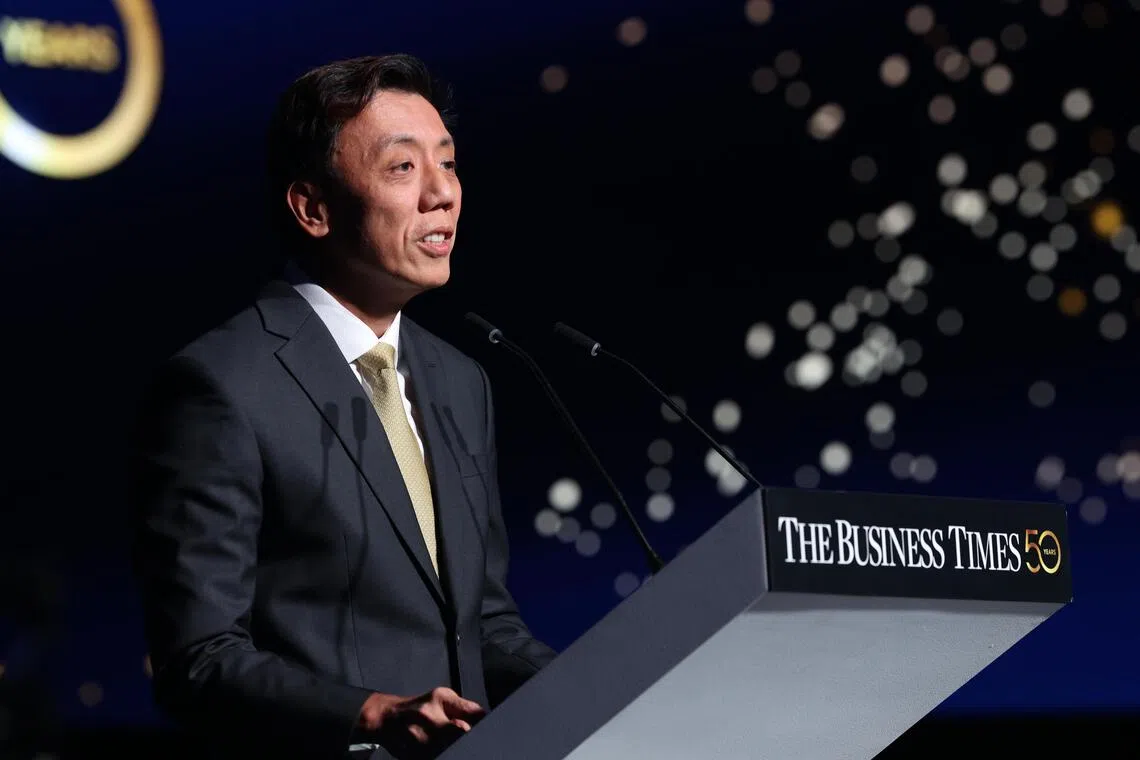
Jeffrey Siow, Minister for Transport and Second Minister for Finance, at BT's 50th anniversary gala dinner on Oct 1. He says trust is especially important in business and financial journalism.
PHOTO: THE BUSINESS TIMES
Published Oct 01, 2026, 09:45 PM
Updated Oct 01, 2026, 09:45 PM
Jeffrey Siow emphasised that trust, judgment, and perspective are essential for business publications, especially as verified information grows vital amid misinformation and AI-generated content.
The Business Times aims to deepen focus on South-east Asia, offering insightful coverage and products like Decoding Asia to help readers understand regional and global business dynamics.
BT plans to expand newsletters, events, and data services to strengthen reader relationships and support Singapore’s and the region’s evolving business ecosystems over the next 50 years.
SINGAPORE – The value of a good business publication lies in trust, judgment and perspective, said Minister for Transport and Second Minister for Finance Jeffrey Siow at The Business Times’ 50th anniversary dinner on Oct 1.
“For its first 50 years, BT chronicled Singapore’s emergence as a global business and financial centre,” he said.
“In your next 50, you have the opportunity to do something larger: to become one of the institutions through which the world understands Singapore and South-east Asia.”
Giving the keynote address at the event held at Marina Bay Sands, Siow said that information is now abundant and anyone can publish to a global audience, but there is more noise to cut through.
“The premium is not simply about access to information or speed of publication,” he added.
Value of verified information will grow
Trust is fundamental to all journalism – but is especially important in business and financial journalism, he said.
Such news is often instantly acted upon, and can affect how an investor deploys capital, how a company responds to a new regulation, or how a business assesses a market, so inaccuracy has serious consequences.
The value of verified information will grow, in a world where rumours can spread quickly and plausible-looking posts can be easily generated by artificial intelligence, he said.
An established newsroom like BT, where the facts have been checked, sources have been tested, and different perspectives have been considered, has an advantage.
Referring to judgment, Siow pointed out that while facts are the foundation of truth, readers need help deciding which ones matter.
In helping a business leader in Singapore decide what a change in US trade policy means for their supply chain, how AI may change their industry, or what interest rate movements mean for financing, journalism adds value beyond reporting, he said.
BT also goes on the ground, bringing the business community together through awards, round tables and dialogues. Journalists can thus keep a close eye on what is top of mind for companies, entrepreneurs and investors.
These insights then feed into products, such as its Decoding Asia series, a newsletter which curates key regional developments. Siow said: “The products demonstrate good judgment: deciding what deserves attention, supplying the context, and helping readers see the larger pattern.”
Finally, perspective is key, with publications’ influence stemming from understanding their own economies and regions deeply, and using that knowledge to interpret developments beyond them.
“Every serious international publication sees the world from somewhere,” Siow said, highlighting the Financial Times in London, The Wall Street Journal in New York, and Nikkei in Tokyo.
“BT has the opportunity to do the same from Singapore and South-east Asia,” he said.
He noted that there is a “real need for this”, with South-east Asia’s growing importance to the global economy. Global businesses are looking more closely at the region for their next opportunities, he added.
And as the 11 Asean economies are at very different stages of development, offering different advantages, the minister said that a business publication that has knowledge of individual markets, businesses and people on the ground is valuable.
“BT is well placed to provide this perspective and has in fact begun moving in this direction,” he said.
BT Global was launched in January 2026 , specifically to cover regional and international developments through a South-east Asian lens. Overseas views of BT’s coverage have more than doubled since, compared with the same time in 2025, to around 35 million views.
In a separate speech at the dinner, BT editor Chen Huifen recalled that “Singapore’s economy was still finding its shape” when the paper was launched in 1976.
“Our stock and commodities markets were young, and we were only beginning to position ourselves as a forex centre.”
BT became the ledger of record for Singapore business, she said. But as the economy matured, it then needed to become interpreters, not just recorders.
Today, readers say they rely on BT for decision-making, trend analysis and strategic foresight at work, and thinking through wealth, career and life outside the office, Chen said.
They also want information in forms beyond writing, with visual journalism, video and audio helping them to make sense of complex ideas – which she said BT is building for.
They also shared that its authority comes from local nuance, and it “should claim the space of authoritative, Asean-focused coverage, while keeping Singapore as (its) core”.
This is where BT is headed, Chen said. Total overseas traffic for the Decoding Asia newsletter increased more than twofold to 35 million page views in the first eight months of this year. Meanwhile, overseas unique users reached 25 million.
“With tens of thousands also subscribing to our new newsletter, these metrics tell us there is a growing appetite for a trusted regional business voice.”
She added: “We will keep South-east Asia as our anchor. But our ambition, over time, is to distil business news from around the world through the lens of this region.”
This will mean being more selective, sharpening focus on themes such as capital and markets, tech and AI, trade and supply chains, energy transition and demographic changes, which matter most across South-east Asia.
BT will also invest further in newsletters, communities and events, to deepen relationships with readers. Complementing its reporting, it will also build a broader portfolio of products, including proprietary data.
At home, BT’s journalism will continue to support the next stage of growth in its capital markets and broader business ecosystem, Chen noted. And across the region, it hopes to fill a real gap by providing consistent, insight-driven coverage of the region’s key markets.
“We don’t know exactly what South-east Asia’s business landscape will look like in another 50 years, and we won’t pretend we do,” she said. “But we intend to be there – still asking what it means, and what comes next – for Singapore, and now, for the region it sits in.”. THE BUSINESS TIMES
交通部长兼财政部第二部长萧伯纳在10月1日《商业时报》50周年庆典晚宴上表示,信任在商业和财经新闻领域尤为重要。
图片来源:商业时报
发布于 2026 年 10 月 1 日晚上 9:45
更新于2026年10月1日晚上9:45
Jeffrey Siow强调,信任、判断和视角对于商业出版物至关重要,尤其是在虚假信息和人工智能生成内容盛行的当下,经过验证的信息变得越来越重要。
《商业时报》致力于加深对东南亚的关注,提供深入的报道和《解码亚洲》等产品,帮助读者了解区域和全球商业动态。
未来 50 年,BT 计划扩大新闻通讯、活动和数据服务,以加强与读者的关系,并支持新加坡和该地区不断发展的商业生态系统。
新加坡——交通部长兼财政部第二部长萧敬腾在10月1日《商业时报》50周年晚宴上表示,一份好的商业出版物的价值在于信任、判断和视角。
他说:“在创刊的头50年里,《商业时报》记录了新加坡崛起成为全球商业和金融中心的过程。”
“在接下来的50年里,你们有机会做一件更伟大的事情:成为世界了解新加坡和东南亚的重要机构之一。”
在滨海湾金沙举行的活动上发表主题演讲时,萧先生表示,现在信息非常丰富,任何人都可以向全球受众发布信息,但同时也有更多的噪音需要过滤。
他补充说:“溢价不仅仅关乎获取信息的途径或发布速度。”
经核实信息的价值将会增长
他说,信任是新闻报道的基础,但在商业和财经新闻报道中尤为重要。
此类新闻往往会立即引发关注,并可能影响投资者如何部署资金、公司如何应对新规或企业如何评估市场,因此不准确会造成严重后果。
他表示,在谣言传播迅速、人工智能可以轻易生成看似可信的帖子的世界里,经过核实的信息的价值将会越来越高。
像 BT 这样成熟的新闻编辑室,事实经过核实,消息来源经过检验,并考虑了不同的观点,具有一定的优势。
谈到判断,萧指出,虽然事实是真理的基础,但读者需要帮助来决定哪些事实重要。
他说,新闻业在帮助新加坡的商业领袖决定美国贸易政策的变化对其供应链意味着什么、人工智能将如何改变他们的行业,或者利率变动对融资意味着什么等方面,其价值远不止于报道。
BT还深入基层,通过颁奖典礼、圆桌会议和对话等形式,将商界人士聚集在一起。因此,记者可以密切关注企业、企业家和投资者最关心的问题。
这些洞察随后会融入到其产品中,例如其“解码亚洲”系列简报,该简报精选了重要的区域发展动态。萧先生表示:“这些产品体现了良好的判断力:能够决定哪些内容值得关注,提供背景信息,并帮助读者了解更大的格局。”
最后,视角至关重要,出版物的影响力源于对自身经济和地区的深刻理解,并运用这些知识来解读其以外的发展。
“每一家严肃的国际出版物都有其自身的视角,”萧先生说道,并特别提到了伦敦的《金融时报》、纽约的《华尔街日报》和东京的《日经新闻》。
“BT 也有机会从新加坡和东南亚地区做到这一点,”他说。
他指出,鉴于东南亚在全球经济中的重要性日益提升,这方面“确实存在迫切需求”。他还补充说,全球企业正更加密切地关注该地区,以寻求新的发展机遇。
部长表示,由于东盟11个经济体的发展阶段各不相同,优势也各有差异,因此,一份了解各个市场、企业和当地民众情况的商业出版物非常有价值。
“BT公司完全有能力提供这种视角,而且实际上已经开始朝着这个方向发展了,”他说。
BT Global于2026年1月正式上线,旨在通过东南亚视角报道区域和国际动态。自上线以来,BT Global在海外的报道浏览量较2025年同期增长了一倍多,达到约3500万次。
在晚宴上的另一次讲话中,《商业时报》编辑陈慧芬回忆说,该报于 1976 年创刊时,“新加坡的经济仍在摸索发展方向”。
“我们的股票和大宗商品市场还很年轻,我们才刚刚开始将自己定位为外汇中心。”
她表示,《商业时报》一度成为新加坡企业的账簿。但随着经济的成熟,它需要扮演的角色不再仅仅是记录者,而是诠释者。
陈先生表示,如今读者们表示,他们在工作中依靠《商业周刊》进行决策、趋势分析和战略远见,并在工作之外思考财富、职业和生活。
他们还希望获得文字以外的信息形式,视觉新闻、视频和音频可以帮助他们理解复杂的概念——她说,英国电信正在为此而建设。
他们还表示,该媒体的权威性源于对当地的了解,并且“应该占据权威的、以东盟为中心的报道领域,同时将新加坡作为(其)核心”。
陈先生表示,这就是BT的发展方向。今年前八个月,《解码亚洲》电子报的海外总访问量增长超过两倍,达到3500万页面浏览量。与此同时,海外独立用户数达到2500万。
“此外,还有数万人订阅了我们的新简报,这些数据表明,人们对值得信赖的区域商业声音的需求日益增长。”
她补充道:“我们将继续以东南亚为中心。但随着时间的推移,我们的目标是通过东南亚地区的视角来解读世界各地的商业新闻。”
这意味着要更加有选择性地关注资本和市场、科技和人工智能、贸易和供应链、能源转型和人口变化等主题,这些主题对东南亚来说最为重要。
BT还将加大对新闻简报、社群和活动的投入,以加深与读者的关系。除了新闻报道外,BT还将构建更广泛的产品组合,包括专有数据。
陈指出,在国内,BT的新闻报道将继续支持其资本市场和更广泛的商业生态系统的下一阶段增长。在整个地区,BT希望通过提供持续、深入的市场洞察报道,填补该地区关键市场的空白。
“我们无法确切知道50年后东南亚的商业格局会是什么样子,我们也不会假装知道,”她说。“但我们打算继续关注——继续探寻这对新加坡以及它所在的地区意味着什么,以及接下来会发生什么。”——《商业时报》