DoD demo contract takes a step closer to beaming solar power from space美国国防部示范合同使从太空传输太阳能的目标更进一步。
The Overview award is the second space-based solar power contract to be announced by the Pentagon's Operational Energy Capability Improvement Fund in recent weeks.
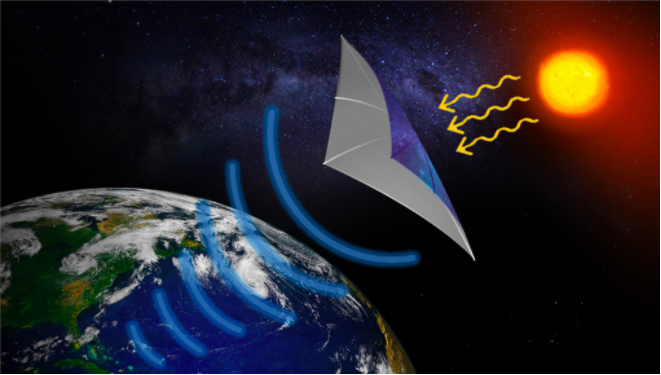
Technologies are maturing to enable space-based solar power beaming to Earth and to other satellites on orbit. (AFRL graphic)
WASHINGTON — Virginia-based startup Overview Energy has been contracted by the Pentagon’s Operational Energy Capability Improvement Fund (OECIF) to demonstrate a key enabling technology for beaming solar energy to users on Earth, according to a company announcement.
Under the contract, Overview will design, build, and test the homing beacon for the company’s satellite-based solar energy system, which converts the Sun’s radiation to near-infrared light to safely transmit power to terrestrial power plants, the Sept. 30 announcement said.
“Ground crews install the beacon at solar receiver sites, enabling Overview satellites to locate the site, lock on, and beam power with high precision. The system requires an active, authenticated beacon before a satellite transmits energy, which prevents signal spoofing and hijacking,” the announcement elaborated.
The OECIF contract is one of several Defense Department research programs on space-based solar power moving ahead in recent years, after decades of fits and starts for the futuristic but potentially revolutionary tech.
“Delivering reliable power to remote and contested locations remains one of the military’s most persistent operational challenges,” Christopher DePuma, Combat Power Portfolio Lead at OECIF, said in the announcement.
“Overview Energy’s technology opens up a new source of reliable power, and the homing beacon ensures precise, secure power delivery from orbit to an authenticated destination. This award advances key technology to bring resilient energy safely to the warfighter,” he added.
According to a Pentagon fact sheet issued by the Office of the Assistant Secretary of Defense for Energy Resilience and Optimization, the OECIF is a “joint operational energy investment program” aimed at “pre-commercialization” technology.
How the industrial base is responding to Air Force, Space Force needs
Demand signals from leadership are shaping investments in design, engineering and manufacturing.
“Through highly targeted science and technology investments, it guides and matures advanced, first-of-a-kind operational energy technologies across warfighting platforms and domains,” the fact sheet says.
Overview’s announcement did not include the contract’s value or the projected data of the on-orbit experiment.
A company spokesperson told Breaking Defense that the demo is planned for early next year, but declined to provide a contract value citing customer constraints on releasing that information.
This isn’t a first defense-related contract for the Virginia startup. In May, the Air Force contracted Overview for a year-long study on the use cases in which space-based solar power could supply electricity “in constrained and contested logistics environments.”
Nor is it the first OECIF contract for a space-based solar power demonstration — as Defense Department interest grows in the potential for rapidly getting power supplies to far-flung bases and into the battlefield without relying on expensive, slow and vulnerable air, sea and land logistics operations.
Katalyst Space on Sept. 21 announced it had been tapped by OECIF to “develop and launch a robotic spacecraft that will assemble a large-format power beaming system on orbit and transmit power back to Earth.”
Katalyst’s Advanced Scalable Growth Architecture for Robotic Deployment (ASGARD) program also is building satellites to harvest the Sun’s rays, but is using microwaves instead of near-infrared to transmit the energy. The microwaves are generated on-board by conversion tiles developed by the Naval Research Laboratory, which has been involved in research on space-based solar power and microwave transmission for a number of years.
Katalyst’s announcement did not reveal the contract’s value, nor the planned date of the demonstration. The company did not respond to a request for comment.
The Pentagon’s Office of Public Affairs did not respond to a request for comment about the two contracts and OECIF’s larger interest in space-based solar power.
技术日趋成熟,有望实现从太空向地球和其他在轨卫星传输太阳能。(AFRL 图示)
华盛顿——据该公司公告称,总部位于弗吉尼亚州的初创公司 Overview Energy 已与五角大楼的作战能源能力改进基金 (OECIF) 签订合同,以展示一项将太阳能传输到地球上用户的关键使能技术。
根据合同,Overview公司将为该公司的卫星太阳能系统设计、建造和测试归航信标,该系统可将太阳辐射转换为近红外光,从而安全地将电力传输到地面发电厂。9月30日的公告称。
公告进一步解释说:“地面工作人员在太阳能接收器站点安装信标,使Overview卫星能够定位站点、锁定目标并高精度地发射功率。该系统要求卫星在发射能量之前必须有一个激活的、经过认证的信标,这可以防止信号欺骗和劫持。”
OECIF 合同是国防部近年来推进的几个太空太阳能发电研究项目之一,此前这项具有未来意义但可能具有革命性的技术经历了数十年的断断续续的发展。
“向偏远和受战地区提供可靠的电力仍然是军队面临的最持久的作战挑战之一,”OECIF 作战力量组合负责人克里斯托弗·德普马在公告中表示。
“Overview Energy公司的这项技术开辟了一种新的可靠能源,其定位信标确保了从轨道到指定目的地的精确、安全的电力输送。这项授标推进了关键技术的发展,能够安全地为作战人员提供可靠的能源,”他补充道。
根据国防部负责能源韧性和优化的助理部长办公室发布的五角大楼情况说明书,OECIF 是一项“联合运营能源投资计划”,旨在推进“商业化前”技术。
工业基础如何响应空军和太空军的需求
领导层的需求信号正在影响着设计、工程和制造领域的投资。
“通过有针对性的科技投资,它指导和完善了各个作战平台和领域中先进的、独一无二的作战能源技术,”情况说明书上写道。
Overview 的公告并未包含合同金额或在轨实验的预计数据。
该公司发言人告诉《防务新闻》,演示计划于明年初进行,但以客户限制发布该信息为由,拒绝透露合同金额。
这并非这家弗吉尼亚州初创公司首次获得国防相关合同。今年5月,美国空军与Overview公司签订了一份为期一年的研究合同,探讨在“资源受限和竞争激烈的后勤环境中”,太空太阳能发电的应用场景。
这也不是 OECIF 首次签订太空太阳能发电示范合同——国防部对快速向偏远基地和战场提供电力供应,而无需依赖昂贵、缓慢且易受攻击的空中、海上和陆地后勤行动的潜力越来越感兴趣。
Katalyst Space 于 9 月 21 日宣布,OECIF 已委托该公司“开发和发射一艘机器人航天器,该航天器将在轨道上组装一个大型电力传输系统,并将电力传输回地球”。
Katalyst公司的“先进可扩展机器人部署增长架构”(ASGARD)项目也在建造卫星来收集太阳能,但它使用微波而非近红外线来传输能量。这些微波由海军研究实验室开发的转换瓦片在卫星上产生。海军研究实验室多年来一直致力于空间太阳能和微波传输的研究。
Katalyst的公告并未透露合同金额,也未公布演示的计划日期。该公司未回应置评请求。
五角大楼公共事务办公室没有回应有关这两份合同以及OECIF对太空太阳能发电的更大兴趣的置评请求。