Inside Ukraine’s First Combat Deployment Of Robotic Amphibious Vehicles走进乌克兰首次两栖机器人作战部署
The commander of a Ukrainian uncrewed ground vehicle unit gives us exclusive insights into how vehicles were designed or modified for amphibious combat operations.
Published Oct 1, 2026 3:20 PM EDT
Taking a break from fighting Russians in the Kostiantynivka sector of the eastern Donetsk region, the commander of a Ukrainian uncrewed ground vehicle (UGV) unit spoke with us about innovations in the use of these systems. One was the first deployment of a UGV specifically designed for amphibious operations to deliver supplies to frontline troops in areas impeded by water obstacles. Large areas of the front line are bisected by rivers and wetlands, and the country has many other small waterways and marsh areas. As we have frequently reported , the use of UGVs by both Ukraine and Russia has exploded as the ubiquity of aerial attack drones makes it far too dangerous for human battlefield movements.
In an exclusive interview with TWZ , the commander of the 93rd Separate Mechanized Brigade’s “Alter Ego” UGV unit, who goes by the call sign “Electric,” offered us unique insights into the challenges of developing amphibious UGVs and how they were deployed.
In the first of two parts, Electric talks about why Alter Ego developed amphibious UGVs – including modifying a Triton variant for this – and how the unit made them work. The second part features his insights into using heavy ‘bomber drones’ to drop UGVs behind enemy lines for kamikaze raids. In addition, a representative of Brave1, Ukraine’s weapons technology accelerator, spoke about developing these systems at scale.
Some of the questions and answers have been slightly edited for clarity.
Q: How did the need for amphibious UGVs for logistics operations first come up?
A: We had this idea for a long time, but recently one of the departments of the Ministry of Defense asked for our help to solve this problem, so that the UGV could overcome water obstacles.
There was a crucial need for this kind of means at certain parts of the front, but the units that are located there didn’t have the capacity by themselves to solve this task. So our battalion was asked to solve this problem because we are one of the most experienced units in terms of UGVs.
A first-ever logistics mission on an amphibious UGV: the robot covered 40 kilometers across land and water. Operators of the "Alter Ego" unit (93rd Brigade) deployed the robotic system across mixed terrain. Facing water obstacles, the UGV seamlessly switched to swimming mode to… pic.twitter.com/rH8waq04a4 — BRAVE1 (@BRAVE1ua) September 29, 2026
A first-ever logistics mission on an amphibious UGV: the robot covered 40 kilometers across land and water. Operators of the "Alter Ego" unit (93rd Brigade) deployed the robotic system across mixed terrain. Facing water obstacles, the UGV seamlessly switched to swimming mode to… pic.twitter.com/rH8waq04a4
Q: How long did it take to design and test the amphibious UGV, and what went into that process?
A: The whole process from development to battle deployment took less than three months.
Q: What did you have to do to make this work?
A: First of all, we looked at amphibious solutions that were on the market, not only in Ukraine, but in the world, and we took two separate approaches. One was taking one of the main UGVs that our unit is using on the ground, and we made it amphibious. And the other approach was that we took one of the solutions that was on the market that already had amphibious capabilities, and we solved several disadvantages that it had. And at the moment, we are using both.
Q: What did you have to do to make the UGV amphibious, and then what were some of the obstacles that had to be overcome to get this operational?
A: First of all, we have to explain that there are different solutions on the market that kind of work on the testing ground — like they can swim, they can drive on the ground, and in the vision of the manufacturer, they are working. But the fact is that these solutions are not ready for the reality on the front line, which is often very different from what is on the testing ground.
And the second point is that the unit has its own workshops where people work near the front line, and the experts, the engineers that work there, they have a very high level of competence to evaluate different solutions and select the one that has potential. And that’s what’s completely different between this unit and everyone else, like manufacturers and others who are working on these solutions, because they don’t understand what’s needed on the battlefield.
The Alter Ego unit’s amphibious uncrewed ground vehicle in action. (Brave1 screencap)
Q: So what did you have to change to make it work?
A: Regarding the amphibious one, basically the unit changed almost everything that that UGV had, starting from electronics, the software, the waterproofing, the communications – we basically changed everything. Regarding the one that we already used on the ground, we basically tried to retain what was allowing it to be an effective UGV on the ground, and we added waterproofing and specific mechanics, so that it can work in the water environment.
Q: You mentioned communications. What kind of communications did you add?
A: The communication means that was installed on the UGV by the manufacturer was not sufficient at all. Basically, it didn’t have enough quality for the battlefield situation. It was not working. But we already have our own communications that we were working on, and we have a lot of experience because we have been working for a long time in this UGV area. So we basically helped to install a sufficient level of communications on this UGV.
Q: So how does the amphibious UGV communicate with the controller? Does it use Starlink or some other satellite communications system for navigation?
A: This is satellite navigation, but not only. Satellite navigation is a part of this communication system.
Q: What are the other parts?
A: It’s better not to talk in detail about the other part of the communication system.
Triton amphibious UGV communications and camera systems. (Brave1)
Q: There were probably a lot of different missions that could have been used for this first amphibious UGV logistics delivery. Why was this particular mission chosen?
A: The Alter Ego unit has so much experience in terms of UGVs, and not just experience of using UGVs, but the experience of being the first in the world. We had one of the first evacuation missions, we had one of the first strike missions using UGVs, the paratrooper UGV, and now the amphibious UGV. So basically, we have the systems to make it work for the first time when nobody knows how to conduct this mission.
Q: No, I mean why did this particular mission get chosen to be the first one?
A: There are certain places on the front line where we have water obstacles that prevent logistics from being done by UGV. At the moment, UGVs are carrying hundreds of tons of logistics, probably the most compared to any other means on the front line, but before this, these water obstacles would prevent UGVs from providing logistics for those parts of the front, and that need can’t be fully satisfied by UAVs or other means. That’s why we did this mission with the amphibious UGV, and now our task here is to scale this technology and provide this logistics system for other similar parts of the front where there are water obstacles.
Kostiantynivka, Ukraine. (Google Earth)
Q: Tell me about where and when this mission took place and what it was like to watch it unfold.
A: So unfortunately, we can’t provide information about when and where this operation took place. But regarding how it went and what we felt, this was another big challenge, because this is something that wasn’t done before, and nobody thought this is real. So this was quite difficult, and to tell the truth, the mission didn’t succeed on the first try, actually, and it required a lot of effort in terms of planning, preparing, engineering, and basically it required 100% effort from everyone involved in that mission.
Q: How many times did it fail before, and what went wrong?
A: We had one failed attempt. The reason for failure was a certain technical problem. After that, we analyzed what went wrong, and we worked on solving those issues. Basically, it’s something that nobody had tried to do, it’s kind of hard to know what can go wrong before you actually try it. So the best way to find a solution like that is to try and then iterate on that attempt and make it better and better and better.
Also, I would like to add that although this was the first successful mission regarding an amphibious UGV, it’s not that there was no work on that before that. We were actively talking to and collecting the experience of everyone who was working on these kinds of missions before, and that was also a reason why this mission succeeded.
Q: How far did the amphibious UGV go for this mission?
A: So the UGV went 40 kilometers one way, and then it returned. So probably around 70 kilometers in total, and it carried food and other supplies.
Q: Did this UGV come under Russian fire on this mission?
A: Yes, and it survived.
Q: How does the UGV switch from water to land operations?
A: So the UGV has two separate control systems, one for water and one for land, and basically it switches to the one that is required at the moment. That’s how it can operate in both environments.
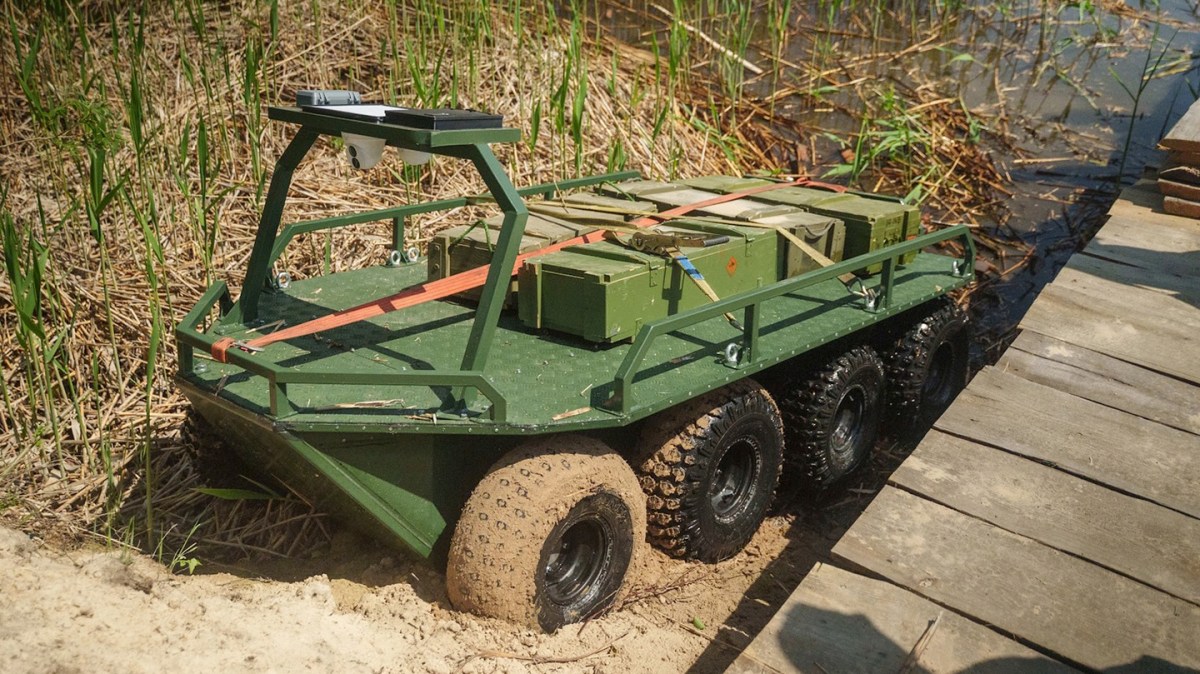
The Alter Ego unit’s uncrewed amphibious ground vehicle (UGV). (Brave1)
Q: Is that autonomous, or is that something that the controller at the base has to do as they watch the UGV on its mission?
A: At the moment, the operator fully controls the UGV manually. And basically, before, the operators of UGVs only knew how to move them on land, but now they also had to learn how to move them in the water. So not only was the technology itself developed, but we also had to prepare the operator and come up with tactics for this UGV.
Q: Did you use AI on this mission in any way, and if so, how?
A: We didn’t use AI.
Q: Have there been other missions using amphibious UGVs?
Q: Can you say how many and what was delivered?
Q: Is this designed only for logistics missions, or will it be used in the future for strike missions, either as a one-way attack system or as a platform for machine guns or other weapons?
A: We can use it in different ways in the future.
Q: Mud season is fast approaching, when much maneuvering becomes impossible or severely degraded because of how difficult it is to move in the thick, oozing slop. Will your amphibious UGVs work in the mud?
A: I think it can operate in the mud in the same way it operates in the water.
In the next segment of our interview, Electric talks about using bomber drones to deliver UGVs behind the lines, and a Brave1 representative talks about how the organization is working to develop these systems at scale for wider use.
Contact the author: howard@twz.com
Comments couldn’t be loaded. Please refresh the page.
发布于美国东部时间2026年10月1日下午3:20
在顿涅茨克东部科斯蒂安蒂尼夫卡地区与俄军交战间隙,一位乌克兰无人地面车辆(UGV)部队指挥官与我们谈到了这些系统使用方面的创新。其中一项创新是首次部署专为两栖作战设计的UGV,用于向受水域障碍影响的前线部队运送补给。前线大片区域被河流和湿地分割,乌克兰境内还有许多其他小型水道和沼泽地。正如我们多次报道的那样,随着空中攻击无人机的普及,人类在战场上的行动变得过于危险,乌克兰和俄罗斯对UGV的使用都呈爆炸式增长。
在接受 TWZ 的独家采访时,第 93 独立机械化旅“另一个自我”无人地面车辆部队的指挥官(代号“Electric”)向我们提供了关于开发两栖无人地面车辆所面临的挑战以及它们的部署方式的独特见解。
在分为两部分的访谈中,第一部分中,Electric 讲述了 Alter Ego 部队为何研发两栖无人地面车辆(UGV),包括为此对 Triton 无人机进行改装,以及该部队如何使其正常运作。第二部分则着重介绍了他关于使用重型“轰炸无人机”将 UGV 空投至敌后执行自杀式袭击的见解。此外,乌克兰武器技术加速器 Brave1 的一位代表也谈到了这些系统的规模化研发。
为了更清晰地表达,部分问答内容略有修改。
问:最初是如何产生对用于后勤作业的两栖无人地面车辆的需求的?
A:我们早就有了这个想法,但最近国防部的一个部门请求我们帮助解决这个问题,以便无人地面车辆能够克服水障碍。
前线某些地区急需这类装备,但驻扎在那里的部队自身没有能力完成这项任务。因此,我们营被委派解决这个问题,因为我们是无人地面车辆方面经验最丰富的部队之一。
史上首次两栖无人地面车辆(UGV)后勤任务:该机器人跨越陆地和水域,行程达40公里。隶属于“Alter Ego”部队(第93旅)的操作人员在混合地形上部署了这套机器人系统。面对水障碍,UGV无缝切换至游泳模式…… pic.twitter.com/rH8waq04a4 — BRAVE1 (@BRAVE1ua) September 29, 2026
两栖无人地面车辆(UGV)首次执行后勤任务:该机器人跨越陆地和水域,行程达40公里。隶属于“Alter Ego”部队(第93旅)的操作人员在混合地形上部署了这套机器人系统。面对水障碍,UGV无缝切换至游泳模式…… pic.twitter.com/rH8waq04a4
问:设计和测试两栖无人地面车辆花了多长时间?这个过程都包含哪些内容?
答:从研发到实战部署的整个过程用时不到三个月。
问:为了实现这个目标,你都做了哪些努力?
答:首先,我们考察了市面上现有的两栖解决方案,不仅包括乌克兰的,也包括全球的,我们采取了两种不同的方法。一种方法是将我们部队目前在地面使用的主要无人地面车辆之一改装成两栖车辆。另一种方法是选择市面上已有的两栖解决方案,并解决其存在的一些缺点。目前,我们两种方法都在使用。
问:为了使无人地面车辆具备两栖能力,你们做了哪些工作?为了使其投入使用,你们克服了哪些障碍?
答:首先,我们必须解释,市面上有一些解决方案在测试场地上似乎有效——比如它们可以游泳,可以在陆地上行驶,在制造商看来,它们确实有效。但事实是,这些解决方案还无法应对一线作战的实际情况,而一线作战环境往往与测试场地截然不同。
第二点是,该部队拥有自己的车间,人员在前线附近工作,那里的专家和工程师具备极高的专业水平,能够评估不同的解决方案并选择最具潜力的方案。这正是该部队与其他所有机构(例如制造商和其他从事此类解决方案研发的机构)的根本区别所在,因为后者并不了解战场上的实际需求。
“另一个自我”小队的无人两栖地面车辆正在作战。(Brave1游戏截图)
问:那么,为了实现这个目标,你做了哪些改变?
答:关于两栖型无人地面车辆,基本上我们对原有的无人地面车辆进行了全面改造,包括电子设备、软件、防水系统、通信设备等等——几乎所有方面都进行了更换。至于我们之前在陆地上使用的那款,我们尽量保留了它作为陆地无人地面车辆的有效性,并增加了防水装置和特定的机械结构,使其能够在水下环境中运行。
问:您提到了沟通。您增加了哪些类型的沟通?
答:制造商安装在无人地面车辆上的通信设备完全不够用。基本上,它的质量无法满足战场环境的要求,根本无法正常工作。但我们有自己研发的通信系统,而且我们在无人地面车辆领域拥有丰富的经验,因为我们长期从事这方面的工作。所以我们协助为这辆无人地面车辆安装了足够好的通信系统。
问:那么,两栖无人地面车辆是如何与控制器通信的?它是否使用星链或其他卫星通信系统进行导航?
答:这是卫星导航,但不仅限于此。卫星导航是该通信系统的一部分。
问:其他部分是什么?
A:最好不要详细讨论通信系统的其他部分。
Triton两栖无人地面车辆通信和摄像系统。(Brave1)
问:这次首次两栖无人地面车辆后勤运输任务可能有很多不同的用途。为什么最终选择了这项任务?
答:Alter Ego部队在无人地面车辆(UGV)方面拥有非常丰富的经验,不仅是使用UGV的经验,更是全球首创。我们执行过最早的撤离任务之一,也执行过最早的UGV打击任务之一,包括伞兵UGV,现在又有了两栖UGV。所以基本上,我们拥有在无人知晓如何执行此类任务的情况下,率先成功完成任务的系统。
问:不,我的意思是,为什么选择这个任务作为第一个任务?
答:前线某些区域存在水域障碍,阻碍了无人地面车辆(UGV)的后勤运输。目前,UGV 每天运送数百吨后勤物资,可能是前线其他任何运输方式中运载量最高的。但在此之前,这些水域障碍会阻碍 UGV 为这些区域提供后勤保障,而无人机或其他方式也无法完全满足这一需求。因此,我们才开展了这项两栖 UGV 任务。现在,我们的任务是推广这项技术,并将这套后勤系统推广到其他存在类似水域障碍的前线区域。
乌克兰科斯蒂安蒂尼夫卡。 (谷歌地球)
问:请告诉我这次任务发生的地点和时间,以及目睹整个过程的感受。
答:很遗憾,我们无法提供关于此次行动的时间和地点的信息。但就行动过程和我们的感受而言,这又是一次巨大的挑战,因为这是前所未有的尝试,而且没人相信这是真的。所以难度相当大,说实话,这次任务实际上并没有一次成功,它需要在计划、准备、工程等方面投入大量精力,基本上需要所有参与人员付出百分之百的努力。
问:之前失败过多少次?都出了什么问题?
答:我们有过一次失败的尝试。失败的原因是某个技术问题。之后,我们分析了问题所在,并着手解决这些问题。基本上,这是没人尝试过的事情,在实际尝试之前很难预料到会出什么问题。所以,找到这类解决方案的最佳方法就是不断尝试,然后反复迭代,使其越来越好。
此外,我想补充一点,虽然这是首次成功执行两栖无人地面车辆任务,但这并不意味着之前没有进行过相关工作。我们积极与所有参与过此类任务的人员交流并收集经验,这也是此次任务成功的原因之一。
问:这辆两栖无人地面车辆在此次任务中行驶了多远?
答:所以无人地面车辆单程行驶了40公里,然后返回。所以总共可能行驶了大约70公里,它运送了食物和其他补给品。
问:这辆无人地面车辆在这次任务中是否遭到俄军炮火攻击?
A:是的,它幸存了下来。
问:无人地面车辆如何从水上作业切换到陆地作业?
答:所以这辆无人地面车辆有两个独立的控制系统,一个用于水上,一个用于陆地,它会根据当前需要自动切换到相应的系统。这就是它能够在两种环境下运行的原因。
“另一个自我”部队的无人两栖地面车辆(UGV)。(Brave1)
问:这是自主的,还是基地控制人员在监视无人地面车辆执行任务时必须执行的操作?
答:目前,操作员完全手动控制无人地面车辆(UGV)。以前,UGV操作员基本上只知道如何在陆地上驾驶它们,但现在他们还必须学习如何在水中驾驶。因此,我们不仅要开发技术本身,还要培训操作员并制定相应的战术。
问:你们在这次任务中是否以任何方式使用了人工智能?如果使用了,是如何实现的?
答:我们没有使用人工智能。
问:之前还有其他使用两栖无人地面车辆执行的任务吗?
问:请问交付了多少件产品以及交付了哪些物品?
问:这是否仅设计用于后勤任务,还是将来会用于打击任务,无论是作为单向攻击系统还是作为机枪或其他武器的平台?
A:将来我们可以用它做很多不同的事情。
问:泥泞季节即将到来,届时由于在厚厚的、黏稠的泥浆中行驶极其困难,许多机动操作将变得不可能或严重受限。你们的两栖无人地面车辆能在泥泞中作业吗?
A:我认为它在泥泞中也能像在水中一样运作。
在接下来的采访中,Electric 谈到了使用轰炸无人机向敌后运送无人地面车辆,而 Brave1 的一位代表则谈到了该组织如何致力于大规模开发这些系统,以便更广泛地使用。
联系作者:howard@twz.com
评论加载失败,请刷新页面。