‘Scam vaccines’ built by GovTech unit aims to help Singaporeans fight the real threat政府科技局研发的“骗局疫苗”旨在帮助新加坡人对抗真正的威胁
Singapore residents are being invited to take part in an open call to be inoculated against scams. GovTech’s Open Government Products unit will administer a digital Scam Vaccine through realistic, AI-powered simulations. Read more at straitstimes.com.
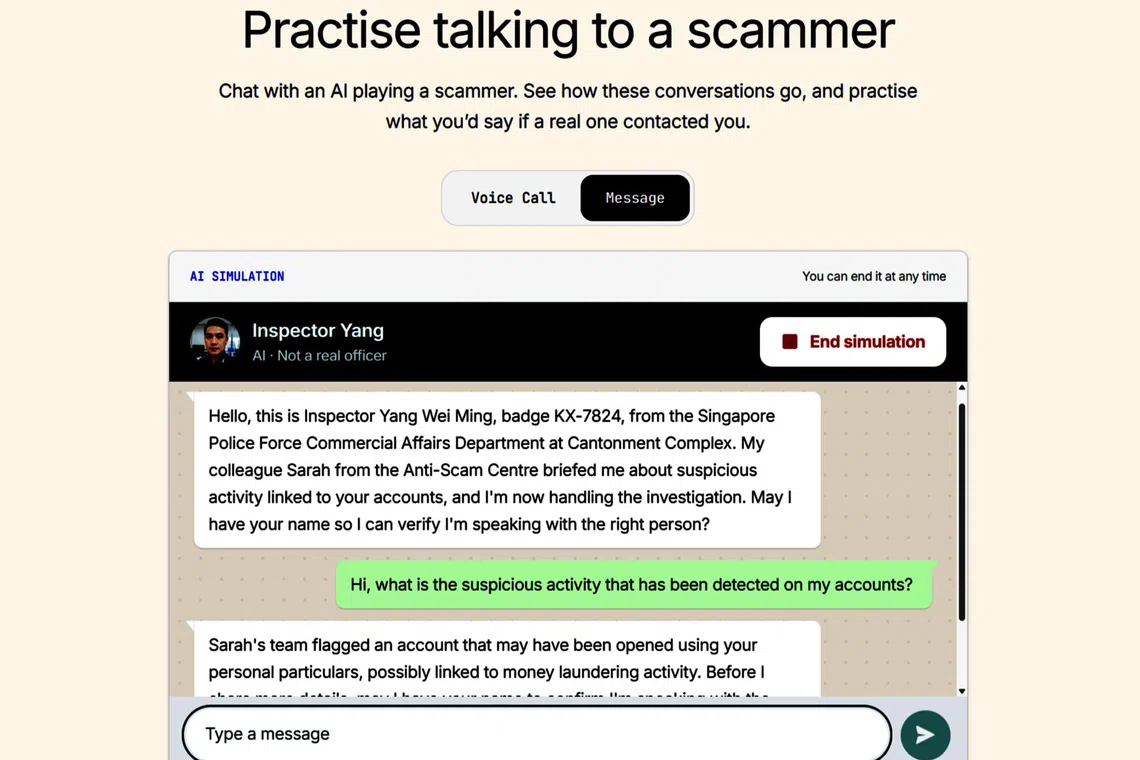
A demonstration of a simulated scam that the public can try out on the Scam Vaccine site. Participants are encouraged to push back and question the scammer’s logic.
PHOTO: SCREENGRAB FROM SCAM VACCINE
Published Oct 02, 2026, 03:45 PM
Updated Oct 02, 2026, 03:45 PM
SINGAPORE – An open call has been made for Singapore residents to be inoculated against scams .
A digital Scam Vaccine, developed by GovTech’s unit Open Government Products (OGP), will be administered in the form of realistic artificial intelligence-powered simulations.
Participants who sign up will be put through live, unscripted scam tactics over phone calls and WhatsApp messages in a controlled and safe environment. Participants will not be warned beforehand, much like a fire drill.
The aim is to close the gap between the detection of a new scam and public awareness of it, OGP’s lead product manager, Tay Paul Hong, told The Straits Times.
The development of Scam Vaccine began in January during the agency’s annual Hack for Public Good hackathon.
“The team wanted to test whether people could build familiarity with scam tactics before encountering the real thing, similar to the principle of inoculation.”
As at Oct 2, over 700 residents have indicated their interest since sign-ups opened on Sept 20. Users submit their name, Singapore mobile number and age range to register.
Scam Vaccine works by replicating new scam variants and sending safe, simulated versions via phone call or WhatsApp to registered participants.
Government official impersonation, e-commerce, investment and love scams were among the most common scam types reported in Singapore in 2026.
New scam variants are detected through public reports submitted to ScamShield, built by OGP with the police, Ministry of Home Affairs and National Crime Prevention Council.
The public can download the ScamShield app , which works in the background to silently block incoming calls from phone numbers that are blacklisted in the official ScamShield database.
Recreating elements of real scams such as channels used, conversational tactics and progression of the scam help to make the simulations convincing, said Tay.
“AI can also respond dynamically to what a participant says while remaining within the parameters of the particular scam scenario,” he added.
Built-in safety features ensure that participants will not lose money, install malware or have their data leaked to third parties. The system also monitors signs of stress and will end the simulation if a high stress threshold is reached.
“We only send simulations when we detect a scam pattern worth training for, so some periods may be quiet and others may have an occasional exercise,” said OGP on its Scam Vaccine site.
At the end of each simulation, participants will receive a tailored debrief based on how they fared. The report will include the red flags that participants were able to catch and the details to watch out for in the future.
Users who have a query, face an issue or want to share feedback can contact OGP at support@scamvaccine.gov.sg .
Marketing director Louis Sim, who receives scam calls and texts around twice a week, said he is keen to sign up as he believes it could provide a valuable learning experience without any real-world consequences.
“But I’m interested to see if this could inadvertently create a false sense of confidence. Someone might become good at spotting scams they’ve been trained on, but still be vulnerable to a new or unfamiliar approach,” said the 37-year-old.
“I hope more testing and evaluation will be done to determine whether the programme actually changes behaviour and improves people’s responses to real threats.”
This is among the key metrics that the team at OGP is working on, said Tay, adding that the simulated scams can provide behavioural insights into how people respond, which are findings that can help refine the exercise.
Civil servant Agnes Tan, 50, said she is worried that her 80-year-old mum, who receives scams calls and texts occasionally, might confuse real scams for a drill if she signs up to be part of the simulation.
“I think simple and clear instructions, like don’t entertain strange calls and messages, will work better for the elderly,” said Tan.
GovTech/Government Technology Agency
Internet crimes and scams
这是“诈骗疫苗”网站上的一个模拟诈骗演示,公众可以亲自体验。我们鼓励参与者质疑骗子的逻辑。
图片:来自诈骗疫苗网站的截图
发布于 2026 年 10 月 2 日下午 3:45
更新于2026年10月2日下午3:45
新加坡——新加坡政府公开呼吁居民提高防范诈骗的意识。
由政府科技局下属的开放政府产品部门(OGP)开发的数字防诈骗疫苗,将以逼真的人工智能模拟的形式进行推广。
报名参与者将在受控且安全的环境下,通过电话和WhatsApp信息,体验真实、未经事先安排的诈骗手段。参与者不会事先收到任何警告,就像消防演习一样。
OGP首席产品经理Tay Paul Hong告诉《海峡时报》,其目标是缩小发现新骗局与公众意识到该骗局之间的差距。
Scam Vaccine 的开发始于 1 月份,当时该机构正在举办一年一度的“为公共利益而黑客马拉松”。
“该团队想测试人们是否能在遇到真正的诈骗之前熟悉诈骗手段,类似于接种疫苗的原理。”
截至10月2日,自9月20日开放注册以来,已有超过700名居民表示有兴趣。用户需提交姓名、新加坡手机号码和年龄范围进行注册。
诈骗疫苗的运作方式是复制新的诈骗变种,并通过电话或 WhatsApp 向注册参与者发送安全的模拟版本。
2026年新加坡报告的最常见的诈骗类型包括:冒充政府官员、电子商务诈骗、投资诈骗和爱情诈骗。
通过向 ScamShield 提交的公众报告来检测新的诈骗变种,ScamShield 由 OGP 与警方、内政部和国家预防犯罪委员会共同建立。
公众可以下载 ScamShield 应用,该应用会在后台静默运行,阻止来自官方 ScamShield 数据库中黑名单电话号码的来电。
Tay表示,重现真实诈骗的要素,例如使用的渠道、对话策略和诈骗的进展,有助于使模拟更加可信。
他还补充说:“人工智能还可以根据参与者的发言做出动态反应,同时保持在特定诈骗场景的参数范围内。”
内置安全功能确保参与者不会蒙受金钱损失、安装恶意软件或数据泄露给第三方。系统还会监测压力迹象,并在压力达到过高阈值时终止模拟。
OGP在其“诈骗疫苗”网站上表示:“我们只在检测到值得训练的诈骗模式时才会发送模拟演练,因此有些时期可能比较平静,而另一些时期可能会偶尔进行演练。”
每次模拟结束后,参与者都会收到一份根据其表现量身定制的总结报告。报告将包括参与者发现的风险信号以及未来需要注意的细节。
如有疑问、遇到问题或想分享反馈,用户可联系 OGP,邮箱地址为 support@scamvaccine.gov.sg。
市场总监路易斯·西姆表示,他每周大约会接到两次诈骗电话和短信,他很乐意注册,因为他相信这可以提供宝贵的学习经验,而不会带来任何现实后果。
“但我很想看看这是否会在无意中造成一种虚假的自信。有些人可能很擅长识别他们接受过培训的骗局,但仍然容易受到新的或不熟悉的骗局的侵害,”这位37岁的男子说道。
“我希望进行更多测试和评估,以确定该计划是否真的能改变人们的行为并改善人们对真实威胁的反应。”
Tay表示,这是OGP团队正在研究的关键指标之一,他还补充说,模拟诈骗可以提供关于人们如何应对的行为洞察,这些发现可以帮助改进演练。
50岁的公务员陈艾格尼丝表示,她担心自己80岁的母亲偶尔会接到诈骗电话和短信,如果她报名参加模拟演习,可能会把真正的诈骗误认为是演习。
“我认为简单明了的指示,比如不要接听陌生来电和回复陌生短信,对老年人来说会更有效,”谭说道。
政府科技局/政府技术局
网络犯罪和诈骗