White House unveils ‘super intelligence’ executive order and industry accord白宫公布“超级智能”行政命令和行业协议
The vice president heralded the administration’s preference for working with, instead of regulating, artificial intelligence companies during Tuesday remarks.
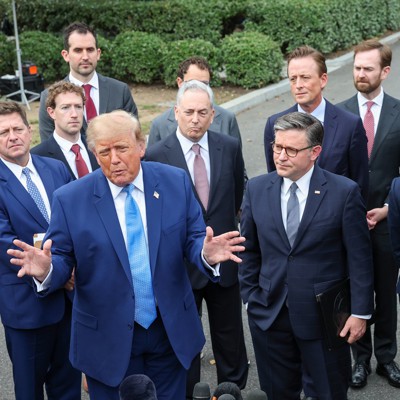
President Donald Trump holds a press briefing with AI executives following a meeting on artificial intelligence, outside the White House on September 29, 2026. Kevin Dietsch / Getty Images
The vice president heralded the administration’s preference for working with, instead of regulating, artificial intelligence companies during Tuesday remarks.
Artificial Intelligence
President Donald Trump signed an executive order Tuesday instructing agencies to refer to artificial intelligence as “super intelligence” in official correspondence, public communications, websites, reports, policy documents and other non-statutory documents.
The order gives the assistant to the president for science and technology 60 days to submit, in consultation with agency heads, proposed legislative language establishing a definition for super intelligence, or SI.
That assessment will include whether SI should modify, expand upon or supersede the legal definition of AI. Trump unveiled the term “super intelligence” last week at the United Nations General Assembly and teased that it would become federal policy at a launch event for America.gov on Tuesday.
The order came hours after Trump and top administration officials met at the White House to discuss AI safety. During the meeting, leaders of major technology companies signed an accord on frontier model safety.
AI safety “starts with every company that is training and deploying frontier models having robust internal processes and controls to ensure that their technology behaves as intended and that any issues are promptly identified and resolved,” according to a copy of the accord.
The document says a participating company will have four layers of controls and audits: “robust internal controls to monitor the capabilities and alignment of its models during training and deployment around areas like cybersecurity,” an internal team to oversee controls, partnerships with independent external auditors and a designated independent committee to oversee reports from internal teams and external auditors.
The accord was signed by Trump, Google CEO Sundar Pichai, Anthropic CEO Dario Amodei, Meta CEO Mark Zuckerberg, OpenAI President Greg Brockman, xAI CEO Elon Musk and NVIDIA President and CEO Jensen Huang.
“We agreed to a number of things that include joint monitoring, board special committees, just generally grading each other’s homework,” Musk said at the America.gov launch event Tuesday afternoon.
The accord and AI rebranding come just months after an OpenAI model escaped its testing environment and hacked into Hugging Face. The accord also comes as lawmakers on both sides of the aisle continue to fight over new measures to ensure AI products are safe.
Vice President JD Vance also delivered remarks Tuesday afternoon where he defended the administration’s preference for working with, rather than regulating, top AI companies.
“The solution to some of the AI risks is for you guys to take the risk seriously, not to come to the government for a regulatory regime that may make things worse if it’s not smart and careful,” Vance added.
But Vance threw cold water on proposals to create a Food and Drug Administration- or Federal Aviation Administration-style regulatory body to oversee frontier models.
“The problem with that is one you have to get regulators who are actually smart about what’s going on and most bureaucrats just know way less about this than the people who are actually building these products,” Vance said.
The vice president argued that the Federal Trade Commission and Justice Department already have the authority to hold AI developers responsible for creating products that harm consumers.
NEXT STORY: Polish defense official says US has decided to establish a base in Poland
2026年9月29日,美国总统唐纳德·特朗普在白宫外与人工智能高管举行新闻发布会,此前他们举行了一次关于人工智能的会议。图片来源:Kevin Dietsch / Getty Images
副总统在周二的讲话中表示,本届政府更倾向于与人工智能公司合作,而不是对其进行监管。
人工智能
周二,唐纳德·特朗普总统签署了一项行政命令,指示各机构在官方信函、公共通讯、网站、报告、政策文件和其他非强制性文件中将人工智能称为“超级智能”。
该命令赋予总统科学技术助理 60 天的时间,与各机构负责人协商,提交关于超级智能(SI)定义的立法提案。
评估内容将包括“超级智能”是否应修改、扩展或取代人工智能的法律定义。特朗普上周在联合国大会上首次提出“超级智能”一词,并在周二举行的America.gov网站启动仪式上暗示,这将成为联邦政策。
就在特朗普与高级政府官员在白宫会晤讨论人工智能安全问题的几个小时后,这项命令便下达了。会晤期间,主要科技公司的领导人签署了一项关于前沿模型安全的协议。
根据该协议的副本,人工智能安全“始于每个训练和部署前沿模型的公司都拥有强大的内部流程和控制措施,以确保其技术按预期运行,并及时发现和解决任何问题”。
该文件称,参与公司将有四层控制和审计:“健全的内部控制,用于监控其模型在网络安全等领域的培训和部署期间的能力和一致性”;一个内部团队来监督控制;与独立的外部审计师建立合作关系;以及一个指定的独立委员会来监督内部团队和外部审计师的报告。
该协议由特朗普、谷歌首席执行官桑达尔·皮查伊、Anthropic 首席执行官达里奥·阿莫迪、Meta 首席执行官马克·扎克伯格、OpenAI 总裁格雷格·布罗克曼、xAI 首席执行官埃隆·马斯克和英伟达总裁兼首席执行官黄仁勋签署。
“我们达成了一些共识,包括联合监督、董事会特别委员会,以及互相点评彼此的工作成果,”马斯克周二下午在 America.gov 启动仪式上说。
就在几个月前,OpenAI 的一个模型逃逸出测试环境并入侵了 Hugging Face 程序。与此同时,这项协议和人工智能品牌重塑也随之而来。此外,两党议员仍在就确保人工智能产品安全的新措施展开激烈争论。
周二下午,副总统 JD Vance 也发表了讲话,他在讲话中为政府倾向于与顶尖人工智能公司合作而不是监管它们的做法辩护。
“解决人工智能部分风险的办法是,你们要认真对待这些风险,而不是向政府寻求监管机制,因为如果监管机制不够明智和谨慎,反而可能会使情况变得更糟,”万斯补充道。
但万斯对建立类似美国食品药品监督管理局或联邦航空管理局的监管机构来监管前沿机型的提议泼了一盆冷水。
“问题在于,你必须找到真正了解情况的监管者,而大多数官僚对这方面的了解远不如那些实际制造这些产品的人,”万斯说。
副总统辩称,联邦贸易委员会和司法部已经有权追究人工智能开发商开发出损害消费者利益的产品的责任。
下一篇报道:波兰国防官员称美国已决定在波兰建立军事基地