Use AI to fight AI threats as part of Singapore’s multi-layered approach, urges Josephine Teo新加坡副总理杨莉明敦促新加坡采取多层次应对措施,利用人工智能对抗人工智能威胁。
Singapore urges a multi-layered approach using AI and stronger cyber defences to safeguard against AI threats and promote international cooperation on AI safety. Read more at straitstimes.com.
新闻视频
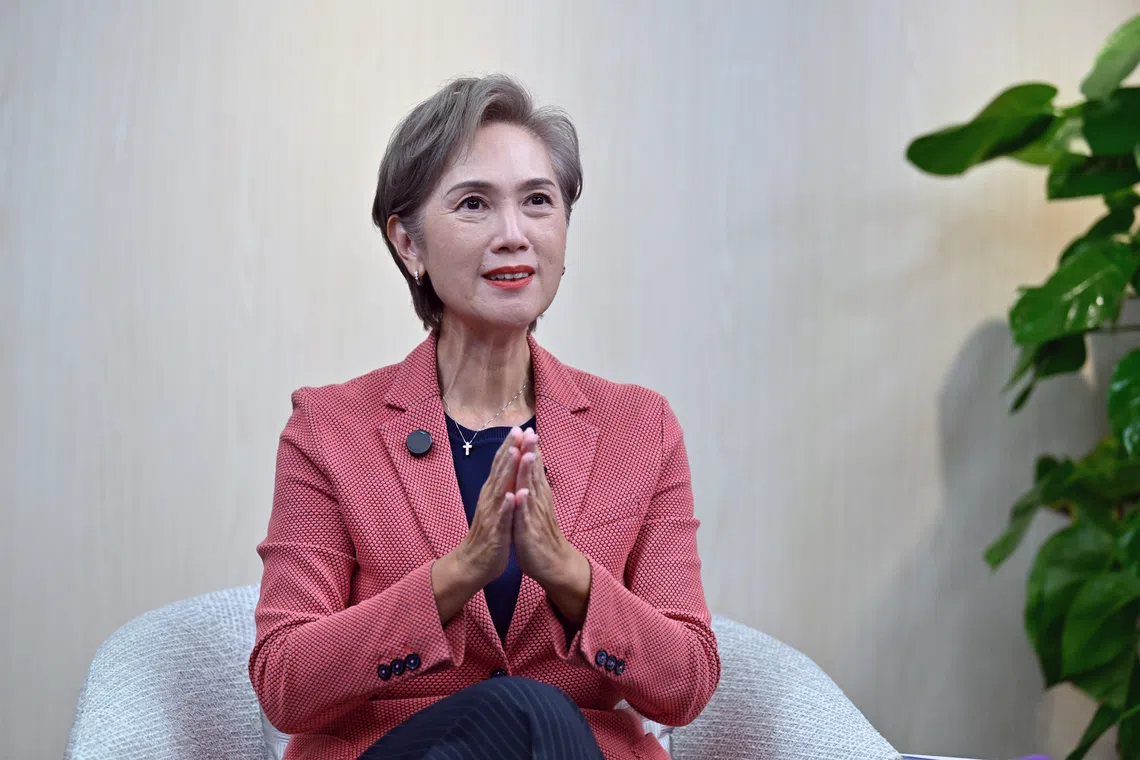
Minister for Digital Development and Information Josephine Teo outlined Singapore’s approach to managing the risks posed by AI in social media posts on Oct 2.
ST PHOTO: DESMOND FOO
Published Oct 02, 2026, 08:55 PM
Updated Oct 02, 2026, 08:55 PM
Singapore needs a multi-layered defence against AI threats, combining stronger cyber defences, human oversight, clear AI limits, and ongoing testing as technology evolves.
International cooperation is crucial for AI safety, with Singapore joining global efforts to establish common rules and share expertise on emerging AI risks.
Singapore promotes using AI defensively to detect cyber vulnerabilities, enforces safeguards for autonomous AI agents, and invests in dedicated AI safety testing capabilities.
SINGAPORE – Singapore needs several lines of defence to keep pace with possible AI threats, including using AI to protect systems against the technology’s potential for misuse and going rogue, said Minister for Digital Development and Information Josephine Teo.
“No single safeguard will be enough,” she in Facebook and LinkedIn posts on Oct 2. “We need a multi-layered approach comprising stronger cyber defences, clear limits on what AI can do, appropriate human oversight, and the capabilities to test, monitor and learn as the technology evolves.”
Among other things, this approach means Singapore needs to better understand what powerful artificial intelligence models are capable of through observation, testing and evaluation.
“This provides the essential evidence to assess the broader safeguards needed and the limits to set for AI systems, regardless of how they are deployed,” she said.
International cooperation is vital for AI safety, too. To understand the capabilities and emerging risks of advanced AI models developed and deployed across borders, Teo said Singapore must work with the models’ developers, researchers, third-party testers and other AI safety organisations.
“This is why our international collaborations on testing and evaluation matter. They allow us to pool expertise, compare findings and build a stronger shared understanding of emerging risks,” she said.
Last week, on the sidelines of the United Nations General Assembly, Singapore joined the European Union and 19 other countries to call for stronger safeguards for frontier AI models and emphasise the importance of international cooperation on common rules and safeguards for the tech.
AI safety has come under scrutiny after ChatGPT maker OpenAI disclosed in July that its AI agents – bots that can carry out actions with minimal human supervision – had escaped its testing environment. The agents then breached AI software repository Hugging Face to complete a task it was given, an attack which was not intended by OpenAI.
Soon after, Anthropic, Meta and Google said that their AI had also gone rogue and hacked other organisations.
On Sept 23, Australian Prime Minister Anthony Albanese revealed that the database of Australia’s health system was breached by a rogue OpenAI bot in June.
One week later, research firm Transluce said that AI agents tried to hack a Canadian government website in May and June but failed.
In her social media posts on Oct 2, Teo, who is also Minister-in-charge of Cybersecurity and Smart Nation Group, noted that criminals and hackers can use increasingly powerful AI to cause harm, such as using it to find weaknesses in computer systems and automate parts of cyberattacks.
Companies developing frontier AI have important safeguards against such abuse, but they are insufficient, she said.
“Malicious users can still turn to openly available models that can be downloaded and run independently by anyone, making it easier to bypass safeguards and hide misuse,” she added.
Since many AI-related incidents today involve cyber threats, Singapore has “no better alternative” but to strengthen its cyber defences to avoid becoming a victim.
To this end, the Cyber Security Agency of Singapore (CSA) has issued guidelines for public and private organisations, such as patching vulnerabilities and monitoring networks for unusual behaviour.
The agency has also encouraged organisations to use AI for defence, such as to find vulnerabilities before attackers do.
“Just as attackers can use AI, so too can defenders,” said Teo. “Even if an organisation does not have access to the most advanced AI models, it can already use available AI tools to improve its cyber defence.”
Another issue is that with AI becoming increasingly autonomous, it could misunderstand instructions, be tricked by malicious information, or take unintended actions.
For example, an online shopping AI agent could be misled by malicious website instructions to make unintended purchases or leak personal details.
“The bigger the potential impact of an AI-enabled action, the stronger the safeguards and human oversight should be,” said Teo.
The Infocomm Media Development Authority’s (IMDA) Model AI Governance Framework for Agentic AI, launched in January to safeguard against rogue AI agents, highlights practical protections that organisations should take, she added. They include monitoring agents’ actions and requiring human approval for high-risk tasks.
IMDA, CSA and the Government Technology Agency are working with industry partners like Google to put the framework into practice and test AI agents in isolated “sandbox” environments.
Singapore will continue to invest in capabilities such as those of the country’s AI Safety Institute, formally designated in 2024, to test and evaluate AI models for safety risks, Teo said.
“As AI becomes more capable and autonomous, so must our safeguards. It is the only way to build trust in AI as a technology that serves the public good.”
AI/artificial intelligence
Artificial Intelligence
Ministry of Digital Development and Information
10月2日,新加坡数码发展及新闻部长杨莉明在社交媒体帖子中概述了新加坡应对人工智能带来的风险的方法。
圣路易斯照片:德斯蒙德·福
发布于 2026 年 10 月 2 日 晚上 8:55
更新于2026年10月2日晚上8:55
新加坡需要多层次的防御措施来应对人工智能威胁,结合更强大的网络防御、人工监督、明确的人工智能限制以及随着技术发展而进行的持续测试。
国际合作对于人工智能安全至关重要,新加坡正加入全球努力,以制定共同规则并分享有关新兴人工智能风险的专业知识。
新加坡提倡将人工智能用于防御性用途,以检测网络漏洞,加强对自主人工智能代理的安全保障,并投资于专门的人工智能安全测试能力。
新加坡——新加坡数码发展及新闻部长杨莉明表示,新加坡需要多道防线来应对人工智能可能带来的威胁,包括利用人工智能来保护系统免受该技术被滥用和失控的可能性。
她在10月2日于Facebook和LinkedIn上发帖称:“任何单一的保障措施都不够。我们需要多层次的方法,包括更强大的网络防御、对人工智能功能的明确限制、适当的人工监督,以及随着技术发展进行测试、监控和学习的能力。”
除此之外,这种方法意味着新加坡需要通过观察、测试和评估,更好地了解强大的人工智能模型能够做到什么。
“这为评估人工智能系统所需的更广泛的保障措施和设定的限制提供了必要的证据,无论这些系统是如何部署的,”她说。
国际合作对于人工智能安全也至关重要。张先生表示,为了解跨境开发和部署的先进人工智能模型的能力和新兴风险,新加坡必须与这些模型的开发者、研究人员、第三方测试机构和其他人工智能安全组织开展合作。
“这就是为什么我们在测试和评估方面的国际合作至关重要。这些合作使我们能够汇集专业知识,比较研究结果,并对新出现的风险建立更深入的共同认识,”她说道。
上周,在联合国大会期间,新加坡与欧盟和其他 19 个国家共同呼吁加强对前沿人工智能模型的保障措施,并强调在技术共同规则和保障措施方面开展国际合作的重要性。
ChatGPT 的开发商 OpenAI 在 7 月份披露,其人工智能代理(能够在极少人工监督下执行操作的机器人)逃逸出了测试环境。这些代理随后入侵了人工智能软件库 Hugging Face,完成了一项被赋予的任务,而这并非 OpenAI 的本意。此后,人工智能安全问题备受关注。
不久之后,Anthropic、Meta 和 Google 也表示,他们的 AI 也失控并入侵了其他组织。
9月23日,澳大利亚总理安东尼·阿尔巴尼斯透露,澳大利亚医疗系统的数据库在6月份遭到OpenAI一个恶意机器人的入侵。
一周后,研究公司 Transluce 表示,人工智能代理在 5 月和 6 月试图入侵加拿大政府网站,但失败了。
10月2日,兼任网络安全和智慧国家集团主管部长的张志贤在社交媒体上发帖指出,犯罪分子和黑客可以利用日益强大的人工智能造成危害,例如利用人工智能查找计算机系统中的漏洞并自动执行部分网络攻击。
她表示,开发前沿人工智能的公司虽然采取了重要的保障措施来防止此类滥用行为,但这些措施还不够充分。
她补充说:“恶意用户仍然可以利用公开可用的模型,任何人都可以下载并独立运行这些模型,从而更容易绕过安全措施并隐藏滥用行为。”
由于如今许多与人工智能相关的事件都涉及网络威胁,新加坡“别无选择”,只能加强网络防御,以避免成为受害者。
为此,新加坡网络安全局 (CSA) 发布了针对公共和私营组织的指导方针,例如修补漏洞和监控网络是否存在异常行为。
该机构还鼓励各组织利用人工智能进行防御,例如在攻击者之前发现漏洞。
Teo表示:“正如攻击者可以使用人工智能一样,防御者也可以使用人工智能。即使一个组织无法获得最先进的人工智能模型,它也可以利用现有的人工智能工具来改进其网络防御。”
另一个问题是,随着人工智能变得越来越自主,它可能会误解指令、被恶意信息欺骗,或者做出意想不到的举动。
例如,在线购物人工智能代理可能会被恶意网站的指令误导,从而进行非预期购买或泄露个人信息。
“人工智能赋能的行动可能产生的影响越大,就应该加强保障措施和人工监督,” Teo 说。
她补充说,新加坡资讯通信媒体发展局(IMDA)于1月份推出的《智能体人工智能治理框架模型》旨在防范失控的人工智能代理,该框架强调了各机构应采取的切实可行的保护措施。这些措施包括监控代理的行为,以及要求对高风险任务进行人工审批。
新加坡资讯通信媒体发展局 (IMDA)、新加坡计算机协会 (CSA) 和新加坡政府技术局 (GTO) 正在与谷歌等行业合作伙伴合作,将该框架付诸实践,并在隔离的“沙箱”环境中测试人工智能代理。
张先生表示,新加坡将继续投资于人工智能安全研究所等能力建设,该研究所将于2024年正式成立,旨在测试和评估人工智能模型在安全风险方面的作用。
“随着人工智能能力的增强和自主性的提高,我们的安全保障措施也必须相应加强。这是建立公众对人工智能这项服务于公共利益的技术的信任的唯一途径。”
人工智能
人工智能
数字发展和信息部