How does cloud seeding work? What it could do for haze at Sepang this weekend人工增雨是如何进行的?它本周末能为雪邦的雾霾带来什么影响?
KUALA LUMPUR, Oct 3 — For more than a month, haze has blanketed parts of Malaysia as transboundary smoke from massive forest and peatland fires in neighbouring Indonesia drifts...
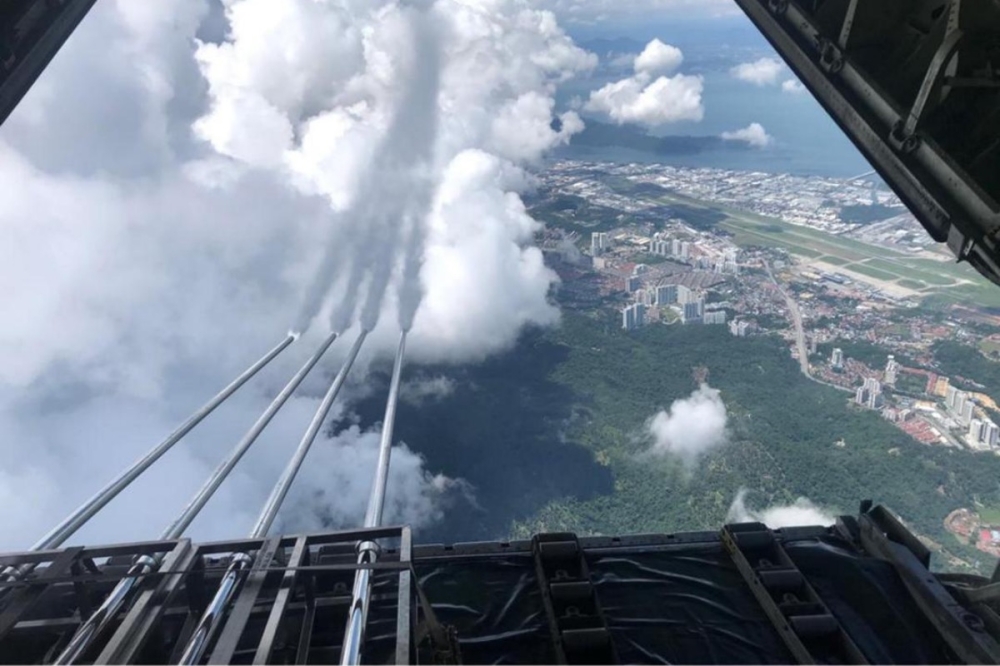
For over a month, Malaysia has been affected by haze due to smoke from forest and peatland fires in Indonesia.
In response, cloud seeding operations are being considered and conducted to enhance rainfall, improve air quality, and create better conditions for the upcoming Bahrain F1 Grand Prix and other affected regions.
Malaysia employs both wet and dry cloud seeding techniques using hygroscopic materials such as salt to stimulate precipitation.
These operations aim to mitigate the haze and maintain adequate water levels in dams amid hot, dry conditions.
KUALA LUMPUR, Oct 3 — For more than a month, haze has blanketed parts of Malaysia as transboundary smoke from massive forest and peatland fires in neighbouring Indonesia drifts across the region.
Many of the fires burn deep into carbon-rich peatlands, which are notoriously difficult to extinguish and can produce thick, acrid smoke for prolonged periods.
With the Sepang International Circuit (SIC) set to host the Bahrain F1 Grand Prix this weekend, SIC chief executive officer Azhan Shafriman Hanif has said cloud seeding operations could be carried out around the circuit to induce rainfall ahead of the event.
The hope is that the additional rainfall could help improve air quality and visibility, creating better conditions for the race and spectators.
The proposal comes as Malaysia has stepped up cloud seeding operations in response to the haze and hot, dry weather.
Fourteen cloud seeding operations involving more than 50 flights have been carried out nationwide as of September 30, 2026, with operations also extended to Sabah and Sarawak.
National Disaster Management Agency (Nadma) operations implementation section director Datuk Mazli Mazlan said the operations were aimed at increasing rainfall, particularly to ensure dam water levels remained sufficient.
So, how exactly does cloud seeding work, what can it achieve, and why is it being considered as one measure to deal with the current conditions?
What is cloud seeding?
Clouds are made up of tiny water droplets or ice crystals that form when water vapour in the atmosphere cools and condenses around microscopic particles such as dust or salt.
These particles, known as condensation nuclei or ice nuclei, provide a surface for water to collect and eventually form larger droplets or ice crystals that can fall as precipitation.
Cloud seeding is a form of weather modification that attempts to enhance this natural process by introducing additional particles into suitable clouds.
It does not create clouds or rain from a clear sky.
Instead, the technique relies on existing clouds that contain sufficient moisture and suitable atmospheric conditions.
How does cloud seeding work?
The process begins with meteorologists identifying suitable clouds — generally those that contain enough moisture but have not yet produced significant rainfall.
Seeding agents are then released into or around the cloud using aircraft, ground-based generators or other methods, depending on the technique being used.
Common seeding materials include silver iodide, which can encourage ice crystal formation in cold clouds, and hygroscopic materials such as salt, which are used in warmer clouds.
Dry ice, or frozen carbon dioxide, can also be used in some cloud seeding operations to cool clouds and encourage ice formation.
Once introduced, the particles provide additional nuclei around which water vapour can condense.
The droplets or ice crystals can then grow as they collect more moisture.
When they become sufficiently large and heavy, they fall from the cloud as precipitation — rain in warm conditions, or snow or hail where temperatures permit.
Cloud seeding therefore works by enhancing precipitation from clouds that are already capable of producing rain, rather than producing rainfall from clear skies.
Three main types of cloud seeding
There are three broad types of cloud seeding, each designed for different cloud and weather conditions:
This is one of the most widely used methods. It involves introducing substances such as silver iodide into cold clouds to encourage the formation of ice crystals, which can grow and eventually fall as precipitation.
This technique aims to increase the size and vertical development of clouds by altering air movement within them. It requires more material and careful planning, but has the potential to enhance rainfall from suitable clouds.
3. Hygroscopic seeding
Used mainly in warm-cloud environments, this method disperses particles such as salt into clouds. The particles act as nuclei around which water droplets can form and grow, eventually becoming large enough to fall as rain.
What does Malaysia use?
According to the Malaysian Meteorological Department (MetMalaysia), cloud seeding operations in Malaysia use two approaches known as wet seeding and dry seeding.
Both methods rely on hygroscopic materials, such as salt, to encourage the formation and growth of water droplets in suitable clouds.
For wet seeding, a salt solution weighing about 200kg is carried in four tanks aboard a Royal Malaysian Air Force (RMAF) C-130 Hercules aircraft.
The solution is sprayed into suitable clouds at an altitude of between 5,000 and 8,000 feet.
For dry seeding, hygroscopic flares mounted on a Cessna 340A aircraft are ignited at the base of suitable clouds at an altitude of between 3,000 and 5,000 feet.
The dispersed salt particles act as Cloud Condensation Nuclei (CCN), providing surfaces around which water vapour can condense and encouraging water droplets to grow until they become sufficiently large and heavy to fall as rain.
Rainfall is typically expected within 30 to 60 minutes after a cloud seeding operation, although the timing depends on prevailing atmospheric conditions and whether the targeted clouds are suitable for seeding.
Bumper weekend in Malaysia: F1, football legends, concerts and comedy shows set to pack Klang Valley
Rantau Panjang wants its buzz back — and traders hope ECRL is the answer
Treat RM220m international maritime trade issue with same urgency as political cases, maritime expert tells MACC
一个多月以来,由于印度尼西亚森林和泥炭地火灾产生的烟雾,马来西亚一直受到雾霾的影响。
为此,相关部门正在考虑并实施人工增雨作业,以增加降雨量,改善空气质量,为即将到来的巴林F1大奖赛和其他受影响地区创造更好的条件。
马来西亚采用湿式和干式人工增雨技术,利用盐等吸湿性材料来刺激降水。
这些措施旨在缓解雾霾,并在炎热干燥的条件下保持水坝中足够的水位。
吉隆坡,10 月 3 日——一个多月以来,马来西亚部分地区一直笼罩在雾霾之中,邻国印度尼西亚大规模森林和泥炭地火灾产生的跨境烟雾飘过该地区。
许多火灾都蔓延到富含碳的泥炭地深处,这些泥炭地极难扑灭,而且会长时间产生浓厚刺鼻的烟雾。
由于雪邦国际赛道(SIC)将于本周末举办巴林F1大奖赛,SIC首席执行官阿兹汉·沙夫里曼·哈尼夫表示,可能会在赛道周围进行人工增雨作业,以在赛事开始前诱发降雨。
希望额外的降雨能够改善空气质量和能见度,为比赛和观众创造更好的条件。
马来西亚为应对雾霾和炎热干燥的天气,加大了人工降雨作业力度,而这项提议正是在此背景下提出的。
截至 2026 年 9 月 30 日,全国已开展 14 次人工增雨作业,涉及 50 多架次航班,作业范围也扩大到沙巴和砂拉越。
国家灾害管理机构(Nadma)行动实施部门主管拿督马兹利·马兹兰表示,这些行动旨在增加降雨量,特别是确保水坝水位保持充足。
那么,人工增雨究竟是如何运作的?它能达到什么目的?为什么它被认为是应对当前状况的措施之一?
什么是人工增雨?
云是由微小的水滴或冰晶组成的,当大气中的水蒸气冷却并凝结在灰尘或盐等微小颗粒周围时,就会形成这些水滴或冰晶。
这些粒子被称为凝结核或冰核,它们为水的聚集提供了表面,最终形成较大的水滴或冰晶,这些水滴或冰晶可以以降水的形式落下。
人工增雨是一种人为改变天气的方式,它试图通过向合适的云层中引入额外的粒子来增强这一自然过程。
它不会凭空变出云或雨。
相反,该技术依赖于现有的含有足够水分和适宜大气条件的云层。
人工增雨的工作原理是什么?
这个过程首先由气象学家确定合适的云层——通常是那些含有足够水汽但尚未产生明显降雨的云层。
然后,根据所使用的技术,使用飞机、地面发生器或其他方法将播撒剂释放到云中或云周围。
常用的播撒材料包括碘化银(可促进冷云中冰晶的形成)和盐等吸湿性材料(用于较暖的云中)。
干冰,也就是固态二氧化碳,也可以用于一些人工增雨作业中,以冷却云层并促进冰晶形成。
一旦引入,这些粒子就能提供额外的凝结核,水蒸气可以围绕这些凝结核凝结。
随着水分的吸收,水滴或冰晶会逐渐长大。
当它们变得足够大、足够重时,就会以降水的形式从云层中落下——在温暖的条件下是雨,在温度允许的情况下是雪或冰雹。
因此,人工增雨的原理是增强已经能够产生降雨的云层的降水量,而不是在晴朗的天空中产生降雨。
三种主要的人工增雨方式
云播种技术大致分为三种类型,每种类型都针对不同的云层和天气条件而设计:
这是应用最广泛的方法之一。它涉及向冷云中引入碘化银等物质,以促进冰晶的形成,冰晶会不断生长,最终以降水的形式落下。
这项技术旨在通过改变云层内部的空气运动来增加云的体积和垂直发展。它需要更多的材料和更周密的计划,但有可能增强合适云层的降雨量。
3. 吸湿性播种
这种方法主要用于暖云环境,它将盐等颗粒物分散到云层中。这些颗粒物充当凝结核,水滴围绕它们形成并生长,最终变得足够大,以降雨的形式落下。
马来西亚使用什么?
根据马来西亚气象局(MetMalaysia)的说法,马来西亚的人工增雨作业采用两种方法,即湿式增雨和干式增雨。
这两种方法都依赖于盐等吸湿性物质,以促进合适的云层中水滴的形成和生长。
对于湿播,马来西亚皇家空军 (RMAF) 的 C-130 大力神运输机上装有四个水箱,其中装有重约 200 公斤的盐溶液。
将溶液喷洒到 5000 至 8000 英尺高度的合适云层中。
对于干播,将安装在塞斯纳 340A 飞机上的吸湿性信号弹在合适的云层底部,高度在 3,000 到 5,000 英尺之间点燃。
分散的盐颗粒充当云凝结核(CCN),为水蒸气凝结提供表面,并促使水滴生长,直到它们足够大、足够重,从而以降雨的形式落下。
人工增雨作业后,通常会在 30 至 60 分钟内出现降雨,但具体时间取决于当时的大气条件以及目标云层是否适合进行人工增雨。
马来西亚周末精彩纷呈:F1赛车、足球传奇、演唱会和喜剧表演将席卷巴生谷
兰道班让站希望重现往日繁荣——交易员们寄希望于东海岸铁路能够解决这个问题。
海事专家敦促反贪污委员会以与政治案件同等的紧迫性处理价值2.2亿令吉的国际海事贸易问题。