From photojournalism ambitions to property, Josh Hu took an unexpected route into the family business从怀揣摄影记者梦想到涉足房地产,Josh Hu 以出人意料的方式进入了家族企业。
AW & Sons’ Josh Hu once wanted to be a photojournalist. Today, he channels that creative instinct into property projects shaped by their location rather than a fixed formula.
AW & Sons’ Josh Hu once wanted to be a photojournalist. Today, he channels that creative instinct into property projects shaped by their location rather than a fixed formula.
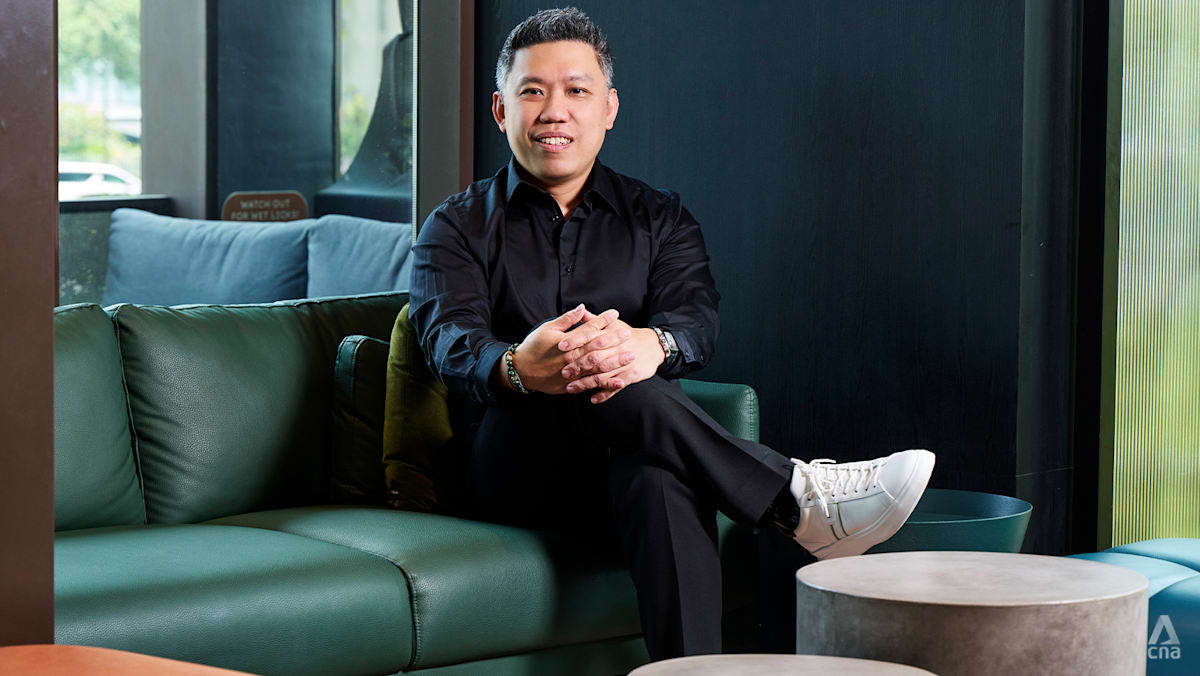
Josh Hu, managing director of AW & Sons Capital, has built a portfolio spanning lifestyle spaces, boutique hotels and, most recently, co-living. (Photo: CNA/Kelvin Chia)
This audio is generated by an AI tool.
There is something mildly amusing about being a third-generation heir but having people mistake you for a professional manager. Josh Hu, 44, experiences this all the time. The most likely reason? His surname.
“Hu” is the Hanyu Pinyin form of “Aw”, the surname under which his family is better known. Hu was born during Singapore’s early-1980s push to adopt Hanyu Pinyin names, an initiative that was later rolled back. The result has given him a convenient way to obscure the family connection rather than announce it. And he rather likes it that way.
The Aw family is notoriously media shy. Hu himself, though friendly and perfectly happy to discuss his latest project – Mber, a hybrid of co-living rooms and serviced apartments – remains reserved.
You get the sense that you are being given precisely as much of the family story as he has decided you need. There is a wall, and it’s a well-built one.
Mber reflects Josh Hu’s push for residential spaces that retain some of the character of a boutique hotel without sacrificing liveability. (Photo: Mber)
Established in 1971, AW & Sons Group – a boutique real estate developer and investment firm – traces its origins to the late patriarch Aw Kim Chen, who expanded his rubber-trading business into real estate. Today, the family office is headquartered at The Offshore, the group’s property on North Canal Road, with residential holdings in London.
Three generations of the Aw family remain involved in stewarding the business. Hu is managing director of AW & Sons Capital, one arm of the group.
During our hour-long chat at Mber, Hu recalled that he had never planned to join the family business. He was more interested in becoming a photojournalist, with stints at the now-defunct Wine & Dine and NewMan magazines, as well as watch publication Revolution. He even entertained ambitions of going into diplomacy.
Then his grandfather summoned him.
Mber’s communal library forms part of the development’s shared spaces for residents. (Photo: Mber)
“I think he had a premonition that his health was failing, so he called me. He said, ‘It’s time to come back and help your dad’.”
That might sound like the setup for a high-society K-drama, but Hu stressed that he was under no pressure to follow a predetermined path. In the Aw family, each generation is given room to explore its own interests.
And when Hu did return, his grandfather didn’t simply give him a title and a place in the business. He gave him a piece of land instead.
Specifically, it was a plot of family land in the Jalan Jurong Kechil area, measuring just under 270 sq m, where Hu believes his father grew up. It became Hu’s first redevelopment project: two semi-detached houses, which his grandfather dubbed his “rites of passage”.
The houses were eventually sold. But the more important transaction had already taken place: Hu had discovered that property could be more than an asset class; it could be a creative medium.
PROPERTY, BUT MAKE IT PERSONAL
The Offshore on North Canal Road was one of Josh Hu’s early projects, conceived as a design-conscious hub for businesses and lifestyle brands. (Photo: The Offshore)
Ask Hu what makes a good development and the answer isn’t simply yield, square footage or exit value. The numbers, naturally, have to make sense.
“At the end of the day, our numbers still have to work. We can't work on a site where the numbers don't stack up.”
But once the financials make sense, something less easily quantifiable comes into play. “You have to look at the value proposition. And when you try to delve into the value proposition, then it becomes the gut and the instinct for the place.”
That thinking goes some way towards explaining why AW & Sons’ projects do not look like the output of a conventional property machine.
For Hu, location, design, brand, customer and financial viability have to converge. The project is shaped by the place rather than the other way around – an approach to an industry that can sometimes feel overly formulaic.
Hu is particularly wary of Singapore’s “cookie-cutter” development culture. His response has been to experiment with different formats – and, crucially, not assume that what worked once should simply be repeated.
Josh Hu says his grandfather taught him to approach the family business “step by step, project by project” – part of the family’s preference for steady, patient growth. (Photo: CNA/Kelvin Chia)
Hu described his family’s approach as “patient capital”. “My parents are very prudent and thrifty. They are not chasing quick returns or the goose that lays the golden eggs.”
Instead, the idea is to acquire good land in good locations and give those assets time to grow. “From my granddad to my dad, I think it's always been that we want to do things in a stable sense. My granddad’s famous words to me are that we do it step by step, project by project. And in that way, we can secure the family legacy as well.”
There is a second lesson embedded in that philosophy: nothing is guaranteed simply because you were born into the family.
“Nothing is handed on a silver platter,” said Hu. “I'll give you a bit to try. You have to prove to me that with whatever that you're given, you start small, but whatever you're given, you have to make the best of it.”
The implication was clear: inheritance gets you a seat at the table. What you do with it is another matter.
FROM THE OFFSHORE TO SOLOHA
Opened in 2019, Hotel Soloha was one of Josh Hu’s experiments with a more design-led approach to hospitality. (Photo: AW & Sons)
If the Jalan Jurong Kechil project was Hu’s baptism, The Offshore was where things got more ambitious.
The family’s three-storey North Canal Road development opened in 2012, when Singapore’s CBD did not have quite the same ecosystem of lifestyle-led commercial spaces it does today.
The concept was closer to what you might encounter in London or New York: a slightly masculine, design-conscious hub where businesses and lifestyle brands could coexist.
Tenants included barbershop Sultans of Shave, tailors and the first local outpost of Ritual Gym – back when boutique HIIT-style fitness was just taking root in Singapore.
The gamble worked. “It's still fully occupied,” Hu said. “It's been more than 10 years.”
Hu’s approach to choosing tenants is revealing, too. In a market where landlords may prioritise maximising rental returns, he takes a longer view. “We have been quite supportive of our tenants, because to me there's no point chasing a tenant out to get a higher rent, and then the whole tenant mix gets thrown off.”
It is another example of his belief that the individual components of a property matter less than the experience they create collectively.
Then came Hotel Soloha.
Josh Hu with his father, AW & Sons Group chairman Aw Chye Wee, at the opening of Hotel Soloha. (Photo: AW & Sons)
Located on Teck Lim Road, just off the Keong Saik stretch, the boutique hotel opened in 2019, shortly before the COVID-19 pandemic. It was decidedly neither beige nor bland. Local artists created punchy murals and lift artwork; a funky noodle bar occupied the ground floor; even the reception desk doubled as a bar.
Hu acknowledged that Singapore’s boutique-hotel pioneers had already laid the groundwork – Unlisted Collection founder Loh Lik Peng, for one, was “way ahead of us” – but Soloha represented an opportunity for his family to combine its property know-how with design and heritage.
“We wanted it to be something more short-term, something more sexy and cool as well.”
It was also, he admitted, a steep learning curve. After the pandemic, the family received an offer it decided was too good to refuse and sold the property.
For a developer looking to replicate a formula, that might have been the end of the story. For Hu, it was the beginning of another experiment.
Mber’s facade along Teck Chye Terrace reflects the development’s attempt to respond to the history and streetscape of Upper Serangoon. (Photo: Mber)
Mber, his latest project in Upper Serangoon, grew partly out of what Hu thought Soloha had got wrong.
The issue was space. Boutique hotels might be aesthetically appealing, but applying the economics of a conservation property to a residential concept could mean carving rooms into sizes that were financially efficient but not necessarily pleasant to live in.
Hu wanted something different. “After Soloha, we realised that we wanted a product whereby the rooms are not too small, but yet you can retain the character of a boutique hotel within a residential setting,” he said. “I think that element is lacking in Singapore.”
Enter Mber, with 125 units comprising 78 co-living rooms and 47 serviced apartments. “The room sizes are within 18 to 20 sq m, on average. And to me, that is the minimum livable space,” he said.
Mber stands on the site of the former Lim Tua Tow Market, also known as Gor Kok Jiok, or “fifth milestone”, after this stretch of Upper Serangoon Road. The market served the surrounding community from the 1950s, while neighbouring Teck Chye Terrace dates to 1928.
Rather than attempting to recreate the old market as a nostalgia exercise, Formwerkz Architects took cues from the area’s shophouse language – sheltered five-foot ways and ground-floor eateries – and translated them into a contemporary building. Again, the place dictated the product.
There is also a practical business logic to the concept. While much of Singapore’s co-living inventory is concentrated in central areas, Hu saw an underserved market in the north-east.
He pointed to families needing temporary accommodation while their HDB flats undergo the Home Improvement Programme (HIP) or home renovations, as well as expatriates moving to the area for work and families seeking proximity to international schools.
The potential catchment is changing, too, stretching from Paya Lebar and Punggol Digital District to Seletar, as employment nodes and international schools draw more people to the wider north-east.
“We're also seeing more foreign nationals relocating to Singapore, to work in the tech companies and MNCs being set up in Punggol. And then there are the mainland Chinese who are coming in because of international schools,” he said. For Hu, these shifts add up to an underserved market.
What began as an unexpected return to the family business became, for Josh Hu, another way to express his creative instincts. (Photo: CNA/Kelvin Chia)
A PORTFOLIO, NOT A FORMULA
There is a neat progression to Hu’s projects. The Offshore was a lifestyle hub. Soloha was a boutique hotel. Mber is a co-living and serviced-apartment concept shaped around its neighbourhood.
Each one borrows something from the last without simply copying it. Hu said the group has now “come full circle”. Along the way, it has developed a portfolio of concepts and brands that could be adapted for future projects.
That sounds less like a series of one-off experiments and more like the beginnings of a creative property playbook. Perhaps that is the unexpected path of the reluctant heir. Hu may have started out wanting to tell stories through media, images or diplomacy.
Instead, he found another medium: buildings, brands and the spaces between them. As it turned out, he didn’t have to leave the family business to find his creative voice. He found it inside.
A single handpicked story that we think you shouldn't miss. Just one a day.
AW & Sons 的 Josh Hu 曾梦想成为一名摄影记者。如今,他将这种创作灵感投入到房地产项目中,这些项目的设计以地域而非固定模式为依据。
AW & Sons Capital 的董事总经理 Josh Hu 打造了一个涵盖生活方式空间、精品酒店以及最近新增的共享居住空间的投资组合。(图片:CNA/Kelvin Chia)
这段音频由人工智能工具生成。
作为家族第三代继承人,却经常被人误认为是职业经理人,这多少有点滑稽。44岁的乔什·胡就经常遇到这种情况。最可能的原因?他的姓氏。
“胡”是“阿”的汉语拼音,阿是他家族更为人熟知的姓氏。胡出生于上世纪80年代初新加坡推行汉语拼音姓名政策期间,这项政策后来被取消。这反而让他找到了一种巧妙的方式来隐藏家族渊源,而不是公开宣扬。而他本人也乐于如此。
欧家向来不喜与媒体接触。胡先生本人虽然友善,也很乐意谈论他的最新项目——Mber(一种融合了共享居住空间和公寓式服务的模式),但他仍然保持低调。
你会感觉他只给了你他认为你需要知道的那么多家族故事。这之间筑起了一道墙,而且是一堵坚固的墙。
Mber体现了Josh Hu追求的理念,即在不牺牲居住舒适度的前提下,打造兼具精品酒店特色的住宅空间。(图片:Mber)
AW & Sons Group 成立于 1971 年,是一家精品房地产开发和投资公司,其创始人是已故的 Aw Kim Chen 先生,他将橡胶贸易业务拓展至房地产领域。如今,这家家族企业的总部位于北运河路 (North Canal Road) 的 The Offshore 大厦,并在伦敦拥有住宅物业。
Aw家族三代人至今仍参与公司管理。胡先生是AW & Sons Capital的董事总经理,该公司是集团旗下的子公司之一。
在Mber餐厅长达一小时的交谈中,胡先生回忆说,他从未想过要加入家族企业。他更想成为一名摄影记者,曾在现已停刊的《Wine & Dine》和《NewMan》杂志以及腕表杂志《Revolution》工作过。他甚至还曾想过从事外交工作。
然后他祖父把他叫了过来。
Mber的公共图书馆是该开发项目为居民提供的共享空间的一部分。(图片:Mber)
“我觉得他预感到自己的健康状况正在恶化,所以给我打了电话。他说,‘是时候回来帮助你父亲了。’”
这听起来像是韩剧里上流社会生活的设定,但胡强调他并没有被迫遵循预设的路线。在吴家,每一代人都有空间去探索自己的兴趣。
胡回来后,他的祖父并没有仅仅给他一个头衔和生意上的位置,而是给了他一块土地。
具体来说,这是一块位于裕廊吉治路(Jalan Jurong Kechil)的家族土地,面积略小于270平方米,胡先生认为他的父亲就在那里长大。这块地后来成了胡先生的第一个重建项目:两栋半独立式住宅,他的祖父称之为他的“成人礼”。
房子最终都卖掉了。但更重要的交易已经发生:胡发现,房地产不仅仅是一种资产类别,它还可以成为一种创作媒介。
财产,但要让它具有个人特色
位于北运河路的The Offshore是Josh Hu早期的项目之一,其设计理念是打造一个注重设计感的商业和生活方式品牌聚集地。(图片:The Offshore)
问胡,好的开发项目应该具备哪些条件,答案并非仅仅是收益率、建筑面积或退出价值。当然,这些数字必须合理才行。
“归根结底,我们的财务数据必须站得住脚。如果财务数据不合理,我们就无法开展工作。”
但一旦财务数据说得通,一些难以量化的因素就开始发挥作用。“你必须审视价值主张。当你试图深入探究价值主张时,最终取决于你对这个地方的直觉和本能。”
这种想法在一定程度上解释了为什么 AW & Sons 的项目看起来不像传统房地产机器的产物。
对胡而言,选址、设计、品牌、客户和财务可行性必须完美融合。项目是由场地塑造的,而非反之——这种理念在建筑行业中实属难得,因为它避免了行业内常见的模式化倾向。
胡先生尤其警惕新加坡“千篇一律”的发展模式。他的应对之策是尝试不同的模式——而且至关重要的是,他不会想当然地认为过去行之有效的方法就应该照搬。
Josh Hu表示,他的祖父教导他要“循序渐进,按项目推进”地经营家族企业——这是家族企业偏好稳健、耐心发展的一部分。(图片:CNA/Kelvin Chia)
胡先生将他家的投资方式描述为“耐心资本”。“我的父母非常谨慎节俭。他们不追求短期回报,也不指望能下金蛋的鹅。”
相反,他们的理念是购置位置优越的优质土地,并给予这些资产时间增值。“从我祖父到我父亲,我认为我们一直都希望以稳健的方式做事。我祖父常跟我说,我们要一步一步来,一个项目一个项目地做。这样,我们才能确保家族传承。”
这种理念中还蕴含着第二个教训:即使你出生在某个家庭,也不能保证你拥有任何东西。
胡说:“天上不会掉馅饼。我会给你一点机会。你必须向我证明,无论得到什么,你都要从小事做起,尽力做到最好。”
言下之意很明显:继承遗产能让你在决策桌上占有一席之地。至于如何利用这份资源,则是另一回事了。
从离岸到索罗哈
索罗哈酒店于2019年开业,是Josh Hu尝试以设计为主导的酒店经营理念的一次实验。(图片:AW & Sons)
如果说 Jalan Jurong Kechil 项目是胡先生的洗礼之作,那么 The Offshore 项目则标志着他的雄心壮志更加远大。
该家族在北运河路开发的三层楼楼于 2012 年开业,当时新加坡中央商务区还没有像今天这样以生活方式为主导的商业空间生态系统。
这个概念更接近于你在伦敦或纽约可能会遇到的那种:一个略带男性化、注重设计的中心,企业和生活方式品牌可以在这里共存。
租户包括理发店 Sultans of Shave、裁缝店和 Ritual Gym 的第一家本地分店——当时精品 HIIT 式健身刚刚在新加坡扎根。
这次冒险成功了。“现在仍然全部租出去了,”胡说。“已经超过10年了。”
胡先生选择租户的方式也颇具启发性。在房东可能优先考虑租金收益最大化的市场中,他却采取了更长远的眼光。“我们一直很支持我们的租户,因为对我来说,为了提高租金而赶走租户毫无意义,那样会破坏整个租户组合的平衡。”
这再次印证了他的观点,即房产的各个组成部分远不如它们共同创造的体验重要。
然后是索罗哈酒店。
Josh Hu 与他的父亲、AW & Sons 集团主席 Aw Chye Wee 出席了 Soloha 酒店的开业典礼。(图片:AW & Sons)
这家精品酒店位于德林路,紧邻恭锡路,于2019年开业,就在新冠疫情爆发前不久。它绝非平淡无奇。当地艺术家创作了色彩鲜艳的壁画和电梯艺术作品;一楼是一家风格独特的面馆;甚至连前台也兼作酒吧。
胡先生承认,新加坡的精品酒店先驱们已经奠定了基础——例如,Unlisted Collection 的创始人罗立鹏就“远远领先于我们”——但 Soloha 为他的家族提供了一个机会,将他们的房地产专业知识与设计和传统结合起来。
“我们希望它更短期一些,也更性感、更酷炫一些。”
他也承认,这的确是一个艰难的学习过程。疫情过后,他们收到了一份他们认为无法拒绝的报价,于是卖掉了房产。
对于想要复制某个公式的开发者来说,故事可能到此结束。但对胡来说,这却是另一项实验的开始。
Mber沿德财台街的立面设计体现了该项目力求呼应上实龙岗的历史和街景。(图片:Mber)
Mber 是他在上实龙岗的最新项目,其部分发展源于胡认为 Soloha 犯的错误。
问题在于空间。精品酒店或许在美学上很吸引人,但如果将保护性建筑的经济效益应用于住宅概念,就可能意味着要将房间分割成经济效益高但居住舒适度未必好的大小。
胡先生想要一些不同的东西。“在Soloha项目之后,我们意识到我们想要的产品,房间不会太小,但又能在住宅环境中保留精品酒店的特色,”他说。“我认为新加坡缺少这种元素。”
Mber项目共有125个单元,包括78间共享居住空间和47套服务式公寓。“房间平均面积在18到20平方米之间。在我看来,这是最小的宜居空间,”他说道。
Mber 坐落于原林大都市场旧址,该市场又名五点路标市场(Gor Kok Jiok),因其位于上实龙岗路(Upper Serangoon Road)的这一路段而得名。该市场自 20 世纪 50 年代起服务于周边社区,而毗邻的德财台(Teck Chye Terrace)则始建于 1928 年。
Formwerkz Architects并没有试图出于怀旧而重现旧市场,而是从该地区的店屋建筑语言中汲取灵感——例如遮蔽的五脚基通道和底层餐馆——并将其转化为一座现代建筑。再次证明,是场地决定了最终的设计成果。
这一概念也具有实际的商业逻辑。虽然新加坡的大部分共享居住空间都集中在中心区域,但胡先生认为东北地区存在一个尚未得到充分满足的市场。
他指出,一些家庭在组屋进行房屋改善计划 (HIP) 或房屋装修期间需要临时住所,一些外籍人士因工作搬到该地区,还有一些家庭希望靠近国际学校。
潜在的辐射范围也在发生变化,从巴耶利峇和榜鹅数码区一直延伸到实里达,因为就业中心和国际学校吸引了更多的人到更广阔的东北地区。
“我们也看到越来越多的外籍人士移居新加坡,在榜鹅设立的科技公司和跨国公司工作。此外,还有一些中国大陆学生因为国际学校的缘故来到新加坡,”他说道。胡先生认为,这些变化导致市场服务不足。
对 Josh Hu 而言,原本意料之外的重返家族企业,却成为了他表达创意灵感的另一种途径。(图片:CNA/Kelvin Chia)
作品集,而非公式
胡的项目发展脉络清晰。“离岸”(The Offshore)是一个生活方式中心。“索罗哈”(Soloha)是一家精品酒店。“Mber”则是一个围绕其所在社区打造的共享居住和服务式公寓项目。
每个项目都借鉴了前一个项目的某些元素,但并非简单地复制。胡表示,该团队如今已“完成了一个完整的循环”。一路走来,他们积累了一系列概念和品牌,这些都可以应用于未来的项目中。
这听起来与其说是一系列零散的实验,不如说是创意产业发展蓝图的雏形。或许这就是这位不情愿的继承人出人意料的命运。胡锦涛最初可能只是想通过媒体、影像或外交手段来讲述故事。
他转而找到了另一种媒介:建筑、品牌以及它们之间的空间。事实证明,他无需离开家族企业就能找到自己的创作方向。他就在内心深处找到了它。
每天一篇,我们精心挑选一篇您不容错过的精彩故事。