New animal welfare code for dog trainers prioritises positive reinforcement, less aversive methods新的犬类训练师动物福利准则优先考虑积极强化,减少惩罚性训练方法。
The Animal and Veterinary Service also announced revisions to the existing code of animal welfare for pet groomers, making it a minimum standard for animals not to be left unattended at any point during grooming.
The Animal and Veterinary Service also announced revisions to the existing code of animal welfare for pet groomers, making it a minimum standard for animals not to be left unattended at any point during grooming.
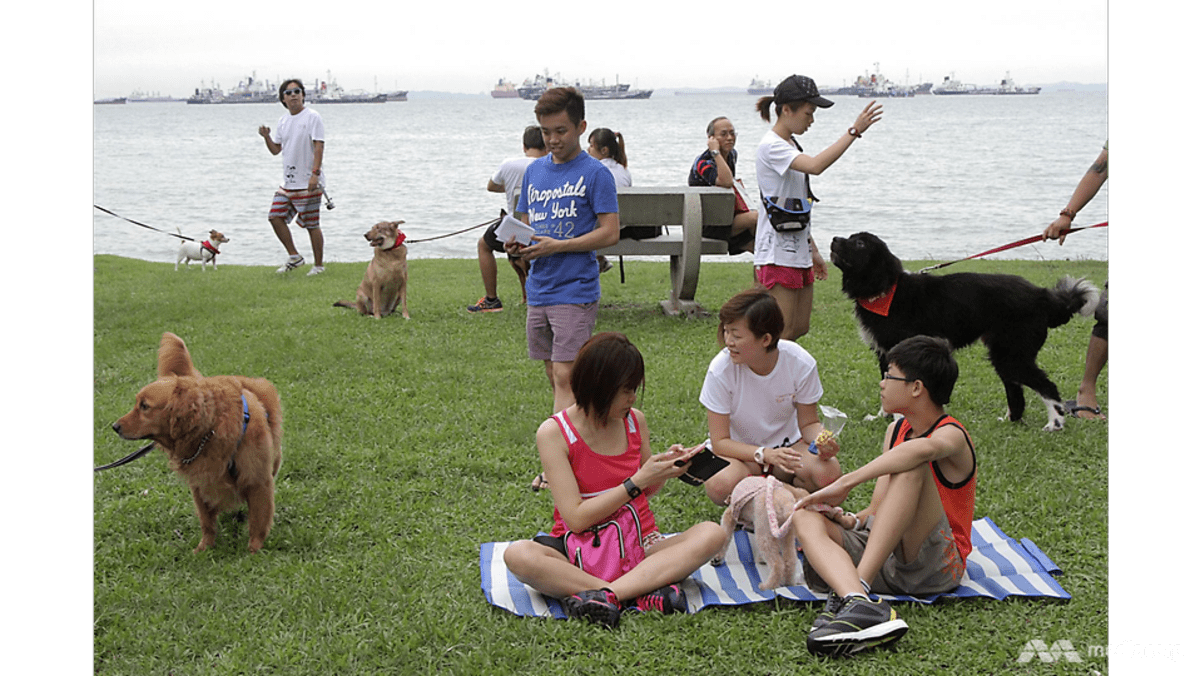
A group of dogs and their companions relax by the beach during the Singapore Specials Run 2014. (Photo: TODAY/Don Wong)
This audio is generated by an AI tool.
SINGAPORE: With a focus on humane training methods that put the welfare of dogs first, a new rulebook was launched by the Animal and Veterinary Service (AVS) on Saturday (Oct 3) which set out the minimum animal welfare standards for dog trainers.
The code for dog trainers adopts the least intrusive, minimally aversive (LIMA) approach, promoting the use of humane, evidence-based training methods and positive reinforcement as the foundation for behaviour modification.
While aversive tools such as electronic shock collars are not banned outright, trainers are now required to systematically work through less intrusive, positive reinforcement techniques before considering any harsher interventions.
The new standards for dog trainers add to the existing code of animal welfare for the pet industry, which has been around since 2016.
CNA Games Guess Word Crack the word, one row at a time Buzzword Create words using the given letters Mini Sudoku Tiny puzzle, mighty brain teaser Mini Crossword Small grid, big challenge Word Search Spot as many words as you can Show More Show Less Previously, dog trainers in Singapore mainly followed guidelines on dog training and behaviour modification, and there has been no dedicated code setting out animal welfare and competency standards for the profession. Apart from dog trainers, AVS, a cluster under the National Parks Board (NParks), also announced revisions to the existing code for pet groomers that aim to raise the bar for groomer competency and standards of care. The revisions include setting a new baseline standard for animals not to be left unattended at any point during grooming. These standards, including those for dog trainers and the rest of the pet industry, are meant to protect the health and welfare of pets. Failure to meet these standards may be used as evidence for prosecution against offences under the Animals and Birds Act, AVS said. Speaking at the World Animal Day event at the National Library Building on Saturday, Minister of State for National Development Alvin Tan said the new and revised codes are part of a broader effort to set clear and relevant standards to raise the overall standard of animal care. "Trainers and groomers also have responsibility. They must uphold professional standards and put animal welfare first," he said. On the dog trainer code in particular, he said positive reinforcement should form the foundation of behaviour modification. "Aversive strategies and devices should be strictly and strongly discouraged except as a last resort," said Mr Tan. He added that AVS will start reviewing the code of animal welfare for pet owners in 2027, stating that "caring for our pets begins at home with pet owners".
Previously, dog trainers in Singapore mainly followed guidelines on dog training and behaviour modification, and there has been no dedicated code setting out animal welfare and competency standards for the profession.
Apart from dog trainers, AVS, a cluster under the National Parks Board (NParks), also announced revisions to the existing code for pet groomers that aim to raise the bar for groomer competency and standards of care.
The revisions include setting a new baseline standard for animals not to be left unattended at any point during grooming.
These standards, including those for dog trainers and the rest of the pet industry, are meant to protect the health and welfare of pets.
Failure to meet these standards may be used as evidence for prosecution against offences under the Animals and Birds Act, AVS said.
Speaking at the World Animal Day event at the National Library Building on Saturday, Minister of State for National Development Alvin Tan said the new and revised codes are part of a broader effort to set clear and relevant standards to raise the overall standard of animal care.
"Trainers and groomers also have responsibility. They must uphold professional standards and put animal welfare first," he said.
On the dog trainer code in particular, he said positive reinforcement should form the foundation of behaviour modification.
"Aversive strategies and devices should be strictly and strongly discouraged except as a last resort," said Mr Tan. He added that AVS will start reviewing the code of animal welfare for pet owners in 2027, stating that "caring for our pets begins at home with pet owners".
A dog being groomed. (File photo)
The updates come after several high-profile incidents involving groomers and trainers in the past few years.
In 2024, a pet groomer left a corgi named Fendi unattended on a table with a short leash tied around its neck. The groomer had gone for lunch when the corgi fell from the table and died after being hanged by the neck.
In 2025, another dog died after allegedly being left unattended at Pawsome Singapore , a pet retail and grooming facility.
In January 2026 Mr Tan said NParks investigated 54 cases of feedback alleging harm to pets caused by groomers over the past three years.
As for dog trainers, in 2022, a dog at training centre K9 Connection was filmed cowering while a handler hit it with a metal bowl . In January 2023, the authorities looked into allegations concerning a golden retriever which developed a severe skin problem on its neck following the use of training collars.
In January 2024, two staff from Xavian and Pack were suspended after videos circulated showing handlers pushing and hitting dogs.
A staff member walking a dog at the Society for the Prevention of Cruelty to Animals premises on Jan 15, 2026. (Photo: CNA/Ili Mansor)
DOG TRAINING STANDARDS
In 2024, then-Senior Minister of State for National Development Tan Kiat How said in parliament that NParks was developing guidelines to highlight the risks of using aversive animal training devices such as electric collars, saying that he had tried on some of the devices himself and experienced pain and shock.
A Dog Training Standards Workgroup was formed in August 2024, co-led by the AVS and the Society for the Prevention of Cruelty to Animals (SPCA) Singapore.
The workgroup comprises dog trainers, veterinarians, animal groups and representatives from working dog units, and was established to explore ways to raise standards in the dog training sector and safeguard animal welfare.
In July 2025, it put out an advisory cautioning against the use of aversive dog training devices, specifically electronic shock and prong collars. Prong collars are collars with inward-facing points that pinch the loose skin around a dog's neck when tension is applied.
The new code for trainers covers six key areas: Training approach, training environment, professional competency and training, client communication and records, referral procedures and transportation and boarding.
The code requires trainers to adopt the LIMA approach to dog training, making positive reinforcement the foundation of any behaviour modification plan.
Trainers must also work progressively through a "hierarchy" of behaviour change procedures, while continuously evaluating both short-term and long-term outcomes to confirm that interventions remain effective, humane and sustainable over time.
The hierarchy prioritises steps such as addressing health, nutritional and physical factors, changing the environment to remove triggers and using positive reinforcement, before considering more intrusive methods as a last resort. These methods should also only be used with professional guidance.
As a best practice, trainers should actively work to minimise and replace aversive strategies within their behaviour modification plans, including any which the owner may have previously used.
As a baseline, trainers must also keep records of the client and dog that are accurate, up-to-date and comprehensive for a minimum period of two years from when the record was created or updated.
The records must be available for NParks’ inspection upon request, the code stated.
Apart from basic details about the dog and client, the records must include the dog’s relevant medical and behavioural history, training logs, any incidents of aggressive behaviour, and pictures and/or videos capturing the state of the dog before training.
"Dog owners can also have greater assurance that dog trainers are guided by defined standards of animal welfare and professional competency," AVS said on Saturday.
A stray cat at a void deck in Singapore. (Photo: CNA/Calvin Oh)
The code for pet groomers was revised after engagements with various groups, including a survey in March this year that received over 70 responses, and two focus group discussions in April 2026 involving pet groomers, veterinarians, animal groups and members of the public.
AVS said that participants were supportive of the review, and broadly agreed on the need to strengthen industry standards.
"The finalised revised code for pet groomers incorporated feedback received through these engagements," AVS said.
Key updates span groomer competency and training, animal holding, handling and supervision, grooming procedures, and client communication as well as record keeping.
While the 2016 code recommended that animals not be left unattended on tables, rooms, or in shower baths as a best practice, the revised code has made this a minimum standard.
Another newly introduced minimum standard states that animals awaiting grooming or collection must be regularly supervised, with those that are tethered or in group holding physically supervised at all times.
Also new to the code for pet groomers is a minimum standard that states groomers must employ safe, secure and species-appropriate restraint techniques and equipment, referring to double-arm lock restraints, Elizabethan collars, towels or safety gloves as examples.
In the revised code, groomers must be able to promptly identify signs of fear, stress, or distress in animals and take appropriate action as a minimum standard, a new addition from the original code.
The code also sets out new sections on competency and training for groomers and on client communication and records.
AVS said that licensing and accreditation of pet groomers is a separate consideration that requires careful assessment and further consultation with stakeholders.
REVIEW OF CODE OF ANIMAL WELFARE FOR PET OWNERS
The AVS will also begin its review of the code of animal welfare for pet owners in 2027 through public consultation.
It said the current code was published in 2017 and will be updated to ensure that welfare standards remain aligned with evolving global practices and Singapore's pet ownership landscape.
The revised code will have two sections, one on the general minimum standards across all pet species, and the other will take into account the species of the pet.
The species-specific section will cover dogs, cats, birds and small mammals including rabbits, guinea pigs, gerbils, hamsters and chinchillas.
AVS said it will engage pet owners, veterinarians, animal groups and the wider community through public consultations, including an online survey and focus group discussions.
But good animal welfare cannot be achieved by regulation alone, said Mr Alvin Tan.
"It depends on the choices we make every day: either to buy, to adopt ... how to care, how we treat our pets, who we entrust them to, how we care for animals in the community and whether we speak up when something is not right."
Get our pick of top stories and thought-provoking articles in your inbox
Stay updated with notifications for breaking news and our best stories
Join our channel for the top reads for the day on your preferred chat app
动物和兽医服务部门还宣布修订现有的宠物美容师动物福利守则,规定在美容过程中任何时候都不得让动物无人看管,这是最低标准。
一群狗狗和它们的主人在2014年新加坡特别活动期间于海滩边放松身心。(图片:TODAY/Don Wong)
这段音频由人工智能工具生成。
新加坡:动物与兽医服务局(AVS)于周六(10月3日)推出了一本新的规则手册,重点关注以犬只福利为先的人道训练方法,该手册规定了训犬师的最低动物福利标准。
训犬师守则采用最小侵入性、最小厌恶性(LIMA)方法,提倡使用人道、循证的训练方法和积极强化作为行为矫正的基础。
虽然电子电击项圈等惩罚性工具并未被完全禁止,但现在要求训练员在考虑任何更严厉的干预措施之前,必须系统地采用侵入性较小的积极强化技术。
新的训犬师标准是对宠物行业现有的动物福利准则的补充,该准则自 2016 年以来一直存在。
CNA游戏 猜词游戏 逐行破解单词 流行词游戏 用给定的字母组成单词 迷你数独 小谜题,脑力挑战 迷你填字游戏 小方格,大挑战 单词搜索 尽可能多地找出单词 显示更多 显示更少 此前,新加坡的训犬师主要遵循犬只训练和行为矫正指南,并没有专门针对该行业的动物福利和能力标准制定规范。除了训犬师之外,隶属于国家公园局 (NParks) 的动物福利服务 (AVS) 也宣布修订现有的宠物美容师规范,旨在提高美容师的能力和护理标准。修订内容包括设定新的基准标准,即在美容过程中任何时候都不得让动物无人看管。这些标准,包括针对训犬师和宠物行业其他从业人员的标准,旨在保护宠物的健康和福利。AVS表示,未能达到这些标准可能会被用作根据《动物和鸟类法》提起诉讼的证据。国家发展部政务部长陈庆炎周六在国家图书馆大楼举行的世界动物日活动上发表讲话时表示,新修订的动物福利守则旨在制定清晰明确的相关标准,以提升动物福利的整体水平。他指出:“训犬师和美容师也负有责任。他们必须恪守职业操守,并将动物福利放在首位。” 他特别提到犬类训犬师守则,强调积极强化应是行为矫正的基础。陈先生说:“除非万不得已,否则应严格禁止使用厌恶疗法和方法。” 他还补充说,新加坡兽医协会(AVS)将于2027年开始审查宠物主人的动物福利守则,并指出“关爱宠物始于宠物主人的家庭”。
此前,新加坡的训犬师主要遵循犬只训练和行为矫正指南,但并没有专门针对该行业的动物福利和能力标准制定规范。
除了训犬师之外,隶属于国家公园局 (NParks) 的动物兽医服务 (AVS) 也宣布对现有的宠物美容师守则进行修订,旨在提高宠物美容师的能力和护理标准。
修订内容包括制定新的基本标准,规定在美容过程中任何时候都不得让动物无人看管。
这些标准,包括针对训犬师和宠物行业其他从业人员的标准,旨在保护宠物的健康和福利。
AVS表示,未能达到这些标准可能会被用作根据《动物和鸟类法》对违法行为提起诉讼的证据。
国家发展部政务部长陈庆炎周六在国家图书馆大楼举行的世界动物日活动上发表讲话时表示,新的和修订后的法规是为制定清晰、相关的标准以提高动物护理整体水平而采取的更广泛努力的一部分。
“驯兽师和美容师也负有责任。他们必须恪守职业操守,并将动物福利放在首位,”他说。
他特别提到训犬师守则,认为积极强化应该是行为矫正的基础。
“除非万不得已,否则应严格强烈反对使用厌恶疗法和装置,”谭先生说。他还补充道,新加坡兽医协会将于2027年开始审查宠物主人的动物福利守则,并指出“照顾宠物要从宠物主人的家庭做起”。
一只正在接受美容的狗。(资料照片)
此次更新是在过去几年中发生多起涉及宠物美容师和驯兽师的备受瞩目的事件之后发布的。
2024年,一位宠物美容师将一只名叫芬迪的柯基犬独自放在桌子上,脖子上只系着一条短牵引绳。美容师去吃午饭时,柯基犬从桌子上摔下来,脖子被勒住后窒息而死。
2025 年,另一只狗据称在新加坡宠物零售和美容店 Pawsome Singapore 无人照看后死亡。
2026年1月,陈先生表示,国家公园局调查了过去三年中54起宠物美容师伤害宠物的反馈案例。
至于训犬师方面,2022年,K9 Connection训练中心的一只狗被拍到在训犬员用金属碗击打它时蜷缩着身子。2023年1月,有关部门调查了一起关于一只金毛寻回犬在使用训练项圈后颈部出现严重皮肤问题的指控。
2024 年 1 月,Xavian 和 Pack 的两名工作人员因视频流传而停职,视频显示训犬员推搡和殴打犬只。
2026年1月15日,一名工作人员在防止虐待动物协会的办公场所遛狗。(图片:CNA/Ili Mansor)
犬类训练标准
2024 年,时任国家发展部高级政务部长陈杰豪在国会表示,国家公园局正在制定指导方针,以强调使用电项圈等厌恶性动物训练设备的风险。他还表示,他自己曾试用过一些此类设备,并经历了疼痛和电击。
2024 年 8 月,由新加坡兽医协会 (AVS) 和新加坡防止虐待动物协会 (SPCA) 共同领导成立了犬类训练标准工作组。
该工作组由训犬师、兽医、动物团体和工作犬单位的代表组成,其成立的目的是探索提高训犬行业标准和保障动物福利的方法。
2025年7月,该机构发布公告,警告不要使用厌恶性犬只训练工具,特别是电击项圈和尖刺项圈。尖刺项圈是指项圈上带有向内凸起的尖刺,施加拉力时会夹住狗脖子周围松弛的皮肤。
新的培训师守则涵盖六个关键领域:培训方法、培训环境、专业能力和培训、客户沟通和记录、转介程序以及交通和住宿。
该规范要求训练员采用 LIMA 方法进行犬类训练,将积极强化作为任何行为矫正计划的基础。
培训人员还必须逐步推进行为改变程序的“层级”,同时不断评估短期和长期结果,以确认干预措施能够长期保持有效、人道和可持续。
该层级优先考虑改善健康、营养和身体状况、改变环境以消除诱因以及运用积极强化等步骤,只有在万不得已的情况下才会考虑更具侵入性的方法。此外,这些方法也必须在专业人士的指导下使用。
作为最佳实践,训练员应积极努力减少和替换行为矫正计划中的厌恶性策略,包括主人以前可能使用过的任何策略。
作为基本要求,训练员还必须保存客户和犬只的准确、最新和全面的记录,保存期限至少为自记录创建或更新之日起两年。
该法规规定,相关记录必须应国家公园局的要求提供查阅。
除了关于狗和客户的基本信息外,记录还必须包括狗的相关医疗和行为史、训练日志、任何攻击性行为事件,以及记录狗在训练前状态的照片和/或视频。
AVS周六表示:“狗主人也可以更加确信,训犬师会遵循既定的动物福利和专业能力标准。”
新加坡组屋底层的一只流浪猫。(图片:CNA/Calvin Oh)
在与各界人士进行沟通后,宠物美容师的行为准则进行了修订,其中包括今年 3 月进行的一项调查(收到了 70 多份回复)以及 2026 年 4 月举行的两次焦点小组讨论(参与者包括宠物美容师、兽医、动物团体和公众)。
AVS表示,与会者对此次审查表示支持,并普遍同意需要加强行业标准。
AVS表示:“最终修订的宠物美容师行为准则纳入了通过这些交流活动收到的反馈意见。”
主要更新内容包括美容师能力和培训、动物的饲养、处理和监督、美容程序、客户沟通以及记录保存。
虽然 2016 年的法规建议最好不要将动物单独留在桌子、房间或淋浴间内,但修订后的法规已将其定为最低标准。
另一项新引入的最低标准规定,等待美容或被领走的动物必须定期受到监督,被拴住或集体圈养的动物必须始终受到人身监督。
宠物美容师规范中新增了一项最低标准,规定美容师必须采用安全、可靠且适合该物种的约束技术和设备,例如双臂锁约束带、伊丽莎白项圈、毛巾或安全手套。
在修订后的法规中,美容师必须能够迅速识别动物的恐惧、压力或痛苦迹象,并采取适当的行动,这是最低标准,也是原法规中的新增内容。
该法规还新增了关于宠物美容师的能力和培训、客户沟通和记录等方面的章节。
AVS表示,宠物美容师的执照和认证是另一个需要考虑的问题,需要仔细评估并与利益相关者进一步磋商。
宠物主人动物福利守则审查
AVS 还将于 2027 年开始通过公众咨询的方式审查宠物主人的动物福利守则。
该机构表示,现行法规于 2017 年发布,并将进行更新,以确保福利标准与不断发展的全球惯例和新加坡的宠物饲养环境保持一致。
修订后的法规将分为两部分,一部分是关于所有宠物物种的一般最低标准,另一部分将考虑宠物的物种。
物种特定部分将涵盖狗、猫、鸟类和小哺乳动物,包括兔子、豚鼠、沙鼠、仓鼠和龙猫。
AVS表示,将通过公开咨询,包括在线调查和焦点小组讨论,与宠物主人、兽医、动物团体和更广泛的社区进行沟通。
艾尔文·谭先生表示,仅靠监管无法实现良好的动物福利。
“这取决于我们每天做出的选择:是购买还是领养……如何照顾宠物,如何对待宠物,我们把它们托付给谁,我们如何在社区里照顾动物,以及当事情不对劲时我们是否会挺身而出。”
订阅我们的邮件,即可获取精选热点新闻和引人深思的文章。
订阅通知,第一时间获取突发新闻和精彩报道。
加入我们的频道,即可在您常用的聊天应用上获取当日热门文章。