Breast surgeon: ‘I’d rather chart my wealth in how many patients’ lives I have touched’乳腺外科医生:“我更愿意用我帮助过的患者数量来衡量我的财富。”
Breast surgeon Lim Geok Hoon pioneers techniques to improve breast cancer surgery outcomes and patient quality of life in Singapore. Read more at straitstimes.com.
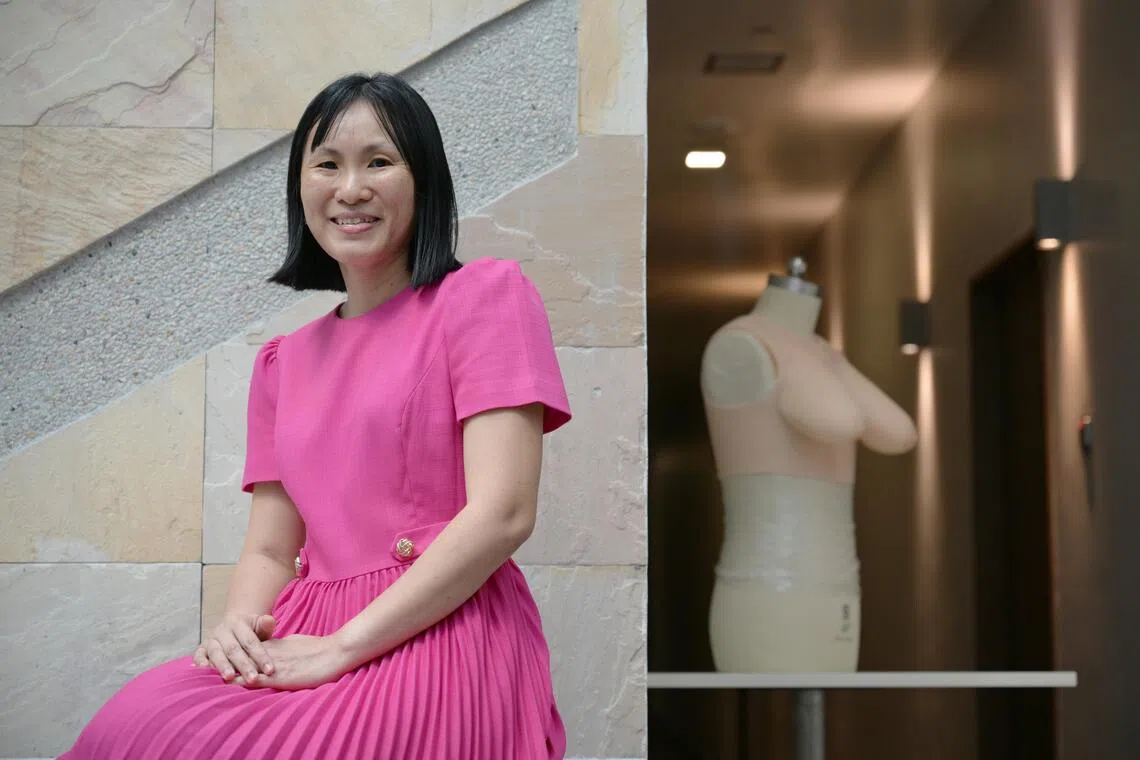
Oncoplastic breast surgeon Lim Geok Hoon and one of her innovations, a half-body breast mould created using 3D-printing technology.
ST PHOTO: NG SOR LUAN
Published Oct 03, 2026, 08:55 AM
Updated Oct 03, 2026, 10:10 AM
Breast surgeon Lim Geok Hoon developed the minimal scar mastectomy technique to reduce visible scarring and preserve nipples, improving cosmetic outcomes for suitable breast cancer patients.
She pioneered innovations like the VBOSS virtual surgery simulator and the SMART lymph node removal technique to train surgeons and reduce risks, benefiting hundreds of patients.
Lim values patient impact, is driven by passion and perseverance, and has organised annual symposiums to share knowledge globally since 2015.
SINGAPORE – When a breast cancer patient saw a photo of the mastectomy scar she would have after surgery, the 50-something woman was so distressed that she almost fainted, recalls oncoplastic breast surgeon Lim Geok Hoon.
Why was the scar so long? Could her nipples be preserved without having to go through breast reconstruction?
That anguished response inspired Lim to develop the minimal scar mastectomy technique in March 2017.
Suitable for women with smaller breasts who do not want their breast tissue reconstructed, the technique produces a less visible scar around the areolas, which are preserved along with the nipples.
Preserving the nipple improves cosmetic results, she adds.
“She was very happy with the result,” says Lim, 50, an associate professor who is head and senior consultant of the KK Breast Department at KK Women’s and Children’s Hospital (KKH).
More than 30 eligible patients have benefited from the technique to date.
That technique is just one of several innovations Lim has pioneered in her 15-year career as a surgeon.
She organised the first Singapore Breast Oncoplastic Surgery Symposium in January 2015 while about six months pregnant with her second son. The pregnancy had been a trying one with nausea and vomiting until her second trimester, but she pressed on.
What drove her was a passion to share what she had learnt during a year-long fellowship in Britain from 2013 to 2014 at St Bartholomew’s Hospital and The Royal Marsden Hospital.
There, she refined her skills in oncoplastic surgery, which allows for larger tumours to be removed without a mastectomy, while ensuring a better cosmetic outcome using plastic surgery techniques.
“I learnt a lot and wanted to bring the knowledge back to share with other people,” she says.
Her husband, a radiologist in his 50s at another public hospital, and their then six-month-old infant joined her in London in support of her career. Her children are now 11 and 14 years old.
That 2015 symposium was so successful that it turned into an annual affair, attracting more than 1,000 medical professionals and community partners from around the world to date.
Its 11th edition held in August in Singapore saw two days of talks and workshops at KKH.
Lim, who attended CHIJ St Nicholas Girls’ School and Hwa Chong Junior College (now Hwa Chong Institution) before earning her medical degree at the National University of Singapore (NUS), says she was drawn to surgery “because you can see the results in patients immediately”.
“There is science and art to breast surgery. The art of it is trying to leave patients looking better than before, if possible. Every patient is unique and each one teaches me to be better,” she says.
KKH has seen its breast conservation rate among breast cancer patients rise by 15% over the past decade as more women now want to retain their breasts, if possible, Lim says.
As an individual surgeon, she knew she could do only so much, so she created a tool that would help any surgeon to practise the techniques needed for oncoplastic surgery.
In 2018, she co-developed the virtual breast oncoplastic surgery simulator (VBOSS) with NUS.
While there were virtual breast surgery simulators available, there were none for oncoplastic breast - conserving surgery to help doctors practise. The tool is free to use online and has seen over 750 users.
“The more surgeons who are trained, the more patients who can benefit,” Lim says.
In 2020, she created a technique for precision lymph node removal in advanced breast cancer patients that is cheaper and does away with tracers, some of which contain radioactive material , to locate cancerous nodes.
The technique is called the skin mark clipped axillary nodes removal technique ( SMART ) and uses ultrasound-guided skin markings to find the nodes if they are located close to the skin’s surface. The nodes are then removed.
It also reduces the risk of lymphoedema, the uncomfortable arm swelling that comes when many lymph nodes in the armpit are removed . SMART has been used in about 30 eligible patients to date.
While she speaks excitedly about her innovations, she admits: “I failed a lot of times.”
“But you need to persevere,” she says. “If it’s really what you want, never stop trying.”
For instance, the half-body breast moulds shown in this article’s photos were a challenge to create using 3D-printing technology, as she needed a soft, flexible model that naturally droops away from the torso like real breasts.
They were made in partnership with NUS after much trial and error.
Used as surgical teaching tools, the moulds allow her to demonstrate the correct marking for oncoplastic surgery to doctors without the need to find a suitable female patient willing to disrobe.
Lim received an Outstanding Clinician Award in SingHealth’s GCEO (Group Chief Executive Officer) Excellence Awards in 2025 for her exceptional contributions. But she says that , day to day, seeing her patients thrive after their ordeals is what makes her smile .
One pregnant patient in her 30s was devastated by her cancer diagnosis and worried about how chemotherapy would affect her unborn child, Lim recalls. She is now the mother of a lively six-year-old.
“People ask for wealth in terms of money, but I’d rather chart my wealth in how many patients’ lives I have touched in this lifetime,” she says.
Stephanie Yeo is senior correspondent at The Straits Times’ Life section.
Health and well-being
KK Women's and Children's Hospital
乳房整形外科医生林玉芬和她的一项创新,即利用 3D 打印技术制作的半身乳房模型。
圣徒照片:吴索銮
发布于 2026 年 10 月 3 日上午 8:55
更新于2026年10月3日上午10:10
乳腺外科医生林玉勋开发了微创乳房切除术,以减少可见疤痕并保留乳头,从而改善适合乳腺癌患者的美容效果。
她率先推出了 VBOSS 虚拟手术模拟器和 SMART 淋巴结切除技术等创新技术,用于培训外科医生和降低风险,使数百名患者受益。
Lim 重视对患者的影响,充满热情和毅力,自 2015 年以来组织年度研讨会,在全球范围内分享知识。
新加坡——据乳房整形外科医生林玉勋回忆,一位乳腺癌患者看到自己术后乳房切除疤痕的照片时,这位五十多岁的女性非常难过,几乎晕倒。
为什么疤痕这么长?能否在不进行乳房重建手术的情况下保留她的乳头?
这种痛苦的反应促使林医生在 2017 年 3 月开发出微创乳房切除术。
该技术适用于胸部较小且不希望进行乳房组织重建的女性,它在乳晕周围产生的疤痕不太明显,乳晕和乳头都能得到保留。
她补充说,保留乳头可以改善美容效果。
“她对结果非常满意,”50岁的林教授说道,她是竹脚妇幼医院(KKH)竹脚乳腺科的主任兼高级顾问,也是一名副教授。
迄今为止,已有超过 30 名符合条件的患者受益于该技术。
这项技术只是林医生在她15年的外科医生生涯中开创的几项创新之一。
2015年1月,在她怀第二个儿子大约六个月的时候,她组织了第一届新加坡乳腺肿瘤整形外科研讨会。怀孕期间,她一直饱受恶心呕吐的折磨,直到孕中期才有所缓解,但她坚持了下来。
促使她投身于此的热情,是想要分享她在 2013 年至 2014 年在英国圣巴塞洛缪医院和皇家马斯登医院进行为期一年的研究员工作期间所学到的知识。
在那里,她精进了肿瘤整形外科的技能,这种手术可以在不进行乳房切除术的情况下切除较大的肿瘤,同时利用整形外科技术确保更好的美容效果。
“我学到了很多东西,想把这些知识带回去与其他人分享,”她说。
她的丈夫是另一家公立医院的一名五十多岁的放射科医生,当时他们六个月大的孩子也来到伦敦支持她的事业。她的孩子现在分别是11岁和14岁。
2015 年的研讨会非常成功,之后便成为一年一度的盛会,迄今为止已吸引了来自世界各地的 1000 多名医疗专业人员和社区合作伙伴。
第 11 届大会于 8 月在新加坡举行,在 KKH 举办了为期两天的讲座和研讨会。
林女士曾在圣尼各拉女校和华侨初级学院(现为华侨中学)就读,之后在新加坡国立大学获得医学学位。她说,她被外科手术吸引是因为“你可以立即看到患者接受手术后的效果”。
“乳房手术既是科学又是艺术。艺术之处在于,尽可能让患者术后比术前更好。每位患者都是独一无二的,每位患者都教会我如何做得更好,”她说道。
林医生表示,过去十年间,KKH 乳腺癌患者的保乳率上升了 15%,因为现在越来越多的女性希望尽可能保留乳房。
作为一名外科医生,她知道自己能做的有限,因此她创造了一种工具,可以帮助任何外科医生练习肿瘤整形手术所需的技术。
2018 年,她与新加坡国立大学共同开发了虚拟乳房肿瘤整形手术模拟器(VBOSS)。
虽然市面上已有虚拟乳房手术模拟器,但却没有用于肿瘤整形保乳手术的模拟器来帮助医生练习。这款工具可在线免费使用,目前已有超过750名用户。
林医生说:“接受培训的外科医生越多,受益的患者就越多。”
2020 年,她发明了一种针对晚期乳腺癌患者的精准淋巴结切除技术,该技术成本更低,并且无需使用示踪剂(其中一些含有放射性物质)来定位癌变淋巴结。
这项技术被称为皮肤标记腋窝淋巴结切除术(SMART),它利用超声引导下的皮肤标记来定位位于皮肤表面附近的淋巴结,然后将其切除。
它还能降低淋巴水肿的风险,淋巴水肿是指腋窝内多个淋巴结切除后出现的令人不适的手臂肿胀。迄今为止,SMART 已在约 30 名符合条件的患者身上使用。
虽然她兴奋地谈论着自己的创新,但她也承认:“我失败了很多次。”
“但你需要坚持不懈,”她说。“如果你真的想要,就永远不要放弃尝试。”
例如,本文照片中展示的半身乳房模型使用 3D 打印技术制作起来颇具挑战性,因为她需要一个柔软、灵活的模型,能够像真正的乳房一样自然地从躯干下垂。
它们是与新加坡国立大学合作,经过多次试验和失败后才研制出来的。
这些模具可用作外科教学工具,使她能够向医生演示肿瘤整形手术的正确标记方法,而无需寻找愿意脱衣服的合适女病人。
林医生因其卓越贡献,荣获2025年新加坡保健集团首席执行官卓越奖杰出临床医生奖。但她表示,每天看到患者在经历磨难后康复,才是让她感到最欣慰的事情。
林医生回忆说,一位三十多岁的孕妇被确诊患癌后深受打击,担心化疗会对未出生的孩子造成影响。如今,她已是一位活泼好动的六岁孩子的母亲。
“人们追求财富时往往用金钱来衡量,但我更愿意用我这辈子帮助过多少病人来衡量我的财富,”她说。
Stephanie Yeo是《海峡时报》生活版的高级记者。
健康与福祉
KK妇女儿童医院