Smooth Agave plant on ‘death bloom’ after over 30 years at Botanic Gardens植物园里一株生长了30多年的光滑龙舌兰,正处于“死亡花期”。
The Singapore Botanic Gardens' Smooth Agave is flowering for the last time, with new plantlets growing to continue its legacy. Read more at straitstimes.com.
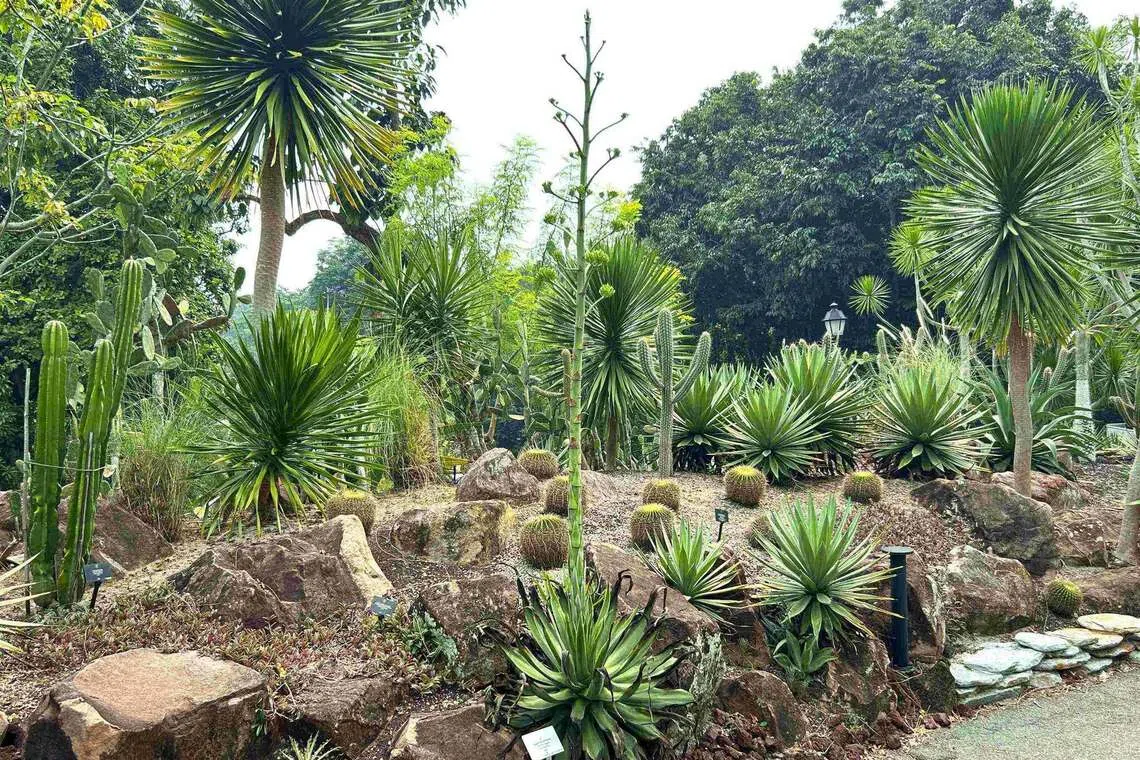
A specimen of Agave demeesteriana during flowering at the Singapore Botanic Gardens, as “a towering flower stalk emerges from the centre of the mother plant”.
Published Oct 03, 2026, 08:55 PM
Updated Oct 03, 2026, 08:55 PM
The Smooth Agave at Singapore Botanic Gardens, planted at the Sun Garden in 2008 and originating from Ohio in 1989, is now blooming for the last time, marking the end of its life cycle.
The plant flowers once, triggered by environmental cues, then dies after using all energy to reproduce, with new plantlets called bulbils growing on its stalk.
Horticulturists will collect these bulbils to grow new plants, ensuring the legacy of the Smooth Agave continues despite the original plant's death.
SINGAPORE – A plant that has been at the Singapore Botanic Gardens for over 30 years is on its “death bloom”, with nature lovers urged to catch the plant’s final chapter.
In a Facebook post on Oct 2, the Gardens said that a Smooth Agave (Agave demeesteriana) “has begun its spectacular final act”. It is one of the few specimens received from The Holden Arboretum in Ohio in November 1989, and subsequently planted at the Sun Garden in 2008.
“Most agaves flower only once in their lifetime, spending their entire lives storing sugars in their base for this final moment,” the Singapore Botanic Gardens said.
But, in an upbeat note, the Gardens said “this farewell also marks a new beginning” as “its legacy will live on through its descendants”.
It explained that, alongside the flowers, small plantlets called bulbils will develop on the stalk, which horticulturists will carefully collect and spread to grow a new generation of Smooth Agaves, also known as a dwarf century plant.
Mature specimens of the plant flower when triggered by environmental factors such as unusually hot weather or seasonal changes, the Gardens said.
It added: “A towering flower stalk emerges from the centre of the mother plant as it pours every last reserve of energy into reproduction. In the process, it destroys its core meristem, its only point of growth.
“Unable to produce new leaves, the mother plant will eventually decline and die.”
Designated on July 2015, the Gardens is Singapore’s only UNESCO World Heritage Site .
ST has contacted the National Parks Board for more information.
Singapore Botanic Gardens
Parks/Nature reserves
National Parks Board
新加坡植物园中一株正在开花的龙舌兰(Agave demeesteriana)标本,“高耸的花茎从母株中心抽出”。
发布于 2026 年 10 月 3 日晚上 8:55
更新于2026年10月3日晚上8:55
新加坡植物园的这株光叶龙舌兰,于 2008 年种植在太阳花园,原产于 1989 年的俄亥俄州,如今正在最后一次开花,标志着其生命周期的结束。
这种植物受环境信号触发,开花一次,然后用尽所有能量进行繁殖后死亡,新的小植物(称为珠芽)会在其茎上生长。
园艺家们将收集这些鳞茎来培育新的植物,从而确保光滑龙舌兰的传承在原株死亡后得以延续。
新加坡——一株在新加坡植物园生长了 30 多年的植物正处于“垂死之花”阶段,自然爱好者们被敦促去见证这株植物的最后篇章。
10月2日,植物园在Facebook上发帖称,一株光叶龙舌兰(Agave demeesteriana)“已经开始了它精彩的最后阶段”。它是1989年11月从俄亥俄州霍尔顿植物园引进的少数几株龙舌兰之一,随后于2008年种植在阳光花园。
新加坡植物园表示:“大多数龙舌兰一生只开一次花,它们一生都在根部储存糖分,为这最后的时刻做准备。”
但花园方面乐观地表示,“这次告别也标志着一个新的开始”,因为“它的遗产将通过后代延续下去”。
它解释说,除了花朵之外,茎上还会长出称为珠芽的小植物,园艺家会小心地收集并播种这些珠芽,以培育新一代的光滑龙舌兰,也称为矮生世纪植物。
植物园表示,这种植物的成熟植株会在异常炎热的天气或季节变化等环境因素触发下开花。
报告还补充道:“当母株将所有能量都倾注于繁殖时,一株高耸的花茎便会从母株中心抽出。在这个过程中,它会破坏自身的核心分生组织,也就是它唯一的生长点。”
“由于无法长出新叶,母株最终会衰弱死亡。”
新加坡花园于 2015 年 7 月被列入世界遗产名录,是新加坡唯一的联合国教科文组织世界遗产。
《海峡时报》已联系国家公园管理局以获取更多信息。
新加坡植物园
公园/自然保护区
国家公园管理局