Singapore’s team sports continue to struggle at Asian Games; authorities explore ways to improve新加坡的团体项目在亚运会上持续表现不佳;当局正在探索改进方法。
Singapore’s team sports faced challenges at the 2026 Asian Games, with authorities exploring ways to improve performance and support full-time training. Read more at straitstimes.com.
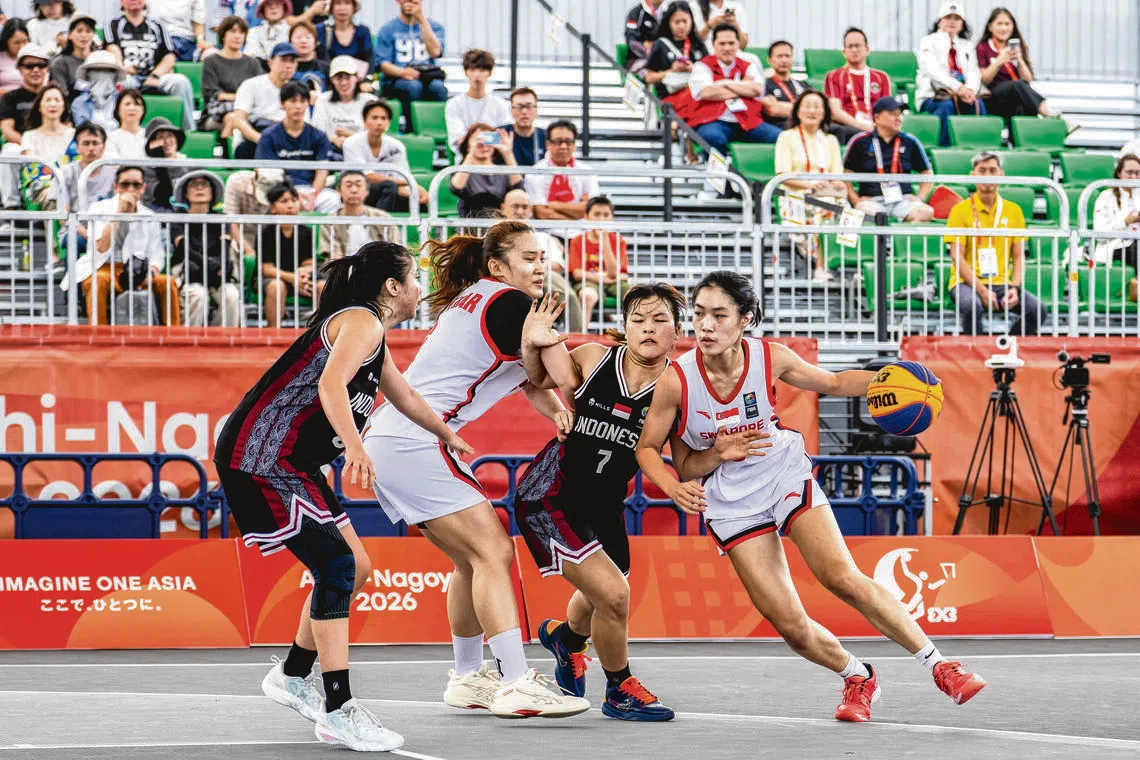
Singapore’s women’s 3x3 basketball team (in white) benefited from training full-time and playing on the Fiba 3x3 circuit, as they beat Indonesia and Kazakhstan to reach the Asian Games quarter-finals.
Published Oct 04, 2026, 04:31 PM
Updated Oct 04, 2026, 04:41 PM
Singapore’s team sports have struggled at the Asian Games, with only the water polo men's team winning medals since 1951 and recent performances declining.
Lack of professional leagues and full-time training opportunities hinder team sports, unlike the 3x3 basketball teams which benefit from regular international competition.
Authorities are studying how to create a full-time, competitive environment locally or overseas to improve team sports’ future performances.
NAGOYA – While there were several fine individual performances from Team Singapore’s athletes at the 2026 Asian Games, the Republic’s team sports have continued to draw a blank at the continental meet.
Only water polo has delivered team sport medals for Singapore at the Asiad since the inaugural 1951 edition. Since their last medal – a men’s team bronze in 1986 – no team from the Republic have stood on an Asian Games podium.
At a press conference on Oct 4 to review Team Singapore’s Aichi-Nagoya campaign, High Performance Sport Institute chief Low Jia Ren acknowledged the challenges faced, adding that the local sports authorities are looking at how to narrow the gap for team sports at future Asiads.
Having formerly captained the men’s national basketball team, the 47-year-old is aware of the differences between the nature of individual and team sports.
Noting team sports’ need for a bigger talent pool, he said: “When you are racing or shooting, this is something you can control (on your own).
“In team sports, there are opponents opposite you, there are teammates alongside you, and you need everyone in the team, whether it’s three or four in 3x3 basketball, or more in rugby sevens and water polo. Everything needs to click at the same time to win at the Asian level, and it’s difficult.”
At the Aichi-Nagoya Games, most of Singapore’s team sports did not have a good outing.
The water polo teams, who were aiming to improve on their encouraging performances at the previous Asiad and inch closer to the podium, were overtaken by more rivals instead.
The men’s team, who had contributed one gold, three silvers and three bronzes in past Games, slipped from fifth to seventh out of eight nations, while the women’s team slid from fourth out of seven countries to last out of six.
Other team sports Singapore competed in include field hockey (women’s team finished 10th out of 12), rugby sevens (women’s and men’s teams respectively placed seventh out of eight and 11th out of 12) and softball (women’s team finished seventh out of eight).
There were glimpses of hope, however, in 3x3 basketball.
Despite a 20-16 loss to last edition’s bronze medallists Mongolia during the play-ins for the quarter-finals, the men’s team gave South Korea their biggest test in a 19-14 pool defeat – the most the eventual champions conceded.
The women’s team went one step further to reach the last eight before losing to eventual runners-up Philippines.
Low noted that unlike the continental powerhouses, Singapore lack professional leagues in many team sports which would provide opportunities for these athletes to pursue their sport full-time and create an environment for them to reach a higher level.
However, studies are being conducted to see what can be adapted for the Singapore context to bring about more improvement.
Citing 3x3 basketball, where Singaporean teams are supported on the FIBA 3x3 circuit, he said: “What made the difference was that they came together, trained at a full-time level, went overseas and competed regularly.
“Almost every weekend, they had competitions against the best in the world, and then worked on what it takes to be competitive.”
While the 3x3 basketballers have the opportunity to train full-time and play regularly in global tournaments, most of the other team sports have at best ad-hoc training and competition tours to prepare for major meets and a handful of players attached to foreign clubs.
Low added: “We need to now study this across all team sports because for every team sport, their environment and leagues are different. If what it takes is a full-time and competitive environment, whether locally or overseas, we need to start to move towards that.”
Dive into all the sporting action and trends in Singapore with ST’s weekly newsletter.
David Lee is senior sports correspondent at The Straits Times, focusing on aquatics, badminton, basketball, cue sports, football and table tennis.
新加坡女子三人篮球队(身穿白色球衣)受益于全职训练和参加国际篮联三人篮球巡回赛,她们击败了印度尼西亚和哈萨克斯坦,晋级亚运会四分之一决赛。
发布于 2026 年 10 月 4 日下午 4:31
更新于2026年10月4日下午4:41
新加坡的团体运动在亚运会上表现不佳,自 1951 年以来只有男子水球队获得过奖牌,而且近来成绩还在下滑。
缺乏职业联赛和全职训练机会阻碍了团队运动的发展,这与受益于定期国际比赛的 3x3 篮球队截然不同。
有关部门正在研究如何在本地或海外创造一个全职的、有竞争力的环境,以提高团队运动的未来表现。
名古屋——尽管新加坡代表队运动员在2026年亚运会上取得了一些不错的个人成绩,但新加坡的团体项目在本次洲际赛事中仍然颗粒无收。
自1951年首届亚运会以来,新加坡只有水球项目获得过团体奖牌。自1986年男子团体铜牌之后,新加坡再也没有代表队登上过亚运会领奖台。
10 月 4 日,新加坡队在新闻发布会上回顾了爱知-名古屋亚运会的征程。高水平运动学院院长刘嘉仁承认了所面临的挑战,并补充说,当地体育部门正在研究如何在未来的亚运会上缩小团体项目的差距。
这位47岁的前男子国家篮球队队长深知个人运动和团队运动的本质区别。
他指出团队运动需要更大的人才库,并说道:“当你参加比赛或射击时,这是你可以(自己)控制的事情。
“在团队运动中,你既有对手,也有队友,你需要团队中的每个人,无论是三人制篮球中的三四个人,还是七人制橄榄球和水球中的更多人。要想在亚洲赛场上获胜,所有环节都必须同时配合默契,这非常困难。”
在爱知-名古屋运动会上,新加坡的大多数团体运动队表现都不理想。
水球队原本希望在上届亚运会上取得令人鼓舞的成绩,并向领奖台更进一步,结果却被更多对手超越。
男子队在上届比赛中曾获得一枚金牌、三枚银牌和三枚铜牌,但在本次比赛中,他们在八个参赛国家中从第五名下滑至第七名;女子队则从七个参赛国家中的第四名下滑至六个参赛国家中的最后名。
新加坡参加的其他团体运动包括曲棍球(女子队在 12 支队伍中排名第 10)、七人制橄榄球(女子队在 8 支队伍中排名第 7,男子队在 12 支队伍中排名第 11)和垒球(女子队在 8 支队伍中排名第 7)。
然而,在三人篮球比赛中,还是看到了一线希望。
尽管在四分之一决赛资格赛中以 20-16 输给了上届铜牌得主蒙古队,但男队在小组赛中以 19-14 的比分输给了韩国队,这是最终的冠军韩国队输掉的最大比分。
女子队更进一步,打入八强,最终输给了亚军菲律宾队。
Low指出,与欧洲大陆体育强国不同,新加坡在许多团队运动中缺乏职业联赛,这无法为这些运动员提供全职从事体育运动的机会,也无法为他们创造达到更高水平的环境。
然而,目前正在进行研究,以了解哪些方法可以适应新加坡的实际情况,从而带来更大的改进。
他以新加坡球队在 FIBA 3x3 巡回赛中得到支持的 3x3 篮球为例,说道:“关键在于他们团结起来,进行全职训练,出国比赛,并定期参加比赛。
“几乎每个周末,他们都会与世界上最优秀的选手进行比赛,然后努力提高自己的竞争力。”
3x3篮球运动员有机会进行全职训练,并定期参加全球锦标赛,而其他大多数团队运动充其量只有临时性的训练和比赛巡回赛来备战重大赛事,并且只有少数球员隶属于外国俱乐部。
洛补充道:“我们现在需要对所有团队运动进行研究,因为每项团队运动的环境和联赛都各不相同。如果需要的是一个全职且具有竞争力的环境,无论是在国内还是海外,我们都需要开始朝着这个方向努力。”
通过《海峡时报》的每周新闻简报,深入了解新加坡的所有体育赛事和趋势。
David Lee 是《海峡时报》的高级体育记者,主要报道水上运动、羽毛球、篮球、台球、足球和乒乓球。