Priority queues, trained staff at polyclinics among proposals to support people with intellectual disabilities为支持智力障碍人士,建议设立优先通道,并在综合诊所配备受过培训的工作人员。
The task force also recommended introducing future care planning across adult disability services to help people with disabilities and their families plan ahead.
The task force also recommended introducing future care planning across adult disability services to help people with disabilities and their families plan ahead.
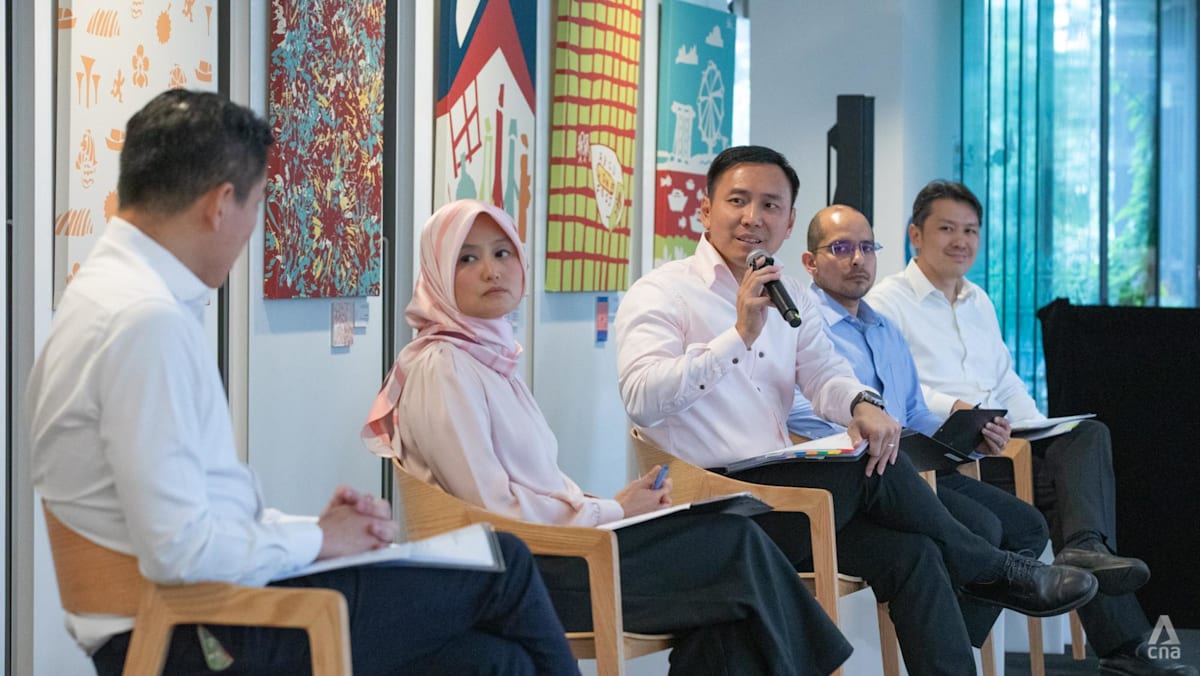
Members of the Taskforce on Assurance for Families with Persons with Disabilities (from left to right) – Eric Chua, Rahayu Mahzam, Goh Pei Ming, Syed Harun Alhabsyi and Shawn Huang – at a press conference. (Photo: CNA/Mak Jia Kee)
This audio is generated by an AI tool.
SINGAPORE: Frontline staff at all polyclinics should be trained by 2028 to better support people with intellectual disabilities and autism, a government task force has recommended.
In a report released on Sunday (Oct 4), the task force also proposed priority queues at polyclinics to shorten waiting times for patients with behavioural or anxiety-related needs.
The Ministry of Health (MOH) will support people with intellectual disabilities and autism by providing more accessible and tailored healthcare services by 2028 to continue living well in the community.
People with intellectual disabilities and autism may face communication barriers when interacting with healthcare staff, while primary care providers may not always understand what they need, the task force said.
CNA Games Guess Word Crack the word, one row at a time Buzzword Create words using the given letters Mini Sudoku Tiny puzzle, mighty brain teaser Mini Crossword Small grid, big challenge Word Search Spot as many words as you can Show More Show Less Beyond healthcare, it recommended expanding community support and opportunities for engagement, and helping people with disabilities live with greater independence. It also proposed introducing future care planning support to help people with disabilities and their families plan ahead. The Taskforce on Assurance for Families with Persons with Disabilities was announced by Prime Minister Lawrence Wong in December 2025. The five-member task force comprises Senior Minister of State for Home Affairs and Social and Family Development Goh Pei Ming, Minister of State for Health and Digital Development and Information Rahayu Mahzam, and Senior Parliamentary Secretaries Eric Chua, Shawn Huang and Syed Harun Alhabsyi. Speaking at a press conference at the Enabling Village, Mr Goh said the recommendations will add on to and reinforce the Enabling Master Plan 2030. "Ultimately, all our recommendations are about giving persons with disabilities and families assurance through life," he said. The aim, he added, is a society where people with disabilities feel a strong sense of belonging. IMPROVING HEALTHCARE ACCESS The task force said it recognises there is a “smaller group of persons with intellectual disabilities and autism” who may require more time and support during polyclinic consultations because of more complex communication, behavioural or healthcare needs. For this group, MOH will designate at least three polyclinics across Singapore by 2028 – at least one from each public healthcare cluster – that will provide enhanced support. At these polyclinics, support will include pre-visit preparation with patients and caregivers, longer consultation time where needed, closer caregiver engagement and help to navigate appointments and follow-up care. The teams can also help link patients and caregivers to the relevant disability services. From 2027, MOH and SG Enable – the focal national agency for disability and inclusion – will progressively roll out a health communication passport. The health ministry said not all people with disabilities will receive the passport in this initial phase. " Over time, MOH and SG Enable will implement the health communication passport at more polyclinics and other suitable healthcare settings. MOH will also explore how the health communication passport can be adapted for persons with other disability types." This passport will have important information about how a person with an intellectual disability or autism communicates, such as their preference for verbal or written communication, or the use of visual aids, and other practical accommodations needed for a smoother healthcare experience. “It will allow healthcare staff to better understand and support the individual and reduce the need for patients and caregivers to repeatedly explain the same information at various touchpoints,” the task force said in the report. To support the initial roll-out, participating social service agencies will help their clients complete the health communication passport and share it with the polyclinic before an appointment. Healthcare staff can arrange for appropriate accommodations in advance and ensure that key information is available to the attending clinicians. The health communication passport will be integrated across key touchpoints at polyclinics, including at registration and during consultation. Mdm Rahayu said the measures mark a "significant improvement" and an important step forward, but the task force recognises that more can still be done. "I n the coming years, we'll continue to look at what are some of the hurdles or barriers for those who are seeking healthcare in our public healthcare institutions, and also understanding what are some of the concerns in long-term care needs. "We will also be looking at how we can address concerns relating to longer-term healthcare support and costs, and improve our healthcare system so that we can better serve the persons with disabilities and families," she said.
Beyond healthcare, it recommended expanding community support and opportunities for engagement, and helping people with disabilities live with greater independence. It also proposed introducing future care planning support to help people with disabilities and their families plan ahead.
The Taskforce on Assurance for Families with Persons with Disabilities was announced by Prime Minister Lawrence Wong in December 2025.
The five-member task force comprises Senior Minister of State for Home Affairs and Social and Family Development Goh Pei Ming, Minister of State for Health and Digital Development and Information Rahayu Mahzam, and Senior Parliamentary Secretaries Eric Chua, Shawn Huang and Syed Harun Alhabsyi.
Speaking at a press conference at the Enabling Village, Mr Goh said the recommendations will add on to and reinforce the Enabling Master Plan 2030.
"Ultimately, all our recommendations are about giving persons with disabilities and families assurance through life," he said. The aim, he added, is a society where people with disabilities feel a strong sense of belonging.
IMPROVING HEALTHCARE ACCESS
The task force said it recognises there is a “smaller group of persons with intellectual disabilities and autism” who may require more time and support during polyclinic consultations because of more complex communication, behavioural or healthcare needs.
For this group, MOH will designate at least three polyclinics across Singapore by 2028 – at least one from each public healthcare cluster – that will provide enhanced support.
At these polyclinics, support will include pre-visit preparation with patients and caregivers, longer consultation time where needed, closer caregiver engagement and help to navigate appointments and follow-up care.
The teams can also help link patients and caregivers to the relevant disability services.
From 2027, MOH and SG Enable – the focal national agency for disability and inclusion – will progressively roll out a health communication passport.
The health ministry said not all people with disabilities will receive the passport in this initial phase.
" Over time, MOH and SG Enable will implement the health communication passport at more polyclinics and other suitable healthcare settings. MOH will also explore how the health communication passport can be adapted for persons with other disability types."
This passport will have important information about how a person with an intellectual disability or autism communicates, such as their preference for verbal or written communication, or the use of visual aids, and other practical accommodations needed for a smoother healthcare experience.
“It will allow healthcare staff to better understand and support the individual and reduce the need for patients and caregivers to repeatedly explain the same information at various touchpoints,” the task force said in the report.
To support the initial roll-out, participating social service agencies will help their clients complete the health communication passport and share it with the polyclinic before an appointment.
Healthcare staff can arrange for appropriate accommodations in advance and ensure that key information is available to the attending clinicians. The health communication passport will be integrated across key touchpoints at polyclinics, including at registration and during consultation.
Mdm Rahayu said the measures mark a "significant improvement" and an important step forward, but the task force recognises that more can still be done.
"I n the coming years, we'll continue to look at what are some of the hurdles or barriers for those who are seeking healthcare in our public healthcare institutions, and also understanding what are some of the concerns in long-term care needs.
"We will also be looking at how we can address concerns relating to longer-term healthcare support and costs, and improve our healthcare system so that we can better serve the persons with disabilities and families," she said.
Beyond healthcare, the task force recommended ways to help more people with disabilities stay connected in their communities.
The Ministry of Social and Family Development (MSF) and SG Enable will expand the Enabling Services Hub network to 12 places across Singapore by 2028. The current three hubs are at Tampines, Jurong West and Punggol, with the fourth coming up in Marine Parade.
These hubs offer community support for persons with disabilities and their caregivers.
“Caregivers of persons with disabilities have shared that having access to timely, trusted support would help them better sustain their caregiving role over time,” said the task force in the report.
From next year, caregivers will be able to access services at Caregiver Support Touchpoints that provide information and navigation support, training, peer support, respite care, as well as support for their physical and mental well-being.
These will be set up in phases at eight sites, including the three current Enabling Services Hubs.
To ensure people with disabilities can access the support they need, the task force proposed last month to add another 1,300 spaces at day activity centres and sheltered workshops by 2030, beyond the 1,000 additional places announced in 2024.
This brings the total number of additional spaces to 2,300 by 2030, on top of the current capacity of 3,600.
The task force recommended that, from the second half of 2027, MSF and SG Enable equip the general public with the skills to interact meaningfully with people with disabilities in their daily lives.
Public education campaigns will shift their focus from awareness alone to practical skills.
The Ministry of Education will join them in deepening efforts across schools and workplaces. Students will have more opportunities to learn about disability and interact with people with disabilities, and the ministry will work with schools to provide resources for teachers.
SG Enable will also work with partners across the public, private and people sectors to enable people with disabilities to participate more fully in everyday life.
These include a partnership with Sentosa Development Corporation to make the attraction more accessible to people with disabilities, a pilot at Paya Lebar Quarter Mall and partnering with grassroots organisations to make neighbourhoods friendlier for people with disabilities.
Senior Parliamentary Secretary for Social and Family Development and Law Eric Chua said inclusion is about belonging, not only about having the right services and support.
"So instead of seeing the disability first, let us first see the person. Instead of holding back because we're unsure what to do, what to say, let us make the effort to engage, include and understand."
PLANNING FOR THE FUTURE
The task force also looked at how families can plan ahead for the changing needs of loved ones with disabilities, rather than seek support only when circumstances change.
MSF and SG Enable recommended introducing future care planning support across adult disability services from 2027. This would build on the individual transition plans already offered to students in special education, or SPED, schools.
Care planners will help people with disabilities and their caregivers understand their current and future wants and needs, and think through situations they may not have considered. They will also help families explore options and get connected to the right services so they do not have to navigate such tasks alone.
Plans can be reviewed as needs and circumstances change, MSF said. It added that it currently has no plans to charge for the service, which would be provided at service touchpoints such as day activity centres and enabling services hubs.
In response to queries by CNA, MSF said it will track reach and support, including how many families go on to complete a care plan.
" MSF will also consider whether caregivers feel more confident and supported in planning for their loved one's future," it said.
Get our pick of top stories and thought-provoking articles in your inbox
Stay updated with notifications for breaking news and our best stories
Join our channel for the top reads for the day on your preferred chat app
工作组还建议在成人残疾服务中引入未来护理计划,以帮助残疾人及其家人提前做好规划。
残疾人士家庭保障工作组成员(从左至右)——蔡志强、拉哈尤·马赫扎姆、吴佩明、赛义德·哈伦·阿尔哈布西和黄晓文——出席新闻发布会。(图片:CNA/麦嘉琪)
这段音频是由人工智能工具生成的。
新加坡:政府工作组建议,到 2028 年,所有综合诊所的一线工作人员都应接受培训,以便更好地支持智力障碍和自闭症人士。
工作组在周日(10 月 4 日)发布的一份报告中还提议在综合诊所设立优先队列,以缩短有行为或焦虑相关需求的患者的等待时间。
卫生部将为智力障碍和自闭症人士提供更多便利和个性化的医疗保健服务,以支持他们在 2028 年前继续在社区中过上良好的生活。
工作组表示,智力障碍和自闭症患者在与医护人员互动时可能会面临沟通障碍,而初级保健提供者可能并不总是了解他们的需求。
CNA游戏猜词游戏:逐行破解单词;流行词游戏:用给定的字母组成单词;迷你数独:小巧的谜题,强大的脑力挑战;迷你填字游戏:小方格,大挑战;单词搜索:尽可能多地找出单词。显示更多 显示更少 除了医疗保健之外,该报告还建议扩大社区支持和参与机会,并帮助残疾人士更加独立地生活。报告还提议引入未来护理计划支持,以帮助残疾人士及其家人提前做好规划。残疾人士家庭保障工作组由总理黄循财于2025年12月宣布成立。该五人工作组由内政部兼社会及家庭发展部高级政务部长吴佩铭、卫生部兼数码发展及新闻部政务部长拉哈尤·马扎姆以及高级政务次长蔡志强、黄晓明和赛义德·哈伦·阿尔哈布西组成。吴先生在“赋能村”举行的新闻发布会上表示,这些建议将补充并强化《2030年赋能总体规划》。他说道:“归根结底,我们所有的建议都是为了让残疾人士及其家庭在生活中获得保障。” 他补充说,目标是建立一个残疾人士拥有强烈归属感的社会。改善医疗保健服务 该工作组表示,他们意识到有一部分“智力障碍和自闭症人士”由于沟通、行为或医疗保健需求更为复杂,在综合诊所就诊时可能需要更多的时间和支持。卫生部将在2028年前指定新加坡至少三家综合诊所(每个公共医疗保健集群至少一家)为这部分人群提供强化支持。这些诊所提供的支持包括:为患者及其照护者提供就诊前准备、在需要时延长就诊时间、加强照护者参与以及协助安排预约和后续护理。这些团队还可以帮助患者及其照护者联系相关的残疾人服务机构。自2027年起,新加坡卫生部(MOH)和国家残疾人及包容性机构SG Enable将逐步推广健康沟通护照。卫生部表示,并非所有残疾人士都能在初期阶段获得该护照。“随着时间的推移,卫生部和SG Enable将在更多综合诊所和其他合适的医疗机构推广健康沟通护照。卫生部还将探索如何调整健康沟通护照,使其适用于其他类型的残疾人士。”该护照将包含有关智力障碍或自闭症人士沟通方式的重要信息,例如他们偏好口头或书面沟通、使用视觉辅助工具的情况,以及其他有助于获得更顺畅医疗体验的实用便利措施。“这将使医护人员能够更好地了解和支持患者,并减少患者及其照护者在不同接触点反复解释相同信息的需要,”工作组在报告中指出。为支持初期推广,参与的社会服务机构将帮助其服务对象填写健康沟通护照,并在预约就诊前将其提交给综合诊所。医护人员可以提前安排合适的住宿,并确保接诊医生能够获取关键信息。健康沟通通行证将整合到综合诊所的各个关键环节,包括挂号和就诊期间。拉哈尤女士表示,这些措施标志着“显著改善”和向前迈出的重要一步,但工作组也意识到仍有许多工作要做。“未来几年,我们将继续关注那些在公共医疗机构寻求医疗保健的人们所面临的障碍,并了解他们在长期护理需求方面存在的问题。”她说道,“我们还将研究如何解决与长期医疗保健支持和费用相关的问题,并改进我们的医疗保健系统,以便更好地服务于残疾人士及其家庭。”
除了医疗保健之外,该报告还建议扩大社区支持和参与机会,帮助残疾人士提高独立生活能力。报告还提议引入未来照护规划支持,帮助残疾人士及其家人提前做好规划。
2025年12月,总理黄循财宣布成立残疾人家庭保障工作组。
该五人特别工作组由内政部兼社会及家庭发展部高级政务部长吴佩明、卫生部兼数码发展及新闻部政务部长拉哈尤·马赫扎姆以及高级政务秘书蔡志强、黄晓明和赛义德·哈伦·阿尔哈布西组成。
吴先生在赋能村举行的新闻发布会上表示,这些建议将补充和加强《2030 年赋能总体规划》。
“归根结底,我们所有的建议都是为了让残疾人士及其家庭在生活中更有保障,”他说道。他补充说,我们的目标是建立一个残疾人士拥有强烈归属感的社会。
改善医疗保健服务获取
工作组表示,他们认识到有“一小部分智力障碍和自闭症人士”由于沟通、行为或医疗保健需求更为复杂,可能需要在综合诊所就诊期间获得更多的时间和支持。
对于这一群体,卫生部将在 2028 年前指定新加坡至少三家综合诊所(每个公共医疗保健集群至少一家)提供加强支持。
在这些综合诊所,支持措施包括:为患者和护理人员提供就诊前准备,在需要时延长咨询时间,加强护理人员的参与,并帮助他们安排预约和后续护理。
这些团队还可以帮助患者和护理人员联系相关的残疾人服务机构。
从 2027 年起,卫生部和 SG Enable(国家残疾人和包容性事务中心机构)将逐步推出健康沟通护照。
卫生部表示,并非所有残疾人士都能在第一阶段获得护照。
“随着时间的推移,卫生部和SG Enable将在更多综合诊所和其他合适的医疗机构推广健康沟通护照。卫生部还将探索如何调整健康沟通护照,使其适用于其他类型的残疾人士。”
这份护照将包含有关智力障碍或自闭症人士如何沟通的重要信息,例如他们偏好口头或书面沟通,或使用视觉辅助工具,以及其他为获得更顺畅的医疗保健体验所需的实际便利措施。
工作组在报告中表示:“这将使医护人员能够更好地了解和支持患者,并减少患者和护理人员在各种接触点反复解释相同信息的需要。”
为了支持初期推广,参与的社会服务机构将帮助他们的客户填写健康沟通护照,并在预约前将其分享给综合诊所。
医护人员可以提前安排合适的住宿,并确保接诊医生能够获取关键信息。健康沟通通行证将整合到综合诊所的各个关键环节,包括挂号和就诊期间。
拉哈尤女士表示,这些措施标志着“显著改善”和向前迈出的重要一步,但工作组也认识到还有更多工作要做。
“在未来几年,我们将继续研究那些在公共医疗机构寻求医疗保健的人们所面临的一些障碍或困难,并了解长期护理需求方面的一些担忧。
“我们还将研究如何解决与长期医疗保健支持和成本相关的问题,并改进我们的医疗保健系统,以便更好地为残疾人和他们的家庭服务,”她说。
除了医疗保健之外,工作组还提出了帮助更多残疾人士与社区保持联系的建议。
社会及家庭发展部 (MSF) 和 SG Enable 计划到 2028 年将赋能服务中心网络扩展到新加坡的 12 个地点。目前已有三个中心分别位于淡滨尼、裕廊西和榜鹅,第四个中心即将落户马林百列。
这些中心为残疾人士及其照护者提供社区支持。
报告指出:“残疾人士的照护者表示,如果能够及时获得可靠的支持,将有助于他们更好地长期履行照护职责。”
从明年起,照顾者将能够通过照顾者支持服务点获得信息和导航支持、培训、同伴支持、喘息服务以及身心健康支持。
这些设施将分阶段在八个地点建立,包括目前的三个赋能服务中心。
为了确保残疾人能够获得他们需要的支持,工作组上个月提议,在 2024 年宣布增加 1000 个名额的基础上,到 2030 年在日间活动中心和庇护工场再增加 1300 个名额。
到 2030 年,新增空间总数将达到 2300 个,而目前的容量为 3600 个。
工作组建议,从 2027 年下半年开始,无国界医生组织和新加坡赋能组织应让公众掌握在日常生活中与残疾人进行有意义互动的技能。
公众教育宣传活动的重点将从单纯提高意识转向实用技能。
教育部将与他们携手,在学校和工作场所深化相关工作。学生将有更多机会了解残疾问题并与残疾人士互动,教育部也将与学校合作,为教师提供资源。
SG Enable 还将与公共、私营和人民部门的合作伙伴携手合作,使残疾人能够更充分地参与日常生活。
其中包括与圣淘沙发展机构合作,使该景点对残疾人士更加友好;在巴耶利峇广场进行试点;以及与基层组织合作,使社区对残疾人士更加友好。
社会及家庭发展部兼法律事务部高级政务次长蔡志强表示,包容意味着归属感,而不仅仅是拥有合适的服务和支持。
“所以,与其先看到残疾,不如先看到这个人。与其因为不确定该做什么、该说什么而退缩,不如努力去参与、去包容、去理解。”
规划未来
该工作组还研究了家庭如何提前规划以应对残疾亲人不断变化的需求,而不是仅仅在情况发生变化时才寻求帮助。
无国界医生和新加坡残疾人援助组织建议从 2027 年起在成人残疾人服务中引入未来护理计划支持。这将建立在已经为特殊教育学校学生提供的个人过渡计划之上。
护理规划师将帮助残障人士及其照护者了解他们当前和未来的需求,并考虑他们可能未曾考虑到的情况。他们还将帮助家庭探索各种选择,并与合适的机构建立联系,使他们不必独自应对这些事务。
无国界医生组织表示,计划会根据需求和情况的变化进行调整。该组织还补充说,目前暂无计划对这项服务收费,服务将在日间活动中心和辅助服务中心等服务点提供。
针对 CNA 的询问,无国界医生表示将跟踪服务覆盖面和支持情况,包括有多少家庭最终完成了护理计划。
“无国界医生组织还将考虑照护者在为他们所爱之人的未来做计划时是否感到更有信心和更有支持,”该组织表示。
订阅我们的邮件,即可获取精选热点新闻和引人深思的文章。
订阅通知,第一时间获取突发新闻和精彩报道。
加入我们的频道,即可在您常用的聊天应用上获取当日热门文章。